Adhyaya 38
Dvīpa-Varṣa Vibhāga and the Priyavrata–Agnīdhra Lineage (Cosmic Geography and Royal Succession)
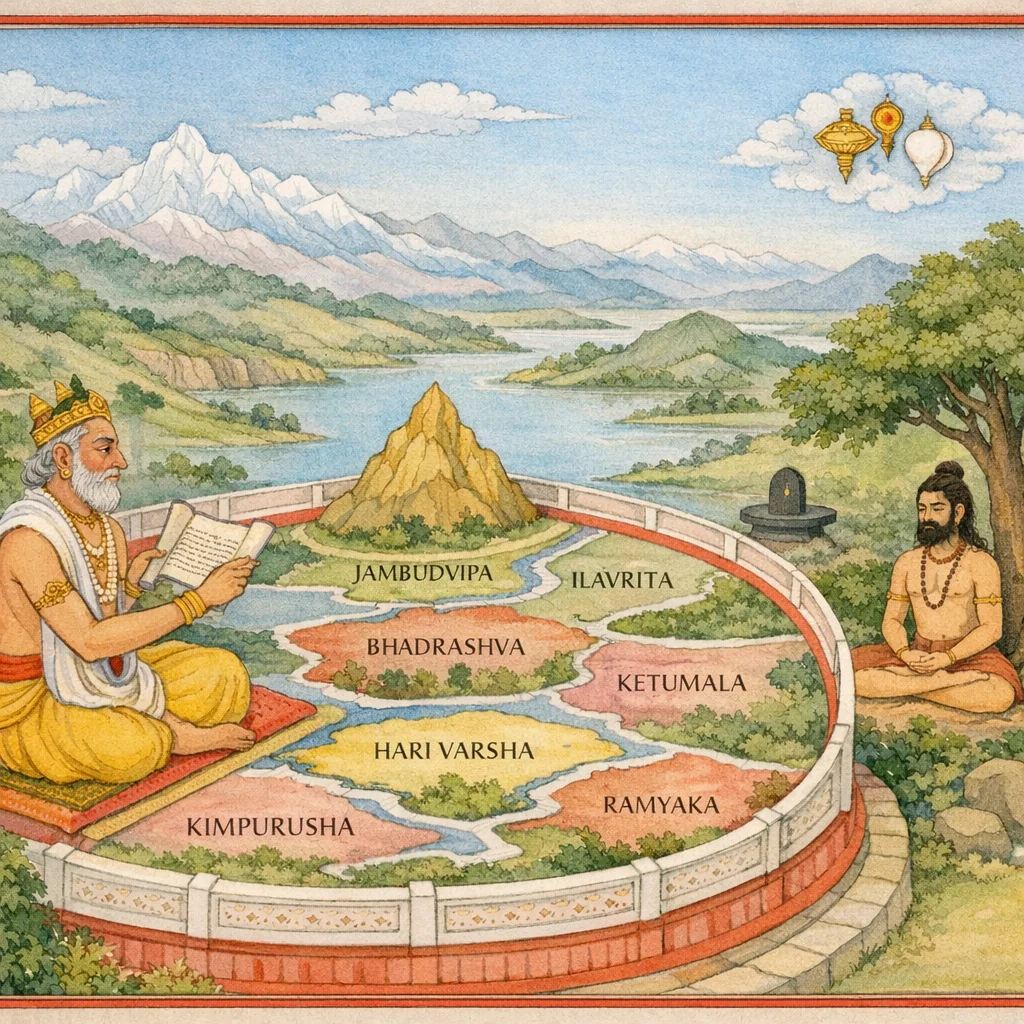
Closing the prior chapter, the Naimiṣa sages urge Sūta to give a clear account of the world-mandala—continents, oceans, mountains, rivers, and the celestial order. Sūta invokes Viṣṇu and speaks of Priyavrata, son of Svāyambhuva Manu, whose sons are installed as rulers over the seven dvīpas, showing kingship as a cosmological office. The chapter lists the dvīpa-kings and their seven named varṣas, then focuses on Agnīdhra’s reign in Jambūdvīpa, describing its nine divisions (varṣas) arranged around Mount Meru. The narration turns from geography to dharma: in certain regions, liberation for the twice-born is said to arise through svadharma governed by varṇa and āśrama. It then shifts to royal genealogy: Nābhi begets Ṛṣabha, who renounces sovereignty and attains a Pāśupata-like realization, modeling the passage from kingship to yoga. The lineage continues through Bharata and later kings, preparing the next chapters to deepen the cosmography and to link righteous rule with renunciant liberation.
Shlokas
Verse 1
इति श्रीकूर्मपुराणे षट्साहस्त्र्यां संहितायां पुर्वविभागे सप्तत्रिंशो ऽध्यायः श्रीकूर्म उवाच एवमुक्तास्तु मुनयो नैमिषीया महामतिम् / पप्रच्छुरुत्तरं सूतं पृथिव्यादिविनिर्णयम्
Thus, in the Śrī Kūrma Purāṇa—within the six-thousand-verse Saṃhitā of the Pūrva-bhāga—the thirty-seventh chapter concludes. Śrī Kūrma said: Having been addressed thus, the sages of Naimiṣa, seeking a decisive reply, questioned the wise Sūta about the proper determination of the earth and the other primordial elements.
Verse 2
ऋषय ऊचुः कथितो भवता सूत सर्गः स्वयंभुवः शुभः / इदानीं श्रोतुमिच्छामस्त्रिलोकस्यास्य मण्डलम्
The sages said: “O Sūta, you have described the auspicious, self-born creation (Svayambhū). Now we wish to hear of the layout—the cosmic mandala—of this threefold world.”
Verse 3
यावन्तः सागरा द्वीपास्तथा वर्षाणि पर्वताः / वनानि सरितः सूर्यग्रहाणां स्थितिरेव च
“As many as there are oceans and continents, so too are there regions (varṣas) and mountains; likewise there are forests and rivers—and also the fixed stations and order of the Sun and the planets.”
Verse 4
यदाधारमिदं कृत्स्नं येषां पृथ्वी पुरा त्वियम् / नृपाणां तत्समासेन सूत वक्तुमिहार्हसि
O Sūta, you should recount—briefly—the kings of old, upon whom this whole realm rested as its support, and by whom this earth was formerly upheld.
Verse 5
सूत उवाच वक्ष्ये देवादिदेवाय विष्णवे प्रभविष्णवे / नमस्कृत्वाप्रमेयाय यदुक्तं तेन धीमता
Sūta said: Having bowed to Viṣṇu—the God of gods, the all-pervading Lord, the immeasurable One—I shall now recount what was spoken by that wise one.
Verse 6
स्वायंभुवस्य तु मनोः प्रागुक्तो यः प्रियव्रतः / पुत्रस्तस्याभवन् पुत्राः प्रजापतिसमा दश
That Priyavrata—previously mentioned—was the son of Svāyambhuva Manu. From him were born ten sons, equal to Prajāpatis in their creative potency and stature.
Verse 7
अग्नीध्रश्चाग्निबाहुश्च वपुष्मान् द्युतिमांस्तथा / मेधा मेधातिथिर्हव्यः सवनः पुत्र एव च
Agnīdhra and Agnibāhu; likewise Vapuṣmān and Dyutimān; also Medhā, Medhātithi, Havya, and Savana—these too were his sons.
Verse 8
ज्योतिष्मान् दशमस्तेषां महाबलपराक्रमः / धार्मिको दाननिरतः सर्वभूतानुकम्पकः
The tenth among them was Jyotiṣmān—mighty in strength and heroism; righteous, devoted to charity, and compassionate toward all beings.
Verse 9
मेधाग्निबाहुपुत्रास्तु त्रयो योगपरायणाः / जातिस्मरा महाभागा न राज्ये दधिरे मतिम्
But the three sons of Medhāgnibāhu, wholly devoted to Yoga, remembered their former births; those great-souled ones did not set their minds upon kingship.
Verse 10
प्रियव्रतो ऽभ्यषिञ्चद् वै सप्तद्वीपेषु सप्त तान् / जम्बुद्वीपेश्वरं पुत्रमग्नीध्रमकरोन्नृपः
King Priyavrata indeed consecrated those seven (sons) as rulers over the seven continents; and the king appointed his son Agnīdhra as the sovereign of Jambūdvīpa.
Verse 11
प्लक्ष्द्वीपेश्वरश्चैव तेन मेधातिथिः कृतः / शाल्मलेशं वपुष्मन्तं नरेन्द्रमभिषिक्तवान्
He appointed Medhātithi as the sovereign of Plakṣa-dvīpa; and he anointed Vapuṣmant as the king who would rule Śālmala-dvīpa.
Verse 12
ज्योतिष्मन्तं कुशद्वीपे राजानं कृतवान् प्रभुः / द्युतिमन्तं च राजानं क्रौञ्चद्वीपे समादिशत्
The Lord appointed Jyotiṣmant as the king in Kuśadvīpa, and likewise installed Dyutimant as the king in Krauñcadvīpa.
Verse 13
शाकद्वीपेश्वरं चापि हव्यं चक्रे प्रियव्रतः / पुष्कराधिपतिं चक्रे सवनं च प्रजापतिः
Priyavrata appointed Havya as the ruler of Śākadvīpa; and the Prajāpati appointed Savana as the lord of Puṣkaradvīpa.
Verse 14
पुष्करे सवनस्यापि महावीतः सुतो ऽभवत् / धातिकिश्चैव द्वावेतौ पुत्रौ पुत्रवतां वरौ
At Puṣkara, Savanā too had a son named Mahāvīta; and Dhātikī as well—these two were his sons, both eminent among those blessed with worthy offspring.
Verse 15
महावीतं स्मृतं वर्षं तस्य नाम्ना महात्मनः / नाम्ना तु धातकेश्चापि धातकीखण्डमुच्यते
That region (varṣa) is remembered as Mahāvīta, named after that great-souled person. And, in the same way, the division is also called Dhātakīkhaṇḍa, being named after Dhātakī.
Verse 16
शाकद्वीपेश्वरस्याथ हव्यस्याप्यभवन् सुताः / जलदश्च कुमारश्च सुकुमारो मणीचकः / कुसुमोत्तरो ऽथ मोदाकिः सप्तमः स्यान्महाद्रुमः
Now, of Havyā as well—the ruler of Śākadvīpa—there were sons: Jalada, Kumāra, Sukumāra, Maṇīcaka, Kusumottara, and Modākī; the seventh was called Mahādruma.
Verse 17
जलदं जलदस्याथ वर्षं प्रथममुच्यते / कुमारस्य तु कौमारं तृतीयं सुकुमारकम्
For one called Jalada, the first varṣa is said to bear the name ‘Jalada’. For Kumāra, the third stage is termed ‘Kaumāra’, and is also called ‘Sukumāraka’, the tender youth.
Verse 18
मणीचकं चतुर्थं तु पञ्चमं कुसुमोत्तरम् / मोदाकं षष्ठमित्युक्तं सप्तमं तु महाद्रुमम्
‘Maṇīcaka’ is declared to be the fourth; the fifth is ‘Kusumottara’. ‘Modāka’ is said to be the sixth, and the seventh is ‘Mahādruma’.
Verse 19
क्रौञ्चद्वीपेश्वरस्यापि सुता द्युतिमतो ऽभवन् / कुशलः प्रथमस्तेषां द्वितीयस्तु मनोहरः
The daughter of the lord of Krauñca-dvīpa became the wife of Dyutimān. Of their sons, the first was Kuśala, and the second was Manohara.
Verse 20
उष्णस्तृतीयः संप्रोक्तश्चतुर्थः प्रवरः स्मृतः / अन्धकारो मुनिश्चैव दुन्दुभिश्चैव सप्तमः / तेषां स्वनामभिर्देशाः क्रौञ्चद्वीपाश्रयाः शुभाः
The third is declared to be Uṣṇa, and the fourth is remembered as Pravara. Andhakāra and Muni are likewise named, with Dundubhi as the seventh. In Krauñcadvīpa there are auspicious territories that bear these very names.
Verse 21
ज्योतिष्मतः कुशद्वीपे सप्तैवासन् महौजसः / उद्भेदो वेणुमांश्चैवाश्वरथो लम्बनो धृतिः / षष्ठः प्रभाकारश्चापि सप्तमः कपिलः स्मृतः
In Kuśadvīpa, the seven mighty and radiant sons of Jyotiṣmat were: Udbheda, Veṇumāṃś, Aśvaratha, Lambana, Dhṛti, the sixth named Prabhākāra, and the seventh remembered as Kapila.
Verse 22
स्वनामचिह्नितान् यत्र तथा वर्षाणि सुव्रताः / ज्ञेयानि सप्त तान्येषु द्वीपेष्वेवं न यो मतः
O you of excellent vows, in those dvīpas the regions called varṣas are distinguished by their own names; know them to be seven. This is the established understanding regarding the dvīpas.
Verse 23
शाल्मलद्वीपनाथस्य सुताश्चासन् वपुष्मतः / श्वेतश्च हरितश्चैव जीमूतो रोहितस्तथा / वैद्युतौ मानसश्चैव सप्तमः सुप्रभो मतः
From the radiant lord of Śālmaladvīpa were born seven illustrious sons: Śveta, Harita, Jīmūta, Rohita, Vaidyuta, Mānasa, and the seventh, renowned as Suprabha.
Verse 24
प्लक्षद्वीपेश्वरस्यापि सप्त मेधातिथेः सुताः / ज्येष्ठः शान्तभयस्तेषां शिशिरश्च सुखोदयः / आनन्दश्च शिवश्चैव क्षेमकश्च ध्रुवस्तथा
Medhātithi, the sovereign of Plakṣa-dvīpa, had seven sons. The eldest was Śāntabhaya; the others were Śiśira, Sukhodaya, Ānanda, Śiva, Kṣemaka, and likewise Dhruva.
Verse 25
प्लक्षद्वीपादिषु ज्ञेयः शाकद्वीपान्तिकेषु वै / वर्णाश्रमविभागेन स्वधर्मो मुक्तये द्विजाः
Know that in regions such as Plakṣa-dvīpa, and also in the lands bordering Śāka-dvīpa, liberation for the twice-born lies in one’s own duty (svadharma), as ordained by the proper divisions of varṇa and āśrama.
Verse 26
जम्बुद्वीपेश्वरस्यापि पुत्रास्त्वासन् महाबलाः / अग्नीध्रस्य द्विजश्रेष्ठास्तन्नामानि निबोधत
O best of the twice-born, Agnīdhra—the lord of Jambūdvīpa—had sons of mighty strength. Now hear their names.
Verse 27
नाभिः किंपुरुषश्चैव तथा हरिरिलावृतः / रम्यो हिरण्वांश्च कुरुर्भद्राश्वः केतुमाहलकः
Nābhi, Kimpuruṣa, Hari, and Ilāvṛta; likewise Ramya, Hiraṇvān, Kuru, Bhadrāśva, and Ketumāhalaka—these are the nine divisions of Jambūdvīpa spoken of here.
Verse 28
जम्बुद्वीपेश्वरो राजा स चाग्नीध्रो महामतिः / विभज्य नवधा तेभ्यो यथान्यायं ददौ पुनः
King Agnīdhra, the great-minded sovereign of Jambūdvīpa, divided it into nine portions and allotted them again to them in due and rightful order.
Verse 29
नाभेस्तु दक्षिणं वर्षं हिमाह्वं प्रददौ पुनः / हेमकूटं ततो वर्षं ददौ किंपुरुषाय तु
To the south of Nābhi he again allotted the region called Himāhva; thereafter he granted the Hemakūṭa region to Kimpuruṣa.
Verse 30
तृतीयं नैषधं वर्षं हरये दत्तवान् पिता / इलावृताय प्रददौ मेरुमध्यमिलावृतम्
Their father bestowed the third region—Naiṣadha-varṣa—upon Haraya; and to Ilāvṛta he granted Ilāvṛta itself, the central realm whose heart is Mount Meru.
Verse 31
नीलाचलाश्रितं वर्षं रम्याय प्रददौ पिता / श्वेतं यदुत्तरं वर्षं पित्रा दत्तं हिरण्वते
Their father allotted to Ramyā the region (varṣa) sheltered by the Nīlācala mountain; and the northern, white region—Śveta-varṣa—was given by the father to Hiraṇvat.
Verse 32
यदुत्तरं शृङ्गवतो वर्षं तत् कुरुवे ददौ / मेरोः पूर्वेण यद् वर्षं भद्राश्वाय न्यवेदयत् / गन्धमादनवर्षं तु केतुमालाय दत्तवान्
The region (varṣa) lying to the north of Śṛṅgavat he bestowed upon Kuru. The region lying to the east of Meru he assigned to Bhadrāśva. And the Gandhamādana-varṣa he gave to Ketumāla.
Verse 33
वर्षेष्वेतेषु तान् पुत्रानभिषिच्य नराधिपः / संसारकष्टतां ज्ञात्वा तपस्तेपे वनं गतः
When those years had passed, the lord of men installed those sons in kingship by consecration; and, having understood the painful hardship inherent in saṃsāra, he went to the forest and practiced tapas, sacred austerity.
Verse 34
हिमाह्वयं तु यस्यैतन्नाभेरासीन्महात्मनः / तस्यर्षभो ऽभवत् पुत्रो मरुदेव्यां महाद्युतिः
The great-souled Nābhi had a region called Himāhvaya (the Himālaya) at his navel. From him, through Marudevī, was born the radiant son Ṛṣabha.
Verse 35
ऋषभाद् भरतो जज्ञे वीरः पुत्रशताग्रजः / सो ऽभिषिच्यर्षभः पुत्रं भरतं पृथिवीपतिः / वानप्रस्थाश्रमं गत्वा तपस्तेपे यथाविधि
From Ṛṣabha was born Bharata, a heroic son, the eldest among a hundred sons. Then Ṛṣabha, lord of the earth, having consecrated Bharata as king, entered the vānaprastha stage of forest-dwelling and performed austerities according to the prescribed rule.
Verse 36
तपसा कर्षितो ऽत्यर्थं कृशो धमनिसंततः / ज्ञानयोगरतो भूत्वा महापाशुपतो ऽभवत्
Greatly worn down by austerity, he became emaciated, with his veins standing out; and, devoted to the Yoga of knowledge (jñāna-yoga), he attained the state of a great Pāśupata—the supreme devotee-realizer of Paśupati, Śiva.
Verse 37
सुमतिर्भरतस्याभूत् पुत्रः परमधार्मिकः / सुमतेस्तैजसस्तस्मादिन्द्रिद्युम्नो व्यजायत
Bharata had a son named Sumati, a man of supreme righteousness. From Sumati was born Taijasa, and from him was born Indradyumna.
Verse 38
परमेष्ठी सुतस्तस्मात् प्रतीहारस्तदन्वयः / प्रतिहर्तेति विख्यात उत्पन्नस्तस्य चात्मजः
From Parameṣṭhī was born Pratīhāra, continuing that very lineage; and his son was born, renowned by the name Pratihartā.
Verse 39
भवस्तस्मादथोद्गीथः प्रस्तावस्तत्सुतो ऽभवत् / पृथुस्ततस्ततो रक्तो रक्तस्यापि गयः सुतः
From him was born Bhava; then from Bhava came Udgītha. Prastāva was his son. Thereafter came Pṛthu; then his descendant Rakta, and Rakta’s son was also Gaya.
Verse 40
नरो गयस्य तनयस्तस्य पुत्रो विराडभूत् / तस्य पुत्रो महावीर्यो धीमांस्तस्मादजायत
Nara was the son of Gaya; his son was Virāṭ. From Virāṭ was born a wise son of great valor, Mahāvīrya.
Verse 41
महान्तो ऽपि ततश्चाभूद् भौवनस्तत्सुतो ऽभवत् / त्वष्टा त्वष्टुश्च विरजो रजस्तस्याप्यभूत् सुतः
Thereafter Mahān was born; his son was Bhauvana. From Bhauvana came Tvaṣṭṛ; and from Tvaṣṭṛ came Viraja. Viraja’s son, in turn, was Rajas.
Verse 42
शतजिद् रजसस्तस्य जज्ञे पुत्रशतं द्विजाः / तेषां प्रधानो बलवान् विश्वज्योतिरिति स्मृतः
O brāhmaṇas, from that Rajas was born Śatajit; and to him a hundred sons were born. Among them, the foremost and mighty one is remembered as Viśvajyoti, “Light of the World”.
Verse 43
आराध्य देवं ब्रह्माणं क्षेमकं नाम पार्थिवम् / असूत पुत्रं धर्मज्ञं महाबाहुमरिन्दमम्
Having worshipped the divine Brahmā, the king named Kṣemaka begot a son—knowing Dharma, mighty-armed, and a subduer of foes.
Verse 44
एते पुरस्ताद् राजानो महासत्त्वा महौजसः / एषां वंशप्रसूतैश्च भुक्तेयं पृथिवी पुरा
These were the kings of old—great-souled and radiant with mighty splendor. And in former times this earth was also ruled and enjoyed by those born in the lines of their dynasties.
Frequently Asked Questions
It frames the earth as a mandala of seven dvīpas, each with seven varṣas named after their rulers/sons, and then gives a focused, Meru-centered account of Jambūdvīpa divided into nine varṣas allotted to Agnīdhra’s sons—linking geography to dynastic stewardship.
Mokṣa is presented as accessible through disciplined svadharma—properly lived according to varṇa and āśrama—especially for the twice-born in specified regions, while the royal narrative simultaneously models the renunciant culmination of dharma in Ṛṣabha’s austerity and yogic attainment.
The chapter uses Ṛṣabha’s post-kingship austerity to illustrate a shared liberative horizon where Śiva-oriented ascetic-yogic ideals (Pāśupata) can function within a broadly Vaiṣṇava cosmological narrative—an early signal of the Kurma Purāṇa’s samanvaya.