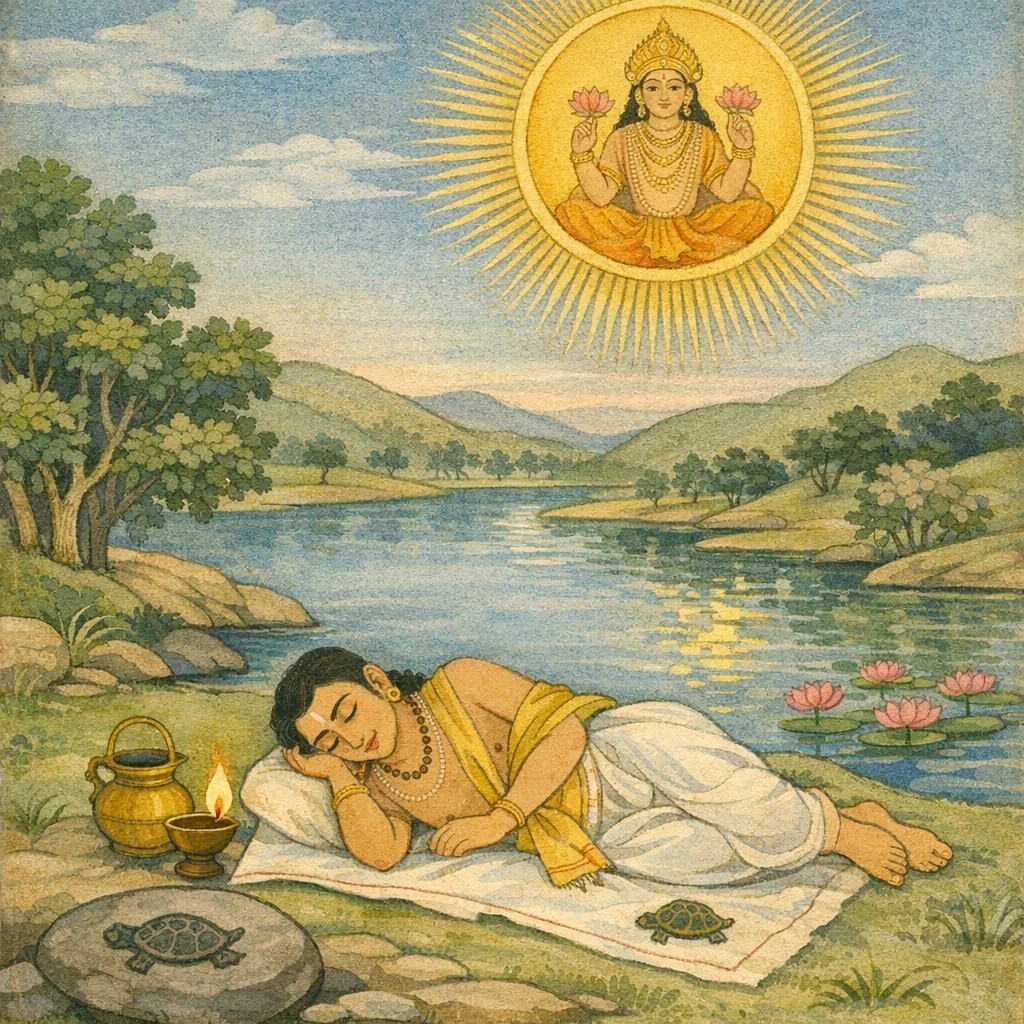
Adhyaya 36
Prayāga-māhātmya and Ṛṇa-pramocana-tīrtha — Māgha-snāna, Austerities, and Release from Debts
After the closing marker of the previous chapter, Mārkaṇḍeya extols the Māgha-month holiness of Prayāga, praising the Gaṅgā–Yamunā confluence as a sin-purifying tīrtha whose merit rivals great gifts, especially go-dāna. He lists austerities and rites performed in the antarvedī between the rivers, including the discipline called kārṣāgni, and describes their fruits in a recurring salvific cycle: ascent to Soma-loka and Indra-loka, a later fall, rebirth as a righteous king, enjoyment of prosperity, and return to the same tīrtha for renewed merit and purification. Striking examples—immersion at the famed sangam, drinking the stream while inverted, and extreme self-offering to birds—affirm the Purāṇic teaching that tapas joined with tīrtha transforms sin and bodily limitation into spiritual excellence and social honor. The chapter then focuses on Ṛṇa-pramocana on the northern bank of the Yamunā south of Prayāga, promising release from debts through a single night’s stay and bathing, culminating in attainment of Sūrya-loka and lasting freedom from indebtedness. Thus it bridges broad praise of Prayāga to a specific sub-tīrtha, preparing the continued catalog of sacred places.
Shlokas
Verse 1
इति श्रीकूर्मपुराणे षट्साहस्त्र्यां संहितायां पूर्वविभागे पञ्चत्रिंशो ऽध्यायः मार्कण्डेय उवाच षष्टिस्तीर्थसहस्त्राणि षष्टिस्तीर्थशतानि च / माघमासे गमिष्यन्ति गङ्गायमुनसंगमम्
Thus, in the Śrī Kūrma Purāṇa, in the six-thousand-verse Saṃhitā, in the Pūrva-bhāga, the thirty-fifth chapter ends. Mārkaṇḍeya said: “Sixty thousand sacred fords, and also six thousand holy places, in the month of Māgha, go to the confluence of the Gaṅgā and Yamunā.”
Verse 2
गवां शतसहस्त्रस्य सम्यग् दत्तस्य यत् फलम् / प्रयागे माघमासे तु त्र्यहं स्नातस्य तत् फलम्
Whatever merit arises from properly gifting a hundred thousand cows—that very same merit is gained by one who bathes for three days at Prayāga during the month of Māgha.
Verse 3
गङ्गायमुनयोर्मध्ये कार्षाग्निं यस्तु साधयेत् / अहीनाङ्गो ऽप्यरोगश्च पञ्चेन्द्रियसमन्वितः
Whoever, in the region between the Gaṅgā and the Yamunā, duly performs the ascetic discipline called kārṣāgni, becomes free from bodily deficiency and disease, endowed with all five senses in full strength.
Verse 4
जलप्रवेशं यः कुर्यात् संगमे लोकविश्रुते / राहुग्रस्तो यथा सोमो विमुक्तः सर्वपातकैः
Whoever immerses himself in the waters at a world-renowned sacred confluence is freed from every sin—just as the Moon, when seized by Rāhu, is released again.
Verse 5
ततः स्वर्गात् परिभ्रष्टो जम्बूद्वीपपतिर्भवेत् / स भुक्त्वा विपुलान् भोगांस्तत् तीर्थं भजते पुनः
Thereafter, fallen back from heaven, he becomes the sovereign ruler of Jambūdvīpa. Having enjoyed abundant pleasures, he again resorts to that sacred tīrtha once more.
Verse 7
सोमलोकमवाप्नोति सोमेन सह मोदते / षष्टिं वर्षसहस्त्राणि षष्टिं वर्षशतानि च
He attains Somaloka, the realm of Soma (the Moon), and rejoices there in Soma’s company—for sixty thousand years, and also for six hundred years.
Verse 8
स्वर्गतः शक्रलोके ऽसौ मुनिगन्धर्वसेवितः / ततो भ्रष्टस्तु राजेन्द्र समृद्धे जायते कुले
Having gone to heaven—into Śakra’s realm, Indra’s world—he is attended by sages and Gandharvas. But when he falls from there, O lord of kings, he is born again in a prosperous family.
Verse 9
अधः शिरास्त्वयोधारामुर्ध्वपादः पिबेन्नरः / शतं वर्षसहस्त्राणि स्वर्गलोके महीयते
A man who drinks the flowing stream while standing inverted—head downward and feet raised—becomes honored in the world of heaven for a hundred thousand years.
Verse 10
तस्माद् भ्रष्टस्तु राजेन्द्र अग्निहोत्री भवेन्नरः / भुक्त्वा तु विपुलान् भोगांस्तत् तीर्थं भजते पुनः
Therefore, O best of kings, a man who has fallen from proper conduct becomes (again) an Agnihotrin, a performer of the Agnihotra. Having enjoyed abundant pleasures, he once more resorts to that sacred tīrtha.
Verse 11
यः स्वदेहं विकर्तेद् वा शकुनिभ्यः प्रयच्छति / विहगैरुपभुक्तस्य शृणु तस्यापि यत्फलम्
Whoever cuts his own body and offers it to the birds—hear now the fruit of merit that accrues even to one whose flesh has been consumed by winged creatures.
Verse 12
शतं वर्षसहस्त्राणि सोमलोके महीयते / ततस्तस्मात् परिभ्रष्टो राजा भवति धार्मिकः
For a hundred thousand years he is honored in the world of Soma (the Moon). Then, when he falls from that realm, he is born again as a righteous king.
Verse 13
गुणवान् रूपसंपन्नो विद्वान् सुप्रियवाक्यवान् / भुक्त्वा तु विपुलान् भोगांस्तततीर्थं भजते पुनः
Endowed with virtues, handsome in form, learned, and sweet-spoken, one enjoys abundant worldly pleasures; yet, in the end, one returns again to that very sacred tīrtha, seeking its refuge and merit once more.
Verse 14
उत्तरे यमुनातीरे प्रयागस्य तु दक्षिणे / ऋणप्रमोचनं नाम तीर्थं तु परमं स्मृतम्
On the northern bank of the Yamunā, and to the south of Prayāga, there is a sacred ford called Ṛṇa-pramocana (“Release from Debts”), remembered as a supremely excellent tīrtha.
Verse 15
एकरात्रोषितः स्नात्वा ऋणैस्तत्र प्रमुच्यते / सूर्यलोकमवाप्नोति अनृणश्च सदा भवेत्
After staying there for a single night and bathing, one is released from debts; one attains the world of the Sun, and thereafter remains forever free from indebtedness.
Frequently Asked Questions
It elevates three days of bathing at Prayāga in Māgha as equivalent in merit to an immense go-dāna (gifting a hundred thousand cows), presenting the saṅgama as a premier purifier that destroys sin and generates lasting spiritual and worldly uplift.
It is placed on the northern bank of the Yamunā, to the south of Prayāga; staying one night and bathing there is said to release one from debts, grant attainment of Sūrya-loka, and establish enduring freedom from indebtedness.
Tapas (such as kārṣāgni and other severe observances) is portrayed as amplifying the tīrtha’s purificatory power, yielding health, sensory completeness, heavenly honor, and righteous rebirth—yet repeatedly redirecting the practitioner back to the tīrtha as the ongoing locus of dharmic renewal.