Adhyaya 35
Prayāga–Gaṅgā Tīrtha-māhātmya and Rules of Pilgrimage (Yātrā-vidhi)
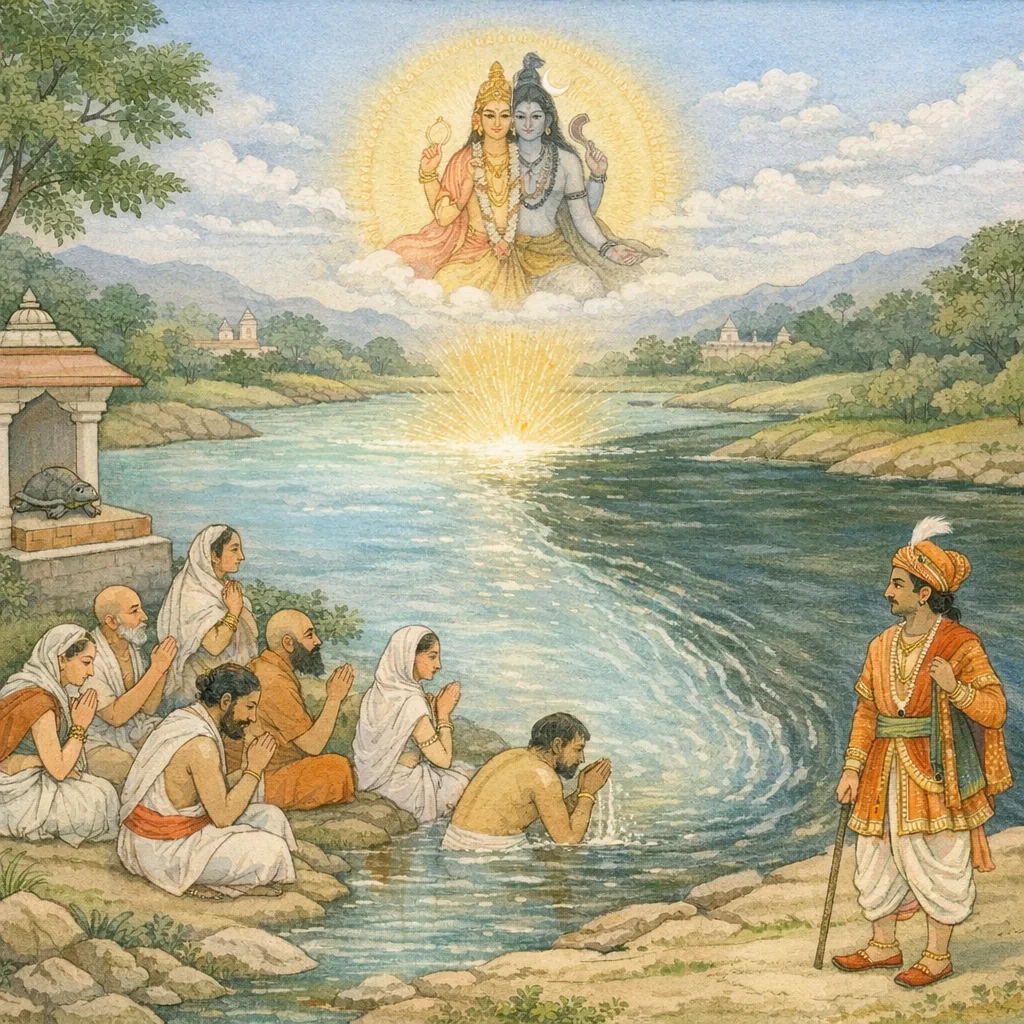
Continuing the Purāṇic teaching on tīrtha observance, Mārkaṇḍeya sets forth the proper order and discipline of pilgrimage, centered on the holiness of Prayāga, the Gaṅgā–Yamunā confluence. The chapter first lays down ethical restraints for yātrā: ostentatious travel by conveyance, driven by greed or display, is condemned as fruitless, and certain harmful acts (such as setting out for Prayāga while riding a bull/ox) are said to bring grave demerit, even causing the ancestors to refuse tarpana. It then proclaims Prayāga’s supremacy—its bath and abhiṣeka equaling great śrauta sacrifices like Rājasūya and Aśvamedha—depicting it as the condensation of innumerable tīrthas, and declaring that death at the confluence yields the yogin’s highest state. A catalogue of nearby sub-tīrthas and kṣetras follows (Nāga sites, Pratiṣṭhāna, Haṃsa-prapatana, the Urvaśī bank, Sandhyā-vaṭa, Koṭitīrtha), each with vow-conditions and specific fruits. The discourse culminates in a Gaṅgā-stuti: Gaṅgā as Tripathagā, uniquely rare at key nodes (Gaṅgā-dvāra, Prayāga, and the ocean meeting), supreme in Kali Yuga, and the final refuge that destroys sin and negates hell—preparing the next movement of tīrtha-centered Dharma and liberation teaching.
Shlokas
Verse 1
इति श्रीकूर्मपुराणे षट्साहस्त्र्यां संहितायां पूर्वविभागे चतुस्त्रिशो ऽध्यायः मार्कण्डेय उवाच कथयिष्यामि ते वत्स तीर्थयात्राविधिक्रमम् / आर्षेण तु विधानेन यथा दृष्टं यथा श्रुतम्
Thus, in the holy Kūrma Purāṇa—within the six-thousand-verse Saṃhitā, in the Pūrvabhāga—begins the thirty-fifth chapter. Mārkaṇḍeya said: “Dear child, I shall explain to you the proper sequence and rule of pilgrimage to the sacred tīrthas, according to the seers’ traditional method—just as it has been seen and as it has been heard.”
Verse 2
प्रयागतीर्थयात्रार्थो यः प्रयाति नरः क्वचित् / बलीवर्दं समारूढः शृणु तस्यापि यत्फलम्
Now hear the fruit gained even by that man who sets out from anywhere on a pilgrimage to the sacred ford of Prayāga (Prayāga-tīrtha), riding upon a bull (or ox).
Verse 3
नरके वसते घोरे समाः कल्पशतायुतम् / ततो निवर्तते घोरो गवां क्रोधो हि दारुणः / सलिलं च न गृह्णन्ति पितरस्तस्य देहिनः
He dwells in a dreadful hell for a hundred million cycles of time. Even after that, the terrible wrath of the cows—truly fierce—does not subside; and the ancestors (pitṛs) of that embodied being do not accept even the water-offering (tarpana) from him.
Verse 4
यस्तु पुत्रांस्तथा बालान् स्नापयेत् पाययेत् तथा / यथात्मना तथा सर्वान् दानं विप्रेषु दापयेत्
Whoever bathes his sons and the young children, and likewise gives them drink and nourishment—treating all dependents as he would his own self—should also cause gifts to be given to the Brahmanas.
Verse 5
ऐश्वर्याल्लोभमोहाद् वा गच्छेद् यानेन यो नरः / निष्फलं तस्य तत् तीर्थं तसमाद्यानं विवर्जयेत्
If a man goes to a sacred ford (tīrtha) by conveyance, driven by display of wealth, greed, or delusion, that pilgrimage becomes fruitless for him; therefore one should avoid such travel-by-vehicle (when motivated by vanity and attachment).
Verse 6
गङ्गायमुनयोर्मध्ये यस्तु कन्यां प्रयच्छति / आर्षेण तु विवाहेन यथा विभवविस्तरम्
Whoever, in the region between the Gaṅgā and the Yamunā, gives a maiden in marriage according to the Ṛṣi-sanctioned (ārṣa) rite—doing so in accordance with his means and resources—attains great religious merit.
Verse 7
न स पश्यति तं घोरं नरकं तेन कर्मणा / उत्तरान् स कुरून् गत्वा मोदते कालमक्षयम्
By that righteous act, he does not behold that dreadful hell. Having gone to the northern Kurus (Uttara-Kuru), he rejoices for an imperishable span of time.
Verse 8
वटमूलं समाश्रित्य यस्तु प्राणान् परित्यजेत् / सर्वलोकानतिक्रम्य रुद्रलोकं स गच्छति
Whoever, taking refuge at the root of a banyan tree, relinquishes the life-breaths—he transcends all worlds and attains Rudra’s realm.
Verse 9
तत्र ब्रह्मादयो देवा दिशश्च सदिगीश्वराः / लोकपालाश्च सिद्धाश्च पितरो लोकसंमताः
There, the gods beginning with Brahmā were present, along with the directions and their presiding lords; the guardians of the worlds, the perfected beings (Siddhas), and the revered Pitṛs honored by all the worlds as well.
Verse 10
सनत्कुमारप्रमुखास्तथा ब्रह्मर्षयो ऽपरे / नागाः सुपार्णाः सिद्धाश्च तथा नित्यं समासते / हरिश्च भगवानास्ते प्रजापतिपुरस्कृतः
Sanatkumāra and other foremost sages, and other brahmarṣis as well; the Nāgas, the Suparṇas (Garuḍa-like divine birds), and the Siddhas—these all continually sit assembled there. And Lord Hari Himself is seated, with the Prajāpatis placed at the fore (presiding in attendance).
Verse 11
गङ्गायमुनयोर्मध्ये पृथिव्या जघनं स्मृतम् / प्रयागं राजशार्दूल त्रिषु लोकेषु विश्रुतम्
Between the Gaṅgā and the Yamunā is said to be the earth’s ‘lower region’ (its sacred posterior). That place is Prayāga, O tiger among kings—renowned throughout the three worlds.
Verse 12
तत्राभिषेकं यः कुर्यात् संगमे संशितव्रतः / तुल्यं फलवाप्नोति राजसूयाश्वमेधयोः
Whoever, disciplined in vows, performs ritual ablution (abhisheka) there at the sacred confluence attains a reward equal to that of the Rājasūya and the Aśvamedha sacrifices.
Verse 13
न मातृवचनात् तात न लोकवचनादपि / मतिरुत्क्रमणीया ते प्रयागगामनं प्रति
Dear son, let not your resolve turn back—neither by your mother’s words nor by the talk of people—when your purpose is to set out for Prayāga.
Verse 14
दश तीर्थ सहस्त्राणि षष्टिकोट्यस्तथापरे / तेषां सान्निध्यमत्रैव तीर्थानां कुरुनन्दन
Ten thousand sacred tīrthas, and also sixty crores of others—of all those pilgrimage places, their very presence is found right here, O delight of the Kurus.
Verse 15
या गतिर्योगयुक्तस्य सत्त्वस्थस्य मनीषिणः / सा गतिस्त्यजतः प्राणान् गङ्गायमुनसंगमे
The same supreme state attained by a wise sage—steadfast in sattva and united with Yoga—is attained by one who gives up the life-breath at the confluence of the Gaṅgā and Yamunā.
Verse 16
न ते जीवन्ति लोके ऽस्मिन् यत्र तत्र युधिष्ठिर / ये प्रयागं न संप्राप्तास्त्रिषु लोकेषु विश्रुतम्
O Yudhiṣṭhira, those who have not reached Prayāga—renowned throughout the three worlds—are not truly living in this world, wherever they may dwell.
Verse 17
एवं दृष्ट्वा तु तत् तीर्थं प्रयागं परमं पदम् / मुच्यते सर्वपापेभ्यः शशाङ्क इव राहुणा
Thus, merely by beholding that sacred ford—Prayāga, the supreme holy station—one is released from all sins, just as the moon is freed from Rāhu’s grasp.
Verse 18
कम्बलाश्वतरौ नागौ यमुनादक्षिणे तटे / तत्र स्नात्वा च पीत्वा च मुच्यते सर्वपातकैः
On the southern bank of the Yamunā dwell the two Nāgas, Kambala and Aśvatara. By bathing there and drinking its water, one is freed from all sins.
Verse 19
तत्र गत्वा नरः स्थानं महादेवस्य धीमतः / आत्मानं तारयेत् पूर्वं दशातीतान् दशापरान्
Having gone there to the sacred abode of wise Mahādeva, a person should first liberate himself; by that merit he also delivers ten ancestors before him and ten descendants after him.
Verse 20
कृत्वाभिषेकं तु नरः सो ऽश्वमेधफलं लभेत् / स्वर्गलोकमवाप्नोति यावदाहूतसंप्लवम्
Having performed the rite of consecration (abhiṣeka), a man obtains the fruit of the Aśvamedha sacrifice; he attains the world of heaven and remains there until the appointed cosmic dissolution.
Verse 21
पूर्वपार्श्वे तु गङ्गायास्त्रैलोक्यख्यातिमान् नृप / अवचः सर्वसामुद्रः प्रतिष्ठानं च विश्रुतम्
O King, on the eastern side of the Gaṅgā lies Avaca, famed throughout the three worlds; and there too is Pratiṣṭhāna, renowned as a great confluence of all waters flowing to the sea.
Verse 22
ब्रह्मचारी जितक्रोधस्त्रिरात्रं यदि तिष्ठति / सर्वपापविशुद्धात्मा सो ऽश्वमेधफलं लभेत्
If a vow-bound brahmacārin, having conquered anger, maintains the discipline for three nights, then—his inner being purified of all sins—he attains merit equal to the fruit of an Aśvamedha sacrifice.
Verse 23
उत्तरेण प्रतिष्ठानं भागीरथ्यास्तु सव्यतः / हंसप्रपतनं नाम तीर्थं त्रैलोक्यविश्रुतम्
To the north lies Pratiṣṭhāna; and on the left bank of the Bhāgīrathī is the sacred ford called Haṃsa-prapatana, renowned throughout the three worlds.
Verse 24
अश्वमेधफलं तत्र स्मृतमात्रात् तु जायते / यावच्चन्द्रश्च सूर्यश्च तावत् स्वर्गे महीयते
There, the merit equal to an Aśvamedha sacrifice arises merely from remembrance; and for as long as the moon and the sun endure, one is honored in heaven.
Verse 25
उर्वशीपुलिने रम्ये विपुले हंसपाण्डुरे / परित्यजतियः प्राणान् शृणु तस्यापि यत् फलम्
Whoever relinquishes his life-breath at the lovely, expansive Urvaśī Bank—white as swans—listen now to the spiritual reward that also accrues to him.
Verse 26
षष्टिवर्षसहस्त्राणि षष्टिवर्षशतानि च / आस्ते स पितृभिः सार्धं स्वर्गलोके नराधिप
For sixty thousand years—and for six hundred years besides—he dwells in the heavenly world together with the Pitṛs, O king among men.
Verse 27
अथं संध्यावटे रम्ये ब्रह्मचारी जितेन्द्रियः / नरः शुचिरुपासीत ब्रह्मलोकमवाप्नुयात्
Then, at the beautiful Sandhyā Banyan (Sandhyā-vaṭa), a man who observes brahmacarya, has conquered his senses, and is pure should perform worship; by doing so, he may attain Brahmaloka, the world of Brahmā.
Verse 28
कोटितीर्थं समाश्रित्य यस्तु प्राणान् परित्यजेत् / कोटिवर्षसहस्त्राणि स्वर्गलोके महीयते
Whoever, taking refuge at Koṭitīrtha, relinquishes his life there, is honored in the heavenly world for thousands of crores of years.
Verse 29
यत्र गङ्गा महाभागा बहुतीर्थतपोवना / सिद्धक्षेत्रं हि तज्ज्ञेयं नात्र कार्या विचारणा
Where the most auspicious Goddess Gaṅgā flows—abounding in many sacred fords and forests of austerity—that place is to be known as a Siddha-kṣetra; no further deliberation is needed.
Verse 30
क्षितौ तारयते मर्त्यान् नागांस्तारयते ऽप्यधः / दिवि तारयते देवांस्तेन त्रिपथगा स्मृता
On earth she ferries mortals across; below she delivers even the Nāgas; and in heaven she conveys the gods—therefore she is remembered as “Tripathagā,” the river that moves through the three paths (three worlds).
Verse 31
यावदस्थीनि गङ्गायां तिष्ठन्ति पुरुषस्य तु / तावद् वर्षसहस्त्राणि स्वर्गलोके महीयते
So long as a man’s bones remain in the Gaṅgā, for that many thousands of years he is honored and exalted in the heavenly world.
Verse 32
तीर्थानां परमं तीर्थं नदीनां परमा नदी / मोक्षदा सर्वभूतानां महापातकिनामपि
Among all sacred fords it is the supreme sacred ford; among all rivers it is the highest river—bestowing liberation upon all beings, even upon those burdened with great sins.
Verse 33
सर्वत्र सुलभा गङ्गा त्रिषु स्थानेषु दुर्लभा / गङ्गाद्वारे प्रयागे च गङ्गासागरसंगमे
The Gaṅgā is easy to reach in many places, yet she is truly rare in three sacred locations: at Gaṅgā-dvāra, at Prayāga, and at the confluence where the Gaṅgā meets the ocean.
Verse 34
सर्वेषामे भूतानां पापोपहतचेतसाम् / गतिमन्वेषमाणानां नास्ति गङ्गासमा गतिः
For all beings whose minds are wounded and darkened by sin, and who seek a true course beyond wandering, there is no refuge or final passage equal to the Gaṅgā.
Verse 35
पवित्राणां पवित्रं च मङ्गलानां च मङ्गलम् / माहेश्वरात् परिभ्रष्टा सर्वपापहरा शुभा
He is the purest among all purifiers, and the most auspicious among all auspicious things. One who has fallen away from Mahādeva’s path loses that blessed power which destroys all sins.
Verse 36
कृते युगे तु तीर्थानि त्रेतायां पुष्करं परम् / द्वापरे तु कुरुक्षेत्रं कलौ गङ्गां विशिष्यते
In the Kṛta Yuga, sacred pilgrimage places (tīrthas) in general are foremost; in the Tretā Yuga, Puṣkara is supreme; in the Dvāpara Yuga, Kurukṣetra is supreme; and in the Kali Yuga, the Gaṅgā is especially pre-eminent.
Verse 37
गङ्गामेव निषेवेत प्रयागे तु विशेषतः / नान्यत् कलियुगोद्भूतं मलं हन्तुं सुदुष्कृतम्
One should resort to the Gaṅgā alone—most especially at Prayāga—for there is nothing else capable of destroying the grievous impurity born of the Kali age, arising from very evil deeds.
Verse 38
अकामो वा सकामो वा गङ्गायां यो विपद्यते / स मृतो जायते स्वर्गे नरकं च न पश्यति
Whether free of desire or full of desire, whoever meets death in the Gaṅgā is reborn in heaven and does not behold hell.
Frequently Asked Questions
The chapter condemns conveyance-based pilgrimage when driven by display, greed, or delusion, stating such motivation renders the yātrā fruitless; the emphasis is on humility, vow-discipline, and non-attachment rather than mere arrival.
Prayāga is presented as the locus where innumerable tīrthas are present, where ablution and abhiṣeka equal the fruits of Rājasūya and Aśvamedha, and where death at the confluence grants the highest yogic state and freedom from sin.
It means Gaṅgā ‘moves through three paths/worlds’: she ferries humans on earth, delivers beings below (including Nāgas), and conveys the gods in heaven—marking her as a cosmic purifier across realms.
It states: in Kṛta, tīrthas generally are foremost; in Tretā, Puṣkara; in Dvāpara, Kurukṣetra; and in Kali, Gaṅgā is especially pre-eminent—most particularly at Prayāga.