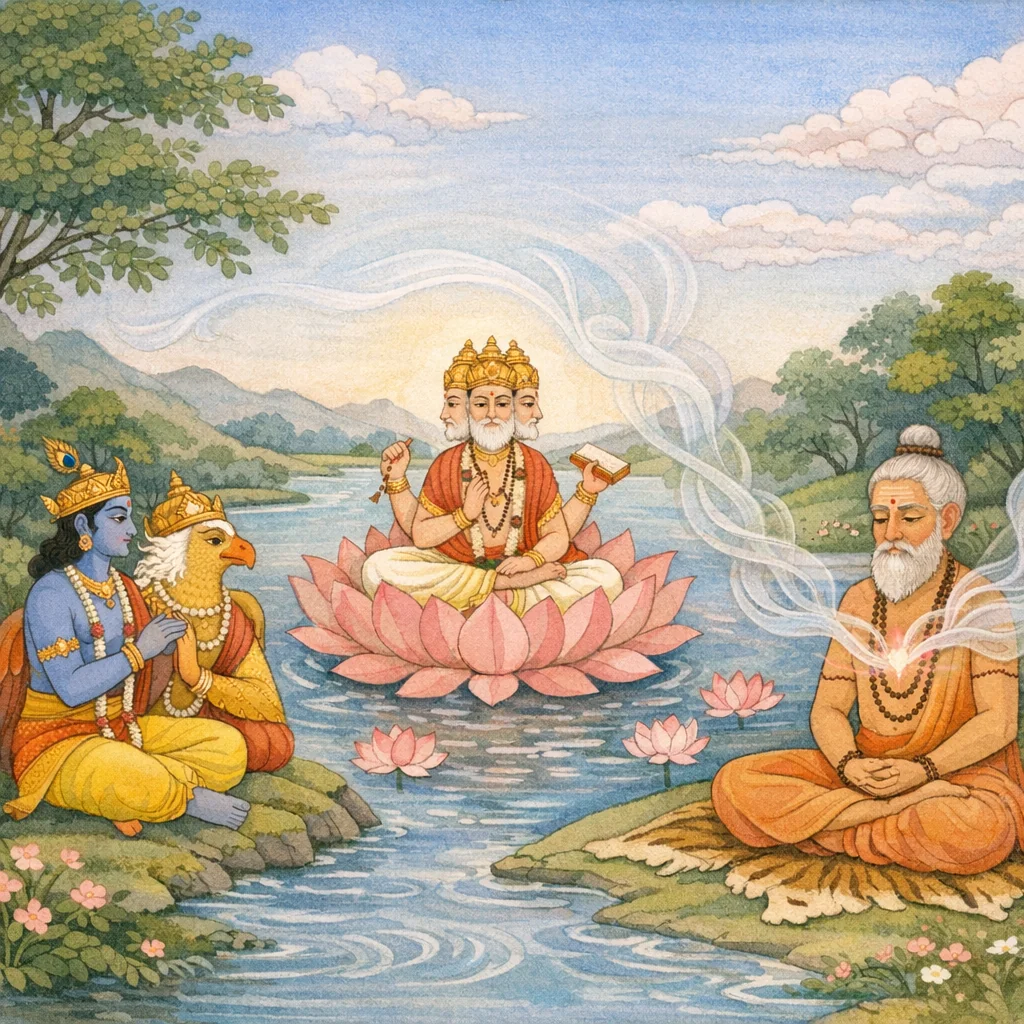
Adhyaya 16
Mahālakṣmī’s Forms, Brahmā’s Fourfold Origin, Vāyu’s Names and Soteriology, and Bhāratī’s Manifestations
Kṛṣṇa first declares Mahālakṣmī inseparable from Hari, then lists her functional manifestations in cosmic creation and divine descents, linking Śrī/Māyā/Prakṛti to particular consorts and goddesses (Śrī, Durgā/Kanyā, Bhūdevī, Annapūrṇā, Dakṣiṇā, Sītā, Rukmiṇī, Satyabhāmā). The teaching turns to Brahmā’s emergence in multiple registers—Viriñca/Viriñci/Vidhi/Caturmukha—grounded in the Vyūha scheme (Vāsudeva, Saṅkarṣaṇa, Pradyumna, Aniruddha) and the cosmic egg and lotus imagery. Kṛṣṇa then expounds Vāyu’s many names as inner powers (Pradhāna, Sūtra, Dhṛti, Smṛti, Mukti/Mukta, Citta, Bala, Sukha), portraying Vāyu as the heart-abiding agent of remembrance, steadiness, and liberation. An extended ethical-epistemic section criticizes crooked (vakra) yoga and desire-driven worship, teaching that kāmya bhakti yields worldly fruits yet obstructs mokṣa, while true prajñā/vijñāna arises through guru-awakening and dispassion (virāga). The chapter closes by mapping Bhāratī/Vāṇī/Sarasvatī as threefold speech and as Vāyu’s consort across births (with links to Hanumān/Bhīma narratives and Draupadī), preparing the continuation of the taxonomy of divine functions, incarnations, and liberating devotion.
Shlokas
Verse 1
नाम पञ्चदशो ऽध्यायः श्रीकृष्ण उवाच / महालक्ष्म्याः स्वरूपं च अवतारान्खगेश्वर / शृणु सम्यङ् महाभाग तज्ज्ञानस्य विनिर्णयम्
Śrī Kṛṣṇa said: O lord of birds, Garuḍa, O greatly blessed one, listen with full attention to this decisive teaching—I shall describe the true form of Mahālakṣmī and her incarnations.
Verse 2
ईशादन्यस्य जगतो ह्यात्मो लोचन एव तु / विषयीकुरुते तत्स्याज्ज्ञानं लक्ष्म्याः प्रकीर्तितम्
For the world apart from the Lord, the Self is only a witness—like an eye; when it turns objects into its concern and identifies with them, that is proclaimed as the “knowledge of Lakṣmī”.
Verse 3
नित्यावियोगिनी देवी हरिपादैकसंश्रया / नित्यमुक्ता नित्यबुद्धा महालक्ष्मीः प्रकीर्तिता
The Goddess, ever inseparable (from the Lord) and taking refuge solely at Hari’s feet, is praised as Mahālakṣmī—eternally free and eternally awakened in wisdom.
Verse 4
मूलस्य च हरेर्भार्या लक्ष्मीः संप्रकीर्तिता / पुंसो हिभार्या प्रकृतिः प्रकृतेश्चा भिमानिनी
Lakṣmī is proclaimed the consort of Hari, who is the very root (source). Indeed, for the Supreme Puruṣa, Prakṛti is called the “wife”; and she is the abhimāninī—the presiding principle of self-identification—of Prakṛti itself.
Verse 5
सृष्टिं कर्तुं गुणान्वीन्द्र पुरुषेण सह प्रभो / तमः पानं तथा कर्तुं प्रकृत्याख्या तदाभवत्
O Lord, to bring forth creation together with Puruṣa endowed with the guṇas, there then arose what is called Prakṛti; and it also came to be for the purpose of absorbing tamas.
Verse 6
वासुदेवस्य भार्या तु माया नाम्नी प्रकीर्तिता / संकर्षणस्य भार्या तु जयेति परिकीर्तिता
The consort of Vāsudeva is proclaimed by the name Māyā; and the consort of Saṅkarṣaṇa is likewise celebrated as Jaya.
Verse 7
अनिरुद्धस्य भार्या तु शान्ता नाम्नीति कीर्तिता / कृतिः प्रद्युम्नभार्यापिं सृष्टिं कर्तुं बभूवह
Aniruddha’s wife is celebrated by the name Śāntā; and Kṛti, the wife of Pradyumna as well, came into being for the purpose of creation.
Verse 8
विष्णुपत्नी कीर्तिता च श्रीदेवी सत्त्वमानिनी / तमोभिमानिनी दुर्गा कन्यकेति प्रकीर्तिता
She is praised as Viṣṇu’s consort—Śrī Devī, who identifies with sattva; and as Durgā, who identifies with tamas, she is also celebrated as the Virgin (Kanyā).
Verse 9
कृष्णावतारे कन्येव नन्दपुत्रानुजा हि सा / रजोभिमानिभूदेवी भार्या सा सूकरस्य च
In the incarnation of Kṛṣṇa, she was born as a maiden—indeed as the younger sister of Nanda’s son. That very Bhūdevī, identified with the quality of rajas, also became the wife of the Boar (Varāha).
Verse 10
वेदाभिमानिनी वीन्द्र अन्नपूर्णा प्रकीर्तिता / नारायणस्य भार्या तु लक्ष्मीरूपा त्वजा स्मृता
O Indra, she is celebrated as Annapūrṇā, the presiding goddess of the Vedas; and by you she is remembered as Lakṣmī in form—the consort of Nārāyaṇa.
Verse 11
यज्ञाख्यस्य हरेर्भार्या दक्षिणा संप्रकीर्तिता
Dakṣiṇā (the sacrificial gift) is praised as the consort of Hari, who is known as Yajña—the Lord embodied as sacrifice.
Verse 12
जयन्ती वृषभस्यैव पत्नी संपरिकीर्तिता / विदेहपुत्री सीता तु रामभार्या प्रकीर्तिता
Jayantī is well known as the wife of Vṛṣabha. And Sītā, the daughter of Videha, is renowned as the wife of Rāma.
Verse 13
रुक्मिणीसत्यभामा च भार्ये कृष्णस्य कीर्तिते / इत्यादिका ह्यनन्ताश्चाप्यावताराः पृथग्विधाः
Rukmiṇī and Satyabhāmā are proclaimed as the wives of Kṛṣṇa. In this manner, there are indeed countless incarnations as well—manifesting in distinct and varied forms.
Verse 14
रमायाः संति विप्रेन्द्र भेदहीनाः परस्परम् / अनन्तानन्तगुणकाद्विष्णोर्न्यूनाः प्रकीर्तिताः
O best of Brahmins, those who belong to Ramā (Śrī) are mutually without difference among themselves; yet they are declared to be lesser than Viṣṇu, whose qualities are infinite and endless.
Verse 15
वक्ष्ये च ब्रह्मणो रूपं शृणु पक्षीन्द्रसत्तम
I shall describe the form of Brahmā; listen, O best of kings among birds.
Verse 16
वासुदेवात्समुत्पन्नो मायायां च खगेश्वर / स एव पुरुषोनाम विरिञ्च इति कीर्तितः
O lord of birds, born from Vāsudeva within Māyā, that very cosmic Person is celebrated by the name ‘Viriñca’—Brahmā.
Verse 17
अनिरुद्धात्तु शान्तायां महत्तत्त्वतनुस्त्वभूत् / तदा महान्विरिञ्चेति संज्ञामाप खगेश्वर
From Aniruddha, within the quiescent primordial state, there arose the body constituted of the Mahat-tattva. Then that Great Principle came to be known as ‘Viriñci’ (Brahmā), O Lord of Birds.
Verse 18
रजसात्र समुत्पन्नो मायायां वासुदेवतः / विधिसंज्ञो विरिञ्चः स ज्ञातव्यः पक्षिसत्तम
From Vāsudeva, within Māyā, there arises the creator through the rajas principle; he is Viriñca, known as ‘Vidhi.’ Know him thus, O best of birds.
Verse 19
ब्रह्माण्डान्तः पद्मनाभो यो जातः कमलासनः / स चर्तुमुखसंज्ञां चाप्यवाप खगसत्तम
O best of birds, within the cosmic egg, from Padmanābha arose the Lotus-seated one; and he also came to be known as ‘Caturmukha’ (the Four-faced).
Verse 20
एवं चत्वारिरूपाणि ब्रह्मणः कीर्तितानि च / वायोर्नामानि वक्ष्येहं शृणु पक्षीन्द्रसत्तम
Thus the four forms of Brahmā have been described. Now I shall declare the names of Vāyu—listen, O best of kings among birds, Garuda.
Verse 21
संकर्षणाच्च गरुड जयायां यो वभूव ह / स वायुः प्रथमो ज्ञेयो प्रधान इति कीर्तितः
O Garuḍa, from Saṅkarṣaṇa arose the one who manifested at the time of victory; he is to be known as the first Vāyu, and he is praised as Pradhāna, the primary principle.
Verse 22
लोकचेष्टाप्रदत्वात्स सूत्रनाम्नापि कीर्तितः / बदरीस्थस्य विष्णोश्च धैर्येण स्तवनाय सः
Because he bestows right conduct upon the world, he is also celebrated by the name “Sūtra”; and with steadfastness he is to be praised as Viṣṇu who abides at Badarī.
Verse 23
धृतिरूपं ययौ वायुस्तस्माद्धृतिरिति स्मृतः / योग्यानां हरिभक्तानां धृतिरूपेण संस्थितः
Vāyu assumed the form of steadfastness; therefore he is remembered as “Dhṛti”. Abiding in that very form of steadfastness, he remains established within yogins and the devotees of Hari.
Verse 24
यतो हृदि स्थितो वायुस्ततो वै धृतिसंज्ञकः / सर्वेषां च दृदि स्थित्वा स्मरते सर्वदा हरिम्
Because the vital wind (vāyu) abides in the heart, it is indeed known as dhṛti, the steadfast sustaining power. Dwelling in the hearts of all, it ever remembers Hari (Lord Viṣṇu).
Verse 25
अतो वायुःस्थितिर्नाम बभूव खगसत्तम / अथवा वायुरेवैकः श्वेतद्वीपगतं हरिम्
Therefore, O best of birds, there came to be a state known as “the abiding of Vāyu”. Or rather, Vāyu alone reached Hari (Viṣṇu) who dwells in Śvetadvīpa.
Verse 26
सदा स्मरति वै वीन्द्र अतोसौ स्मृतिसंज्ञकः / सर्वेषां च हृदिस्थित्वा ज्ञातो विष्णोरुदीरणात्
O Garuḍa, best of birds, he ever remembers; therefore he is known as “Smṛti,” the power of remembrance. Abiding in the hearts of all beings, he is realized through the utterance and recollection of Lord Viṣṇu’s Name.
Verse 27
अतो मे मुक्तिनामाभूद्वायुरेव न संशयः / ज्ञानद्वारेण भक्तानां मुक्तिदो मदनुज्ञया
Therefore my name became “Mukta”; indeed it is Vāyu—there is no doubt. Through the gateway of true knowledge, he grants liberation to devotees, by my permission.
Verse 28
यतो सौ वायुरेवैको मुक्तिनामा भूवह / विष्णौ भक्तिं वर्ध्यति भक्तानां हृदि संस्थितः
Therefore that one Vāyu alone—known as “Mukti”—abides; dwelling in the hearts of devotees, he increases their devotion to Viṣṇu.
Verse 29
अतोसौ विष्णुभक्तश्च कीर्तितो नात्र संशयः / एषोसौ सर्वजीवानां चित्तसंज्ञानमेव च
Therefore he is declared to be a devotee of Lord Viṣṇu—of this there is no doubt. Indeed, he is the very consciousness and inner awareness of all living beings.
Verse 30
चित्तरूपो यतो वायुरतश्चित्तमिति स्मृतः / प्रभुः प्रभूणां गरुड सोदराणां च सर्वशः
Because the vital wind, Vāyu (prāṇa), assumes the form of consciousness, it is therefore remembered as “citta,” the mind-stuff. O Garuḍa, it is the lord of lords, and in every way the ruler over its own associated, co-functioning faculties.
Verse 31
अतस्तु वायुरेवैको महाप्रभुरिति स्मृतः / सर्वेषां च हृहि स्थित्वा बलं पश्यति सत्तम
Therefore Vāyu, the life-wind alone, is remembered as the great sovereign; abiding in the hearts of all, O best of beings, he observes their strength—the vital power.
Verse 32
अतो बलमिति ह्याख्यामवाप विनतासुत / सर्वेषां च हृदि स्थित्वा पुत्रपौत्रादिकैर्जनैः
Therefore, O son of Vinatā (Garuḍa), he came to be known by the name “Bala”; and abiding in the hearts of all, he is sustained and strengthened by people through sons, grandsons, and the like.
Verse 33
याजनं कुरुते नित्यमतोसौ यष्टृसंज्ञकः / अनन्तकल्पमारभ्य वायुपर्यन्तमेव च
Therefore, one who continually causes sacrifices (yajña) to be performed is known as a “yaṣṭṛ”, a sacrificial patron. From the beginning of endless cosmic cycles, this designation endures—up to the realm of Vāyu as well.
Verse 34
वक्रत्वं नास्ति योगस्य ऋजुर्योग्य इति स्मृतः / योगस्य वक्रता नाम काम्यता हरिपूजने / ईशरुद्रादिकानां च काम्येन हरिपूजनम्
In yoga there is no crookedness; one fit for yoga is remembered as straightforward. What is called the “crookedness” of yoga is desire-driven intent (kāmya) in the worship of Hari—namely, worshipping Hari with motives such as seeking the favor of Īśa (Śiva), Rudra, and other deities.
Verse 35
कस्यचित्त्वथ पक्षीन्द्र ह्यतस्त्वनृजवः स्मृताः
But in the case of some, O Lord of birds, for this very reason they are remembered as “not straight”—that is, crooked or deceitful in conduct.
Verse 36
ऋष्यादीनां च मध्येपि काम्येन हरिपूजनम् / अतो न ऋजवो ज्ञेया मनुष्याणां च का कथा
Even among rishis and the wise, worship of Hari is at times performed with desire for personal gain. Therefore they should not be deemed wholly straightforward; what then can be said of ordinary human beings?
Verse 37
यावत्काम्यसपर्यां वै न जहाति नरोत्तमः / तथा ऋष्यादयश्चैव मोक्षस्य परिपन्थिनीम्
O best of men, so long as one does not abandon desire-motivated worship and ritual service, even sages and the like remain upon the path that obstructs liberation (moksha).
Verse 38
अनादिकालमारभ्य कर्मजन्या च वासना / मोक्षाधिकारिणः सर्वे कुर्वते कस्य पूजनम्
From beginningless time, the latent tendencies (vāsanās) born of karma persist. Therefore, all who are qualified for liberation—whose worship do they perform?
Verse 39
नष्टप्रायं च तत्सर्वं गुरोः संज्ञानबोधकात् / प्राप्ययोगं समाचर्य अन्ते मोक्षमवाप्नुयात्
By the Guru’s awakening instruction that imparts true recognition (right knowledge), nearly all that ignorance and its effects are destroyed; having attained yoga and practiced it properly, one finally reaches liberation.
Verse 40
काम्येन पूजनं विष्णोरैश्वर्यं प्रददाति च / ज्ञानं च विपरीतं स्यात्तेन यात्यधरं तमः
Worship of Lord Viṣṇu performed with desire for worldly gain indeed grants prosperity and power; yet by it one’s knowledge becomes distorted, and thus one descends into lower darkness—spiritual delusion.
Verse 41
तदेव विपरीतं चेज्ज्ञानाय परिकीर्तितम् / शिलायां विष्णुबुद्धिस्तु विष्णुबुद्धिर्द्विजे तथा
But if the very opposite is proclaimed as “knowledge,” it is a perversion of understanding: to take a mere stone to be Viṣṇu is one thing, and likewise such “Viṣṇu-mindedness” toward a brāhmaṇa is also enjoined.
Verse 42
सलिले तीर्थबुद्धिस्तु रोणुकायां तथैव च / शिवे सूर्ये पण्मुखे च विष्णुबुद्धिः खगेश्वर
O Khageśvara (Garuda), in water one should hold the understanding of a tīrtha, a sacred ford; likewise in the cow (roṇukā). And in Śiva, in the Sun, and in Ṣaṇmukha (Kārttikeya), one should maintain the devotional recognition of Viṣṇu.
Verse 43
इत्याद्यमखिलं ज्ञानं विपरीतमिति स्मृतम् / शिलाद्येषु च सर्वेषु ऐक्येनव विचिन्तनम्
All such “knowledge,” beginning with these notions, is remembered to be inverted (wrong understanding). Likewise, to contemplate only oneness in all things—starting from stones and the like—is also counted as such.
Verse 44
विष्णुबुद्धिरिति प्रोक्तं न तु तत्रस्थवेदनम् / अनाद्यनन्तकालेपि काम्येन हरिपूजनम्
What is called “Viṣṇu-buddhi” is the turning of one’s intellect toward Viṣṇu, not mere awareness of being present in that place. Even through beginningless and endless time, worship of Hari done with desire for specific results remains kāmya—worship motivated by desire.
Verse 45
यतो नास्ति ततो वायुरृजुर्योग्यः प्रकीर्तितः / अन्येषां सर्वदा नास्ति अतो न ऋजवः स्मृताः
Where there is no obstruction, there the wind is declared to be straight and fit (to move rightly). But for others, obstruction is always present; therefore they are not regarded as straight.
Verse 46
हरिं दर्शयते वापि अपरोक्षेण सर्वदा / मोक्षाधिकारिणां काले अतः प्रज्ञेति कथ्यते
It ever reveals Hari (the Supreme Lord) directly, without any mediation. Therefore, when one becomes qualified for moksha, it is called “prajñā”—true, awakened wisdom.
Verse 47
परोक्षेणापि सर्वेषां हरिं दर्शयते सदा / अतो वायुः सदा वीन्द्र ज्ञानमित्येव कीर्तितः
Even indirectly, Vāyu ever causes all beings to behold Hari (the Lord). Therefore, O lord of birds (Garuda), Vāyu is always celebrated as “knowledge” itself.
Verse 48
हिताहितोपदेष्टृत्वाद्भक्तानां हृदये स्थितः / ततश्च गुरुसंज्ञां चाप्यवाप स च मारुतः
Because he instructs devotees in what is beneficial and what is harmful, he abides in their hearts; therefore that Maruta (Vāyu) also attained the designation of “Guru”.
Verse 49
योगिनां हृदये स्थित्वा सध्यायति हरिं परम् / पार्थक्येनापि तं ध्यायन्महाध्यातेति स स्मृतः
Abiding in the hearts of yogins, he continually contemplates Hari, the Supreme. Even while maintaining a sense of distinction, one who meditates upon Him is remembered as a great meditator (mahādhyātā).
Verse 50
यद्योग्यतानुसारेण विजानाति परं हरिम् / रुद्रादौ विद्यमानांश्च गुणाञ्जानाति सर्वदा
According to one’s fitness and capacity, one comes to know the Supreme Hari; and one also ever recognizes the qualities present in Rudra and the other deities.
Verse 51
अतो वै विज्ञनामासौ प्रोक्तो हि खगसत्तम / काम्यानां कर्मणां त्यागाद्विराग इति स स्मृतः
Therefore, O Garuḍa, best of birds, this indeed is called “vijñāna” (realized knowledge). And because it arises from renouncing desire-driven actions, it is remembered as “virāga” (dispassion, detachment).
Verse 52
वैराग्यं संजनयति विराग इति स स्मृतः
That which gives rise to dispassion is remembered as “virāga” (detachment).
Verse 53
देवानां पुण्यपापाभ्यां सुखमेवोत्तरोत्तरम् / तत्सुखं तूत्तरेषां च वायुपर्यन्तमेव च
Among the gods, due to differing measures of merit and demerit, happiness increases step by step in higher and higher ranks. That very happiness continues to rise among the successive higher deities, extending up to (the sphere of) Vāyu.
Verse 54
देवानां च ऋषीणां च उत्तमानां नृणां तथा / सुखांशं जनयेद्वायुर्यतोतः सुखसंज्ञकः
Among the Devas, the Ṛṣis, and likewise among the best of human beings, Vāyu generates a portion of happiness; therefore he is known as “Sukha” (the giver of ease).
Verse 55
भुनक्ति सर्वदा वीद्रं तत्र मुख्यस्तु मारुतः / दुः खशोकादिकं किञ्चिद्देवानां भवति प्रभो
There, the “vīdra” is continually consumed—among those factors, the Wind (Maruta) is the foremost. From it arise, O Lord, a certain measure of sorrow, grief, and related afflictions even for the gods.
Verse 56
तच्चासुरावेशवशादित्यवेहि न संशयः / तज्जीवस्य भवेत्किञ्चिद्दैत्यानां क्रमशो भवेत्
Know this with certainty, without doubt: it occurs by the force of asuric possession. In that embodied soul, something of the Daitya nature gradually comes to manifest, step by step.
Verse 57
यतः कलिश्चाधिकः स्यादतो दुः खीति स स्मृतः / दैत्यानां पुण्यपापाभ्यां दुः ख मेवोत्तरोत्तरम्
Because the age of Kali becomes predominant, it is remembered as an age of suffering. For the Daityas, through the interplay of merit and sin, suffering alone increases more and more, step by step.
Verse 58
तद्दुः खमुत्तरेषां च कलिपर्यन्तमेव च / भुनक्ति सर्वदा वीन्द्र ततः कलिरिति स्मृतः
That very suffering is continually experienced by those who come after, lasting up to the end of the Kali age. Therefore, O Vīndra—O Garuda, best of birds—it is remembered as ‘Kali’, the age that makes beings endure such misery.
Verse 59
सुखहर्षादिकं किं चिद्दैत्यानां भवति प्रभो / देवावेशो भवेत्तस्य नात्र कार्या विचारणा
O Lord, if some measure of happiness, exhilaration, or the like arises even in the Daityas, it is due to the influence (possession) of a Deva; on this there is no need for further deliberation.
Verse 60
देवानां निरयो नास्ति दैत्यानां विनतासुत / सुखस्वरूपं तन्नास्ति विषयोत्थमपि द्विज
For the Devas there is no hell; and for the Daityas too, O son of Vinatā. That pure happiness which is happiness by its very nature does not exist there—only pleasure born of sense-objects, O twice-born.
Verse 61
विषयोत्थं किञ्चिदपि देवावेशादुदीरितम् / तमो नास्त्येव देवानां दुः खं नास्ति स्वरूपतः
Even if something born of sense-objects is uttered under a divine impulse, as though by possession, darkness truly does not exist for the Devas; by their very nature, suffering is not inherent in them.
Verse 62
विषयोत्थं महादुः खं देवानां नास्ति सर्वदा / दुः खशोकादिकं किं चिदसुरावेशतो भवेत्
Among the Devas, the great suffering that arises from sense-objects never exists; yet a little sorrow, grief, and the like may occur only through possession or intrusion by Asuras.
Verse 63
अतः कलिः सदा दुः खी सुखी वायुस्तु सर्वदा / मनुष्याणा मृषीणां च सुखं दुः खं खगेश्वर
Therefore, O Khageśvara, Kali is ever miserable, while Vāyu is ever happy; and for human beings and sages alike, both happiness and sorrow are experienced.
Verse 64
भवेत्तत्पुण्यिपापाभ्यां पुण्यभोगी च मारुतः / कष्टभङ्गः कलिलयो नात्र कार्या विचारणा
From those accumulated merits and sins, Vāyu—the life-breath—becomes an enjoyer of merit, tasting its pleasant fruits; and amid confusion and distress it becomes the breaker of hardships—of this there is no need for further doubt or deliberation.
Verse 65
प्राणादिसुखपर्यन्ता अंशा एकोनविंशतिः / प्रविष्टाः संति लोकेषु पृथक्संति खगेश्वर
O Lord of birds (Garuda), the portions beginning with prāṇa and ending with sukha are nineteen in number; they enter into the worlds and exist there as distinct, separate factors.
Verse 66
मारुतरेवतारांश्च शृणु पक्षीन्द्रसत्तम / चतुर्दशसु चन्द्रेषु द्वितीयौयो विरोचनः
O best of birds, hear also of the incarnations called Māruta and Revata. Among the fourteen lunar manifestations, the second is named Virocana.
Verse 67
स वायुरिति संप्रोक्त इन्द्रादीनां खगेश्वर / हरितत्त्वेषु सर्वेषु स विष्वग्याव्यतेक्षणः
O Lord of birds (Garuda), he is declared to be Vāyu, the life-wind, for Indra and the other gods. In all tattvas and realities he pervades everywhere, his vision extending throughout the universe.
Verse 68
अतो रोचननामासौ मरुदंशः प्रकीर्तितः रामावतारे हनुमान्रामकार्यार्थसाधकः / स एव भीमसेनस्तु जातो भूम्यां महाबलः
Therefore he is celebrated as Rocana, a portion of the Maruts. In the avatāra of Rāma he became Hanumān, accomplisher of Rāma’s purpose; and that very one was born on earth as the mighty Bhīmasena.
Verse 69
कृष्णावतारे विज्ञेयो मरुदंशः प्रकीर्तितः
In the avatāra of Kṛṣṇa, he is to be known as an aṁśa (partial manifestation) of the Maruts—thus it is declared.
Verse 70
मणिमान्नाम दैत्यस्तु संराख्यो भविष्यति / सर्वेषां संकरं यस्तु करिष्यति न संशयः
A Daitya named Maṇimān will indeed arise, known as Saṃrākhya. He will bring about confusion and intermixture among all—of this there is no doubt.
Verse 71
तेन संकरनामासौ भविष्यति खगेश्वर / धर्मान्भागवतान्सर्वान्विनाशयति सर्वथा
Therefore, O lord of birds (Garuda), he will be known by the name “Saṅkara,” and he will utterly destroy, in every way, all the dharmas of the Bhāgavatas (the Lord’s devotees).
Verse 72
तदा भूमौ वासुदेवो भविष्यति न संशयः / यज्ञार्थैः सदृशो यस्य नास्ति लोके चतुर्दशे
Then, upon the earth, Vāsudeva will manifest—of this there is no doubt. In all the fourteen worlds, nothing is comparable to the purpose and fruits of the yajña (sacrifice) that are bound to Him.
Verse 73
अतः स प्रज्ञया पूर्णो भविष्यति न संशयः / अवतारास्त्रयो वायोर्मतं भागवताभिधम्
Therefore he will become complete in wisdom—there is no doubt. The three incarnations of Vāyu are regarded as the doctrine known as the Bhāgavata, the teaching of devotion.
Verse 74
स्थापनं दुष्टदमनं द्वयमेव प्रयोजनम् / नान्यत्प्रयोजनं वायोस्तथा वैरोचनात्मके
Establishing order and restraining the wicked—these two alone are the purposes. For Vāyu there is no other purpose; so too in the Vairocanātmaka aspect.
Verse 75
अवतारत्रये वीन्द्र दुः खं गर्भादिसंभवम् / नास्ति नास्त्येव वायोस्तु तथा वैरोचनादिके
O lord of birds (Garuda), in the three divine incarnations there is no suffering arising from entering the womb and the like; indeed, such womb-born misery does not exist for Vāyu, nor for Virocana and others of that class.
Verse 76
शुक्रशोणितसंबन्धो ह्यवतारचतुष्टये / नास्ति नास्त्येव पक्षीन्द्र यतो नास्त्यशुभं ततः
In the Lord’s fourfold descent (avatāra), there is no connection with semen and blood—no ordinary biological birth. Truly, O king of birds, where such a material cause is absent, no impurity or inauspiciousness can arise from it.
Verse 77
पूर्वं गर्भं समाशोष्य समये प्रभवस्य च / प्रादुर्भवति देवेशी ह्यवतारचतुष्टये
First, drawing in the embryo, and then—at the proper time for manifestation—the Divine Sovereign Goddess indeed appears for the quartet of incarnations.
Verse 78
त्रयोविंशतिरूपाणां वायोश्चैव खगेश्वर / रूपैरृजुस्वरूपैश्च ब्रह्मणः परमेष्ठिनः
O lord of birds, Vāyu (the Wind) has twenty‑three forms; and Brahmā, the Supreme Ordainer (Parameṣṭhin), is also spoken of through forms—both in his direct nature and in manifested aspects.
Verse 79
सत्यमेव न संदेहो नित्यानन्दसुखादिषु / एवमेव विजानीयान्नान्यथा तु कथञ्चन
This alone is true, without any doubt, concerning the Self’s eternal bliss and happiness. One should know it only in this way, and never otherwise, in any manner.
Verse 80
एतस्य श्रवणादेव मोक्षं यान्ति न संशयः / तदनन्तरजान्वक्ष्ये शृणु पक्षीन्द्रसत्तम
By merely listening to this, one attains liberation (mokṣa)—there is no doubt. Now I shall tell what comes immediately after this; listen, O best among the kings of birds.
Verse 81
कृतौ प्रद्युम्नतश्चैव समुत्पन्ने खगेश्वर / स्त्रियौ द्वे यमले चैव तयोर्मध्ये तु यद्यिका
O lord of birds, when Kṛtā and Pradyumnatā were born, two twin women also arose; and between those two, Yadyikā was born.
Verse 82
वाणीतिसंज्ञकां वीन्द्र ब्रह्माणीसंज्ञकां विदुः / पुरुषाख्यविरिञ्चस्य भार्या सावित्रिका मता / चतुर्मुखस्य भार्या तु कीर्तिता सा सरस्वती
O Vīndra, she who is known as Vāṇīti is also understood to be called Brahmāṇī. The consort of Viriñca, who is termed Puruṣa, is regarded as Sāvitrikā; and the wife of the four-faced Brahmā is celebrated as Sarasvatī.
Verse 83
एवं त्रिरूपं विज्ञेयं वाण्याश्च खगसत्तम / वक्ष्ये ऽवतारान् भारत्याः समाहितमनाः शृणु
Thus, O best of birds, understand that Vāṇī—Sacred Speech—is of three forms. Now I shall describe the manifestations of Bhāratī; listen with a focused mind.
Verse 84
सर्ववेदाभिमानित्वात्सर्ववेदात्मिका स्मृता / महाध्यातुश्च वायोस्तु भार्यासा परिकीर्तिता
Because she presides over and is identified with all the Vedas, she is remembered as embodying all the Vedas. She is also proclaimed to be the consort of Vāyu, the great sustaining principle.
Verse 85
ज्ञानरूपस्य वायोस्तु भार्या सा परिकीर्तिता / सदा सुखस्वरूपत्वाद्भारती तु सुखात्मिका
Bhāratī is proclaimed to be the consort of Vāyu, whose nature is knowledge; and because she is ever of the very form of bliss, Bhāratī is indeed bliss-ensouled.
Verse 86
सुखस्वरूप वायोस्तु भार्या सा परिकीर्तिता / गुरुस्तु वायुरेवोक्तस्तस्मिन् भक्तियुता सती
She is proclaimed the bliss-natured consort of Vāyu; and Vāyu himself is declared to be her guru—therefore that virtuous lady abides in devotion to him.
Verse 87
ततस्तु भारती नित्या गुरुभक्तिरिति स्मृता / महागुरोर्हि वायोश्च भार्या वै परिकीर्तिता
Then Bhāratī is remembered as the ever-abiding devotion to the Guru; indeed, she is also celebrated as the wife of Vāyu, the great Guru.
Verse 88
हरौ स्नेहयुतत्वाच्च हरिप्रीतिरिति स्मृता / धृतिरूपस्य वायोश्च भार्या सा परिकीर्तिता
Because she is endowed with loving affection toward Hari, she is remembered as “Hariprīti” (the delight of Hari). She is also proclaimed the wife of Vāyu, whose nature is Dhṛti—steadfastness.
Verse 89
सर्वमन्त्राभिमानित्वात्सर्वमन्त्रात्मिका स्मृता / महाप्रभोश्च वायोश्च भार्या वै सा प्रकीर्तिता
Because she presides over all mantras, she is remembered as the very essence of all mantras. Indeed, she is proclaimed the consort of the Great Lord, and also of Vāyu.
Verse 90
भुज्यन्ते सर्वभोगास्तु विष्णुप्रीत्यर्थमेवच / अतस्तु भारती ज्ञेया भुजिनाम्ना प्रकीर्तिता
All enjoyments are to be partaken of solely for the sake of pleasing Viṣṇu; therefore this is to be understood as “Bhāratī”, and it is celebrated by the name “Bhujinā” (the teaching of regulated enjoyment).
Verse 91
चित्ररूपस्य वायोस्तु भार्या सा परिकीर्तिता / रोचनेन्द्रस्य भार्या च श्रद्धाख्या परिकीर्तिता
She is proclaimed the wife of Vāyu in his form called Citrarūpa; and she named Śraddhā is proclaimed the wife of King Rocanendra.
Verse 92
हनुमांश्च तदा जज्ञे त्रेतायां पक्षिसत्तम / तदा शिवाख्यविप्राच्च जज्ञे सा भारती स्मृता
O best of birds, in the Tretā age Hanumān was born; and at that time, from a brāhmaṇa named Śiva, she—remembered as Bhāratī—was also born.
Verse 93
न केवलं भारती साशच्याद्यैश्चैव संयुता / तस्मिन्संजनिताः सर्वाः प्रापुर्योगं स्वभर्तृभिः
Not only was Bhāratī united with Śacī and the others; all those women who were born there likewise attained union with their own husbands.
Verse 94
अन्यगेति च विज्ञेया कन्या तन्मतिसंज्ञिका / त्रेतान्ते सैव पक्षीन्द्र शच्याद्यैश्चैव संयुता
Know her as the maiden called Anyagetī, also known by the epithet “Tan-mati”. At the close of the Tretā age, O lord of birds, she too was united with Śacī and the others.
Verse 95
दमयन्त्यनलाज्जाता इन्द्रसेनेति चोच्यते / नलं नन्दयते यस्मात्तस्माच्च नलनन्दिनी
Born of Damayantī and King Nala, she is called Indrasenā. And since she gladdens King Nala, she is also known as Nalanandinī—“she who brings joy to Nala.”
Verse 96
तत्र स्वभर्तृसंयोगं नैव चाप खगेश्वर / तत्रान्यगात्वं विज्ञेयं पुरुषस्थेन वायुना
There, O lord of birds, there is no union at all with one’s former husband. There, the condition of “going elsewhere” is to be understood as wrought by the vital wind abiding within the person (prāṇa), bearing the being onward.
Verse 97
किञ्चित्कालं तथा स्थित्वा कन्यैव मृति माप सा / शच्यादिसंयुता सैव द्रुपदस्य महात्मनः
After remaining thus for some time, she met death while still a maiden; and she—accompanied by Śacī and the other divine ladies—came to the noble Drupada, the great-souled king.
Verse 98
वेदिमध्यात्समुद्भूता भीमसेनार्थमेव च / तत्रान्यगात्वं नास्त्येव योगश्च सह भर्तृभिः
Born from the very midst of the sacrificial altar for Bhīmasena alone, she had no possibility of going to anyone else; and her union was only with her own husbands.
Verse 99
केवला भारती ज्ञेया काशिराजस्य कन्यका / काली नाम्ना तु सा ज्ञेया भीमसेनप्रिया सदा
Know her as Kevalā Bhāratī, the daughter of the king of Kāśī. She is also known by the name Kālī, ever dear to Bhīmasena.
Verse 100
वाच्यादिभिः संयुतैवद्रौपदी द्रुपदात्मजा / देहं त्यक्त्वाविशिष्टैव कारटीग्रामसंज्ञकै
Draupadī, the daughter of Drupada, though endowed with noble qualities such as refined speech, cast off her body and became indistinguishable, known only by the designation of the village called Kāraṭī.
Verse 101
संकरस्य गृहे वीन्द्र भविष्यति कलौ युगे / वायोस्तृतीयरूपार्थं सा कन्यैव मृतिं गता
O Indra, in the Kali age she shall be born in the house of Śaṅkara; and to manifest the third form of Vāyu, that maiden herself went unto death.
Verse 102
इत्याद्या वायुभार्याश्च ब्रह्मभार्याश्च सतम / स्वभर्तृभ्यां च पक्षीन्द्र गुणैश्चैव शताधमाः
Thus, O best of birds, women such as the wife of Vāyu and the wife of Brahmā and others—by their conduct toward their own husbands and by their qualities—are reckoned among the vilest of the wicked.
Frequently Asked Questions
It identifies Prakṛti as the ‘wife’ of the Supreme Person and presents Lakṣmī as the presiding abhimāninī (self-identifying principle) of Prakṛti; in the Vyūha scheme, the consort of Vāsudeva is named Māyā, linking Śakti to cosmic manifestation while maintaining Lakṣmī’s inseparability from Hari.
Brahmā is described through four designations/origin-modes: Viriñca/Viriñci (arising via cosmic principles such as Mahat), Vidhi (arising from rajas within Māyā from Vāsudeva), and Caturmukha (lotus-born within the cosmic egg from Padmanābha).
Crookedness is defined as motive-based worship of Hari—approaching Viṣṇu with self-serving desires and instrumental aims. Such intent is said to obstruct liberation, whereas straightforward practice is characterized by unobstructed orientation toward Hari and renunciation of kāmya aims.
Vāyu is portrayed as the heart-abiding power of remembrance and knowledge that reveals Hari. Through the ‘gateway of true knowledge’ he grants liberation to devotees (by divine permission), hence names like Mukta/Mukti and the identification with prajñā and vijñāna.
Bhāratī is presented as sacred speech/devotional intelligence that presides over mantras and the Vedas, and as the consort of Vāyu (who is knowledge). She is also framed as guru-bhakti and Hariprīti (delight in Hari), expressing a theology where right speech and devotion are energized by Vāyu’s inner guidance.