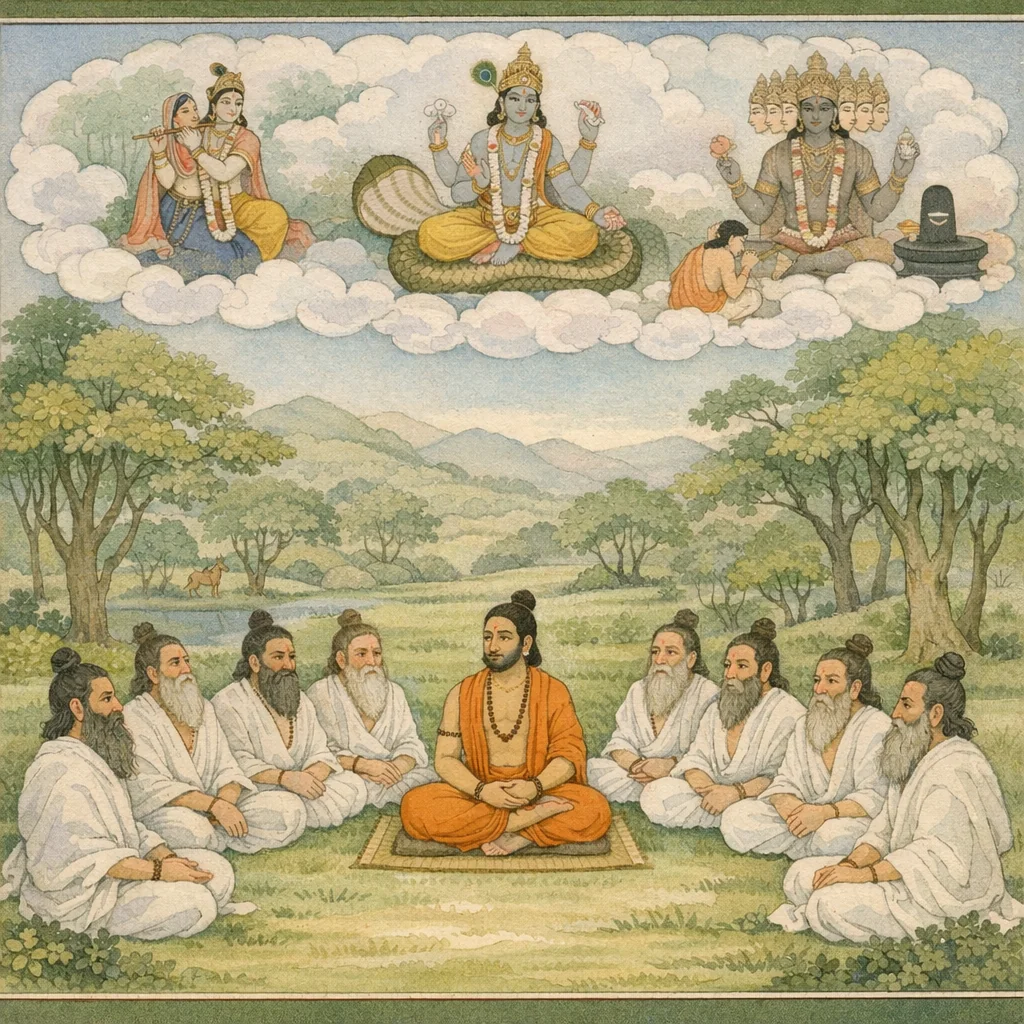
Adhyaya 1
Means to Liberation: Supremacy of Hari, Proper Salutations, and Purāṇic Authority
The chapter begins with a maṅgalācaraṇa and a poetic vision of Kṛṣṇa’s many-sided revelation, then shifts to the Naimiṣāraṇya setting where celibate sages led by Śaunaka seek the means to attain the four puruṣārthas—especially unwavering devotion to Hari and the completion of threefold karma. They approach Sūta at Siddhāśrama, asking how Viṣṇu is pleased and what decisive knowledge leads to liberation (mokṣa). Sūta explains the proper order of salutations: Viṣṇu as the sole supreme reality; Śrī, Vāyu, and Bhāratī as subordinate yet venerable supports; and Vyāsa honored last as the author and, in function, non-different from Hari. The discourse warns against sectarian misworship and clarifies that Vāyu’s emblem should be integrated as a locus for Hari, not treated as an independent deity. It then classifies the Purāṇas by guṇa, highlighting Bhāgavata, Viṣṇu, and Garuḍa as especially sāttvika and beneficial in Kali-yuga, laying the doctrinal ground for the coming Preta-kalpa teachings on rites, post-death states, and liberation-oriented practice.
Shlokas
Verse 1
प्रेतकल्पे मोक्षोपायनिरूपणं नामैकोनपञ्चाशत्तमो ऽध्यायः श्रीगणेशायनमः / श्रीलक्ष्मीनृसिंहाय नमः / श्रीदत्तात्रेयाय नमः / श्रीवेदव्यासाय नमः / श्रीहयग्रीवाय नमः / ॐ मल्लानामशनिर्नृणां नरवरः स्त्रीणां स्मरो मूर्तिमान् गोपानां स्वजनो ऽसतां क्षितिभृतां शास्ता स्वपित्रोः शिशुः / मृत्युर्भोजपतेर्विधातृविहित स्तत्त्वं परं योगिनां वृष्णीनां च पतिः सदैव शुशुभे रङ्गे ऽच्युतः साग्रजः
In the Preta-kalpa, this is the forty-ninth chapter, called “The Explanation of the Means to Liberation.” Salutations to Śrī Gaṇeśa; to Śrī Lakṣmī-Nṛsiṃha; to Śrī Dattātreya; to Śrī Vedavyāsa; and to Śrī Hayagrīva. Om: In the arena, Acyuta (Kṛṣṇa), together with His elder brother, shone forth— to the wrestlers like a thunderbolt; to men the best of men; to women embodied Love; to the cowherds their own kinsman; to the wicked a chastiser; to kings a ruler and disciplinarian; to His parents a child; to Kaṃsa (the Bhoja lord) Death itself; to the yogins the supreme truth; and to the Vṛṣṇis their lord.
Verse 2
नमो नारायणायेति तस्मै वै मूलरूपिणे / नमस्कृत्य प्रवक्ष्यामि नारायणकथामिमाम्
“Namo Nārāyaṇāya”—salutations to Nārāyaṇa, who is indeed the primal, original form. Having bowed in reverence, I shall now expound this sacred narration of Nārāyaṇa.
Verse 3
शौनकाद्या महात्मानो ह्यृषयो ब्रह्मवादिनः / नैमिषाख्ये महापुण्ये तपस्तेपुर्महत्तरम्
The great-souled sages—Śaunaka and others—who were expounders of Brahman, performed very great austerities in the supremely sacred place known as Naimiṣa.
Verse 4
जितेन्द्रिया जिताहाराः संतः सत्यपरायणाः / यजन्तः परया भक्त्या विष्णुमाद्यं जगद्गुरुम्
Self-controlled and moderate in diet, the righteous—steadfast in truth—worship Vishnu, the Primordial One, the Guru of the world, with supreme devotion.
Verse 5
गृणन्तः परमं ब्रह्म जगच्चक्षुर्महौजसः / सर्वशास्त्रार्थतत्त्वज्ञास्तेपुर्नैमिष कानने
Praising the Supreme Brahman—the mighty, radiant Seer of the universe—those sages who knew the true essence of the meanings of all scriptures performed austerities in the forest of Naimiṣa.
Verse 6
यज्ञैर्यज्ञपतिं केचिज्ज्ञानैर्ज्ञानात्मकं परम् / केचित्परमया भक्त्या नारायणमपूजयन्
Some worship the Lord of sacrifices through sacrificial rites; others worship the Supreme, whose nature is pure knowledge, through spiritual knowledge; and some, with the highest devotion, worshipped Nārāyaṇa.
Verse 7
एकदा तु महात्मानः समाजं चक्रुरुत्तमाः / धर्मार्थकाममोक्षाणामुपायं ज्ञातुमिच्छवः
Once, those noble great-souled ones convened an excellent assembly, desiring to know the means to attain dharma, artha, kāma, and mokṣa.
Verse 8
षद्विंशतिसहस्राणि मुनीनामूर्ध्वरेतसाम् / तेषां शिष्यप्रशिष्याणां संख्या वक्तुं न शङ्क्यते
There are twenty-six thousand sages who are celibate ascetics (with their vital energy turned upward). The number of their disciples and grand-disciples cannot be stated.
Verse 9
मुनयो भावितात्मानो मिलितास्ते महोजसः / लोकानुग्रहकर्तारो वीतरागा विमत्सराः
Those munis—self-restrained and inwardly refined—assembled together, mighty in spiritual radiance; benefactors of the worlds, they were free from attachment and devoid of envy.
Verse 10
कथं हरौ मनुष्याणां भक्तिरव्यभिचारिणी / केन सिध्येत्तु सकलं कर्म त्रिविधमात्मनः
How does unwavering, unerring devotion (bhakti) to Hari arise in human beings? And by what means is the entire threefold karma of the self brought to accomplishment?
Verse 11
इत्येवं प्रष्टुमात्मानमुद्यतान्प्रेक्ष्य शौनकः / सांज लिर्वाक्यमाह स्म विनयावनतः सुधीः
Seeing them thus prepared to question him, the wise Śaunaka—bowed in humility, with hands joined in reverence—then spoke these words.
Verse 12
शौनक उवाच / आस्ते सिद्धाश्रमे पुण्ये सूतः पौराणिकोत्तमः / स एतदखिलं वेत्ति व्यासशिष्यो यतीश्वरः
Śaunaka said: In the holy Siddhāśrama dwells Sūta, foremost among the narrators of the Purāṇas. He knows all of this in its entirety—he is Vyāsa’s disciple and a lord among ascetics.
Verse 13
तस्मात्तमेव पृच्छाम इत्येवं शौनको मुनिः / अथ ते ऋषयो जग्मुः पुण्यं सिद्धाश्रमं ततः
Therefore, we shall question him alone—thus spoke the sage Śaunaka. Then those ṛṣis set out from there and went to the holy Siddhāśrama.
Verse 14
पप्रच्छुस्ते सुखासीनं नैमिषारण्यवासिनः / ऋषय ऊचुः / वयं त्वतिथयः प्राप्तास्त्वातिथेयोसि सुव्रत
The sages dwelling in Naimiṣāraṇya questioned you as you sat in ease. The ṛṣis said: “We have come as your guests; O you of noble vows, you are the host who should receive the guest.”
Verse 15
स्नानदानोपचारेण पूजयित्वा यथाविधि / केन विष्णुः प्रसन्नः स्यात्स कथं पूज्यते नरैः
Having worshipped Him properly according to rule, with ritual services such as sacred bathing and gifts—by what means does Viṣṇu become pleased, and how is He to be worshipped by human beings?
Verse 16
मुक्तिसाधनभूतं च ब्रूहि तत्त्वविनिर्णयम् / सूत उवाच / शृणुध्वमृष्यः सर्वे हरिं तत्त्वविनिर्णयम्
“Explain also the decisive knowledge of reality, which serves as the means to liberation.” Sūta said: “O sages, all of you listen to Hari’s determination of the truth.”
Verse 17
नत्वा विष्णुं श्रियं वायुं भारतीं शेषसंज्ञकम् / द्वैपायनं गुरुं कृष्णं प्रवक्ष्यामि यथामति
Having bowed to Viṣṇu, to Śrī (Lakṣmī), to Vāyu, to Bhāratī (Sarasvatī), and to the one known as Śeṣa, and also to the sage Dvaipāyana (Vyāsa) and to my teacher Kṛṣṇa, I shall now expound to the best of my understanding.
Verse 18
नास्ति नारायणसमं न भूतं न भविष्यति / एतेन सत्यवाक्येन सर्वार्थान्साधयाम्यहम्
None is equal to Nārāyaṇa—neither in the past nor in the future. By the power of this truthful declaration, I accomplish all aims.
Verse 19
शौनक उवाच / किमर्थं नमनं विष्णोर्ग्रन्थादौ मुनिसत्तम / कर्तव्यं ब्रूहि मे ब्रह्मन्कृपया मम सुव्रत
Śaunaka said: “O best of sages, for what reason should one offer obeisance to Viṣṇu at the beginning of a treatise? O revered Brahman, please tell me—out of compassion—O you of excellent vows.”
Verse 20
ततः श्रियं ततो वायुं भारतीं च ततः परम् / अन्ते व्यासं किमर्थं च त्वं नमस्कृतवानसि / सूतसूत महाभाग ब्रूहि कारणमत्र च
“First you bowed to Śrī, then to Vāyu, then to Bhāratī (Sarasvatī), and thereafter (others). But why did you offer obeisance to Vyāsa at the end? O noble son of a Sūta, please tell the reason for this as well.”
Verse 21
सूत उवाच / आदौ वन्द्यः सर्ववेदैकवेद्यो वेदे शास्त्रे सेतिहासे पुराणे / सत्तां प्रायो विष्णुरेवैक एव प्रकाशते ऽतो नम्य एको हरिर्हि
Sūta said: “In the beginning, the One worthy of reverence—known through all the Vedas alone—is declared in the Veda, in the śāstras, in the Itihāsas, and in the Purāṇas. Indeed, as the supreme Reality, Viṣṇu alone is chiefly revealed; therefore the One Hari alone is to be bowed to.”
Verse 22
सर्वत्र मुख्यस्त्वधिकोन्यतोपि स एव नम्यो न च शङ्कराद्याः / नमन्ति ये ऽविनयाच्छङ्करं तु विनायकं चण्डिकां रेणुकां च
He alone is everywhere the Supreme—higher than all others—and He alone is truly worthy of reverent bowing, not Śaṅkara and the other deities. Those who, through lack of proper discernment and humility, bow instead to Śaṅkara, to Vināyaka, to Caṇḍikā, and to Reṇukā (as the highest) fail to recognize the ultimate Lord.
Verse 23
तथा सूर्यं भैरवं मातारश्व तथा वाणीं गिरिजां वै श्रियं च / सर्वेपि ते वैष्णवा नैव लोके न तद्भक्ता वेति चार्या वदन्ति
Likewise, those who worship the Sun, Bhairava, Mātariśvan (Vāyu), Vāṇī (Sarasvatī), Girijā (Pārvatī), and Śrī (Lakṣmī)—in this world, all of them are indeed Vaiṣṇavas; the teachers declare that they are not ‘non-devotees’ of Him.
Verse 24
न पार्थिक्यान्नमनं कार्यमेव प्रीणन्ति नैता देवताः पूजनेन / पूजां गृहीत्वा देवताश्चैव सर्वाः किञ्चिद्दत्वा फलदानेन तांश्च
These deities are not truly pleased by worldly distinctions or by mere formal bowing, nor are they satisfied by worship alone. Having accepted the offering of worship, all the deities in turn grant some result, bestowing fruits according to what is offered and what is done.
Verse 25
संतर्प्य तुष्टैः स्वमनोनु सारात्तैः कारितां काम्यपूजां तथैव / निवेदयित्वा परदेवतायां विष्णौ हरौ श्रीपुरुषादिवन्द्ये
Having satisfied and gladdened the devoted according to one’s own intent, one should likewise perform the desired (kāmya) worship as they enjoin. Then, offering it to the Supreme Deity—Viṣṇu, Hari—venerable as Śrī-Puruṣa and the primal Lord, one should dedicate it wholly to Him.
Verse 26
इहापरत्रापि सुखेतराणि दास्यन्ति पश्चादधरं वै तमश्च / अतो ह्येते नैव पूज्या न नम्या मोक्षेच्छुभिर्ब्राह्मणाद्यैर्द्विजेन्द्र
Here and hereafter they bestow not happiness but suffering, and afterwards they lead one down into the lower darkness. Therefore, O best of the twice-born, seekers of liberation—Brahmins and others—should neither worship them nor bow to them.
Verse 27
तथैव सर्वाश्रमिभिश्च नित्यं महाविपत्तावपि विप्रवर्याः / श्रीकाम्य या ये तु भजन्ति नित्यं श्रीब्रह्मरुद्रेद्रयमादिदेवान्
Likewise, O best of Brahmins, people of all the āśramas should worship regularly, even in times of great calamity. But those who, desiring prosperity, worship daily the primeval deities—Brahmā, Rudra (Śiva), Indra, Yama, and others—attain the auspiciousness they seek.
Verse 28
इहेव भुञ्जन्ति महच्च दुः खं महापदः कुष्ठभगन्दरादीन् / नमन्ति ये ऽवैष्णवान्ब्रह्मरुद्रवायु प्रतीकान्नैव ते विष्णुभक्ताः
Even here, in this very life, they suffer intense misery—great calamities such as leprosy (kuṣṭha), fistula (bhagandara), and other severe diseases. Those who bow to non-Vaiṣṇavas, taking symbols or representations of Brahmā, Rudra, or Vāyu as their refuge, are not in truth devotees of Viṣṇu.
Verse 29
अभिप्रायं त्वत्र वक्ष्ये मुनीन्द्राः परं गोप्यं हृदि धार्यं हि तद्धि / वायोः प्रतीकं पूज्यमेवेह विप्रा न ब्रह्मरुद्रादिप्रतीकमेव
O best of sages, I shall declare here the intended meaning—this is supremely secret and must be held within the heart. Here, O learned brāhmaṇas, it is the emblem of Vāyu, the Wind-god, that is to be worshipped, and not merely the emblems of Brahmā, Rudra, and the others.
Verse 30
पूजाकाले देवदेवस्य विष्णोर्वायोः प्रतीकं योग्यभागे निधाय / अन्तर्गतं तस्य वायोर्हरिं च लक्ष्मीपतिं पूजयित्वा हि सम्यक्
At the time of worship, having placed in the proper spot a symbol of Vāyu for Lord Viṣṇu, the God of gods, one should then duly worship Hari—the Lord of Lakṣmī—who abides within that Vāyu.
Verse 31
पश्चाद्वायोः सुप्रतीकं च सम्यङ् निर्माल्यशेषेण हरेः समर्चयेत् / पृथक्च स्रग्धूपविलेपनादिपूजां प्रकुर्वन्ति च ये विमूढः
Afterwards, one should properly worship Vāyu’s auspicious emblem as well, using the remaining sacred offerings from Hari’s worship. But those deluded people who perform separate worship with garlands, incense, unguents, and the like, as though independent of Hari, are misguided.
Verse 32
तेषां दुः खमिह लोके परत्र भविष्यते नात्र विचार्यमस्ति / प्रायश्चित्तं स्वस्ति विप्राः कथञ्चित्तत्कुर्वन्तु स्मरणं नाम विष्णोः
For such people, suffering will arise in this world and in the next—there is no doubt about it. Therefore, O brāhmaṇas, let there be well-being: somehow let them undertake expiation, and above all the remembrance of the Name of Viṣṇu.
Verse 33
पाषण्डरुद्रादिकसं प्रतिष्ठितान्हरेर्वायोः शङ्करस्य प्रतीकान् / नमन्ति ये फलबुद्ध्या विभूढास्तेषां फलं शाश्वतं दुः खमेव
Those deluded people who, seeking rewards, bow to the false emblems and images of Hari, Vāyu, and Śaṅkara set up by heretical sectarians—for them, the result is only everlasting sorrow.
Verse 34
वायोः प्रतीकं यदि विप्रवर्यैः प्रतिष्ठितं चेन्नमनं हि कार्यम् / नैवेद्यशेषेण हरेश्च विष्णोः पूजा कृता चेन्न हि दोषलेशः
If an emblem (pratīka) of Vāyu has been duly installed by eminent brāhmaṇas, then offering reverent salutation to it is indeed proper. And if worship of Hari—Lord Viṣṇu—has been performed using the remnants of the food-offering (naivedya), there is not even the slightest fault in that.
Verse 35
गुरुर्हि मुख्यो हनुमज्जनिर्महान्रामाङ्घ्रिभक्तो हनुमान्सदैव / एवं विदित्वा परमं हरिं च पुत्रं पुनर्मुख्यदेवस्य वायोः
Indeed, Hanuman—born of the mighty Vāyu—is the foremost guru, ever devoted to the feet of Rama. Knowing thus the Supreme Hari, and again knowing that Hanuman is the son of Vāyu, the chief among the gods, one should honor him accordingly.
Verse 37
नमस्कारो नान्यथा विप्रवर्या आधीयतां हृदि सर्वै रहस्यमम् / ये वैष्णवा वैष्ण वदासभृत्याः सर्वेपि ते सर्वदा विष्णुमेव // गर्प्३,१।३६ / नमन्ति ये वै प्रतिपादयन्ति तथैव पुण्यानि च सात्त्विकानि / नमन्ति ये वासुदेवं हरिं च सम्यक् स्वशक्त्या प्रतिपादयन्ति
O best of brāhmaṇas, understand this secret and hold it in your heart: true reverence (namaskāra) is none other than this—those who are Vaiṣṇavas, devoted servants established in Vaiṣṇava conduct, are always fixed upon Viṣṇu alone. Those who bow in worship and also teach and uphold pure, sāttvika, meritorious deeds—those who, according to their capacity, properly bow to and expound Vāsudeva, Hari—truly offer the right kind of homage.
Verse 38
प्रवृत्तिमार्गेण न पूजयन्ति ह्यापत्काले परदैवं तदन्यम् / ते वैष्णवा वैष्णवदासभृत्या अन्ये च सर्वे ऽवैष्णवमात्रकाः स्मृताः
Those who, even while living the life of worldly engagement (pravṛtti), do not worship any other deity as supreme—especially in times of distress—are known as Vaiṣṇavas, along with those who serve the servants of Vaiṣṇavas. All others are remembered as merely non‑Vaiṣṇavas.
Verse 39
उपक्रमैरुपसंहारस्य लिङ्गैर्हरिं गुरुं ह्यन्तरेणैव यान्ति / तानेवाहुः सत्पुराणानि विप्राः कलौ युगे नाभ्यसूयन्ति सर्वे
Those scriptures that, by their opening statements, concluding sections, and defining marks, lead one solely to Hari—the supreme Guru—are indeed called the true Purāṇas by learned brāhmaṇas; and in the Kali age, not all people disparage them.
Verse 40
यतो हितान्ये प्रतिपादयन्ति प्रवृत्तिधर्मान्स्वस्ववर्णानुरूपान् / अतो ह्यसूयन्ति सदा विमूढाः कलौ हि विप्राः प्रचुरा हि तेपि
Because those who benefit society teach the active duties (pravṛtti-dharmas) suited to each person’s own varṇa, the deluded in Kali-yuga continually resent them; for in Kali-yuga—even among those called “brāhmaṇas”—such resentful people are indeed many.
Verse 41
न चास्ति विष्णोः सदृशं च दैवतं न चास्ति वायोः सदृशो गुरुश्च / न चास्ति तीर्थं सदृशं विष्णुपद्याः न विष्णुभक्तेन समोस्ति भक्तः
There is no deity equal to Viṣṇu; there is no guru equal to Vāyu. There is no sacred ford (tīrtha) equal to Viṣṇu’s Foot—the Gaṅgā—and among devotees none is equal to a devotee of Viṣṇu.
Verse 42
अन्यानि विष्णोः प्रतिपादकानि सर्वाणि ते सात्त्विकानीति चाहुः / श्राव्याणि तान्येव मनुष्यलोके श्राव्याणि नान्यानि च दुः खदानि
They say that all other teachings which expound Lord Viṣṇu are sāttvika in nature. In the human world, only those are fit to be heard; other discourses should not be listened to, for they bring sorrow.
Verse 43
कलौ युगे सर्व पुराणमध्ये त्रीण्येव मुख्यानि हरिप्रियाणि / मुख्यं पुराणं हि कलौ नृणां च श्रेयस्करं भागवतं पुराणम्
In the Kali age, among all the Purāṇas, only three are regarded as foremost and dear to Hari. And among them, for people in Kali-yuga, the Bhāgavata Purāṇa is indeed the principal Purāṇa, bringing the highest welfare.
Verse 44
पूर्वं हि सृष्टिः प्रतिपाद्यते त्र यतो ह्यतो भागवतं परं स्मृतम् / यस्मिन्पुराणे कथयन्ति सृष्टिं ह्यादौ विष्णोर्ब्रह्मरुद्रादिकानाम्
Here, creation is first expounded; therefore this teaching is remembered as supremely bhāgavata. In this Purāṇa they narrate creation from the very beginning—starting with Viṣṇu, and then Brahmā, Rudra, and the other divine beings.
Verse 45
नानार्थमेवं कथयन्ति विप्र नीचोच्चरूपं ज्ञानमाहुर्महान्तः / तेनैव सिद्धं प्रवदन्ति सर्वं ह्यतः परं भागवतं पुराणम्
O brāhmaṇa, they expound thus with many intended meanings. The great sages declare that knowledge has forms both lower and higher. By that very knowledge all things are said to be established and proven; therefore, beyond all stands the Bhāgavata Purāṇa as the supreme purāṇic teaching.
Verse 46
ततः परं विष्णुपुराणमाहुस्ततः परं गारुडसंज्ञकं च / त्रीण्येव मुख्या नि कलौ नृणां तु तथा विशेषो गारुडे किञ्चिदस्ति
After that, they declare the Viṣṇu Purāṇa; and after that, the one known as the Gāruḍa (Garuda Purāṇa). In the Kali age, for human beings these three alone are regarded as foremost—and in the Garuḍa there is also a certain special distinction.
Verse 47
शृणुध्वं वै तं विशेषं च विप्रास्त्र्यंशैर्युक्तं गारुडाख्यं पुराणम् / आद्यांशं वै कर्मकाण्डं वदन्ति द्वितीयांशं धर्मकाण्डं तमाहुः
“O Brāhmaṇas, listen to this distinctive teaching: the Purāṇa known as the Garuḍa Purāṇa is arranged in three parts. They declare its first portion to be the karma-kāṇḍa, the section on rites and actions, and its second portion to be the dharma-kāṇḍa, the section on dharma (righteous duty and sacred law).”
Verse 48
तृतीयांशं ब्रह्मकाण्डं वदन्ति तेषां मध्ये त्वन्तिमोयं वरिष्ठः / तृतीयांशश्रवणात्पुण्यमाहुस्तुल्यं पुण्यं भागवतस्य विप्राः
They call the third portion the Brahma-kāṇḍa; and among those parts, this concluding section is the most excellent. The learned brāhmaṇas declare that merely hearing this third portion yields merit equal to the merit of hearing the Bhāgavata Purāṇa.
Verse 49
तृतीयांशे पठिते वेदतुल्यं फलं भवेन्नात्र विचार्यमस्ति / तृतीयांशश्रवणादेव विप्राः फलं प्रोक्तं पठतोप्यर्थमेवम्
When one-third of this text is recited, the resulting merit becomes equal to that of the Vedas—there is no need for doubt about this. O brāhmaṇas, it is declared that even by merely hearing one-third, the same fruit is obtained, just as by reciting it.
Verse 50
तृतीयांशश्रवणादर्थतश्च पुण्यं चाहुः पठतो वै दशांशम् / ततो वरं मत्स्यपुराणमाहुस्ततो वरं कूर्मपूराणमाहुः
They say that hearing even a third of it, with understanding of its meaning, brings merit; and for one who recites it, indeed a tenth part of that merit is gained. Yet they proclaim the Matsya Purāṇa to be superior, and the Kūrma Purāṇa superior even to that.
Verse 51
तथैव वै वायुपुराणमाहुस्त्रीण्येव चाहुः सात्त्विकानीति लोके / तत्रापि किञ्चिद्वेदितव्यं भवेच्च पुराणषट्के सत्त्वरूपे मुनीन्द्राः
Likewise, they declare the Vāyu Purāṇa as well; and in the world it is said that there are precisely three sāttvika Purāṇas. Even among them, O best of sages, something further is to be understood regarding the sixfold set of Purāṇas that are of the nature of sattva.
Verse 52
सत्त्वाधमे मात्स्यकौर्मे तथाहुर्वायु चाहुः सात्त्विकं मध्यमं च / विष्णोः पुराणं भागवतं पुराणं सत्त्वोत्तमं गारुडं चाहुरार्याः
They say that the Matsya and Kūrma Purāṇas are of the lower grade within sattva; the Vāyu Purāṇa is said to be sāttvika of the middle grade. The Viṣṇu Purāṇa and the Bhāgavata Purāṇa are held to be the highest in sattva; and the noble ones also declare the Garuḍa Purāṇa to be sattva-uttama, supreme in purity.
Verse 53
स्कान्दं पाद्मं वामनं वै वराहं तथाग्रेयं भविष्यं पर्वसृष्टौ / एतान्याहू राजसानीति विप्रास्तत्रैकदेशः सात्त्विकस्तामसश्च
The Skanda, Padma, Vāmana, and Varāha Purāṇas, as well as the Agni, Bhaviṣya, and the Parva-sṛṣṭi—brahmins declare these to be predominantly rājasa. Yet within them, certain portions are also sāttvika and tāmasa.
Verse 54
रजः प्राचुर्याद्राजसानीति च हुः श्राव्याणि नैतानि मुमुक्षुभिः सदा / तेषां मध्ये सात्त्विकांशाश्च संति तेषां श्रुतेर्गारुडीयं फलं च
Because rajas predominates, they are called ‘rājasa’. Seekers of liberation should not always listen to such teachings. Yet within them there are also sāttvika portions; and by hearing those, the Garuḍa Purāṇa bestows its beneficial fruit.
Verse 55
ब्रह्माण्डलैङ्ग्ये ब्रह्मवैवर्तकं वै मार्कंण्डेयं ब्राह्ममादित्यकं च / एतान्या हुस्तामसानीति विप्रास्तत्रैकदेशः सात्त्विको राजसश्च
The Brahmāṇḍa and Liṅga, the Brahma-vaivartaka, the Mārkaṇḍeya, the Brāhma, and the Āditya—learned brāhmaṇas declare these to be predominantly tāmasic Purāṇas; yet within them, some portions are sāttvic and some are rājasik as well.
Verse 56
श्राव्याणि नैतानि मनुष्यलोके तत्त्वेच्छुभिस्तामसानीत्यतो हि / तेषु स्थिताः सात्त्विकांशा मुनीन्द्रास्तेषां श्रुतिर्गारुडैकाङ्घ्रितुल्या
These matters are not to be recited in the human world to seekers of truth, for they are tamasic in nature. Therefore, among them abide great sages endowed with a share of sattva; and their authoritative hearing (scriptural testimony) is said to be comparable to Garuḍa’s single foot—unyielding and decisive.
Verse 57
अल्पान्युपपुराणानि वदन्त्यष्टादशानि च / विष्णुधर्मोतरं चैव तन्त्रं भागवतं तथा
They say the minor Purāṇas (Upapurāṇas) are few, and that they are eighteen in number—such as the Viṣṇudharmottara, the Tantra, and the Bhāgavata as well.
Verse 58
तत्त्वसारं नारसिंहं वायुप्रोक्तं तथैव च / तथा हंसपुराणं च षडेतानि मुनीश्वराः
“(There are) the Tattvasāra, the Nārasiṃha (text), and likewise that which was taught by Vāyu; and also the Haṃsa Purāṇa—these are six (authoritative works), O lords among sages.”
Verse 59
सात्त्विकान्येव जानीध्वं प्रायशो नात्र संशयः / एतेषां श्रवणादेव गारुडार्धफलं श्रुतम्
Know these to be predominantly sāttvic indeed—of this there is virtually no doubt. It is heard that merely by listening to these, one attains half the merit of the Garuḍa Purāṇa.
Verse 60
भविष्योत्तरनामानं बृहन्नारदमेव च / यमनारदसंवादं लघुनारदमेव च
Also, there are texts known as the Bhaviṣyottara, the Bṛhan-Nārada, the dialogue of Yama and Nārada, and likewise the Laghu-Nārada.
Verse 61
विनायकपुराणं च बृहद्ब्रह्माण्डमेव च / एतानि राजसान्याहुः श्रवणाद्भुक्तरुत्तमा
The Vināyaka Purāṇa and the great Brahmāṇḍa Purāṇa as well—these are said to be rājasa. By hearing them, O best of birds, one attains worldly enjoyment and prosperity.
Verse 62
गारुडात्पादतुल्यं च फलं चाहुर्मनीषिणः / पुराणं भागवतं शैवं नन्दिप्रोक्तं तथैव च
The wise declare that the fruit of merit gained from the Garuḍa Purāṇa is equal to a quarter (a single ‘foot’) of the merit of the Bhāgavata Purāṇa, the Śaiva Purāṇa, and likewise the Purāṇa spoken by Nandin.
Verse 63
पाशुपत्यं रैणुकं च भैरवं च तथैव च / एतानि तामसान्याहुर्हरितत्त्वार्थवेदिनः
The Pāśupata, the Raiṇuka, and likewise the Bhairava—those who truly know the principles and purport of Hari declare these to be tāmasic, born of darkness and ignorance.
Verse 64
एतेषां श्रवणाद्विप्रागारुडाङ्घ्यर्ध्मेव च / सर्वेष्वपि पुराणेषु श्रेष्ठं भागवतं स्मृतम्
O Brahmins, by hearing these teachings—and likewise even by hearing but half of the Garuḍa (Purāṇa) at the Lord’s feet—it is remembered that among all the Purāṇas, the Bhāgavata is the supreme (śreṣṭha).
Verse 65
वेदैस्तुल्य सम पाठे श्रवणे च तदर्धकम् / अर्थतः श्रवणे चास्य पुण्यं दशगुणं स्मृतम्
It is remembered that reciting this evenly and correctly bears merit equal to the Vedas; merely hearing it yields half that merit. But hearing it with understanding of its meaning is said to grant tenfold merit.
Verse 66
वक्तुः स्याद्द्विगुणं पुण्यं व्याख्यातुश्च तथाधिकम् / अनन्तवेदैःसाम्यमाहुर्महान्तः भारान्महत्त्वाद्भारतस्यापि विप्राः
The merit of the reciter is said to be twice that of one who merely hears, and the merit of the expositor who explains it is greater still. The great sages declare that (the Mahābhārata) is equal to the endless Vedas; and learned brāhmaṇas say it is called “Bhārata” because of the weighty greatness of its majesty.
Verse 67
वेदोभ्योस्य त्वर्थतश्चाधिकत्वं वदन्ति बै विष्णुरहस्यवेदिनः
Those who know the secret doctrine of Viṣṇu declare that, in its true purport, this teaching is even superior to the Vedas.
Verse 68
तत्र श्रेष्ठां गीतिकामाहुरार्यास्तथैव विष्णोर्नामसाहस्रक च / तयोस्तत्र श्रवणाद्भारतस्य दशाधिकं फलमाहुर्महान्तः
There, the noble ones declare the most excellent sacred song to be the Gītā, and likewise the Viṣṇu-nāma-sahasra, the thousand names of Viṣṇu. The great sages say that merely hearing those two yields a fruit tenfold greater than hearing the Bhārata (Mahābhārata).
Verse 69
दैत्याः सर्व विप्रकुलेषु भूत्वा कृते युगे भारते षट्सहस्र्याम् / निष्कास्य कांश्चिन्नवनिर्मितानां निवेशनं तत्र कुर्वन्ति नित्यम्
In the Kṛta Yuga, within the land of Bhārata, the Daityas, taking birth in various brāhmaṇa lineages, drove some people out from their newly built homes and continually made their own dwelling there.
Verse 70
मत्वा हरिं भगवान्व्यासरूपी चक्रे तदा भागवतं पुराणम् / तथा समाख्याय च वैष्णवं तत्ततः परं गारुडाख्यं स चक्रे
Recognizing Hari (Viṣṇu) as the Supreme, the Blessed Lord—assuming the form of Vyāsa—then composed the Bhāgavata Purāṇa. Likewise, having expounded the Vaiṣṇava teaching, he thereafter composed the Purāṇa known as the Gāruḍa.
Verse 71
अतो हि गारुडं मुख्यं पुराणं शास्त्रसंमतम् / गारुडेन समं नास्ति विष्णुधर्मप्रदर्शने
Therefore the Garuḍa Purāṇa is the foremost Purāṇa, affirmed by the śāstras; in revealing the dharma of Viṣṇu, none is equal to the Garuḍa (Purāṇa).
Verse 72
यथा सुराणां प्रवरो जनार्दनो यथायुधानां प्रवरः सुदर्शनम् / यथाश्वमेधः प्रवरः क्रतूनां छिन्नेषु भक्तेषु तथैव रुद्रः
Just as Janārdana is foremost among the gods, and Sudarśana foremost among weapons, and the Aśvamedha foremost among sacrifices—so too Rudra is foremost when devotees are cut off from their supports and broken by adversity.
Verse 73
नदीषु गङ्गा जलजेषु पद्ममच्छिन्नभक्तेषु तथैव वायुः / तथा पुराणेषु च गारुडं च मुख्यं तदाहुर्हरितत्त्वदर्शने
Among rivers, the Gaṅgā is foremost; among water-born things, the lotus is foremost; among unwavering devotees, Vāyu is likewise foremost. In the same way, among the Purāṇas, the Gāruḍa Purāṇa is declared the chief for understanding the truth of Hari (Viṣṇu).
Verse 74
गारुडाख्यपुराणे तु प्रतिपाद्यो हरिः स्मृतः / अतो हरिर्नमस्कार्यो गम्यो योग्यो हरिः स्मृतः
In the Purāṇa known as the Gāruḍa, Hari is remembered as the One to be taught and realized. Therefore Hari alone is to be saluted (namaskāra), approached as the goal, and united with through yoga—thus is Hari remembered.
Verse 75
भाग्यात्मकत्वाच्छ्रीदेव्या नमनं नदनु स्मृतम् / परो नरोत्तमो वा स साधकेशोपि च स्मृतः
Because Śrī Devī is of the very nature of auspicious fortune, it is taught that bowing to her is itself a meritorious gift-offering. Such a person is remembered as supreme—indeed the best among men—and is regarded as a foremost sādhaka.
Verse 76
अतो नम्यो वायुरपि पुराणादौ द्विजोत्तमाः / भारती वाक्यरूपत्वान्नम्या वायोरनन्तरम्
Therefore, O best of the twice-born, at the very beginning of this Purāṇa Vāyu also is to be saluted; and Bhāratī (Sarasvatī), being the very form of speech, is to be revered immediately after Vāyu.
Verse 77
उपसाधको नरः प्रोक्तो यतोतस्तदनन्तरम् / नम्य इत्यच्यते सद्भिस्तारतम्येन सर्वदा
Up to that point a man is called an upasādhaka, one who serves and attends upon; immediately after that, the virtuous always refer to him as namya—worthy of reverent salutation—according to the gradation of merit.
Verse 78
अतो व्यासं नमस्कुर्याद्ग्रन्थकर्तृत्वहेतुतः / शौनक उवाच / व्यासस्य नमनं ह्यन्ते कथं कार्यं महात्मनः
Therefore one should bow to Vyāsa, for he is the cause—the author—of this sacred treatise. Śaunaka said: “At the conclusion, how should the salutation to the great-souled Vyāsa be properly performed?”
Verse 79
अन्ते च वन्दने तस्य कारणं ब्रूहि सुव्रत / सूत उवाच / विष्णोरनन्तरं व्यासनमनं मुख्यमेव हि
And at the end, during the act of salutation to him, tell me the reason, O you of excellent vows. Sūta said: Immediately after saluting Viṣṇu, bowing to Vyāsa is indeed the foremost practice.
Verse 80
हरिरेव यतो व्यासो वाच्यचक्रस्वरूपकः / व्यासो नैव समत्वेन प्रोक्तो भगवतो हरेः
Since Vyāsa is truly Hari Himself—embodying the very wheel of sacred discourse—Vyāsa has never been proclaimed as merely equal to the Blessed Lord Hari.
Verse 81
तत्रापि कारणं वक्ष्ये सादरेण मुनीश्वराः / व्यासस्तु कश्चन ऋषिः पुराणे तामसे स्मृतः
There too, O foremost of sages, I shall respectfully state the reason. In the tradition of the Tāmasa Purāṇa, a certain ṛṣi named Vyāsa is mentioned.
Verse 82
प्रविशन्ति ह्यन्धतम इति त्वन्ते नमस्कृतः
“Indeed, they enter the blinding darkness”—so it is said; therefore, at the end, one should bow with reverent homage.
Verse 83
यदिदं परमं गोप्यं हृदि धार्यं न संशयः / पराणां नम्यमेवोक्तं प्रतिपाद्यं यतोत्र हि
This teaching, supremely confidential, should be held within the heart—without any doubt. It is declared worthy of reverence by all; therefore it must be clearly taught and established here.
Verse 84
समासव्यासभावाद्धि पराणां तत्प्रतीयते / वास्तवं तं न जानीयुरुपजीव्यो यतो हरिः
Because of concise and expanded modes of expression, others understand that truth in differing ways; yet they do not know its real essence—since Hari (Viṣṇu) is the ultimate support to be relied upon.
Verse 85
हरिर्व्यासस्त्वेक एव व्यासस्तु हरिवत्स्मृतः / उपजीव्यतदीशत्वे तयोरेव न संशयः
Hari and Vyāsa are, in truth, one and the same; and Vyāsa is remembered as being like Hari. Concerning the relation of the dependent and the Lord, there is no doubt—this applies to them alone.
Verse 86
ईशकोटिप्रविष्टत्वाच्छ्रियः स्वामित्वमीरितम् / त्रयाणामुपजीव्यत्वात्सेव्यत्वात्स्वामिता स्मृताः
Because Śrī (Lakṣmī) has entered into the very core of the Lord, her lordship is declared. And because the three are those by whom others live and whom others must serve, they too are remembered as possessing sovereignty.
Verse 87
वाय्वादीनां त्रयाणां च सेव्यत्वात्सेव्यता स्मृता / भूभारहरणे विष्णोः प्रधानाङ्गं हि मारुतिः
Because the three beginning with Vāyu are worthy of reverent service, their worship is declared proper. And in Viṣṇu’s work of removing the burden of the earth, Māruti (Hanumān) is indeed His chief instrument—His principal limb, as it were.
Verse 88
वाक्यरूपा भारती तु द्वितीयाङ्गं हि सा स्मृता / तृतीयाङ्ग हरेः शेषो न नम्याः साम्यतो हरेः
Bhāratī (Sarasvatī), whose very form is sacred speech, is remembered as the second limb of Hari. The third limb of Hari is Śeṣa; he is not to be bowed to as an equal of Hari, for his likeness to Hari is only derived and dependent.
Verse 89
प्रतिपाद्या मुख्यतया नम्या एव समीरिताः / अवान्तराश्च वाय्वाद्या न नम्यास्तेन ते स्मृताः
Those to be taught here have been stated as primarily worthy of reverent salutation. The subsidiary ones—beginning with Vāyu and others—are not to be saluted in this context; therefore they are remembered as non-objects of obeisance here.
Verse 90
भीष्मद्रोणादिनामानि भीमादिष्वेव मुख्यतः / वाचकानि यतो नित्यं तन्नम्यास्ते मुनीश्वराः
Because names such as Bhīṣma and Droṇa, in their primary sense, are also appellations applied to Bhīma and others, those lordly sages are ever worthy of reverent salutation.
Verse 91
पराणामेव नम्यत्वं प्रतिपाद्यत्वमेव हि / एतत्सर्वं मयाख्यातं किमन्यच्छ्रोतुमिच्छथ
Indeed, I have explained that one should bow only to the Supreme, and that this alone is what must be taught. All this has been declared by me—what else do you wish to hear?
Frequently Asked Questions
The chapter presents Vyāsa as the author-cause of the treatise and as Hari’s manifestation in the function of sacred discourse; thus, after establishing Viṣṇu’s primacy, saluting Vyāsa at the conclusion seals the transmission lineage and acknowledges the text’s revealed authority without positing a second supreme.
It defines them by textual indicators—opening statements, concluding sections, and defining marks—that direct the reader solely to Hari as the supreme Guru; texts that consistently culminate in Viṣṇu-refuge and Viṣṇu-realization are treated as properly purāṇic in liberative intent.