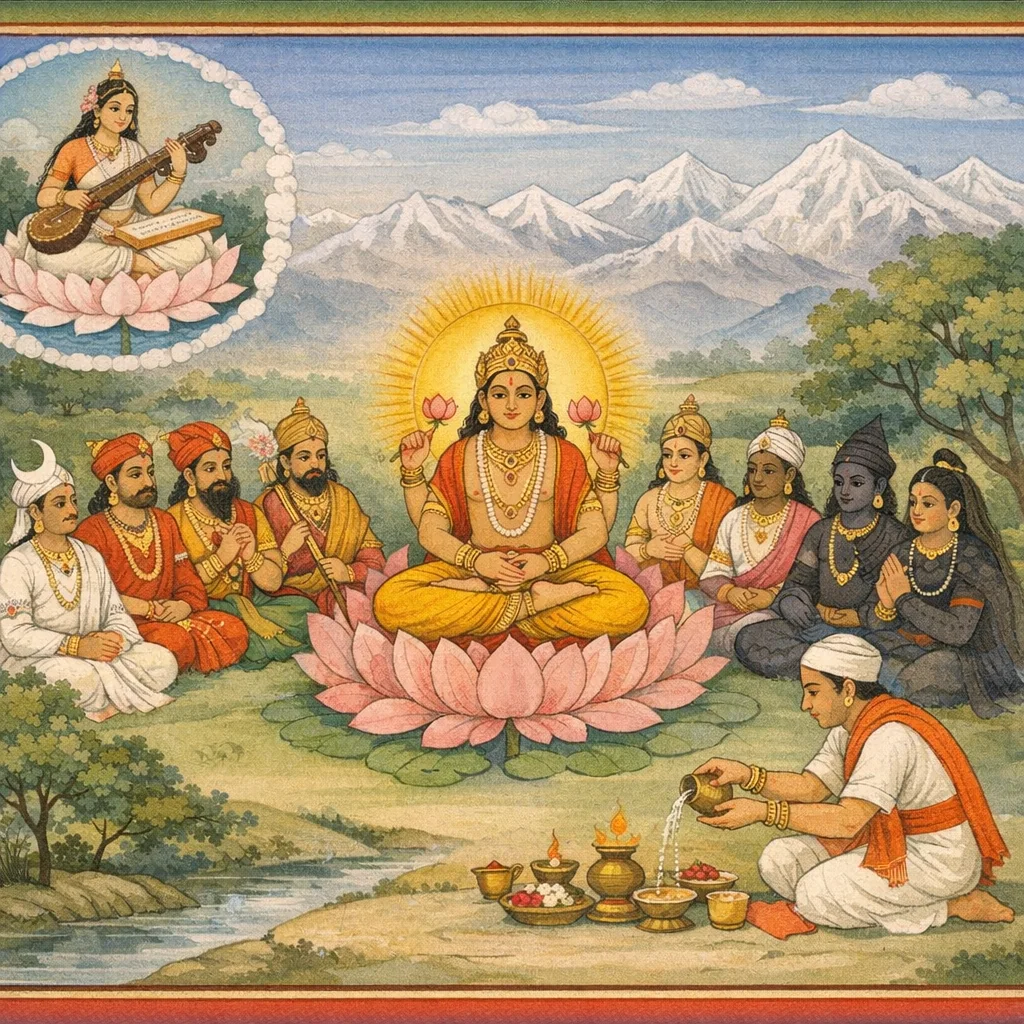
Adhyaya 7
Sūrya–Navagraha Pūjā Upacāra, Śiva–Vaiṣṇava Salutations, and Sarasvatī-Mantra Vidhi
Prompted by Rudra’s request to Vyāsa for the “highest” essence of worship of Sūrya and the devatās, Hari teaches a practice that grants adhikāra in dharma and kāma while remaining directed toward auspicious spiritual ends. The chapter opens with mantra-led salutations to Sūrya upon the solar throne and to the Navagrahas (Soma, Maṅgala, Budha, Bṛhaspati, Śukra, Śanaiścara, Rāhu, Ketu), then sets out the standard pūjā upacāra sequence: seat, invocation, pādya, arghya, ācamanīya, bath, garments, yajñopavīta, fragrance, flowers, incense, lamp, salutations, circumambulation, and dismissal. It then expands into a prescribed chain of obeisances—Śiva’s limbs and five faces, Gaurī, gurus and deities, and finally Viṣṇu/Nārāyaṇa as Vāsudeva with vyūhas, avatāras, attendants, and emblems—ending with the dikpālas and Viṣvaksena. Using these Hari-mantras, the worshipper offers each honor “mantra by mantra,” and the adhyāya turns to Sarasvatī worship (as Viṣṇu-śakti), giving her hrīṃ-based mantra-nyāsa and describing her powers. It concludes with instructions to prepare her lotus-seat and to place the sacred thread (pavitra) for Sarasvatī, Sūrya, and other deities with their respective mantras, setting continuity for the more deity-specific ritual details that follow.
Shlokas
Verse 1
नाम षष्ठो ऽध्यायः रुद्र उवाच / सूर्यादिपूजनं ब्रूहि कृतं स्वायम्भुवादिभिः / भुक्तिमुक्तिप्रदं सारं व्यास ! संक्षेपतः परम्
Rudra said: “O Vyāsa, explain the worship of the Sun and the other deities, as practiced by Svāyambhuva and the rest—its supreme essence, bestowing both worldly enjoyment and liberation—briefly, in its highest form.”
Verse 2
हरिरुवाच / सूर्यादिपूजां वक्ष्यामि धर्ंमकामादिकारिकाम्
Hari (Lord Viṣṇu) said: “I shall explain the worship of Sūrya and the other deities, which grants eligibility and attainment in matters such as dharma and kāma.”
Verse 3
ॐ सूर्यासनाय नमः / ॐ नमः सूर्यमूर्तये / ॐ ह्रां ह्रीं सः सूर्याय नमः / ॐ सोमाय नमः / ॐ मङ्गलाय नमः / ॐ बुधाय नमः ॐ बृहस्पतये नमः / ॐ शुक्राय नमः / ॐ शनैश्चराय नमः / ॐ राहवे नमः / ॐ केतवे नमः / ॐ तेजश्चण्डाय नमः
Om, salutations to the One seated upon the solar throne. Om, salutations to the Sun embodied as a divine form. Om—hrāṃ hrīṃ saḥ—salutations to Sūrya. Om, salutations to Soma (the Moon). Om, salutations to Maṅgala (Mars). Om, salutations to Budha (Mercury). Om, salutations to Bṛhaspati (Jupiter). Om, salutations to Śukra (Venus). Om, salutations to Śanaiścara (Saturn). Om, salutations to Rāhu. Om, salutations to Ketu. Om, salutations to Tejaścaṇḍa, the radiant and fierce One.
Verse 4
आसनावाहनं पाद्यमर्घ्यमाचमनं तथा / स्नानं वस्त्रोपवीतञ्च गन्धपुष्पं च धूपकम्
One offers a seat and invocation (āvāhana), water for washing the feet, arghya, and sipping-water (ācamanīya); also a ceremonial bath, garments and the sacred thread (upavīta); and fragrance, flowers, and incense (dhūpa).
Verse 5
दीपकं च नस्कारं प्रदक्षिणविसर्जने / सूर्यादीनां सदा कुर्यादिति मन्त्रैर्वृषध्वज !
O Vṛṣadhvaja (Śiva), one should always offer the lamp, make reverent salutations, perform circumambulation (pradakṣiṇā), and conclude with the proper ritual dismissal—especially for Sūrya and the other deities—accompanied by mantras.
Verse 6
ॐ ह्रांशिवाय नमः / ॐ ह्रां शिवमूर्तये शिवाय नमः / ॐ ह्रां हृदयाय नमः / ॐ ह्रीं शिरसे स्वाहा / ॐ ह्रूं शिखायै वषट् / ॐ ह्रै कवचाय हुं / ॐ ह्रौं नेत्रत्रयाय वौषट् / ॐ ह्रः अस्त्राय नमः / ॐ ह्रां सद्योजातय नमः / ॐ ह्रीं वामदेवाय नमः / ॐ ह्रूं अघोराय नमः / ॐ ह्रैं तत्पुरुषाय नमः / ॐ ह्रौं ईशानाय नमः / ॐ ह्रीं गौर्यै नमः / ॐ ह्रौं गुरुभ्यो नमः / ॐ ह्रौं इन्द्राय नमः / ॐ ह्रौं चण्डाय नमः / ॐ ह्रां अघोराय नमः / ॐ वासुदेवासनाय नमः / ॐ वासुदवमूर्तये नमः / ॐ अं ॐ नमो भगवते वासुदेवाय नमः / ॐ आं ॐ नमो भगवते सङ्कर्षणाय नमः / ॐ अं ॐ नमो भगवते प्रद्युम्नाय नमः / ॐ अः ॐ नमो भगवते अनिरुद्धाय नमः / ॐ नारायणाय नमः / ॐ तत्सब्द्रह्यणे नमः / ॐ ह्रां विष्णवे नमः / ॐ क्षौं नमो भगवते नरसिंहाय नमः / ॐ भूः ॐ नमो भगवते वराहाय नमः / ॐ कं टं पं शं वैनतेयाय नमः / ॐ जं खं रं सुदर्श नाय नमः / ॐ खं ठं फं षं गदैयौ नमः / ॐ वं लं मं क्षं पाञ्चजन्याय नमः / ॐ घं ढं भं हं श्रियै नमः / ॐ गं डं वं सं पुष्ट्यै नमः / ॐ धं षं वं सं वनमालायै नमः / ॐ सं दं लं श्रीवत्साय नमः / ॐ ठं चं भं यं कौस्तुभाय नमः / ॐ गुरुभ्यो नमः / ॐ इन्द्रादिदिक्पालेभ्यो नमः / ॐ विष्वक्सेनाय नमः
A prescribed sequence of salutations is given: obeisance to Śiva in His forms and limbs (heart, head, crest-lock, armor, three eyes, and weapon), to Śiva’s five faces (Sadyojāta, Vāmadeva, Aghora, Tatpuruṣa, Īśāna), to Gaurī, to the gurus and deities such as Indra and Caṇḍa; then obeisance to Lord Viṣṇu/Nārāyaṇa as Vāsudeva and His vyūhas (Saṅkarṣaṇa, Pradyumna, Aniruddha), as well as His avatāras (Nṛsiṃha, Varāha) and His divine attendants and emblems—Garuḍa (Vainateya), Sudarśana, Gadā, Pāñcajanya, Śrī, Puṣṭi, Vanamālā, Śrīvatsa, Kaustubha—concluding with salutations to the guardians of the directions and to Viṣvaksena.
Verse 7
आसनादीन्हरेरतैर्मन्त्रैर्मन्त्रैर्दद्याद्वृषध्वज ! / विष्णुशक्त्याः सरस्वत्याः पूजां शृणु शुभप्रदाम्
O Vṛṣadhvaja (Śiva), with those mantras devoted to Hari one should offer the seat and the other ritual honors, mantra by mantra. Now hear the auspicious, benefic-bestowing worship of Sarasvatī, the śakti of Viṣṇu.
Verse 8
ॐ ह्रीं सरस्वत्यै नमः / ॐ ह्रां हृदयाय नमः / ॐ ह्रीं शिरसे नमः / ॐ ह्रूं शिखायै नमः / ॐ ह्रैं कवचाय नमः / ॐ ह्रौं नेत्रत्रयाय नमः / ॐ ह्रः अस्त्राय नमः
Om—hrīṃ—salutations to Sarasvatī. Om—hrāṃ—salutations to the Heart. Om—hrīṃ—salutations to the Head. Om—hrūṃ—salutations to the Crown-lock (śikhā). Om—hraiṃ—salutations to the Spiritual Armor (kavaca). Om—hrauṃ—salutations to the Three Eyes. Om—hraḥ—salutations to the Weapon, the mantric missile (astra).
Verse 9
श्रद्धा ऋद्धिः कला मेधा तुष्टिः पुष्टिः प्रभा मतिः / ॐ ह्रीङ्काराद्या नमो ऽन्ताश्च सरस्वत्याश्च शक्तयः
Faith, prosperity, skill, intelligence, contentment, nourishment, radiance, and right understanding—these are the powers (śaktis) of Sarasvatī, beginning with the sacred syllable “Hrīṃ” and ending with “Namo”.
Verse 10
क्षेत्रपालाय नमः / ॐ गुरुभ्यो नमः / ॐ परमगुरुभ्यो नमः
Salutations to Kṣetrapāla, the Guardian of the sacred precinct. Oṃ—salutations to the Gurus. Oṃ—salutations to the Paramagurus, the supreme spiritual preceptors.
Verse 11
पद्मस्थायाः सरस्वत्या आसनाद्यं प्रकल्पयेत् / सूर्यादीनां स्वकैर्प्रन्त्रैः पवित्रारोहणं तथा
One should arrange the seat (āsana) and the related requisites for Sarasvatī seated upon a lotus; and likewise, for Sūrya and the other deities, one should perform the rite of placing the pavitra (sacred thread) using their respective mantras.
Frequently Asked Questions
The chapter lists a standard pūjā progression: āsana and āvāhana, pādya, arghya, ācamanīya, snāna, vastra and yajñopavīta, gandha, puṣpa, dhūpa, dīpa, namaskāra, pradakṣiṇā, and the proper concluding visarjana—performed with mantras, especially for Sūrya and the other deities.
After the general Sūrya–graha salutations and upacāras, Sarasvatī is treated as Viṣṇu’s śakti with a dedicated bīja-centered set of aṅga-mantras (heart, head, śikhā, kavaca, eyes, weapon) and an explicit list of her śaktis (faith, prosperity, skill, intelligence, contentment, nourishment, radiance, right understanding), along with instructions to prepare her lotus-seat.
It acts as a ritual ‘framework’ that sanctifies and safeguards the worship: beginning with Śiva’s forms and pañcavaktra, moving through gurus and deities, and culminating in Nārāyaṇa’s cosmic manifestations and insignia, then dikpālas and Viṣvaksena—thereby situating the specific deity-pūjā within a complete theological and protective mandala.