Adhyaya 37
Gāyatrī-Kalpa: Sandhyā-Japa, Devī-Namaskāra, and Homa for Dharma, Kāma, and Moksha
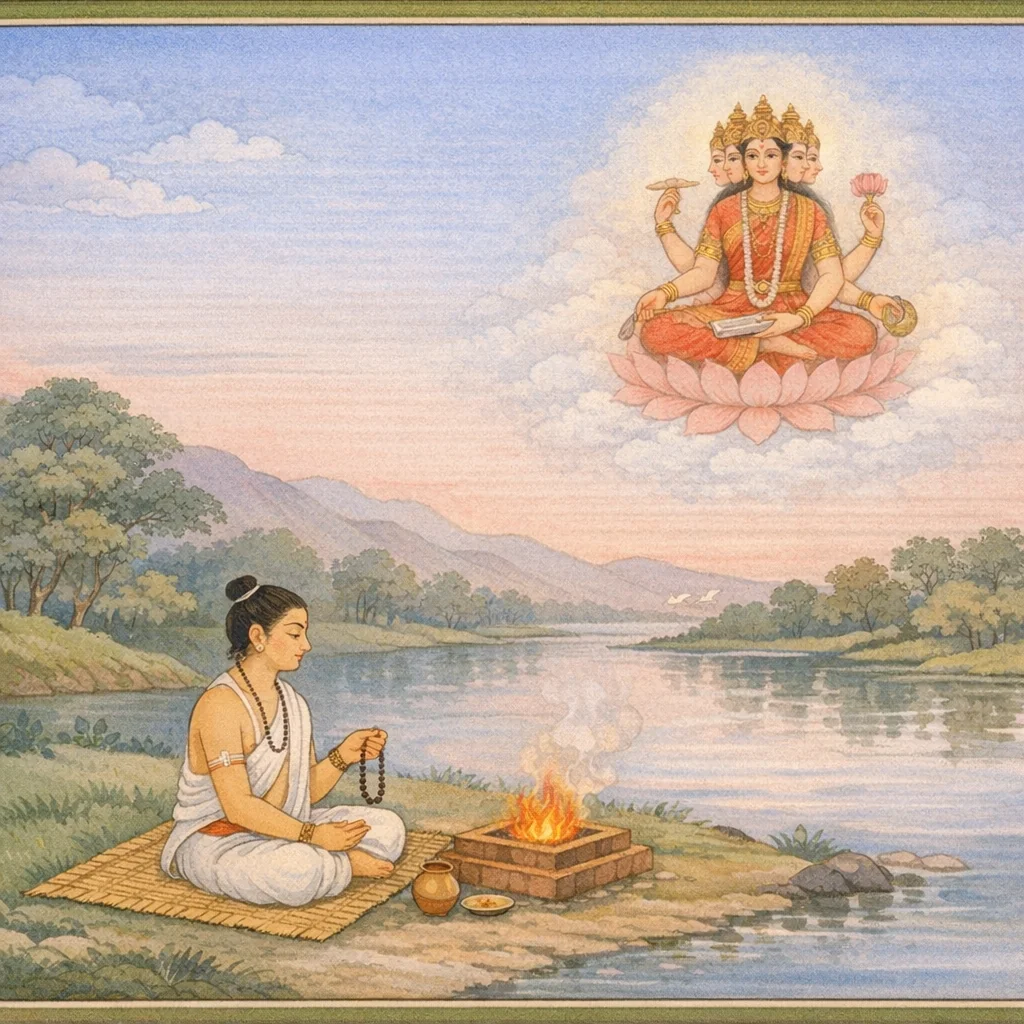
Continuing the Brahma Khanda’s stress on right conduct (ācāra) and mantra-based purification, Hari sets forth a focused Gāyatrī-kalpa: her supremacy, her power to destroy sin, and the counted discipline of japa (108/1008). Daily practice is anchored in the three sandhyās; afterward one performs ācamana and invokes the Goddess as the remover of sins. The invocation expands into a litany joining Bhūr-Bhuvaḥ-Svaḥ with her names and forms—Gāyatrī, Sāvitrī, Sarasvatī, Vedamātṛ, and other epithets—uniting cosmology, devotion, and mantra. Ritual acts follow: homa with samidh and ghee in prescribed counts (including large offerings), worship of an image (sandalwood or gold), and a purashcarana-like completion (100,000 japa with dietary restraint; 20,000 oblations) promising fulfillment of dharma, kāma, and moksha. The chapter ends with a permission formula sending the Goddess forth “as she pleases,” returning from intensive rite to broader dharmic observance in the teachings ahead.
Shlokas
Verse 1
षट्त्रिंशो ऽध्यायः हरिरुवाच / गायत्त्री परमा देवी भुक्तिमुक्तिप्रदा च ताम् / यो जपेत्तस्य पापानिविनश्यन्ति महान्त्यपि
Hari said: “Gāyatrī is the supreme Goddess, bestower of both bhukti (worldly enjoyment) and mukti (liberation). For one who repeats her in japa, even great sins are destroyed.”
Verse 2
गायत्त्रीकल्पमाख्यास्ये भुक्तिमुक्तिप्रदं च तत् / अष्टोत्तरं सहस्रं वा अथवाष्टशतं जपेत्
I shall explain the kalpa, the prescribed procedure of Gāyatrī that bestows both bhukti and mukti. One should repeat it in japa either 1,008 times, or else 108 times.
Verse 3
त्रिसन्ध्यं ब्रह्मलोकीस्याच्छतं जप्त्वा जलं पिबेत् / संध्यायां सर्वपापघ्नीं देवीमावाह्य पूजयेत्
At the three junctions of the day—dawn, noon, and dusk—one should perform Sandhyā worship and become fit for the world of Brahmā; having recited the sacred formula a hundred times, one should sip purifying water (ācamana). At Sandhyā time, invoking the Goddess who destroys all sins, one should worship and honor her.
Verse 4
भूर्भुवः स्वः स्वमन्त्रेण युतां द्वादशनामभिः / गायत्र्यै नमः / सावित्र्यै सरस्वत्यै नमोनमः
With her own mantra—“Bhūr, Bhuvaḥ, Svaḥ”—together with the twelve names: obeisance to Gāyatrī; obeisance again and again to Sāvitrī and to Sarasvatī.
Verse 5
वेदमात्रे च सांकृत्यै ब्रह्माणी कौशिकी क्रमात् / साध्व्यै सर्वार्थसाधिन्यै सहस्राक्ष्यै च भूर्भुवः
In due order one should offer salutations to Vedamātṛ, to Sāṃkṛtyā, to Brahmāṇī, and to Kauśikī; to the Virtuous One, to her who accomplishes all aims, and to the Thousand‑eyed One—the protectress of Bhūr and Bhuvaḥ.
Verse 6
स्वरेवं जुहुया दग्नौ समिदाज्यं हविष्यकम् / अष्टोत्तरसहस्रं वाप्यथवाष्टशन्त घृतम्
In the same prescribed manner, one should offer into the fire of Agni the oblation (havis) of fuel‑sticks (samidh) and ghee (ghṛta). The offering should be made either 1,008 times, or else as 800 offerings of ghee.
Verse 7
धर्मकामादिसिद्ध्यर्थं जुहुयात्सर्वकर्मसु / प्रतिमां चन्दनस्वर्णनिर्मितां प्रतिपूज्य च
For the attainment of dharma, kāma, and other aims, one should perform fire‑oblations (homa) in all rites; and, having duly worshipped, one should also venerate a sacred image (pratimā) fashioned of sandalwood or of gold.
Verse 8
यथा लक्षं तु जप्तव्यं पयोमूलफलार्शनैः / अयुतद्वयहोमेन सर्वकामानवाप्नुयात्
In the prescribed manner, one should complete a lakh (100,000) japa, sustaining oneself on milk, roots, and fruits; and by performing a fire-offering (homa) of twenty thousand oblations, one attains the fulfillment of all desired aims.
Verse 9
उत्तरे शिखरे जाता भूम्यां पर्वत वासिनी / ब्रह्मणा समनुज्ञाता गच्छ देवि यथासुखम्
Born upon the northern peak, dwelling on the earth as a mountain-resident—having been duly permitted by Brahmā, go forth, O Goddess, as you please, in ease and well-being.
Frequently Asked Questions
Sandhyā is presented as the daily liminal time suited for purification and mantra-connection. By placing japa and worship at these junctions, the practice becomes a continuous discipline of inner cleansing, aligning the practitioner with dharmic rhythm and readiness for higher spiritual attainment.
The chapter links counted japa to two outcomes: pāpa-kṣaya (destruction of sins) and the dual fruit of bhoga and moksha. 108 functions as a stable daily minimum, while 1008 indicates intensified observance; the larger laksha-japa with homa is framed as a completion that yields siddhi-like fulfillment of aims.