Adhyaya 25
Pādukā-Vandana and the Ananta Padmāsana: Mantra-Body of Śiva-Śakti
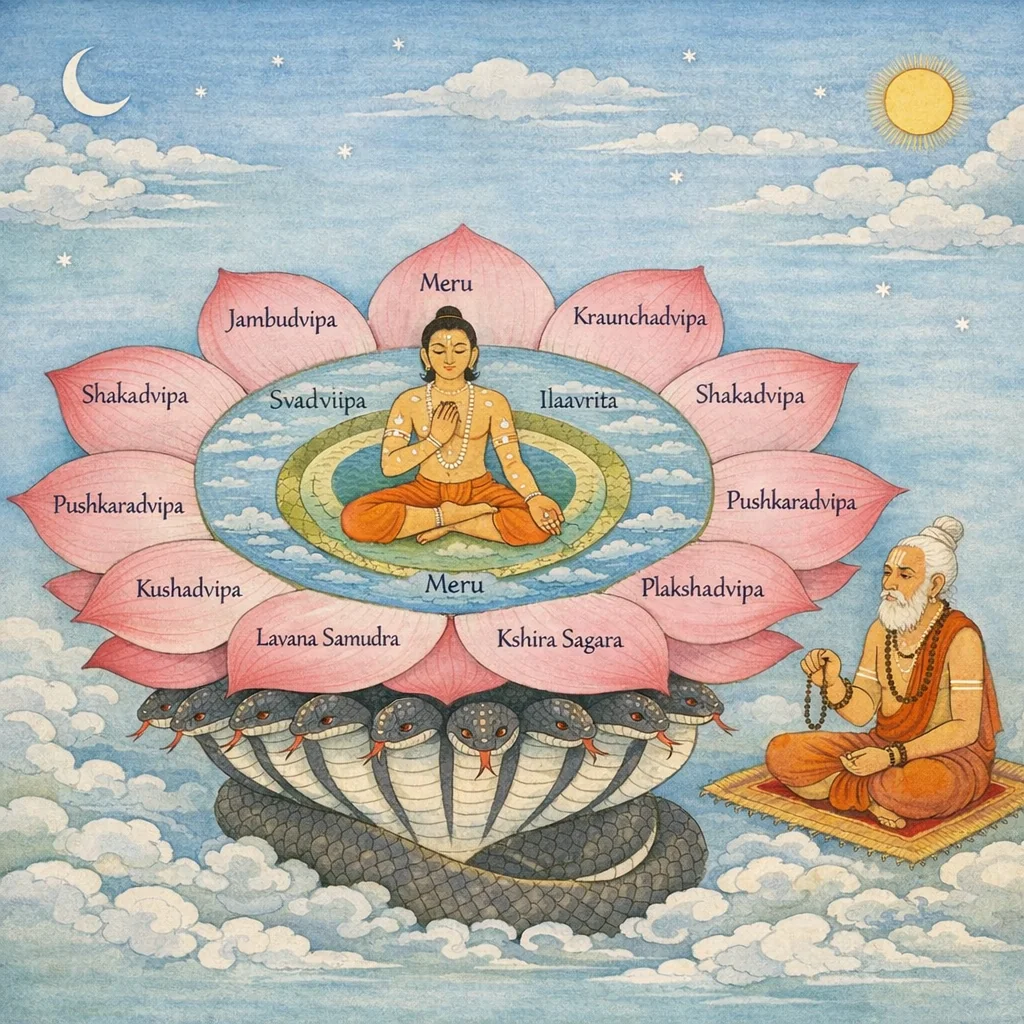
In the Purāṇic manner of establishing authority before instruction, Sūta begins with invocatory bīja-mantras and directs worship to the pādukās of Ananta-Śakti and Ādhāra-Śakti, then to forms such as Kālāgni-Rudra, Hāṭakeśvara, and Śeṣabhaṭṭāraka. The emphasis shifts from personal reverence to a complete cosmographic visualization: the lotus-seat called “Ananta” is praised as containing earth, worlds, continents, oceans, and all directions. The chapter then compresses tantric Śaiva metaphysics into a mantra-map—kalās, tattvas, phonemes, the ninefold formula, Sadyojāta and related mantra-structures, and aṅga-nyāsa (heart and limbs)—culminating in the Supreme Nectar-Ocean of perfected knowledge, identified with Sadāśiva-essence and the Jyeṣṭhā-cakra with Rudra-Śakti. Thus it serves as a consecratory threshold, ritually “seating” the teaching in the total cosmos so the next chapters proceed from a stabilized mantra-field and sanctified speaker-lineage.
Shlokas
Verse 1
नम् चतुर्विशो ऽध्यायः सूत उवाच / ऐं क्रीं श्रीं स्फें क्षैं अनन्तशक्तिपादुकां पूजयामि नमः
Sūta said: “AIM, KRĪM, ŚRĪM, SPHEṂ, KṢAIṂ—salutations! I worship the pādukā, the sacred sandals of Ananta‑Śakti, the Endless Power.”
Verse 2
ऐं श्रीं फ्रैं क्षैं आधारशक्तिपादुकां पूजयामि नमः / ॐ ह्रं कालाग्निरुद्रपादुकां पूजयामि नमः
With the seed-syllables aiṃ, śrīṃ, phraiṃ, and kṣaiṃ, I worship the sacred pādukā of Ādhāra-Śakti, the Foundation Power; salutations. With oṃ and hraṃ, I worship the sacred pādukā of Kālāgni-Rudra—Rudra as the fire of Time; salutations.
Verse 3
ॐ ह्रीं हुं हाटकेश्वरदेवपादुकां पूजयामि नमः / ॐ ह्रीं शेषभट्टारकपादुकां पूजयामि नमः
Om. With the seed-syllables Hrīṃ and Huṃ, I worship the sacred pādukā of Lord Hāṭakeśvara; salutations. Om. With Hrīṃ, I worship the sacred pādukā of Śeṣabhaṭṭāraka; salutations.
Verse 4
ॐ ह्रीं श्रीं पूथिवीतत्सवर्णभुवनद्वीपसमुद्रदिशामनन्ताख्यमासनं पद्मासनं पूजयामि नमः
Om—Hrīm—Śrīm. I worship and bow to the lotus-seat, Padmāsana, the seat called “Ananta”, encompassing the earth, the like realms, the worlds, continents, oceans, and all directions.
Verse 5
ह्रीं श्रीं निवृत्त्यादि कला पृथिव्यादितत्त्व मनन्तादिभुवनमोङ्कारादिवर्णम् / हकारादिनवात्मकपदः सद्योदातादिमन्त्रः ह्रां हृदयाद्यङ्गः / एवं मन्त्रमहेश्वर सिद्धविद्यात्मकः परामृतार्णवः सर्वभूतो दिक्समस्तषडङ्गः सदाशिवार्णवपयः पूर्णोदधिपक्षश्रीमानास्पदात्मकः विद्योमापूर्णज्ञत्वकर्तृत्वलक्षणज्येष्ठाचक्ररुद्रशक्त्यात्मककर्णि कः / नवशक्तिशिवादिभिर्मूलमण्डलत्रयकुजात्मकोत्पन्नापद्मासनपादुकां पूजयामि नमः
Hrīṃ and Śrīṃ—this mantra embodies the kalās beginning with Nivṛtti, the tattvas beginning with Earth, the worlds beginning with Ananta, and the phonemes beginning with Oṃ. It is the ninefold formula beginning with “ha”, the mantra-series beginning with Sadyojāta, with “hrāṃ” as the heart and the other limbs (aṅgas). Thus the Great Lord as mantra—of the nature of perfected sacred knowledge—appears as the Supreme Ocean of Nectar, pervading all beings, with six limbs extending to all directions; as the ocean of Sadāśiva’s essence, the glorious support of the full expanse of the sea; as the central lotus-core (karṇikā) constituted of Vidyā, sky-like fullness, complete omniscience and agency, marked by the Jyeṣṭhā-cakra with Rudra-Śakti. With the nine Śaktis and the forms beginning with Śiva—arisen from the root and the three maṇḍalas—I worship, with obeisance, the lotus-seat and the sacred pādukā.
Frequently Asked Questions
Kālāgni-Rudra represents time as consuming fire—dissolution and transcendence of temporality. Invoking him within pādukā worship frames the deity’s support not only as sustaining (ādhāra) but also as the power that completes cycles of manifestation, making the ritual cosmologically total (creation–maintenance–dissolution).
It indicates aṅga-structure (heart and other limbs) applied as a complete directional pervasion, akin to nyāsa logic: the mantra is installed as a full-bodied presence that covers the practitioner and space, signaling that the deity/mantra is not partial but omnidirectional and all-pervading.