Adhyaya 14
Dhyāna of Hari as the Nirguṇa Witness (Ātman), and the Attainment of Viṣṇu’s Realm
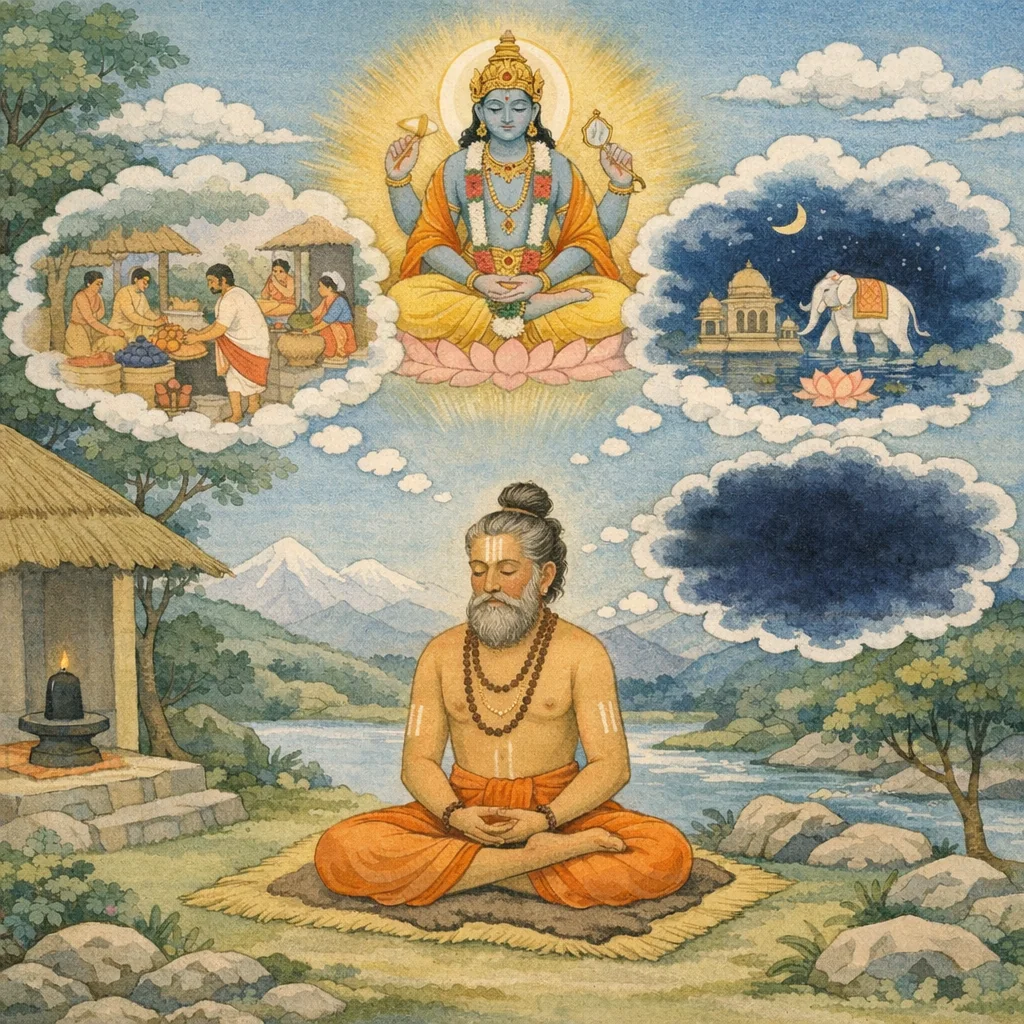
Continuing the Brahma Khanda’s grounding in first principles, this chapter turns from devotional identification with the Lord to a precise contemplative discipline: through dhyāna, Hari is known as both the One to be meditated upon and the reality realized by meditation. Hari declares Himself Vāsudeva, the Supreme Ātman abiding in bodies as consciousness while remaining wholly unbound. By layered negations—body and senses, then mind, then intellect—the Lord is presented as the inner knower and witness (sākṣin) of all functions without participation. The three states (waking, dream, deep sleep) show the Self as their constant witness, culminating in the proclamation of Turiya, pure awareness beyond the guṇas. The chapter closes by joining doctrine to practice and fruit: the wise who meditate attain the Supreme Abode and become “of that nature,” and continual recitation leads to Viṣṇu’s realm, preparing for later chapters that interpret ritual, karma, and post-mortem realities within this non-dual witness framework.
Shlokas
Verse 1
ऽध्यायः हरिरुवाच / ध्यायिभिः प्रोच्यते ध्येयो ध्यानेन हरिरीश्वरः
Hari said: Meditators declare the One who is to be meditated upon; through meditation, Hari—the Lord—is realized.
Verse 2
तच्छृणुष्व महेशान सर्वपापविनाशनम् / विष्णुः सर्वेश्वरो ऽनन्तः षड्भिर्भूपरिवर्जितः
Listen to this, O Maheshāna—this teaching destroys all sins: Viṣṇu is the Lord of all, the Infinite (Ananta), beyond the six earthly conditions.
Verse 3
वासुदेवो जगन्नाथो ब्रह्मात्मास्म्यहमेव हि / देहिदेहस्थितो नित्यः सर्वदेहविवर्जितः
I alone am Vāsudeva, the Lord of the universe; I am the Supreme Self (Brahman). As the indwelling conscious Self, I eternally abide within bodies, yet I remain completely free from all bodies.
Verse 4
देहधर्ंमविहीनश्च क्षराक्षरविवर्जितः / षड्विधेषु स्थितो द्रष्टा श्रोता घ्राता ह्यतीन्द्रियः
Devoid of the body’s functions and laws, and beyond both the perishable and the imperishable, he abides within the sixfold as the witness—seer, hearer, and smeller—yet transcending the senses.
Verse 5
तद्धर्ंमरहितः स्रष्टा नामगोत्रविवर्जितः / मन्ता मनः स्थितो देवो मनसा परिवर्जितः
That Creator is free of all limiting attributes and transcends such dharmas; He has no name and no lineage. He is the inner Knower, dwelling within the mind; yet that Divine is beyond the mind, untouched by mental conception.
Verse 6
मनोधर्ंमविहीनश्च विज्ञानं ज्ञानमेव च / बोद्धा बुद्धिस्थितः साक्षी सर्वज्ञो बुद्धिवर्जितः
He is devoid of the mind’s attributes; He is verily pure consciousness and true knowledge. He is the knower, abiding in the intellect as its inner witness—omniscient, yet untouched by and independent of the intellect.
Verse 7
बुद्धिधर्ंमविहीनश्च सर्वः सर्वगतो मनः / सर्वप्राणिविनिर्मुक्तः प्राणधर्ंमविवर्जितः
The mind is devoid of the dharma of intelligence; it is all-pervading and goes everywhere. It is detached from all living beings, and it is free from the dharma (functions) of the vital breath.
Verse 8
प्राणप्राणो महाशान्तो भयेन परिवर्जितः / अहङ्कारादिहीनश्च तद्धर्ंमपरिवर्जितः
He is the very life within all living beings, supremely tranquil, and free from fear. He is devoid of ego and the like, and He never departs from His own dharma—His essential nature.
Verse 9
तत्साक्षी तन्नियन्ता च परमानन्दरूपकः / जाग्रत्स्वप्नसुषुप्तिस्थस्तत्साक्षी तद्विवर्जितः
He is the Witness of all, and also its Controller, whose very nature is supreme bliss. Abiding through the states of waking, dream, and deep sleep, He remains their Witness—yet He is untouched by them and free from them.
Verse 10
तुरीयः परमो धाता दृग्रूपो गुणवर्जितः / मुक्तो बुद्धो ऽजरो व्यापी सत्य आत्मास्म्यहं शिवः
I am Turiya, the Fourth, the Supreme Sustainer; of the nature of pure witnessing awareness, free from the guṇas. Liberated and awakened, undecaying and all-pervading—true indeed is the Self: I am Śiva.
Verse 11
एवं ये मानवा विज्ञा ध्यायन्तीशं परं पदम् / प्राप्नुयुस्ते च तद्रूपं नात्र कार्या विचारणा
Thus, those wise human beings who meditate on the Lord—the Supreme Abode—attain that state, and they become of that very nature. On this there is no need for any further doubt or deliberation.
Verse 12
पठेद्य एतत्सततं विष्णुलोकं स गच्छति
Whoever recites this continually goes to Viṣṇu’s realm.
Frequently Asked Questions
They are the classical transformations/conditions associated with embodied existence (commonly: birth, existence, growth, transformation, decay, destruction). The chapter uses them to mark the Lord as beyond all bodily change.
The text describes the Self as consciousness that illumines bodily and mental processes as a witness (sākṣin). Because witnessing does not require identification with what is witnessed, the Self ‘abides within’ while remaining unconditioned and unattached.