Adhyaya 104
Karma-vipāka: Rebirths and Bodily Marks Resulting from Specific Sins
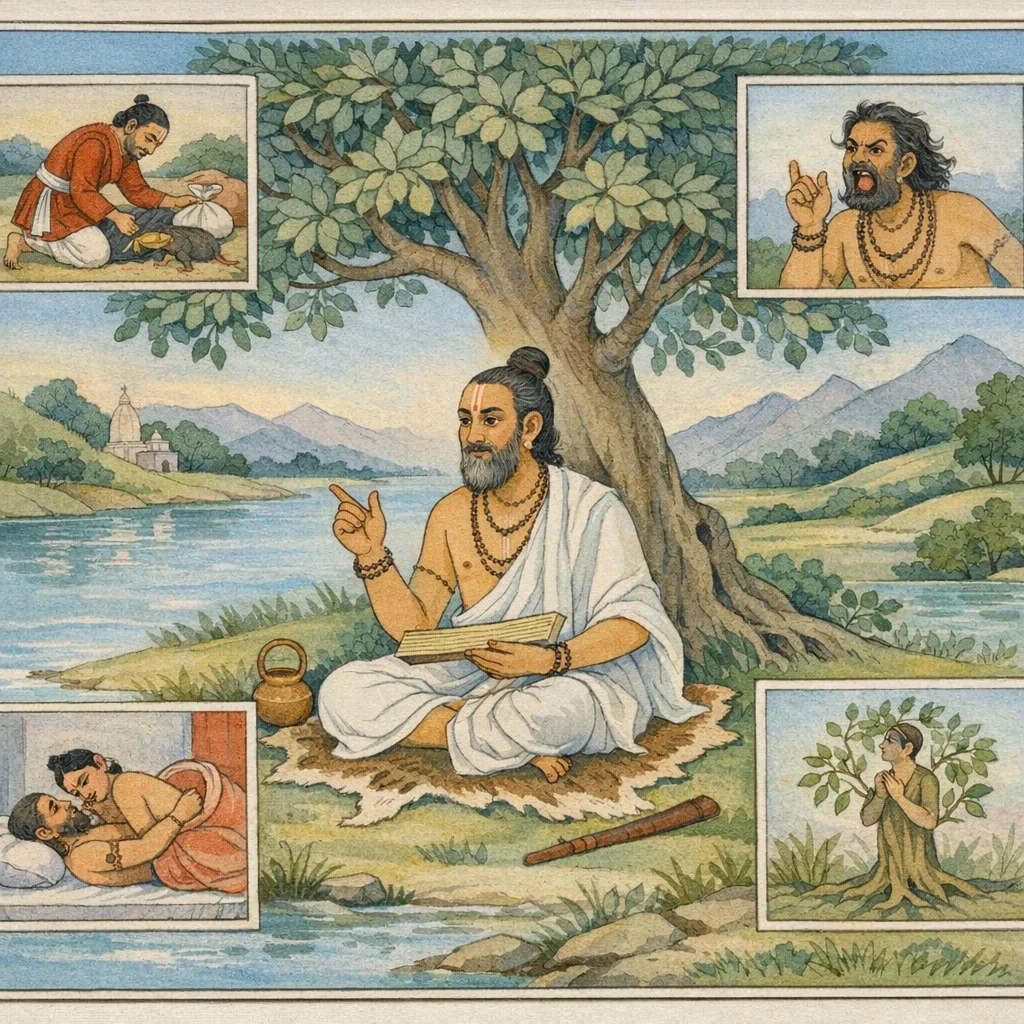
Continuing the Preta Kalpa’s teaching on the afterlife, Yājñavalkya explains that when grievous sins are “exhausted” through hell-experience, the jīva returns to embodied life in forms that match its karma. The chapter lists emblematic correspondences: brahmahatyā and surāpāna lead to degraded animal births; theft of gold, food, grain, fruit, cattle, cloth, or salt yields births as worms, rodents, birds, primates, or as humans marked by deformity and poverty; violation of the guru’s bed results in vegetative birth; slander and betrayal appear as sensory stigma (foul odor, putrid mouth) and social baseness. The closing verses turn from punitive mapping to restoration: after such births and the removal of defilement, the jīva may regain auspicious marks, wealth, and even higher human conditions fit for yogic life, preparing the shift from consequence to purification and dharmic rehabilitation.
Shlokas
Verse 1
नाम त्र्युत्तरशततमो ऽध्यायः श्रागरुडमहापुराणम्- १०४ याज्ञवल्क्य उवाच / नरकात्पताकोद्भूतात्क्षयात्पापस्य कमणः / ब्रह्महा श्वा खरोष्ट्रः स्याद्भेको यकः सुराप्यपि
Yājñavalkya said: When the sinful karma born of grievous transgressions is exhausted through the sufferings of hell, the slayer of a brāhmaṇa is reborn as a dog, a donkey, or a camel; and even the drinker of intoxicants is reborn as a frog, a yak, and the like.
Verse 2
स्वर्णचोरः कृमिः कीटः तृणादिर्गुरुतल्पगः / क्षयरोगी श्यावदन्तः कुनखी शिपिविष्टकः
A thief of gold becomes a worm or an insect; the violator of the guru’s bed (gurutalpaga) becomes grass and the like. One afflicted with consumption, one with darkened teeth, one with deformed nails, and one with a skin disease—such are the states born of specific sins.
Verse 3
ब्रह्महत्याक्रमात्स्युश्च तत्सर्वं वा शिशेर्भवेत् / अन्नहर्ता मयावी स्यान्मूको वागपहारकः
Through the sequence of sins (beginning with brahmin-slaying), one may be born as a child to suffer those consequences, or all those results may befall the child. The stealer of food becomes deceitful; the one who steals another’s speech becomes mute.
Verse 4
धान्यहार्यतिरिक्ताङ्गः पिशुनः पूतिनासिकः / तैलाहारी तैलपायी पूतिवक्त्रस्तु सूचकः
One who steals grain and valuables is born with deformed or extra limbs. A slanderer (piśuna) is born with a foul-smelling nose. One who steals oil—or drinks it greedily—is born with a putrid mouth; and an informer who betrays others is marked likewise.
Verse 5
ब्रह्मस्वं कन्यकां क्रीत्वा वने रक्षो भवेद्वृषः / रत्नहृद्धीनजातः स्यात्पत्रशाकहरः शिखी
One who appropriates what belongs to a brāhmaṇa, or who buys a maiden as though she were a commodity, becomes a rākṣasa in the forest—like a bull. One who steals gems is born dull-witted; and one who takes away leafy vegetables and greens is reborn as a peacock.
Verse 6
गुच्छं चुचुन्दरी हृत्वा धान्यहृन्मूषको भवेत् / फलं कपिः पशून्हृत्वा त्वजा काकः पयस्तथा
He who steals a bunch (of produce) is reborn a musk-rat; he who steals grain is reborn a mouse. He who steals fruit is reborn a monkey; he who steals cattle is reborn a crow; likewise, the theft of milk brings a similar fallen birth.
Verse 7
मांसं गृध्रः पटं श्वित्री चीरी लवणहारकः / यथाकर्म फलं प्राप्य तिर्यक्त्वं कालपर्ययात्
He who steals flesh is reborn a vulture; he who steals cloth is reborn afflicted with leprosy. He who takes garments is reborn clad in rags; he who steals salt becomes a thief of salt. Thus, receiving the fruit of one’s own deeds, in the turning of time one attains an animal, non-human birth according to karma.
Verse 8
जायन्ते लक्षणभ्रष्टा दरिद्राः पुरुषाधमाः / ततो निष्कलुषीभूता कुले महति योगिनः
They are born bereft of auspicious marks—poor and base among men; thereafter, when freed from defilement, they are born in a great lineage as yogins.
Verse 9
जायन्ते लक्षणोपेता धनधान्यसमन्विताः
They are born endowed with auspicious marks, furnished with wealth and an abundance of grain.
Frequently Asked Questions
It states that when the sinful karma generated by major transgressions is exhausted through naraka-anubhava, the jīva is reborn; the new embodiment (animal birth, defect, or social condition) reflects remaining karmic tendencies and the specific nature of the prior act.
The chapter uses theft as a scalable moral template—from gold to food to clothing—because appropriation disrupts dharma and social trust; the text then illustrates graded consequences as loss of dignity, capacity, and auspicious marks in future embodiment.
Yes. It explicitly concludes that after the removal of defilement, beings may be reborn with auspicious marks and even in great lineages, with conditions supportive of yogic discipline—indicating a rehabilitative karmic arc rather than permanent condemnation.