Adhyaya 10
Śrī-nyāsa, Lotus Maṇḍala Construction, and Homa to Mahālakṣmī with Sarasvatī Invocation
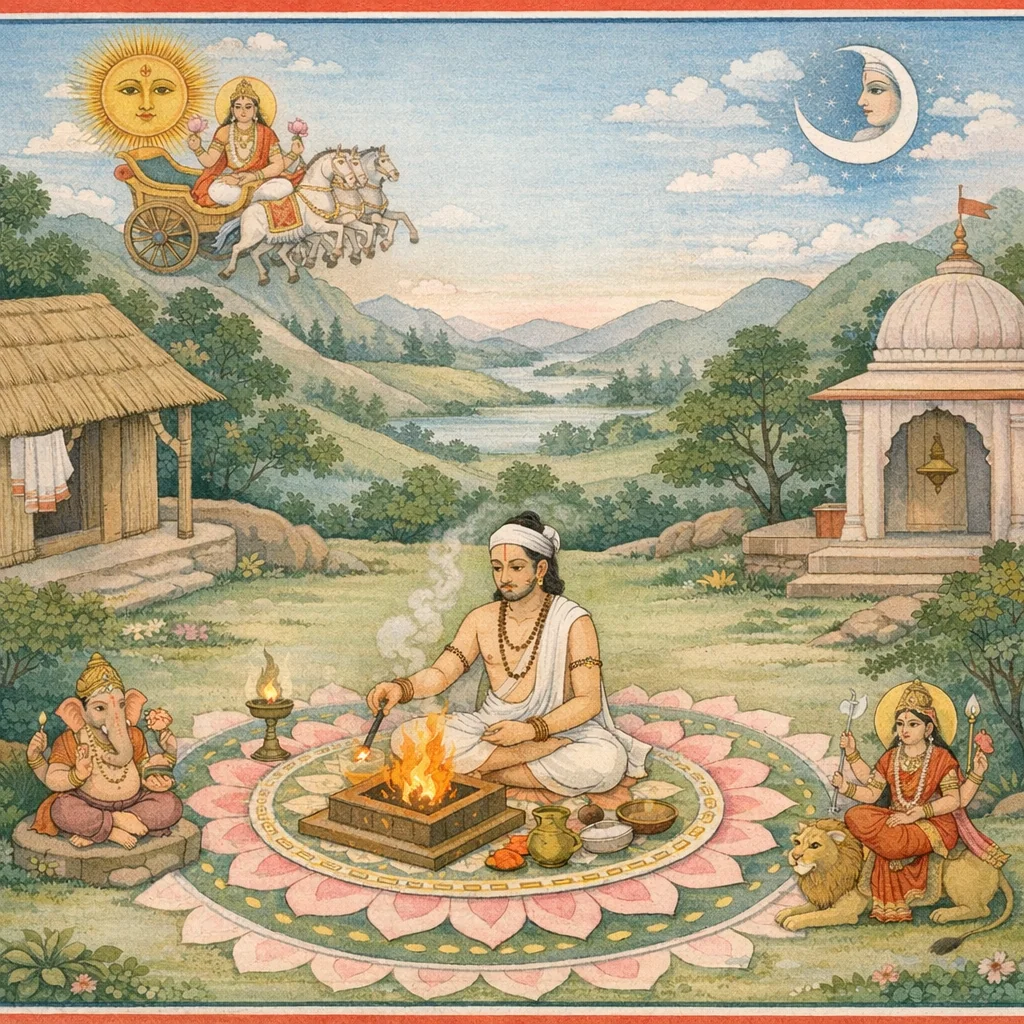
Continuing the Ācāra-khaṇḍa’s practical focus on ritual method, this chapter moves from general worship patterns into a Śrī-centered sādhana. It begins with Mahālakṣmī bīja-recitation and a structured nyāsa placed across six bodily stations. The practice then expands into sacred space through the construction of a lotus-womb maṇḍala with four gates, described as rājasic and pervaded by cosmic principles—ākāśa and the elements, Vedic order, and the Sun and Moon. Protective and empowering presences are installed in the maṇḍala’s corners, including Lakṣmī with auspicious signs, Durgā, gaṇas, and the Guru, establishing śakti and guidance. The practitioner then performs homa, first invoking Kṣetrapāla to secure the ground, and offers oblations in a Mahālakṣmī mantra-form. The chapter concludes by extending worship to Sarasvatī through bīja-mantras and a speech-awakening formula, preparing for later sections on targeted upāsanā and ritual means to attain siddhi.
Shlokas
Verse 1
नवमो ऽध्यायः हरिरुवाच / र् श्यादिपूजां प्रवर्श्यामि स्थण्डिलादिषु सिद्धये / श्रीं ह्रीं महालक्ष्म्यै नमः / श्रां श्रीं श्रूं श्रैं श्रौं श्रः क्रमाद्धृदयं च शिरः शिखाम् / कवचं नेत्रमस्त्रं च आसनं मूर्तिमर्चयेत्
Hari said: “For the attainment of siddhi, I shall set forth the worship that begins with the syllable ‘śrī’, to be performed upon the sthaṇḍila (ritual altar) and the related arrangements. (Recite:) ‘Śrīṃ, Hrīṃ—obeisance to Mahālakṣmī.’ Then, in due order with ‘Śrāṃ, Śrīṃ, Śrūṃ, Śraiṃ, Śrauṃ, Śraḥ’, one should place these as nyāsas upon the heart, head, topknot (śikhā), armor (kavaca), eyes, and weapon; thereafter consecrate the seat and worship the mūrti.”
Verse 2
मण्डले पद्मगर्भे च चतुर्द्वारि रजो ऽन्विते / चतुः षष्ट्यन्तमष्टादि खाक्षे खाक्ष्यादि मण्डलम्
In that maṇḍala—lotus-wombed (padma-garbha), having four gates, and suffused with rajas (the active quality)—the circular arrangement is described as beginning from “eighteen” and extending up to “sixty-four”, with divisions denoted by the “kha–akṣa” (space/ether–syllable) sequence.
Verse 3
खाक्षीन्दुसूर्यगं सर्वं खादिवेदेन्दुवर्तनात् / लक्ष्मीमङ्गानि चैकस्मिन्कोणे दुर्गां गणं गुरुम्
By the arrangement and movement of the ether (kha) and the rest—together with the Vedas, the Moon, and the Sun—everything is pervaded and set in motion. In one corner are Lakṣmī and the auspicious signs; and also Durgā, the gaṇas, and the Guru.
Verse 4
क्षेत्रपालमथाग्न्यादौ होमाञ्जुहाव कामभाक् / ॐ घं टं डं हं श्रीमहालक्ष्म्यै नमः
Then, desiring the intended fruit, he offered oblations into the fire in the homa—first invoking Kṣetrapāla, the guardian of the sacred ground—and recited: “Oṁ ghaṁ ṭaṁ ḍaṁ haṁ—salutations to Śrī Mahālakṣmī.”
Verse 5
अनेन पूजयेल्लक्ष्मीं पूर्वोक्तपरिवारकैः / ॐ सैं सरस्वत्यै नमः / ॐ ह्रीं सैं सरस्वत्यै नमः
By this procedure and mantra, one should worship Lakṣmī together with the attendants previously mentioned. (Recite:) “Oṃ saiṃ—obeisance to Sarasvatī”; “Oṃ hrīṃ saiṃ—obeisance to Sarasvatī.”
Verse 6
ॐ ह्रीं वदवदवाग्वादिनिस्वाहा ॐ ह्रीं सरस्वत्यै नमः
Om. Hrīm. “Speak, speak”—O goddess who sets speech in motion, svāhā. Om. Hrīm. Salutations to Sarasvatī.
Frequently Asked Questions
The text describes a graded circular arrangement expanding from 18 up to 64 divisions, indexed through a syllabic (“kha–akṣa”) sequence. Functionally, it indicates increasing differentiation of sacred space for placement, movement, and invocation within the ritual diagram.
They signal that the ritual space is a microcosm: elemental order (ākāśa and others), temporal regulators (Sun/Moon), and Vedic vibration collectively ‘animate’ the maṇḍala so worship aligns personal intention with cosmic rhythm.