Adhyaya 15
मदनकामेश्वरप्रादुर्भावः (Manifestation of Madana-Kāmeśvara)
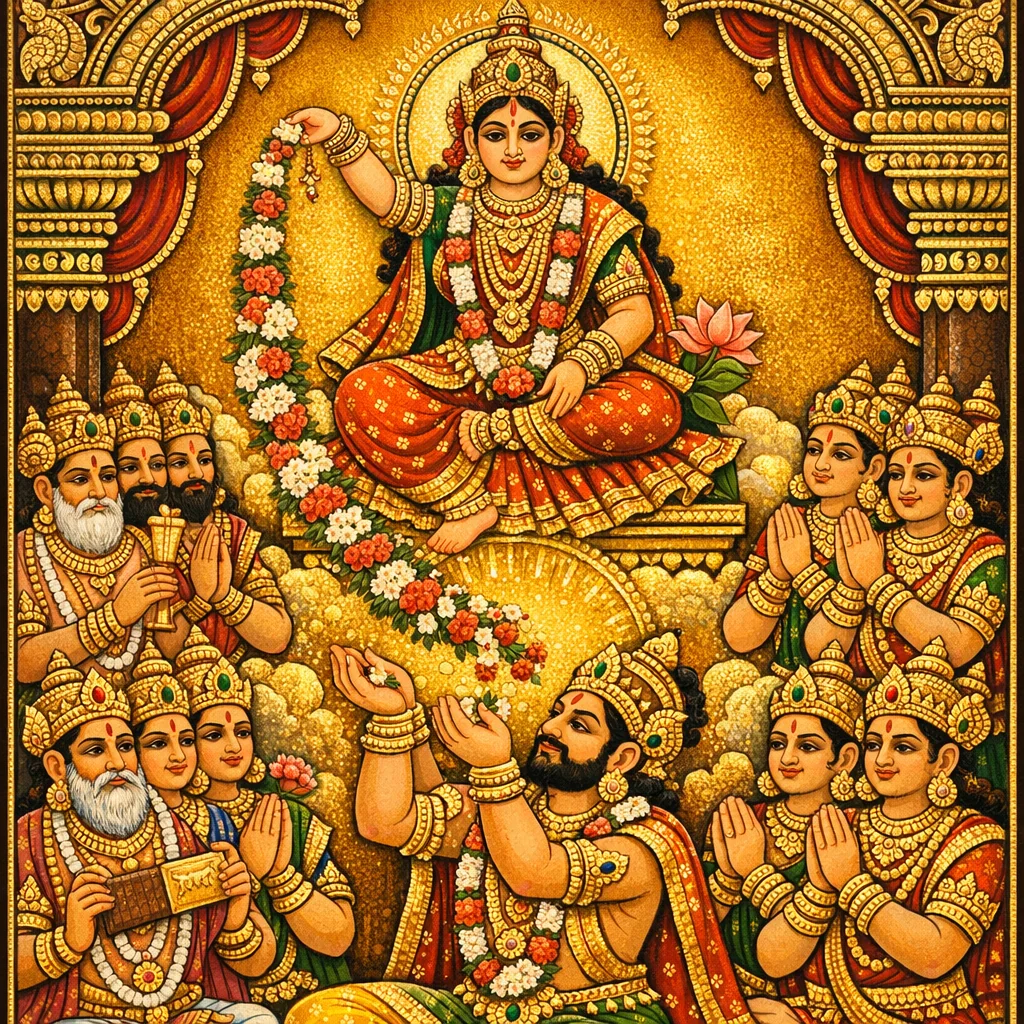
Within the Hayagrīva–Agastya dialogue of the Lalitopākhyāna, this chapter turns from doctrinal praise to a concrete divine event: the manifestation/recognition of Kāmeśvara as the consort aligned with the Goddess’ sovereign will. The Goddess proclaims her svātantrya (absolute autonomy) and insists that her beloved must accord with her own nature; Brahmā, supported by the devas, replies with counsel grounded in dharma and artha. A concise account of four marriage forms (udvāha-catuṣṭaya) places social rite within cosmic order, and a metaphysical hymn identifies the Goddess with non-dual Brahman and Prakṛti as the causal matrix. Choice and destiny are then revealed through the garland episode: the Devī casts a mālā into the sky, it descends upon Kāmeśvara, the gods rejoice, and the union is resolved to be solemnized by ritual for jagat-maṅgala, the auspicious welfare of the world.
Shlokas
Verse 1
इति श्रीब्रह्माण्डे महापुराणे उत्तरभागे हयग्रीवागस्त्यसंवादे ललितोपाख्याने मदनकामेश्वरप्रादुर्भावो नाम चतुर्दशो ऽध्यायः तच्छ्रुत्वा वचनं देवी मन्दस्मितमुखांबुजा / उवाच स ततो वाक्यं ब्रह्मविष्णुमुखान्सुरान्
Thus, in the Śrī Brahmāṇḍa Mahāpurāṇa, in the Uttara section, within the dialogue of Hayagrīva and Agastya, in the Lalitā narrative, is the fourteenth chapter called “The Manifestation of Madana-Kāmeśvara.” Hearing these words, the Goddess, whose lotus-face bore a gentle smile, then addressed the gods headed by Brahmā and Viṣṇu.
Verse 2
स्वतन्त्राहं सदा देवाः स्वेच्छाचारविहारिणी / ममानुरूपचरितो भविता तु मम प्रियः
O gods, I am ever sovereign and free, moving according to my own will; and my beloved shall be one whose conduct accords with my nature.
Verse 3
तथेति तत्प्रतिश्रुत्य सर्वेर्देवैः पितामहः / उवाच च महादेवीं धर्मार्थसहितं वचः
When all the gods assented, “So be it,” Pitāmaha Brahmā spoke to the Mahādevī words imbued with dharma and artha.
Verse 4
कालक्रीता क्रयक्रीता पितृदत्ता स्वयंयुता / नारीपुरुषयोरेवमुद्वाहस्तु चतुर्विधः
Kālakrītā, krayakrītā, pitṛdattā, and svayaṃyutā—thus the marriage of woman and man is declared to be of four kinds.
Verse 5
कालक्रीता तु वेश्या स्यात्क्रयक्रीता तु दासिका / गन्धर्वोद्वाहिता युक्ता भार्या स्यात्पितृदत्तका
A woman obtained for a term is called a veśyā; one bought for a price is called a dāsikā. She who is joined by the Gandharva rite, and she who is given by the father, is called a wife.
Verse 6
समानधर्मिणी युक्ता भार्या पितृवशंवदा / यदद्वैतं परं ब्रह्म सदसद्भाववर्जितम्
A wife who is in harmony with the same dharma and rightly joined is one who follows the father’s will. But the supreme Brahman, non-dual, is free from all states of being and non-being.
Verse 7
चिदानन्दात्मकं तस्मात्प्रकृतिः समजायत / त्वमेवासीच्च तद्ब्रह्म प्रकृतिः सा त्वमेव हि
From That whose very nature is consciousness and bliss (cid-ānanda), Prakṛti arose. You yourself were that Brahman; and that Prakṛti, indeed, is you alone.
Verse 8
त्वमेवानादिरखिला कार्यकारणरूपिणी / त्वामेव हि विचिन्वन्ति योगिनः सनकादयः
You alone are beginningless and all-encompassing, taking the form of cause and effect. It is you whom the yogins—Sanaka and the rest—ceaselessly seek.
Verse 9
सदसत्कर्मरूपां च व्यक्ताव्यक्तो दयात्मिकाम् / त्वामेव हि प्रशंसंति पञ्चब्रह्मस्वरूपिणीम्
You are the form of karma as both being and non-being, both manifest and unmanifest, compassionate in essence. You alone are praised as the Pañca-Brahma, the fivefold form of Brahman.
Verse 10
त्वामेव हि सृजस्यादौ त्वमेव ह्यवसि क्षणात् / भजस्व पुरुषं कञ्चिल्लोकानुग्रहकाम्यया
You alone create in the beginning, and you alone preserve in an instant; desiring to show grace to the worlds, choose some Purusha.
Verse 11
इति विज्ञापिता देवी ब्रह्मणा सकलैः सुरैः / स्रजमुद्यम्य हस्तेन चक्षेप गगनान्तरे
Thus entreated by Brahmā and all the gods, the Goddess lifted the garland in her hand and cast it into the open sky.
Verse 12
तयोत्सृष्टा हि सा माला शोभयन्ती नभस्थलम् / पपात कण्ठदेशे हि तदा कामेश्वरस्य तु
That garland, cast forth by them and adorning the vault of heaven, then fell upon the neck of Kāmeśvara.
Verse 13
ततो मुमुदिरे देवा ब्रह्मविष्णुपुरोगमाः / ववृषुः पुष्पवर्षाणि मन्दवातेरिता घनाः
Then the gods, led by Brahmā and Viṣṇu, rejoiced; and clouds, stirred by a gentle breeze, rained down showers of flowers.
Verse 14
अथोवाच विधाता तु भगवन्तं जनार्दनम् / कर्तव्यो विधिनोद्वाहस्त्वनयोः शिवयोर्हरे
Then the Creator (Brahmā) spoke to the Blessed Janārdana: “O Hari, the marriage of these two—Śiva and Śivā—should be solemnized according to sacred rite.”
Verse 15
मुहुर्तो देवसम्प्राप्तो जगन्मङ्गलकारकः / त्वद्रूपा हि महादेवी सहजश्च भवानपि
This auspicious moment has been attained by the gods, bringing blessing to the world. The Great Goddess is truly of your very form, and you too are by nature her companion.
Verse 16
दातुमर्हसि कल्याणीमस्मै कामशिवाय तु / तच्छ्रुत्वा वचनं तस्य देवदेवस्त्रिविक्रमः
You are worthy to bestow the Auspicious One (Kalyāṇī) upon this Kāma-Śiva. Hearing his words, Trivikrama, the God of gods, consented.
Verse 17
ददौ तस्यै विधानेन प्रीत्या तां शङ्कराय तु / देवर्षिपितृमुख्यानां सर्वेषां देवयोगिनाम्
In due rite, and with joy, he gave her to Śaṅkara, before the deva-sages, the foremost of the Pitṛs, and all the divine yogins.
Verse 18
कल्याणं कारयामास शिवयोरादिकेशवः / उपायनानि प्रददुः सर्वे ब्रह्मादयः सुराः
Ādi-Keśava caused the auspicious wedding of Śiva and the Goddess to be performed. All the gods, led by Brahmā, presented gifts.
Verse 19
ददौ ब्रह्मेक्षुचापं तु वज्रसारमनश्वरम् / तयोः पुष्पायुधं प्रादादम्लानं हरिरव्ययम्
Brahmā bestowed the sugarcane bow, adamant in essence and imperishable. Hari, the Unfailing One, gave to them both the unfading weapon of flowers.
Verse 20
नागपाशं ददौ ताभ्यां वरुणो यादसांपतिः / अङ्कुशं च ददौ ताभ्यां विश्वकर्मा विशांपतिः
Varuṇa, lord of the creatures of the waters, gave to them both the nāga-noose; and Viśvakarmā, lord of the people, gave to them both the goad (aṅkuśa).
Verse 21
किरीटमग्निः प्रायच्छत्ताटङ्कौ चन्द्रभास्करौ / नवरत्नमयीं भूषां प्रादाद्रत्नाकरः स्वयम्
Agni bestowed the crown; the Moon and the Sun gave the earrings; and Ratnākara himself presented an ornament wrought of the nine gems.
Verse 22
ददौ सुराणामधिपो मधुपात्रमथाक्षयम् / चिन्तामणिमयीं मालां कुबेरः प्रददौ तदा
The lord of the gods bestowed an inexhaustible vessel of honey; and then Kubera gave a garland fashioned of Cintāmaṇi gems.
Verse 23
साम्राज्यसूचकं छत्रं ददौ लक्ष्मीपतिः स्वयम् / गङ्गा च यमुना ताभ्यां चामरे चन्द्रभास्वरे
Lakṣmīpati himself gave the royal parasol, the sign of sovereignty; and Gaṅgā and Yamunā bestowed upon them moon-bright cāmara fans.
Verse 24
अष्टौ च वसवो रुद्रा आदित्याश्चाश्विनौ तथा / दिक्पाला मरुतः साध्या गन्धर्वाः प्रमथेश्वराः / स्वानिस्वान्यायुधान्यस्यै प्रददुः परितोषिताः
The eight Vasus, the Rudras, the Ādityas, and the Aśvin twins; the guardians of the directions, the Maruts, the Sādhyas, the Gandharvas, and the lords of the Pramathas—delighted, they bestowed upon her their own respective weapons.
Verse 25
रथांश्च तुरगान्नागान्महावेगान्महाबलान् / उष्टानरोगानश्वांस्तान्क्षुत्तृष्णापरिवर्जितान् / ददुर्वज्रोपमाकारान्सायुधान्सपरिच्छदान्
They bestowed chariots, horses, and elephants—of mighty speed and mighty strength—along with camels free from disease and steeds untouched by hunger and thirst; fashioned like the thunderbolt, furnished with weapons and complete equipment.
Verse 26
अथाभिषेकमातेनुः साम्राज्ये शिवयोः शिवम् / अथाकरोद्विमानं च नाम्ना तु कुसुमाकरम्
Then they performed the auspicious abhiṣeka within the sovereignty of the blessed pair of Śiva; and thereafter they fashioned a celestial vimāna named Kusumākara.
Verse 27
विधाताम्लानमालं वै नित्यं चाभेद्यमायुधैः / दिवि भुव्यन्तरिक्षे च कामगं सुसमृद्धिमत्
Vidhātā bestowed a garland that never withers, ever invulnerable to weapons; it moves at will through heaven, earth, and mid-air, overflowing with splendid abundance.
Verse 28
यद्गन्धघ्राणमात्रेण भ्रान्तिरोगक्षुर्धातयः / तत्क्षणादेव नश्यन्ति मनोह्लादकरं शुभम्
By merely breathing in its fragrance, delusion, disease, and the coarse disorders of the dhātus vanish that very instant; it is auspicious and gladdens the heart.
Verse 29
तद्विमानमथारोप्य तावुभौ दिव्यदंपती / चामख्याजनच्छत्रध्वजयष्टिमनोहरम्
Then the divine couple ascended that vimāna, lovely with yak-tail fans, ceremonial fans, royal parasols, banners, and splendid flagstaffs.
Verse 30
वीणावेणुमृदङ्गादिविविधैस्तौर्यवादनैः / सेव्यमाना सुरगणैर्निर्गत्य नृपमन्दिरात्
Amid the varied music of vīṇā, veṇu, mṛdaṅga and other instruments, attended by hosts of devas, she came forth from the royal palace.
Verse 31
ययौ वीथीं विहारेशा शोभयन्ती निजौजसा / प्रतिहर्म्याग्रसंस्थाभिरप्सरोभिः सहस्रशः
The Lady of revelry moved along the street, adorning it with her own radiance, accompanied by thousands of apsaras stationed at the palace-fronts.
Verse 32
सलाजाक्षतहस्ताभिः पुरन्ध्रीभिश्च वर्षिता / गाथाभिर्मङ्गलार्थाभिर्वीणावेण्वादिनिस्वनैः / तुष्यन्ती वीवीथिवीथीषु मन्दमन्दमथाययौ
Women, holding laja and akṣata in their hands, showered her with offerings; auspicious songs were sung and the sounds of vīṇā and veṇu rang out; pleased, she moved slowly through street after street.
Verse 33
प्रतिगृह्याप्स रोभिस्तु कृतं नीराजनाविधिम् / अवरुह्य विमानग्रात्प्रविवेश महासभाम्
Receiving the nīrājana rite performed by the apsaras, she descended from the vimāna and entered the great assembly hall.
Verse 34
सिंहासनमधिष्ठाय सह देवेन शंभुना / यद्यद्वाञ्छन्ति तत्रस्था मनसैव महाजनाः / सर्वज्ञा साक्षिपातेन तत्तत्कामानपूरयत्
Seated upon the lion-throne with the god Śambhu, whatever the great ones present desired within their hearts, she—omniscient—fulfilled by a mere cast of her gaze.
Verse 35
तद्दृष्ट्वा चरितं देव्या ब्रह्मा लोक पितामहः / कामाक्षीति तदाभिख्यां ददौ कामेश्वरीति च
Beholding the Goddess’s sacred deed, Brahmā, the Pitāmaha of the worlds, then bestowed upon her the name “Kāmākṣī,” and also “Kāmeśvarī.”
Verse 36
ववर्षाश्चर्यमेघो ऽपि पुरे तस्मिंस्तदाज्ञया / महार्हाणि च वस्तूनि दिव्यान्याभरणानि च
By her command, in that city a wondrous cloud rained down most precious treasures and divine ornaments.
Verse 37
चिन्तामणिः कल्पवृक्षः कमला कामधेनवः / प्रतिवेश्म ततस्तस्थुः पुरो देव्याजयाय ते
Then Cintāmaṇi, the wish-fulfilling Kalpavṛkṣa, Kamalā, and the Kāmadhenus stood before every house, to proclaim the Goddess’s victory.
Verse 38
तां सेवैकरसाकारां विमुक्तान्यक्रियागुणाः / सर्वकामार्थसंयुक्ता हृष्यन्तः सार्वकालिकम्
One-pointed in her service, freed from inert qualities, and endowed with every desire and attainment, they rejoiced at all times.
Verse 39
पितामहो हरिश्चैव महादेवश्च वासवः / अन्ये दिशामधीशास्तु सकला देवतागणाः
There were Pitāmaha Brahmā, Hari, Mahādeva, Vāsava (Indra), and the other lords of the directions—the entire host of the gods.
Verse 40
देवर्षयो नारदाद्याः सनकाद्याश्च योगिनः / महर्षयश्च मन्वाद्या वशिष्ठाद्यास्तपोधनाः
Devarṣis such as Nārada, yogins such as Sanaka, and Mahārṣis such as Manu and Vasiṣṭha—ascetics rich in tapas—were present there.
Verse 41
गन्धर्वाप्सरसो यक्षा याश्चान्या देवजातयः / दिवि भूम्यन्तरिक्षेषु ससंबाधं वसंति ये
Gandharvas, Apsarases, Yakṣas, and other divine races—who dwell in throngs in heaven, on earth, and in the mid-air—were all there.
Verse 42
ते सर्वे चाप्यसंबाधं निवसंति स्म तत्पुरे
And all of them dwelt in that city without any crowding, in spacious ease.
Verse 43
एवं तद्वत्सला देवी नान्यत्रैत्यखिलाज्जनात् / तोषयामास सततमनुरागेण भूयसा
Thus the Goddess, tenderly devoted to all, did not depart elsewhere away from the people, but ever delighted them with ever-greater love.
Verse 44
राज्ञो महति भूर्लोके विदुषः सकलेप्सिताम् / राज्ञी दुदोहाभीष्टानि सर्वभूतलवासिनाम्
In Bhūrloka, for that great and learned king, the queen—as though milking forth what was desired—bestowed wished-for boons upon all who dwell upon the earth.
Verse 45
त्रिलोकैकमहीपाले सांबिके कामशङ्करे / दशवर्षसहस्राणि ययुः क्षण इवापरः
In the reign of Kāmaśaṅkara, the sole king of the three worlds and beloved of Ambikā, ten thousand years passed as though they were but another moment.
Verse 46
ततः कदा चिदागत्य नारदो भगवानृषिः / प्रणम्य परमां शक्तिं प्रोवाच विनयान्वितः
Then, at a certain time, the blessed sage Nārada arrived; bowing to the Supreme Śakti, he spoke with humble reverence.
Verse 47
पर ब्रह्म परं धाम पवित्रं परमैश्वरि / मदसद्भावसंकल्पविकल्पकलनात्मिका
O Parameśvarī! You are the Supreme Brahman, the supreme abode, the holiest purity; you are the very essence that measures and shapes the saṅkalpas and vikalpas of my states of being and non-being.
Verse 48
जगदभ्युदयार्थाय व्यक्तभावमुपागता / असज्जनविनाशार्था सज्जनाभ्युदयार्थिनी / प्रवृत्तिस्तव कल्याणि साधूनां रक्षणाय हि
O Kalyāṇī! For the world’s uplift you have assumed a manifest form; to destroy the wicked, to raise the virtuous, and to protect the sādhus—such is your sacred activity.
Verse 49
अयं भण्डो ऽसुरो देवि बाधते जगतां त्रयम् / त्वयैकयैव जेतव्यो न शक्यस्त्वपरैः सुरैः
O Devī! This asura named Bhaṇḍa afflicts the three worlds; he can be conquered by you alone—other devas are not able to defeat him.
Verse 50
त्वत्सेवैकपरा देवाश्चिरकालमिहोषिताः / त्वदाज्ञया गमिष्यन्ति स्वानिस्वानि पुराणि तु
The gods have dwelt here for a long time, devoted solely to Your service; by Your command they shall depart to their own respective abodes.
Verse 51
अमङ्गलानि शून्यानि समृद्धार्थानि संत्वतः / एवं विज्ञापिता देवी नारदेनाखिलेश्वरी / स्वस्ववासनिवासाय प्रेषयामास चामरान्
In Your presence, all inauspiciousness is made void and every purpose is brought to fullness. Thus addressed by Nārada, the Goddess—Sovereign of all—sent the Cāmaras back to their respective abodes.
Verse 52
ब्रह्माणं च हरिं शंभुं वासवादीन्दिशां पतीन् / यथार्हं पूजयित्वा तु प्रेषयामास चांबिका
Ambikā duly worshipped Brahmā, Hari, Śambhu, and Indra with the lords of the directions, and then sent them on their way.
Verse 53
अपराधं ततस्त्यक्तुमपि संप्रेषिताः सुराः / स्वस्वांशैः शिवयोः सेवामादिपित्रोरकुर्वत
Thereafter the gods were sent forth to abandon their offense; and through their own respective portions they rendered service to Śiva and Śivā, the primordial Parents.
Verse 54
एतदाख्यानमायुष्यं सर्वमङ्गलकारणम् / आविर्भावं महादेव्यास्तस्या राज्याभिषेचनम्
This sacred account bestows longevity and is the source of all auspiciousness: the manifestation of the Mahādevī and her royal consecration.
Verse 55
यः प्रातरुत्थितो विद्वान्भक्तिश्रद्धासमन्वितः / जपेद्धनसमृद्धः स्यात्सुधासंमितवाग्भवेत्
Whoever rises at dawn, wise and endowed with bhakti and śraddhā, and performs japa, becomes prosperous in wealth, and his speech turns sweet like nectar.
Verse 56
नाशुभं विद्यते तस्य परत्रेह च धीमतः / यशः प्राप्नोति विपुलं समानोत्तमतामपि
For that wise one, no ill exists either here or hereafter; he attains abundant fame and likewise reaches the highest excellence.
Verse 57
अचला श्रीर्भवेतस्य श्रेयश्चैव पदेपदे / कदाचिन्न भयं तस्य तेजस्वी वीर्यवान्भवेत्
His Śrī becomes steadfast, and welfare attends him at every step; fear never arises for him—he becomes radiant and full of valor.
Verse 58
तापत्रयविहीनश्च पुरुषार्थैश्च पूर्यते / त्रिसंध्यं यो जपेन्नित्यं ध्यात्वा सिंहासनेश्वरीम्
Free from the threefold afflictions and fulfilled with the puruṣārthas is one who, meditating on Siṃhāsaneśvarī, performs japa daily at the three sandhyās.
Verse 59
षण्मासान्महतीं लक्ष्मीं प्राप्नुयाज्जापकोत्तमः
The foremost practitioner of japa attains great Lakṣmī within six months.
Frequently Asked Questions
This chapter is primarily theological and ritual-normative rather than a vaṃśa catalog; its “lineage function” is indirect—legitimizing the divine consort pairing (Śakti–Kāmeśvara) that underwrites later sacred-historical authority in the Lalitopākhyāna frame.
It outlines a fourfold model of marriage (udvāha-catuṣṭaya) and characterizes certain forms (e.g., kālakrītā/krayakrītā) alongside gandharva and pitṛdattā, using ritual classification to align social practice with dharma and cosmic order.
The mālā functions as a public, cosmically witnessed selection-sign: the Goddess’ autonomous choice becomes an objective omen, prompting the devas to celebrate and Brahmā to urge a formal, auspicious rite—transforming metaphysical compatibility into ritually sanctioned union.