Adhyaya 38
Cākṣuṣa–Vaivasvata Manvantara Transition, Deva-Gaṇa Taxonomy, and Loka-Triad Etymology (Bhūr–Antarikṣa–Dyu)
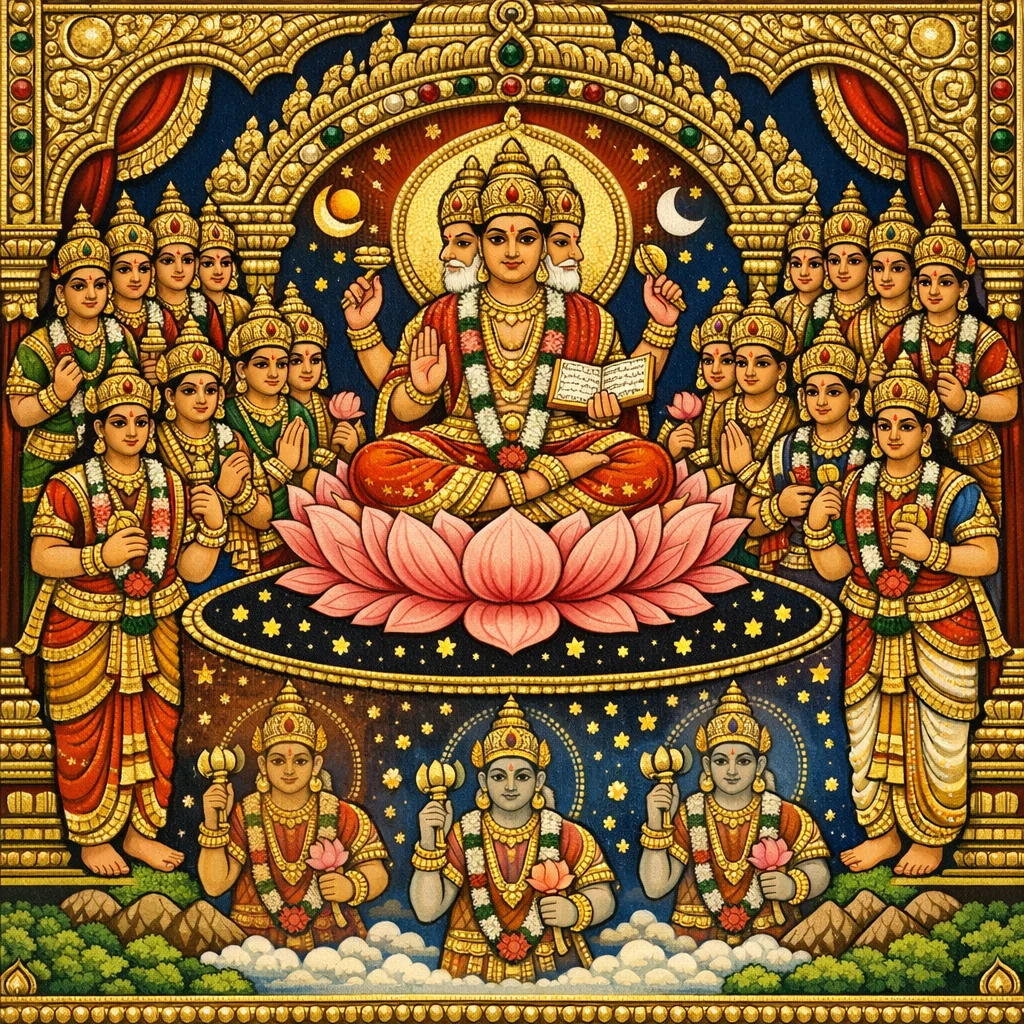
This adhyāya, narrated by Sūta, turns on manvantara reasoning and cosmographic meaning. It situates the teaching in the Vaivasvata Manu cycle and introduces a Marīci–Kaśyapa genealogical frame for the arising of deva-groups and paramarṣis. Major divine collectives—Ādityas, Vasus, Rudras, Sādhyas, Viśvedevas, and Maruts—are enumerated, with some traced to Kaśyapa’s progeny and others to Dharma’s sons, blending lineage logic (vaṃśa) with functional taxonomy (deva-gaṇa). The text then generalizes the pattern of Indras across manvantaras: rulers alike in qualities, sustaining the worlds through tapas, tejas, buddhi, bala, and śruta. It proceeds to explain the three worlds (loka-traya) both as temporal categories (bhūta/bhavat/bhavya) and as realms named Bhūr (earth), Antarikṣa (mid-region), and Dyu/Div (heaven). Finally, it grounds “Bhūr” etymologically in the root bhū (being/existence), presenting Brahmā’s primordial utterance (vyāhṛti) as a sacred naming-act that stabilizes cosmic ontology.
Shlokas
Verse 1
इति श्रीब्रह्माण्डे महापुराणे वायुप्रोक्ते पूर्वभागे द्वितीये ऽनुषङ्गपादे चाक्षुषसर्गवर्णनं नाम सप्तत्रिंशत्तमो ऽध्यायः सूत उवाच सप्तम त्वथ पर्याये मनोर्वैवस्वतस्य ह / मारीचात्कश्यपाद्देवा जज्ञिरे परमर्षयः
Thus, in the Śrī Brahmāṇḍa Mahāpurāṇa, proclaimed by Vāyu, in the former section, in the second anuṣaṅga-pāda, is the thirty-seventh chapter called “The Description of the Cākṣuṣa Creation.” Sūta said: In the seventh cycle of Manu Vaivasvata, from Kaśyapa of Marīci’s line were born the Devas and the supreme Ṛṣis.
Verse 2
आदित्या वसवी रुद्राः साध्या विश्वे मरुद्गणाः / भृगवोंऽगिरसश्चैव ते ऽष्ठौ देवगणाः स्मृताः
The Ādityas, the Vasus, the Rudras, the Sādhyas, the Viśvedevas, the hosts of the Maruts, the Bhṛgus, and the Aṅgirasas—these are remembered as the eight divine groups.
Verse 3
आदित्या मरुतो रुद्रा विज्ञेयाः कश्यपात्मजाः / साध्याश्य वसवो विश्वे धर्मपुत्रास्त्रयो गणाः
The Ādityas, the Maruts, and the Rudras are to be known as sons of Kaśyapa; while the Sādhyas, the Vasus, and the Viśvedevas—these three hosts—are sons of Dharma.
Verse 4
भृगोस्तु भृगवो देवा ह्यङ्गिरसोंऽगिरः सुताः / वैवस्वतेंऽतरे ह्यस्मिन्नित्ये ते छन्दजा मताः
From Bhṛgu came the Bhṛgus as Devas, and from Aṅgiras came the sons of Aṅgiras; in this Vaivasvata Manvantara they are held to be eternal, born of chandas—the sacred metres.
Verse 5
एते ऽपि च गमिष्यन्ति महान्तं कालपर्ययात् / एवं सर्गस्तु मारीचो विज्ञेयः सांप्रतः शुभः
They too will pass on to a great end through the turning of Time; thus, this creation connected with Marīci is to be understood, in the present account, as auspicious.
Verse 6
तेजस्वी सांप्रतस्तेषामिन्द्रो नाम्ना महाबलः / अतीतानागता ये च वर्त्तन्ते सांप्रतं च ये
In their present age there reigns a radiant one named Indra, mighty in strength. Those who have passed, those yet to come, and those who abide now—over all of them he is lord.
Verse 7
सर्वे मन्वन्तरेद्रास्ते विज्ञेयास्तुल्यलक्षणाः / भूतभव्यभवन्नाथाः सहस्राक्षाः पुरन्दराः
All the Indras of the various Manvantaras are to be known as bearing the same marks. They are lords of past, future, and present—thousand-eyed ones, famed as Purandara.
Verse 8
सघवन्तश्चते सर्वे शृङ्गिणो वज्रपाणयः / सर्वैः क्रतुशतेनेष्टं पृथक्छतगुणेन तु
All of them are Saghavanta, horned, and bearers of the vajra. Each has performed a hundred kratus (sacrificial rites), and each, in his own measure, has offered iṣṭi with fruit a hundredfold.
Verse 9
त्रैलोक्ये यानि सत्त्वानि गतिमन्ति ध्रुवाणि च / अभिभूयावतिष्ठन्ति धर्माद्यैः कारणैरपि
In the three worlds, beings that move toward their courses, and even those that stand firm and constant, are overruled by causes such as dharma and the like, and thus abide in their own stations.
Verse 10
तेजसा तपसा बुद्ध्या बलश्रुतपराक्रमैः / भूतभव्यभवन्नाथा यथा ते प्रभविष्णवः
By tejas (radiance), tapas (austerity), wisdom, strength, sacred śruti, and valor, they—lords of past, future, and present—become thus mighty and fully empowered.
Verse 11
एतत्सर्वं प्रवक्ष्यामि ब्रुवतो मे निबोधत / भूतभव्यभवद्ध्येत त्समृतं लोकत्रयं द्विजैः
All this I shall declare; heed my words. By contemplating the past, the future, and the present, the twice-born have remembered the three worlds.
Verse 12
भूर्लोको ऽयं स्मृतो भूतमन्तरिक्षं भवत्स्मृतम् / भव्यं स्मृतं दिवं ह्येतत्तेषां वक्ष्यामि साधनम्
This Bhūrloka is remembered as the past, and the mid-region (antarikṣa) as the present. Heaven is remembered as the future; now I shall speak of the means pertaining to them.
Verse 13
ध्यायता लोकनामानि ब्रह्मणाग्रे विभाषितम् / भूरिति व्याहृतं पूर्वं भूर्लोको ऽयमभूत्तदा
Meditating on the names of the worlds, Brahmā uttered them in the beginning. First the vyāhṛti “bhūḥ” was spoken; then this Bhūrloka came into being.
Verse 14
भू सत्तायां स्मृतो धातुस्तथासौ लोकदर्शने / भूतत्वाद्दर्शनाच्चैव भूर्लोको ऽयमभूत्ततः
The root “bhū” is remembered in the sense of “existence”, and it is so known in worldly understanding. Because it is ‘bhūta’ and because it is seen, this Bhūrloka came to be.
Verse 15
अतो ऽयं प्रथमो लोको भूतत्वाद्भूर्द्वजैः स्मृतः / भूते ऽस्मिन्भवदित्युक्तं द्वितीयं ब्रह्मणा पुनः
Therefore this first world, by virtue of being bhūta, is remembered by the twice-born as “bhūḥ”. And within this very bhūta, Brahmā again spoke of the second as “bhavaḥ”.
Verse 16
भवदित्यत्पद्यमाने काले शब्दो ऽयमुच्यते / भवनात्तु भुवल्लोको निरुत्तया हि निरुच्यते
When ‘bhavat’ comes into being in its proper time, this word is uttered. From ‘bhavana’ the realm called ‘bhuvaḥ’ is explained according to nirukta.
Verse 17
अन्तरिक्षं भवत्तस्माद्द्वितीयो लोक उच्यते / उत्पन्ने तु तथा लोके द्वितीये ब्रह्मणा पुनः
From that arose the mid-space, antarikṣa; therefore it is called the second world. And when that second world had arisen, Brahmā again…
Verse 18
भव्येति व्याहृतं पश्चाद्भव्यो लोकस्ततो ऽभवत् / अनागते भव्य इत शब्द एष विभाव्यते
Thereafter the vyāhṛti ‘bhavya’ was uttered, and from it arose the world called Bhavya. This word ‘bhavya’ is also understood as what is yet to come—the future.
Verse 19
तस्माद्भव्यो ह्यसौ लोको नामतस्त्रिदिवं स्मृतम् / भूरितीयं स्मृता भूमिरन्तरिक्षं भुवः स्मृतम्
Therefore that Bhavya world is remembered by name as ‘tridiva’. ‘Bhūḥ’ is recalled as the earth, and ‘bhuvaḥ’ as the mid-space, antarikṣa.
Verse 20
दिवं स्मृतं तथा भव्यं त्रलोक्यस्यैष निर्णयः / त्रैलोक्ययुक्तैर्व्याहारैस्तिस्रो व्याहृतयो ऽभवन्
‘Diva’ too is remembered as Bhavya—this is the determination concerning the three worlds. Through these utterances bound to the triloka, the three vyāhṛtis came to be.
Verse 21
नाथ इत्येष धातुर्वै धातुज्ञैः पालने स्मृतः / यस्माद्भूतस्य लोकस्य भव्यस्य भवतस्तथा
The root “nātha,” say the knowers of roots, is remembered in the sense of protection; for he sustains the worlds of past, present, and future.
Verse 22
लोकत्रयस्य नाथास्ते तस्मादिन्द्राद्विजैः स्मृताः / प्रधानभूता देवेन्द्रा गुणभूतास्तथैव च
They are the lords of the three worlds; therefore the twice-born remember them as “Indras.” These Devendras are of the nature of Pradhāna, and likewise of the Guṇas.
Verse 23
मन्वन्तरेषु ये देवा यज्ञभाजो भवन्ति हि / यज्ञगन्धर्वरक्षांसि पिशाचो रगमानुषाः
In the Manvantaras, those deities who partake of the sacrificial offering are indeed the Yajña-Gandharvas, the Rākṣasas, the Piśācas, and the Ragamānuṣas.
Verse 24
महिमानः स्मृता ह्येते देवेन्द्राणां तु सर्वशः / देवेन्द्रा गुरवो नाथा राजानः पितरो हि ते
These are remembered, in every way, as the glories of the Devendras: the Devendras are teachers, protectors, kings, and indeed like fathers.
Verse 25
रक्षन्तीमाः प्रजा ह्येते धर्मेणेह सुरोत्तमाः / इत्येतल्लक्षणं प्रोक्तं देवेन्द्राणां समासतः
These best of the gods protect the people here through dharma; thus, in brief, the defining mark of the Devendras has been declared.
Verse 26
सप्तर्षीन्संप्रवक्ष्यामि सांप्रतं ये दिवं श्रिताः / गाधिजः कौशिको धीमान्विश्वामित्रो महातपाः
Now I shall declare the Seven Ṛṣis who at present abide in heaven: Viśvāmitra, the wise and great ascetic, son of Gādhi, of the Kauśika lineage.
Verse 27
भार्गवो जमदग्निश्च ह्यौर्वपुत्रः प्रतापवान् / बृहस्पतिसुतश्चापि भरद्वाजो महा यशाः
Jamadagni of the Bhārgava line, and the valiant son of Aurva; and also Bharadvāja, son of Bṛhaspati, renowned with great fame.
Verse 28
औतथ्यो गौतमो विद्वाञ्शरद्वान्नाम धार्मिकः / स्वायंभुवो ऽत्रिर्भगवान्ब्रह्मकोशः सपञ्चमः
Autathya; Gautama the learned; and the righteous one named Śaradvān; and Atri Bhagavān, sprung from Svayambhū—he is the fifth, called Brahmakośa.
Verse 29
षष्ठो वसिष्ठपुत्रस्तु वसुमांल्लोकविश्रुतः / वत्सरः काश्यपश्यैव सप्तैते साधुसंमताः
The sixth is Vasumān, son of Vasiṣṭha, famed throughout the worlds; and Vatsara and Kāśyapa—these seven are approved by the righteous.
Verse 30
एते सप्तर्षयश्योक्ता वर्त्तन्ते सांप्रतेंऽतरे / इक्ष्वाकुश्च नृगश्चैव धृष्टः शर्यातिरेब च
These Seven Ṛṣis have thus been spoken of; at present they abide in the intermediate realm (each in his own sphere). And likewise Ikṣvāku, Nṛga, Dhṛṣṭa, and Śaryāti.
Verse 31
नरिष्यन्तश्चविख्यातो नाभागो दिष्ट एव च / करूषश्च पृषध्रश्च पांशुश्चनवमः स्मृतः
Nariṣyanta was renowned; so too were Nābhāga and Diṣṭa; and Karūṣa, Pṛṣadhra, and Pāṃśu—remembered as the ninth.
Verse 32
मनोर्वैवस्वतस्यैते नव पुत्राः सुधार्मिकाः / कीर्तिता वै तथा ह्येते सप्तमं चैतदन्तरम्
These were the nine sons of Manu Vaivasvata, all steadfast in dharma; thus indeed are they proclaimed, and this is the seventh Manvantara.
Verse 33
इत्येष ह मया पादो द्वितीयः कथितोद्विजाः / विस्तरेणानुपूर्व्या च भूयः किं कथयाम्यहम्
O dvijas, thus have I spoken the second pāda, in due order and at length; what more is there for me to say?
Frequently Asked Questions
The chapter anchors certain divine groups in a Marīci–Kaśyapa lineage (Kaśyapa as a key progenitor), while also attributing some collectives (e.g., Sādhyas/Vasus/Viśvedevas in the sample) to Dharma’s sons—showing how Purāṇic taxonomy often blends descent and function.
Indra is presented as a recurring office rather than a single unchanging individual: manvantara-Indras are said to be similar in marks and sustain the worlds through tapas, tejas, intellect, strength, and valor—supporting a cyclic-time model of divine governance.
They are framed as the three worlds (loka-traya) and also correlated with temporal categories (bhūta/bhavat/bhavya). “Bhūr” is etymologized from the root bhū (to be), and Brahmā’s primordial utterance (vyāhṛti) is treated as a naming-act that fixes cosmic ontology.