Adhyaya 65
Nimivaṃśānukīrtana (Genealogical Recitation of the Nimi Line) — with Atri–Soma Origin Motif
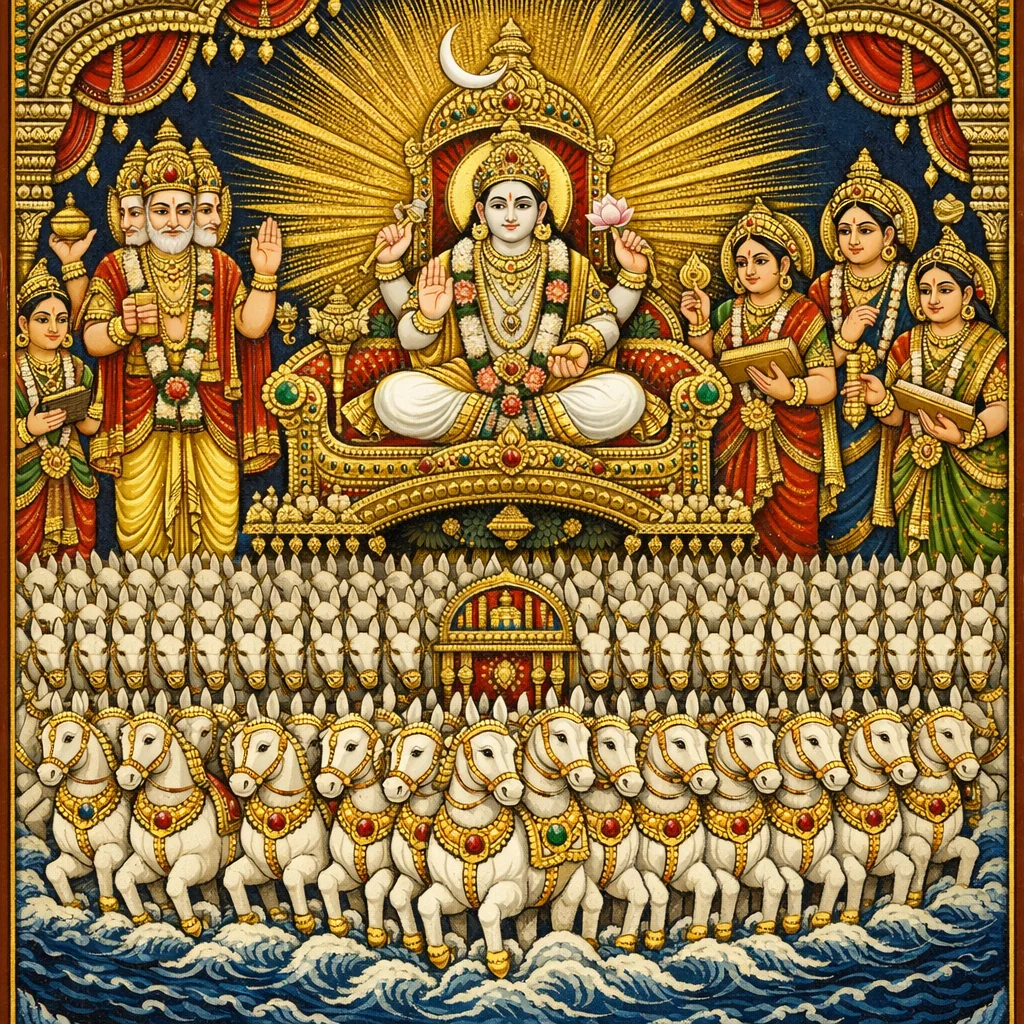
Sūta narrates a genealogical–cosmogonic vignette that centers on Ṛṣi Atri as the father of Soma. Atri is portrayed as an exemplary tapasvin—arms uplifted, austere, and disciplined in deed, mind, and speech—performing the severe penance Suduścara for thousands of “divine years.” From this ascetic concentration, Soma-hood (somatva) manifests in radiant, quasi-astronomical imagery, shining in many directions as a world-illumining principle. A pregnancy/embryo motif follows: ten devīs attempt to bear the Soma-garbha but cannot sustain it, and the luminous embryo falls toward earth. Brahmā, as Lokapitāmaha, intervenes for the welfare of the worlds, placing Soma on a chariot yoked with a thousand horses, aligning him with regulated celestial movement. Devas and renowned groups—including Brahmā’s mind-born sons and the ritual-verse traditions of Ṛg/Yajus/Atharva-Aṅgiras—praise Soma; his increasing tejas nourishes the three worlds, and his repeated circuiting of the ocean-bounded earth is linked to terrestrial fertility, especially the arising of medicinal plants (oṣadhis). Though the chapter is titled for Nimi’s lineage, this Soma episode serves as a genealogical prelude, establishing cosmic legitimacy and ritual authority for the dynastic narration to follow.
Shlokas
Verse 1
एति श्रीब्रह्माण्डे महापुराणे वायुप्रोक्ते मध्यमभागे तृतीये उपोद्धातपादे निमिवंशानुकीर्तनं नाम चतुःषष्टितमो ऽध्यायः // ६४// सूत उवाच पिता सोमस्य वै विप्रा जज्ञे ऽत्रिर्भगवानृषिः / तत्रात्रिः सर्वलोकानां तस्थौ स्वेनौजसा वृतः
Thus, in the Śrī Brahmāṇḍa Mahāpurāṇa, in the middle section proclaimed by Vāyu, in the third upoddhāta-pāda, is the sixty-fourth chapter called “The Recital of Nimi’s Lineage.” Sūta said: O brāhmaṇas, here was born the blessed sage Atri, father of Soma; and Atri, encompassed by his own spiritual might, stood among all the worlds.
Verse 2
कर्मणा मनसा वाचा शुभान्येव समाचरन् / काष्ठकुड्यशिलाभूत ऊर्द्ध्वबाहुर्महाद्युतिः
By deed, by mind, and by speech he practiced only what is auspicious; unmoving like wood, wall, and stone, he stood with arms uplifted, radiant with great splendor.
Verse 3
सुदुश्चरं नाम तपो येन तप्तं महात्पुरा / त्रीणि वर्षसहस्राणि दिव्यानीति हि नः श्रुतम्
That great soul once performed the exceedingly arduous austerity called “Suduścara”; we have heard that it endured for three thousand divine years.
Verse 4
तस्योर्द्ध्वरेतसस्तत्र स्थितस्यानिमिषस्य ह / सोमत्वं तनुरापेदे महाबुद्धिः स वै द्विजः
There, that great-minded dvija—an ūrdhva-retas, steadfast and unblinking in austerity—had his very body attain Somatva, the state of Soma.
Verse 5
ऊर्द्ध्वमाचक्रमे तस्य सोमत्वं भावितात्मनः / नेत्राभ्या मस्रवत्सोमो दशधा द्योतयन् दिशः
The Somatva of that ascetic, whose inner being was fully refined, rose upward; from his eyes Soma streamed forth in tenfold currents, illumining the directions.
Verse 6
तं गर्भं विधिना हृष्टा दश देव्यो दधुस्तदा / समेत्य धारयामासुर्न च ताः समशक्नुवन्
Then, in accordance with sacred ordinance, ten goddesses, rejoicing, received that embryo; gathering together they sought to bear it, yet they were unable to sustain it.
Verse 7
स ताभ्यः सहसैवाथ दिग्भ्यो गर्भः प्रसाधितः / पपात भासयंल्लोकाञ्छीतांशुः सर्वभावनः
Then that embryo suddenly slipped from them, spreading toward the quarters and falling; Śītāṃśu—the Moon—shone upon the worlds, the nourisher of all beings.
Verse 8
यदा न धारणे शक्तास्तस्य गर्भस्य ताः स्त्रियः / ततः सहाभिः शीतांशुर्निपपात वसुंधराम्
When those women were unable to bear that embryo, then Śītāṃśu—the Moon—fell with them upon Vasundharā, the Earth.
Verse 9
पतन्तं सोममालोक्य ब्रह्मा लोकपितामहः / रथमारोपयामास लोकानां हितकाम्यया
Seeing Soma—the Moon—falling, Brahmā, the grandsire of the worlds, set him upon a chariot, desiring the welfare of all realms.
Verse 10
स हि वेदमयो विप्रा धर्मात्मा सत्यसंगरः / युक्ते वाजिसहस्रेण रथे ऽध्यास्तेति नःश्रुतम्
O vipras, he is of Vedic essence, righteous in soul and steadfast in truth; we have heard that he sits upon a chariot yoked with a thousand steeds.
Verse 11
तस्मिन्निपतिते देवाः पुत्रे ऽत्रेः परमात्मनः / तुष्टुवुर्ब्रह्मणः पुत्रा मानसाः सप्त विश्रुताः
When there fell the son of Atri, the Supreme Self, the seven renowned mind-born sons of Brahmā, the Devas, praised him.
Verse 12
तत्रैवाङ्गिरसास्तस्य भृगोश्चैवात्मजास्तथा / ऋग्भिर्यजुर्भिर्बहुभिरथर्वाङ्गिरसैरपि
There too, the Āṅgirasa sages and the sons of Bhṛgu praised him with many hymns of the Ṛg and Yajur, and also with Atharvāṅgirasa chants.
Verse 13
ततः संस्तूयमानस्य तेजः सोमस्य भास्वतः / आप्यायमानं लोकांस्त्रीन्भावयामास सर्वशः
Then, as the radiant Soma was hymned, his splendor swelled and in every way illumined and nourished the three worlds.
Verse 14
स तेन रथमुख्येन सागरान्तां वसुंधराम् / त्रिःसप्तकृत्वो ऽतियशाश्चकाराभिप्रदक्षिणम्
He, of surpassing renown, mounted that foremost chariot and performed pradakṣiṇā around the earth bounded by the oceans twenty-one times.
Verse 15
तस्य यद्वर्द्धितं तेजः पृथिवीमन्वपद्यत / ओषध्यस्ताः समुद्भूतास्तेजसा खं ज्वलत्युत
His increased splendor spread through the earth; from that tejas medicinal herbs arose, and even the sky seemed to blaze.
Verse 16
ताभिः पुण्यात्ययं लोकान्प्रजाश्चापि चतुर्विधाः / पोष्टा हि भगवान्सोमो जगतो हि द्विजोत्तमाः
By those merit-bestowing powers, the worlds and the fourfold beings are nourished; O best of the twice-born, Bhagavan Soma is truly the sustainer of the cosmos.
Verse 17
स लब्धतेजास्तपसा संस्तवैस्तैः स्वकर्मभिः / तवस्तेपे महाभागः समानां नवतीर्दश
By tapas he gained radiant power, aided by those hymns of praise and by his own deeds; that greatly blessed one performed austerities for ninety and ten years—one hundred years in all.
Verse 18
इरण्यवर्णा या देव्यो धारयन्त्यात्मना जगत् / विभुस्तासां मुदा सोमः प्रख्यातःस्वेन कर्मणा
The golden-hued goddesses uphold the world by their own inner power; among them, all-pervading Soma became joyfully renowned through his own deeds.
Verse 19
ततस्तस्मै ददौ राज्यं ब्रह्मा ब्रह्मविदां वरः / बीजौषधीनां विप्राणामपां च द्विजसत्तमाः
Then Brahma, foremost among the knowers of Brahman, bestowed upon him sovereignty over seeds and healing herbs, over the brahmins, and over the waters as well, O best of the twice-born.
Verse 20
सो ऽभिषिक्तो महातेजा महाराज्येन राजराट् / लोकान्वै भावयामास तेजस्वी तपतां वरः
That king of kings, mighty in splendor, was anointed with the great sovereignty; radiant, best among ascetics, he truly caused the worlds to flourish and be sustained.
Verse 21
सप्तविंशतिरिन्दोस्तु दाक्षायण्यो महाव्रताः / ददौ प्राचेतसो दक्षो नक्षत्राणीति या विदुः
For the Moon, Daksha, son of Pracetas, gave twenty-seven Dākṣāyaṇī maidens of great vows—those whom the wise know as the Nakṣatras.
Verse 22
स तत्प्राप्य महाद्राज्यं सोमः सोमवतां प्रभुः / समारेभे राजसूयं सहस्रशतदक्षिणम्
Having gained that great sovereignty, Soma—lord of those devoted to Soma—began the Rājasūya sacrifice, bestowing daksinā in thousands and hundreds.
Verse 23
हिरण्यगर्भश्चोद्गाता ब्रह्मा ब्रह्मत्वमीयिवान् / सदस्यस्तत्र भगवान्हरिर्नारायणः प्रभुः
There Hiraṇyagarbha—Brahmā who had attained Brahmahood—served as the Udgātā; and among the assembly sat Bhagavān Hari Nārāyaṇa, the Lord.
Verse 24
सनत्कुमारप्रमुखैराद्यैर्ब्रह्मर्षिभिर्वृतः
He was surrounded by the primeval Brahmarṣis, led by Sanatkumāra.
Verse 25
दक्षिणामददात्सोमस्त्रींल्लोकानिति नः श्रुतम् / तेभ्यो ब्रह्मर्षिमुख्येभ्यः सदस्येभ्यश्च वै द्विजाः
We have heard that Soma gave the three worlds themselves as daksinā—unto those foremost Brahmarṣis and the members of the assembly, O twice-born.
Verse 26
तं सिनी च कुहूश्चैव वपुः पुष्टिः प्रभा वसुः / कीर्त्तिर्धृतिश्च लक्ष्मीश्च नव देव्यः सिषेविरे
Sini and Kuhū, Vapu and Puṣṭi, Prabhā and Vasu, Kīrti and Dhṛti, and Lakṣmī—these nine goddesses attended upon him in service.
Verse 27
प्राप्यावभृथमव्यग्रः सर्वदेवर्षिपूजितः / अतिरेजे हि राजेन्द्रो दशधा भासयन्दिशः
Having attained the avabhṛtha bath, untroubled and revered by all the gods and devarṣis, the king of kings shone exceedingly, illuminating the ten directions manifold.
Verse 28
तस्य तत्प्राप्य दुष्प्रापमैश्वर्यमृषिसंस्तुतम् / विबभ्राम मतिर्विप्रा विनयादनयावृता
Though he gained that hard-won sovereignty praised by the ṛṣis, his mind reeled—bereft of humility and veiled by unrighteous ways.
Verse 29
बृहस्पतेः सवै भार्यां तारां नाम यशस्विनीम् / जहार सहसा सर्वानवमत्याङ्गिरःसुतान्
Scorning all the sons of Aṅgiras (the sons of Bṛhaspati), he suddenly carried off Tārā, the illustrious wife of Bṛhaspati.
Verse 30
स याच्यमानो देवैश्च तथा देवर्षिभिश्च ह / नैव व्यसर्जयत्तारां तस्मा अङ्गिरसे तदा
Though entreated by the gods and the devarṣis, he did not at that time release Tārā back to Aṅgirasa (Bṛhaspati).
Verse 31
उशनास्तस्य जग्राह पार्ष्णिमङ्गिरसो भवः / स हि शिष्यो महातेजाः पितुः पूर्वं बृहस्पतेः
Uśanas seized his heel, and Bhava of the Aṅgiras line seized it as well. He was of mighty splendor, and had earlier been the disciple of his father, Bṛhaspati.
Verse 32
तेन स्नेहेन भगवान्रुद्रस्तस्य बृहस्पतेः / पार्ष्मिग्राहो ऽभवद्देवः प्रगृह्याजगवं धनुः
Through that affection, the Blessed Rudra became the one who held the heel for Bṛhaspati; and the god lifted and grasped the Ājagava bow.
Verse 33
तेन ब्रह्मशिरो नाम परमास्त्रं महात्मना / उद्दिश्य देवानुत्सृष्टं येनैषां नाशितं यशः
That great-souled one released the supreme weapon called Brahmaśira, aimed at the gods; by it their glory was brought to ruin.
Verse 34
तत्र तद्युद्धमभवत्प्रख्यातं तारकामयम् / देवानां दानवानां च लोकक्षयकरं महत्
There arose the great and famed war called Tārakāmaya, between the gods and the dānavas—vast, and bringing ruin upon the worlds.
Verse 35
तत्र शिष्टास्तु ये देवास्तुषिताश्चैव ते स्मृताः / ब्रह्माणं शरणं जग्मुरादिदेवं पितामहम्
There, the righteous gods—remembered also as the Tuṣitas—went for refuge to Brahmā, the primal deity, the Grandfather of all.
Verse 36
ततो निवार्योशनसं रुद्रं ज्येष्ठं च शङ्करम् / ददावाङ्गिरसे तारां स्वयमेत्य पितामहः
Then, having restrained Ushanas and the eldest Rudra Shankara, the Grandfather Brahma himself came and gave Tara back to Angirasa (Brihaspati).
Verse 37
अन्तर्वत्नीं च तां दृष्ट्वा तारां ताराधिपाननाम् / गर्भमुत्सृज सद्यस्त्वं विप्रः प्राह बृहस्पतिः
Seeing Tara, whose face was like the moon, pregnant, the Brahmin Brihaspati said: 'Expel the fetus immediately.'
Verse 38
मदीयायां न ते योनौ गर्भो धार्यः कथञ्चन / अथो तारासृजद्गर्भं ज्वलन्तमिव पावकम्
'In my wife, you must not hold a fetus in any way.' Then Tara expelled the fetus which was like a blazing fire.
Verse 39
जातमात्रो ऽथ भगवान्देवानामाक्षिपद्वपुः / ततः संशयमापन्नस्तारामकथयन्सुराः
As soon as he was born, the divine child outshone the splendor of the gods. Then, falling into doubt, the gods spoke to Tara.
Verse 40
सत्यं ब्रूहि सुतः कस्य सोमस्याथ बृहस्पतेः / ह्रीयमाणा यदा देवान्नाह सा साध्वसाधु वा
'Tell the truth, whose son is this? Soma's or Brihaspati's?' Being ashamed, she said nothing, neither good nor bad, to the gods.
Verse 41
तदा तां शप्तुमारब्धः कुमारो दस्युहन्तमः / तं निवार्य तदाब्रह्मा तारां पप्रच्छ संशयम्
Then Kumāra, the great slayer of marauders, began to curse her. Restraining him, Brahmā questioned Tārā in doubt.
Verse 42
यदत्र तथ्यं तद्ब्रूहि तारे कस्य सुतस्त्वयम् / सा प्राञ्जलिरुवाचेदं ब्रह्माणं वरदं प्रभुम्
“Tārā, speak what is true here—whose son is this?” Then Tārā, with folded hands, spoke to Brahmā, the boon-giving Lord.
Verse 43
सोमस्यति महात्मानं कुमारं दस्युहन्तमम् / ततः सुतमुपाघ्राय सोमो राजा प्रजापतिः
“This great-souled Kumāra, the slayer of marauders, is Soma’s.” Then Soma, the king and Prajāpati, lovingly inhaled his son’s scent and accepted him.
Verse 44
बुध इत्यकरोन्नाम तस्य पुत्रस्य धीमतः / प्रतिघस्रं च गगने समभ्युत्तिष्ठते बुधः
He gave that wise son the name “Budha”. And Budha rises in the sky day after day.
Verse 45
उत्पादयामास तदा पुत्रं वे राजपुत्रिका / तस्य पुत्रो महातेजा बभूवैलः पुरूरवाः
Then the king’s daughter bore a son. And from that son was born the mighty, radiant Aila Purūrava.
Verse 46
उर्वश्यां जज्ञिरे तस्य पत्राः षट् सुमहौजसः / प्रसह्य धर्षितस्तत्र विवशो राजयक्ष्मणा
From Urvaśī were born to him six sons of mighty splendor. There he was forcibly afflicted by rājayakṣmā and became helpless.
Verse 47
ततो यक्ष्माभिभूतस्तु सोमः प्रक्षिणमण्डलः / जगाम शरणायाथ पितरं सो ऽत्रिमेव तु
Then Soma, overcome by yakṣmā and with his radiant orb diminished, went for refuge to his father—none other than Sage Atri.
Verse 48
तस्य तत्पापशमनं चकारात्रिर्महायशाः / स राजयक्ष्मणा मुक्तः श्रीया जजवाल सर्वशः
The greatly renowned Atri performed the pacification of his sin. Freed from rājayakṣmā, he blazed everywhere with Śrī—radiant prosperity.
Verse 49
एतत्सोमस्य वै जन्म कीर्त्तितं द्विजसत्तमाः / वंशं तस्य द्विजश्रेष्ठा कीर्त्यमानं निबोधत
O best of the twice-born, thus has Soma’s birth been recounted. O foremost among brahmins, now hear the celebrated account of his lineage.
Verse 50
धन्यमारोग्यमायुष्यं पुण्यं कल्मषशोधनम् / सौम्यस्य चन्म श्रुत्वैवं सर्वपापैः प्रमुच्यते
This is auspicious, health-giving, life-prolonging, meritorious, and cleansing of defilement. Hearing thus of Soma’s birth, one is freed from all sins.
Frequently Asked Questions
The chapter is titled for Nimivaṃśānukīrtana (the Nimi dynasty recitation). The sampled passage functions as a legitimizing preface: it grounds later genealogical narration in the authoritative ṛṣi-origin motif of Atri and the cosmically significant birth/manifestation of Soma.
Soma is set on a chariot yoked with a thousand horses (a classic astral-regulation image), praised by Vedic traditions, and described as illuminating the directions and nourishing the three worlds; his repeated circumambulation of the ocean-bounded earth is linked to terrestrial vitality.
No. The provided verses concern Atri’s tapas and Soma’s manifestation and are not from the Lalitopākhyāna section; accordingly, no Lalitā-vidyā or yantra material appears in the sampled text.