Adhyaya 40
Pushkarākṣa’s Battle with Rāma Jāmadagnya (Bhārgava) — Astras and the Fall of a Prince
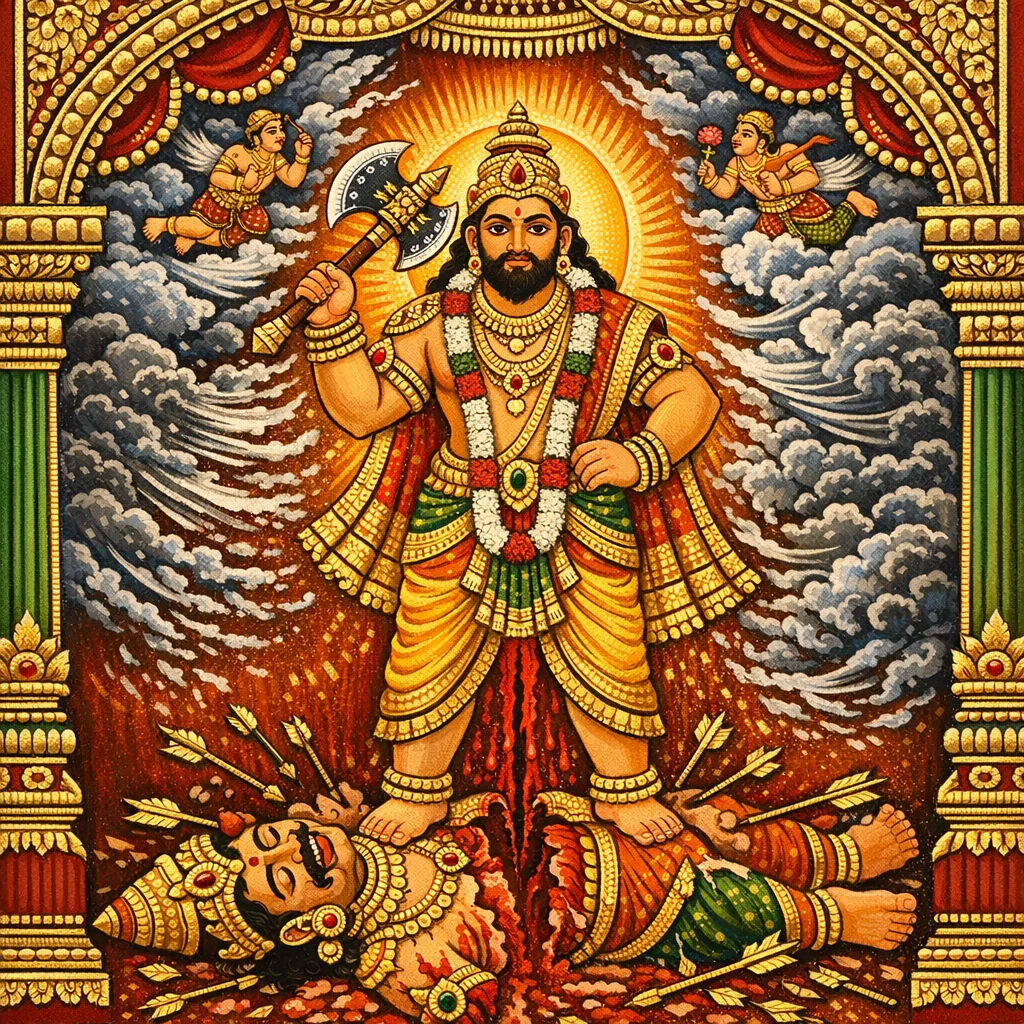
This adhyāya continues the Bhārgava-carita within the Upodghāta frame, with Vasiṣṭha as narrator. After Sucandra—praised as a crest-jewel among kings—falls, his son Puṣkarākṣa advances to battle Rāma Jāmadagnya (Paraśurāma), the foremost Bhārgava warrior. Emphasizing astra-counterastra order, Puṣkarākṣa blankets the field with a dense arrow-net (śarajāla) and briefly checks Rāma. Rāma answers with the Vāruṇa astra, raising storm-clouds and flooding rains; Puṣkarākṣa dispels them by the Vāyavya astra. Rāma then fixes the Brahma astra, whose force drags down Puṣkarākṣa like a serpent struck by a staff. Closing in, Puṣkarākṣa shoots many arrows that pin and wound Rāma, even on head and arms; yet Rāma surges forward with the dreadful axe (paraśu) and cleaves Puṣkarākṣa from topknot to feet, to the amazement of men and celestials. The episode ends with Rāma, wrathful, burning the opposing host like fire consuming a forest—both a heroic climax and a marker of dynastic termination.
Shlokas
Verse 1
इति श्रीब्रह्माण्डे महापुराणे वायुप्रोक्ते मध्यभागे तृतीय उपोद्धातपादे भार्गवचरिते एकोनचत्वारिंशत्तमो ऽध्यायः // ३९// वसिष्ठ उवाच सुचन्द्रे पतिते राजन् राजेन्द्राणां शिरोमणौ / तत्पुत्रः पुष्कराक्षस्तु रामं योद्धुमथागतः
Thus, in the Śrī Brahmāṇḍa Mahāpurāṇa, in the middle section spoken by Vāyu, in the third Upoddhāta-pāda of the Bhārgava narrative, the thirty-ninth chapter concludes. Vasiṣṭha said: “O King, when Sucandra—crest-jewel of royal lords—had fallen, his son Puṣkarākṣa then came to fight Rāma.”
Verse 2
स रथस्थो महावीर्यः सर्वशस्त्रास्त्रकोविदः / अभिवीक्ष्य रणेत्युग्रं रामं कालातकोपमम्
Mounted upon his chariot, mighty in valor and skilled in every weapon, he beheld Rāma—fierce in battle, dreadful as Kālāntaka, the Ender of Time.
Verse 3
चकार शरजालं च भार्गवेन्द्रस्य सर्वतः / मुहूर्त्तं जामदग्न्यो ऽपि बाणैः संझदितो ऽभवत्
He cast a net of arrows all around Bhārgavendra (Paraśurāma); for a moment even Jāmadagnya was shrouded by the shafts.
Verse 4
ततो निष्कम्य सहसा भार्गवेन्द्रो महाबलः / शरबन्धान्महाराज समुदैक्षत सर्वतः
Then Bhārgavendra (Paraśurāma), mighty in strength, suddenly emerged; O great king, from within that bondage of arrows he looked in every direction.
Verse 5
दृष्ट्वा तं पुष्काराक्षं तु सुचन्द्रतनयं तदा / क्रोधमाहारयामास दिधक्षन्निव पावकः
Then, seeing Puṣkarākṣa, the son of Sucandra, he was seized by wrath, like a fire eager to burn.
Verse 6
स क्रोधेन समाविष्टो वारुणं समवासृजत् / ततो मेघाः समुत्पन्ना गर्जन्तो भैरवान्नवान्
Seized by anger, he released the Varuṇāstra; then new clouds arose, thundering with dreadful roar.
Verse 7
ववृषुर्जलधाराभिः प्लावयन्तो धरां नृप / पुष्कराक्षो महावीर्यो वायव्यास्त्रुमवासृजत्
O king, they poured down in streams of water, flooding the earth; then the mighty hero Puṣkarākṣa released the Vāyavyāstra.
Verse 8
तेन ते ऽदर्शनं नीताः सद्य एव बलाहकाः / अथ रामो भृशं क्रुद्धो ब्राह्मं तत्राभिसंदधे
By that, those clouds were made invisible at once; then Rāma, fiercely enraged, fixed the Brahmāstra there.
Verse 9
पुष्कराक्षो ऽपि तेनैव विचकर्ष महाबलः / ब्राह्म सो ऽप्याहितं दृष्ट्वा दण्डाहत इवारगः
Puṣkarākṣa too, though immensely strong, was drawn by that very power; seeing the Brahmāstra set, he became like a serpent struck by a staff.
Verse 10
घोरं परशुमादाय निःश्वसंस्तमधावत / रामस्याधावतस्तत्र पुष्कराक्षो धनुर्धरः
Taking up his terrible axe, breathing heavily, he rushed forward. As Rama ran thither, Pushkaraksha, the wielder of the bow, stood ready.
Verse 11
संदधे पञ्चविशिखान्दीप्तास्यानुरगानिव / एकैकेन च बाणेन हृदि शीर्षे भुजद्वये
He fixed five arrows that resembled snakes with blazing mouths. He struck with one arrow each in the heart, the head, and the two arms.
Verse 12
शिखायां च क्रमाद्भित्त्वा तस्तंभ भृश मातुरम् / स चैवं पीडीतो रामः पुष्कराक्षेण संयुगे
And piercing his topknot in sequence, he paralyzed the deeply agitated Rama. Thus was Rama afflicted by Pushkaraksha in the battle.
Verse 13
क्षणं स्थित्वा भृशं धावन्परशुं मूर्ध्न्यपतयात् / शिखामारभ्य पादान्तं पुथ्कराक्षं द्विधाकरोत्
Pausing for a moment, then running furiously, he brought the axe down on his head. From the topknot down to the feet, he split Pushkaraksha in two.
Verse 14
पतिते शकले भूमौ तत्कालं पश्यता नृणाम् / आश्चर्यं सुमाहज्जातं दिवि चैव दिवौ कसाम्
When the pieces fell upon the ground, at that moment, a great wonder arose among the men watching and among the gods in heaven.
Verse 15
विदार्य रामस्तं क्रोधात्पुष्कराक्ष महाबलम् / तत्सैन्यमदहत्क्रुद्धः पावको विपिनं यथा
Rama tore apart the mighty Pushkaraksha in anger and burned his army just as a raging fire burns down a forest.
Verse 16
यतो यतो धावति भार्गवेन्द्रो मनो ऽनिलौजाः प्रहरन्परश्वधम् / ततस्ततो वाजिरथेभमानवा निकृत्तगात्राः शतशो निपेतुः
Wherever Bhargavendra ran with the speed of mind and wind, striking with his axe, there hundreds of horses, chariots, elephants, and men fell with severed limbs.
Verse 17
रामेण तत्रा तिबलेन संगरे निहन्यमानास्तु परश्वधेन / हा तात मातस्त्विति जल्पमांना भस्मीबभूवुः सुविचूर्णितास्तदा
Being slain in that battle by the extremely mighty Rama with his axe, crying out 'Oh father! Oh mother!', they were crushed and reduced to ashes.
Verse 18
मुहूर्त्तमात्रेण च भार्गवेण तत्पुष्कराक्षस्य बलं समग्रम् / अनेकराजन्यकुलं हतेश्वरं इतं नवाक्षौहिणिकं भृशातुरम्
In a mere moment, Bhargava destroyed Pushkaraksha's entire army of nine Akshauhinis and many royal families, leaving them leaderless and in great distress.
Verse 19
पतिते पुष्कराक्षे तु कार्त्तवीर्यार्जुनः स्वयम् / आजगाम महावीर्यः सुवर्णरथमास्थितः
When Pushkaraksha fell, the mighty Kartavirya Arjuna himself arrived, seated on a golden chariot.
Verse 20
नानाशस्त्रसमाकीर्णं नानारत्नपरिच्छदम् / दशनल्वप्रमाणं च शतवाजियुतं नृपः
That king was surrounded by many kinds of weapons and adorned with many jewels; his chariot was of daśanālva measure and yoked with a hundred horses.
Verse 21
युते बाहुसहस्रेण नानायुधधरेण च / बभौ स्वर्लोकमारोक्ष्यन्देहति सुकृती यथा
Joined with a thousand arms and bearers of many weapons, he shone forth like a meritorious man who, leaving the body, ascends to the heavenly world.
Verse 22
पुत्रास्तस्य महावीर्याः शतं युद्धविशारदाः / सेनाः संव्यूह्य संतस्थुः संग्रामे पितुराज्ञया
His hundred sons, mighty in valor and skilled in war, arrayed the armies in formation and took their stand in battle by their father’s command.
Verse 23
कार्त्तवीर्यस्तु बलवान्रामं दृष्ट्वा रणाजिरे / कालान्तकयमप्रख्यं योद्धुं समुपचक्रमे
Kārttavīrya, the mighty one, seeing Rāma on the battlefield—like Yama who ends all at the final hour—set about to fight him.
Verse 24
दक्षे पञ्चशतं बाणान्वामे पञ्चशतं धनुः / जग्रा ह भार्गवेन्द्रस्य समरे जेतुमुद्यतः
Eager to conquer Bhārgavendra in battle, he seized five hundred arrows in his right hand and five hundred bows in his left.
Verse 25
बाणवर्षं चकाराथ रामस्योपरि भूपते / यथा बलाहको वीर पर्वतोपरि वर्षति
O king, then he poured a rain of arrows upon Rama, as a mighty cloud rains upon a mountain.
Verse 26
बाणवर्षेण नेनाजौ सत्कृतो भृगुनन्दनः / जग्राह स्वघनुर्दिव्यं बाणवर्षं तथाकरोत्
Thus honored in battle by that rain of arrows, the son of Bhṛgu seized his divine bow and likewise unleashed a shower of shafts.
Verse 27
तावुभौरणसंदृप्तौ तदा भार्गवहैहयौ / चक्रतुर्यद्धमतुलं तुमुलं लोमहर्षणम्
Then, drunk with the fury of war, both Bhārgava and Haihaya waged a matchless, tumultuous battle that made the hair stand on end.
Verse 28
ब्रह्मास्त्रं च सभूपालः संदधे रणमूर्द्धनि / वधाय भार्गवेन्द्रस्य सर्वशस्त्रास्त्रधृगबली
That mighty king, wielder of every weapon and astra, at the height of battle set the Brahmāstra in place to slay Bhārgavendra.
Verse 29
रामो ऽपि वार्युपस्पृश्य ब्रह्मं ब्राह्मय संदधे / ततो व्योम्नि सदा सक्ते द्वे चाप्य स्त्रे नराधिप
O lord of men, Rama too, after touching water in purification, set the Brahmā-astra; then in the sky those two astras remained fixed, locked together.
Verse 30
ववृधाते जगत्प्रान्ते तेजसा ज्वलनार्कवत् / त्रयो लोकाः सपाताला दृष्ट्वा तन्महदद्भुतम्
At the world’s edge it swelled in splendor, like a blazing sun. The three worlds, with Pātāla, beheld that great marvel.
Verse 31
ज्वलदस्त्रयुगं तप्ता मेनिरे ऽस्योपसंयमम् / रामस्तदा वीक्ष्य जगत्प्रणाशं जगन्निवासोक्तमथास्मरत्तदा
Scorched by the blazing pair of weapons, all longed for its restraint. Then Rāma, seeing the world’s destruction, remembered the words spoken by Jagannivāsa.
Verse 32
रक्षा विधेयाद्य मयास्य संयमो निवारणीयः परमांशधारिणा / इति व्यवस्य प्रभुरुग्रतेजा नेत्रद्वयेनाथ तदस्त्रयुगमम्
“Today I must protect; by one who bears the supreme divine portion it must be restrained and checked.” So resolved, the Lord of fierce radiance, with His two eyes, held back that pair of weapons.
Verse 33
पीत्वातिरामं जगदाकलय्य तस्थौ क्षणं ध्यानगतो महात्मा / ध्यानप्रभावेण ततस्तु तस्य ब्रह्मास्त्रयुग्मं विगतप्रभावम्
Having absorbed Atirāma and gathered the world back into order, the great soul stood for a moment in meditation. By the power of that dhyāna, his pair of Brahmāstras lost their might.
Verse 34
पपात भूमौ सहसाथ तत्क्षणं सर्वं जगत्स्वास्थ्यमुपाजगाम / स जामदग्न्यो महातां महीयान्स्रष्टुं तथा पालयितुं निहन्तुम्
In that very instant it suddenly fell to the earth, and the whole world returned to well-being. That Jāmadagnya was greatest among the great—able to create, to preserve, and to destroy.
Verse 35
विभुस्तथापीह निजंप्रभावं गोपायितुं लोकविधिं चकार / धनुर्द्धरः शूरतमो महस्वान्सदग्रणीः संसदि तथ्यवक्ता
Though he was the all-pervading Lord, he concealed his own splendor here and established the order of the world. A bow-bearer, the bravest and most radiant, he led the righteous and spoke truth in the assembly.
Verse 36
कलाकलापेषु कृतप्रयत्नो विद्यासु शास्त्रेषु बुधो विधिज्ञः / एवं नृलोके प्रथयन्स्वभावं सर्वाणि कल्यानि करोति नित्यम्
He strove in every art, was wise in learning and śāstras, and knew the sacred rules. Thus, in the human world, revealing his nature, he ever performs all auspicious deeds.
Verse 37
सर्वे तु लोका विजितास्तु तेन रामेण राजन्यनिषूदनेन / एवं स रामः प्रथितप्रभावः प्रशामयित्वा तु तदस्त्रयुग्मम्
That Rāma, the slayer of the warrior-kings, conquered all the worlds. Thus Rāma, famed for his might, calmed that pair of weapons and rendered them powerless.
Verse 38
पुनः प्रवृत्तो निधनं प्रकर्तुं रणागणे हैहयवंशकेतोः / तुणीरतः पत्रियुगं गृहीत्वा पुङ्खे निधायाथ धनुर्ज्यकायाम्
Again he pressed on in the battlefield to bring death to the standard-bearer of the Haihaya line. From his quiver he took a pair of arrows and set them, fletched, upon the bowstring.
Verse 39
आलक्ष्य लक्ष्यं नृपकर्णयुग्मं चकर्त्त चूडामणिहर्तुकामः / स कृत्तकर्णो नृपतिर्महात्मा विनिर्जिताशेषजगत्प्रवीरः
Marking his aim at the king’s two ears, and longing to seize the crest-jewel (cūḍāmaṇi), he cut them off. Yet that great-souled king—conqueror of all the world’s champions—remained unshaken.
Verse 40
मेने निजं वीर्यमिह प्रणष्टं रामेण भूमीशतिरस्कृतात्मा / क्षणं धराधीशतनुर्विवर्णा गतानुभावा नृपतेर्बभूव
Scorned by Rama, the king deemed his own valor lost in that very place. In a moment the lord of the earth grew pale, and his former might and splendor ebbed away.
Verse 41
लेख्येव सच्चित्रकरप्रयुक्ता सुदीनचित्तस्य विलक्ष्यते ऽग / ततः स राजा निजवीर्यवैभवं समस्तलोकाधिकतां प्रयातम्
The king’s dejected state was plain to see, like a picture drawn by a master artist. Then he beheld the majesty of his own heroic power risen to a station surpassing all the worlds.
Verse 42
विचिन्त्य पौलस्त्यजयादिलब्धं शोचन्निवासीत्स जयाभिकाङ्क्षीं / दध्यौ पुनर्मीलितलोचनो नृपौ दत्तं तमात्रेयकुलप्रदीपम्
Pondering what he had gained through victory over Paulastya and the rest, the king—yearning for conquest—sat as one sunk in grief. Then, closing his eyes, he meditated on the great Datta, the lamp of the Atreya line.
Verse 43
यस्य प्रभावानुगृहीत ओजसा तिरश्चकारा खिललोकपालकान् / यदास्य हृद्येष महानुभावो दत्तः प्रयातो न हि दर्शनं तदा
By the might blessed through his own radiance, Datta had humbled even all the Lokapalas. Yet when that great-souled Datta departed from his heart, then there was no longer any vision of him.
Verse 44
खिन्नो ऽतिमात्रं धरणीपतिस्तदा पुनः पुनर्ध्यानपथं जगाम / स ध्यायमानो ऽपि न चाजगाम दत्तो मनोगोचरमस्य राजन्
Then the lord of the earth, utterly wearied, returned again and again to the path of meditation. O king, even as he contemplated, Datta did not come within the reach of his mind.
Verse 45
तपस्विनो दान्ततमस्य साधोरनागसो दुष्कृतिकारिणो विभुः / एवं यदात्रेस्तनयो महात्मा दृष्टो न च ध्यानपथे नृपेण
The austere sage, perfectly self-restrained and blameless, the mighty Lord who can master even wrongdoers—such was the great son of Atri. The king beheld him, yet not upon the path of meditation.
Verse 46
तदातिदुः खेन विदूयमानः शोकेन मोहेन युतो बभूव / तं शोकमग्नं नृपतिं महात्मा रामो जगादाखिलचित्तदर्शी
Then, torn by overwhelming sorrow, he was seized by grief and delusion. To that king, sunk in lamentation, spoke the great Rama, who beholds every heart.
Verse 47
मा शोकभावं नृपते प्रयाहि नैवानुशोचन्ति महानुभावाः / यस्ते वरायाभवमादिसर्गे स एव चाहं तंव सादनाय
O king, do not yield to grief; the great-hearted do not lament. He who, at the dawn of creation, appeared to grant you a boon—that very one am I, come to accomplish your purpose.
Verse 48
समागतस्त्वं भवधीरचित्तः संग्रामकाले न विषादचर्चा / सर्वो हि लोकः स्वकृतं भुनक्ति शुभाशुभं दैवकृतं विपाके
You have come—keep your heart steadfast; in the hour of battle there is no place for despondent talk. All the world partakes of the fruit of its own deeds; good and evil ripen, by divine ordinance, in their destined result.
Verse 49
अन्योनको ऽप्यस्य शुभाशुभस्य विपर्ययं कर्तुमलं नरेश / यत्ते सुपुण्यं बहुजन्मसंचितं तेनेह दत्तस्य वरार्हपात्रम्
O king, none can reverse this interplay of good and evil. It is your great merit, gathered through many births, that has made you here a worthy vessel for the boon bestowed.
Verse 50
जातो भवानद्य तु दुष्कृतस्य फलं प्रभुङ्क्ष्व त्वमिहार्जितस्य / गुरुर्विमत्यापकृतस्त्वया मे यतस्ततः कर्णनिकृन्तनं ते
You are born indeed, but today experience the fruit of the evil deed earned by you here. Since my Guru (father) was insulted and harmed by you out of disrespect, I shall cut off your ears.
Verse 51
कृतं मया पश्य हरन्तमोजसा चूडामणिं मामपत्दृत्य ते यशः / इत्येवमुक्त्वा स भृगुर्महात्मा नियोज्य बाणं च विकृष्य चापम्
Behold what is done by me, forcibly taking away your crest-jewel and destroying your fame. Having said this, that great soul of the Bhrigu race fixed an arrow and drew his bow.
Verse 52
चिक्षेप राज्ञः स तु लाघवेन च्छित्त्वा मणिं रामममुपाजगाम / तद्वीक्ष्य कर्मास्य मुनेः सुतस्य स चार्जुनो हैहयवंशधर्त्ता
He shot at the king with dexterity; having cut off the jewel, the arrow returned to Rama. Seeing that feat of the Sage's son, that Arjuna, the upholder of the Haihaya lineage...
Verse 53
समुद्यतो ऽभूत्पुनरप्युदायुधस्तं हन्तुमाजौ द्विजमात्मशत्रुम् / शूलशक्तिगदाचक्रखढ्गपट्टिशतोमरैः
...became ready again with raised weapons to kill that Brahmin, his enemy, in battle. With trident, spear, mace, discus, sword, axe, and iron club...
Verse 54
नानाप्रहरणैश्चान्यैराजघान द्विजात्मजम् / स रामो लाघवेनैव संप्रक्षिप्तान्यनेन च
...and with various other missiles, he struck at the son of the Brahmin. That Rama, with mere dexterity, [countered] those thrown by him...
Verse 55
शूलादीनि चकर्त्ताशु मध्य एव निजाशुगैः / स राजा वार्युपस्पृश्य ससर्जाग्नेयमुत्तमम्
With his own swift arrows the king quickly cut the tridents and other weapons in mid-course. Then, touching water in rite, he unleashed the supreme Agni-astra.
Verse 56
अस्त्रं रामो वारुणेन शमयामास सत्वरम् / गान्धर्वं विदधे राजा वायव्येनाहनद्विभुम्
Rama swiftly quelled that weapon with the Varuna-astra. Then the king, employing the Vayu-astra, set forth the Gandharva-astra and struck the mighty foe.
Verse 57
नागास्त्रं गारुडेनापि रामश्चिच्छेद भूपते / दत्तेन दत्तं यच्छूलमव्यर्थं मन्त्रपूर्वकम्
O king, Rama also severed the Naga-astra with the Garuda-astra. And the trident Datta bestowed with mantras is never rendered fruitless.
Verse 58
जग्राह समरे राजा भार्गवस्य वधाय च / तच्छूलं शतसूर्याभमनिवार्यं सुरासुरैः
In battle the king seized that trident to slay Bhargava. It blazed like a hundred suns, irresistible to devas and asuras alike.
Verse 59
चिक्षेप राममुद्दिश्य समग्रेण बलेन सः / मूर्ध्नि तद्भार्गवस्याथ निपपात महीपते
He hurled it with all his might, aiming at Rama. Yet, O king, it fell instead upon Bhargava’s head.
Verse 60
तेन शूलप्रहारेण व्यथितो भार्गवस्तदा / मूर्च्छामवाप राजेन्द्र पपात च हरिं स्मरन्
Struck by that blow of the trident, Bhārgava was wracked with pain then, O king; he fell into a swoon and collapsed to the earth, remembering Hari.
Verse 61
पतिते भार्गवे तत्र सर्वे देवा भयाकुलाः / समाजग्मुः पुरस्कृत्य ब्रह्मविष्णुमहेश्वरान्
When Bhārgava fell there, all the gods were shaken with fear; gathering together, they placed Brahmā, Viṣṇu, and Maheśvara at their fore.
Verse 62
शङ्करस्तु महाज्ञानी साक्षान्मृत्युञ्जयः प्रभुः / भार्गवं जीवयामास संजीवन्या स विद्यया
Śaṅkara, the all-knowing—Lord Mṛtyuñjaya himself—revived Bhārgava by that Sañjīvanī lore.
Verse 63
रामस्तु चेतनां प्राप्य ददर्श पुरतः सुरान् / प्रणनाम च राजेन्द्र भक्त्या ब्रह्मादिकांस्तु तान्
Rāma, regaining consciousness, beheld the gods before him; O king, with devotion he bowed to Brahmā and the rest.
Verse 64
ते स्तुता भार्गवेन्द्रेण सद्यो ऽदर्शनमागताः / स रामो वार्युस्पृश्य जजाप कवचं तु तत्
Praised by Bhārgavendra, they vanished from sight at once; then Rāma, touching water for ācamana, recited that kavaca in japa.
Verse 65
उत्थितश्च सुसंरब्धो निर्दहन्निव चक्षुषा / स्मृत्वा पाशुपतं चास्त्रं शिवदत्तं स भार्गवः
Then Bhārgava rose up in fierce wrath, as though he would burn with his very gaze. He called to mind the Pāśupata weapon, bestowed by Śiva.
Verse 66
सद्यः संहृतवांस्तत्तु कार्त्तवीर्यं महाबलम् / स राजा दत्तभक्तस्तु विष्णोश्चक्रं सुदर्शनम् / प्रविष्टो भस्मसाज्जातं शरीरं बाहुनन्दन
At once he brought down Kārttavīrya, the mighty one. That king, a devotee of Datta, was consumed by Viṣṇu’s Sudarśana discus, his body reduced to ashes—O Bāhunandana.
Frequently Asked Questions
It marks a dynastic transition by narrating the fall of Sucandra and the death of his son Puṣkarākṣa, functioning as a termination/turning-point episode within the surrounding royal genealogy.
Puṣkarākṣa’s arrow-net is answered by Rāma’s Vāruṇa astra (storm/flood), countered by Puṣkarākṣa’s Vāyavya astra (wind dispersal), culminating in Rāma’s Brahma astra as a decisive, hierarchy-topping force—illustrating counter-astra pairing and escalation.
No; the sampled material is Bhārgava-carita centered on Paraśurāma and royal opponents, emphasizing martial-dynastic narration rather than the Śākta esoterica and yantra/vidyā frameworks typical of the Lalitopākhyāna section.