Adhyaya 37
Agastyopadeśa: Viṣṇupada-stava-sādhanā and Paraśurāma’s Darśana of Hari
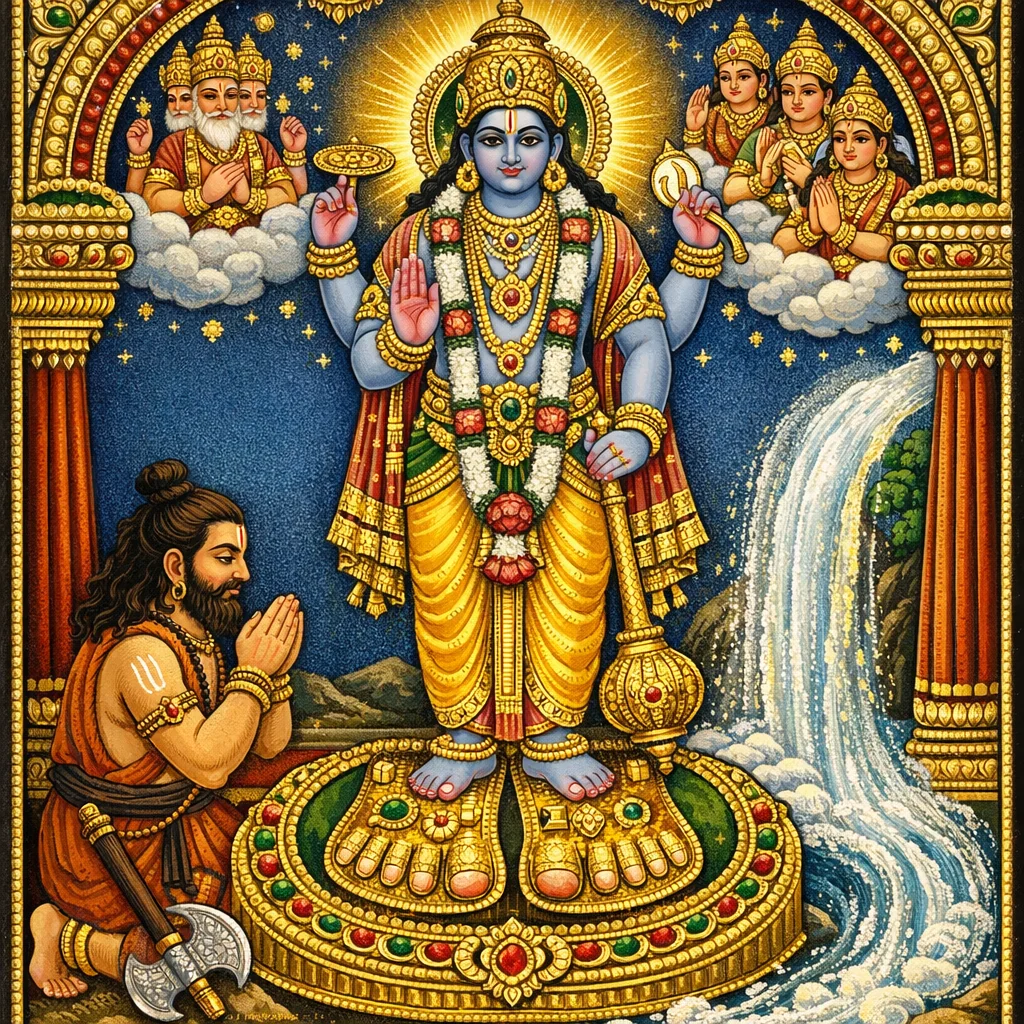
Framed by Vasiṣṭha’s narration, this chapter tells how Paraśurāma, after reporting a wondrous incident heard in a hunting setting, comes before the sage Agastya (Kumbhasaṃbhava). Agastya gives upadeśa for Paraśurāma’s welfare and spiritual efficacy, pointing him to a far-off and exceedingly rare “great place of Viṣṇu” marked by the Lord’s footprints (Viṣṇupada). The site bears cosmic significance: Gaṅgā is said to arise there from the left side/foot-region of the Mahātman during the Trivikrama stride by which Bali was subdued. Agastya prescribes a month-long observance—disciplined recitation of a particular divine stava (divya stava), with regulated conduct and diet—and connects it with the “kavaca” practice Paraśurāma had earlier mastered for conquering enemies, now promised to confer siddhi when joined to this vow. Vasiṣṭha then describes Paraśurāma’s obedience: he leaves the āśrama, reaches the footprint-site linked to the river’s emergence, resides there, and sustains the recitation. The practice culminates in Hari’s satisfaction and direct darśana: Kṛṣṇa, hailed as caturvyūhādhipa and adorned with kirīṭa, kuṇḍalas, kaustubha, and pītavāsa, appears in captivating form before Jāmadagnya. Paraśurāma rises, prostrates, and offers a formal hymn of surrender to the supreme Lord praised by Brahmā and the gods, presenting a model of how sacred geography and disciplined stotra-sādhanā lead to divine encounter.
Shlokas
Verse 1
इति श्रीब्रह्माण्डे महापुराणे वायुप्रोक्ते मध्यभागे तृतीय उपोद्धातपादे भार्गवचरिते षट्त्रिंशत्तमो ऽध्यायः // ३६// वसिष्ठ उवाच दृष्ट्वा परशुरामस्तु तदाश्चर्यं महाद्भुतम् / जगाद सर्ववृत्तान्तं मृगयोस्तु यथाश्रुतम्
Thus, in the Śrī Brahmāṇḍa Mahāpurāṇa, in the middle section spoken by Vāyu, in the third introductory division, within the Bhārgava narrative, ends the thirty-sixth chapter. Vasiṣṭha said—Paraśurāma, beholding that great and wondrous marvel, recounted the entire account of the pair of deer just as he had heard it.
Verse 2
तच्छ्रुत्वा भगवान्साक्षादगस्त्यः कुंभसंभवः / मोदमान उवाचेदं भार्गवं पुरतः स्थितम्
Hearing this, the blessed Agastya—born of the sacred jar—rejoiced and spoke these words to Bhārgava standing before him.
Verse 3
अगस्त्य उवाच शृणु राम महाभाग कार्याकार्विशारद / हितं वदामि यत्ते ऽद्य तत्कुरुष्व समाहितः
Agastya said: “Listen, O greatly blessed Rama, skilled in what should and should not be done. Today I speak for your welfare—do it with a steady, focused mind.”
Verse 4
इतो विदूरे सुमहत्स्थानं विष्णोः सुदुर्लभम् / पदानि यत्र दृश्यन्ते न्यस्तानि सुमाहात्मना
Far from here lies a supremely great and hard-to-attain abode of Vishnu, where the footprints set down by that exalted Mahatma are seen.
Verse 5
यत्र गङ्गा समुद्भूता वामस्य महात्मनः / पदाग्रात्क्रमतो लोकांस्तद्बलेस्तु विनिग्रहे
There the Ganga sprang forth from the tip of that great being’s left foot, as he strode step by step across the worlds to restrain Bali.
Verse 6
तत्र गत्वा स्तवं चेदं मासमैकमनन्यधीः / पठस्व नियमेनैव नियतो नियताशनः
Go there and for one full month, with undivided mind, recite this hymn strictly by the prescribed observance—self-restrained and moderate in food.
Verse 7
यत्त्वया कवचं पूर्वमभ्यस्तं सिद्धिमिच्छता / शत्रूणां निग्रहार्थाय तच्च ते सिद्धिदं भवेत्
O seeker of siddhi, the sacred armor you formerly practiced in desire of attainment—meant for the subduing of foes—may it become for you a bestower of siddhi.
Verse 8
वसिष्ठ उवाच एव मुक्तो ह्यगस्त्येन रामः शत्रुनिबर्हणः / नमस्कृत्य मुनीं शान्तं निर्जगामाश्रमाद्बहिः
Vasiṣṭha said: Thus released by Agastya, Rāma, the crusher of foes, bowed to the tranquil sage and went out from the hermitage.
Verse 9
पुनस्तेनैव मार्गेण संप्राप्तस्तत्र सत्वरम् / यत्रोत्तरात्पदन्यासान्निर्गता स्वर्णदी नृप
O king, he again took that very path and swiftly reached the place where, from a footstep set to the north, the river Svarṇadī had issued forth.
Verse 10
तत्र वासं प्रकल्प्यासावकृतव्रणसंयुतः / समभ्यस्यत्स्तवं दिव्यं कृष्मप्रेमामृताभिधम्
There he made his dwelling; though marked with wounds, he diligently practiced the divine hymn called “Kṛṣṇa-premāmṛta,” the nectar of love for Kṛṣṇa.
Verse 11
नित्यं व्रजपतेस्तस्य स्तोत्रं तुष्टो ऽभवद्धरिः / जगाम दर्शनं तस्य जामदग्न्यस्य भूपते
O king, pleased by that daily hymn to the Lord of Vraja, Hari came to grant his vision to Jāmadagnya (Paraśurāma).
Verse 12
चतुर्व्यूहाधिपः साक्षात्कृष्णः कमललोचनः / किरीटंनार्कवर्णेन कुण्डलाभ्यां च राजितः
The Lord of the fourfold emanations—Kṛṣṇa Himself, lotus-eyed—shone adorned with a sun-hued crown and a pair of radiant earrings.
Verse 13
कौस्तुभोद्भासितोरस्कः पीतवासा धनप्रभः / मुरलीवादनपरः साक्षान्मोहनरूपधृक्
His chest blazed with the Kaustubha jewel; clad in yellow garments, he shone like a treasure; intent on playing the flute, he truly bore the enchanting form.
Verse 14
तं दृष्ट्वा सहसोत्थाय जामदग्न्यो मुदान्वितः / प्रणम्य दण्डवद्भमौ तुष्टाव प्रयतो विभुम्
Seeing Him, Jamadagni’s son (Paraśurāma) rose at once in joy; bowing in full prostration upon the earth, he reverently praised that all-pervading Lord.
Verse 15
परशुराम् उवाच नमो नमः कारणविग्रहाय प्रपन्नपालाय सुरार्त्तिहारिणे / ब्रह्मेशविष्ण्विद्रमुखस्तुताय नतो ऽस्मि नित्यं परमेश्वराय
Paraśurāma said: “Homage, homage to You—the embodied First Cause, the Protector of those who seek refuge, the Remover of the gods’ distress; praised by Brahmā, Īśa, Viṣṇu, Indra and the rest—I bow always to the Supreme Lord.”
Verse 16
यं वेदवादैर्विविधप्रकारैर्निर्णेतुमीशानमुखा न शक्नुयुः / तं त्वामनिर्देश्यमचं पुराममनन्तमीडे भव मे दयापरः
He whom even Īśāna and the rest cannot determine through the Veda’s many modes of speech—to You, the indescribable, unborn, primeval, infinite One, I offer praise; be compassionate toward me, O Lord.
Verse 17
यस्त्वेक ईशो निजवाञ्च्छितप्रदो धत्ते तनूर्लोकविहार रक्षणे / नाना विधा देवमनुष्यतिर्यग्यादः सु भूमेर्भरवारणाय
He, the one Īśvara who grants the wished-for fruits, assumes many bodies for the world’s protection and divine līlā; as deva, human, and other beings, he removes the burden of the earth.
Verse 18
तं त्वामहं भक्तजनानुरक्तं विरक्तमत्यन्तमपीन्दिरादिषु / स्वयं समक्षंव्यभिचारदुष्टचित्तास्वपि प्रेमनिबद्धमानसम्
I bow to you—beloved of devotees, utterly detached even from Indirā (Lakṣmī) and all splendor; and though present before one’s eyes, your heart is bound by love even toward minds tainted by wayward conduct.
Verse 19
यं वै प्रसन्ना असुराः सुरा नराः सकिन्नरास्तिर्यकेयोनयो ऽपि हि / गताः स्वरूपं निखलं विहाय ते देहस्त्र्यपत्यार्थममत्वमीश्वर
O Īśvara! When you are gracious, asuras, suras, humans, kinnaras, and even beings of animal birth abandon their former state entirely and come to you; yet for the sake of body, wife, and children they become bound by the possessive “mine” (mamatva).
Verse 20
तं देवदेवं भजतामभीप्सितप्रदं निरीहं गुणवर्जितं च / अचिन्त्यमव्यक्तमघौघनाशनं प्राप्तो ऽरणं प्रेमनिधानमादरात्
With reverence, take refuge in that Deva of devas: he grants the desired boon to those who worship, is desireless and beyond the guṇas; inconceivable, unmanifest, destroyer of floods of sin, a treasury of love.
Verse 21
तपन्ति तापैर्विविधैः स्वदेहमन्ये तु यज्ञैर्विविधैर्यजन्ति / स्वप्ने ऽपि ते रूपमलौकिकंविभो पश्यन्ति नैवार्थनिबद्धवासनाः
Some scorch their bodies with many austerities, while others worship through varied sacrifices; O Vibhu, those whose desires are not bound to wealth behold your otherworldly form even in dreams.
Verse 22
ये वै त्वदीयं चरणं भवश्रमान्निर्विण्मचित्ता विधिवत्स्मरन्ति / नमन्ति भक्त्याथ समर्चयन्ति वै परस्परं संसदि वर्णयन्ति
Those whose hearts have grown weary of the toil of worldly becoming remember Your feet in due rite; they bow in devotion and worship, and in the assembly they speak to one another of Your glory.
Verse 23
तेनैकजन्मोद्भवपङ्कभेदनप्रसक्तचित्ता भवतोंऽघ्रिपद्मे / तरन्ति चान्यानपि तारयन्ति हि भवौषधं नाम सुधा तवेश
Thus, with minds intent on breaking through the mire of sin born of a single life, they cling to the lotus of Your feet; they cross over and carry others across as well, O Lord, for Your Name is the medicine for the sickness of samsara—nectar indeed.
Verse 24
अहं प्रभो कामनिबद्धचित्तो भवन्तमार्यं विविधप्रयत्नैः / आराधयं नाथ भवानभिज्ञः किं ते ह विज्ञाप्यमिहास्ति लोके
O Lord, my mind is bound by desire; though I strive in many ways, O noble One, I cannot worship You as I should. O Master, You are all-knowing—what is there in this world that I could even report to You?
Verse 25
वसिष्ठ उवाच इत्येवं जामदग्न्यं तु स्तुवन्तं प्रणतं पुरः / उवाचागाधया वाचा मोहयन्निव मायया
Vasiṣṭha said: Seeing Jāmadagnya before him, praising and bowed down, he spoke in words deep and unfathomable, as though enchanting by māyā.
Verse 26
कृष्ण उवाच हन्त राम महाभाग सिद्धं ते कार्यमुत्तमम् / कवचस्य स्तवस्यापि प्रभावादवधारय
Kṛṣṇa said: Come, O greatly blessed Rāma—your noble task is accomplished. Know also, and hold as certain, the power of this kavaca-hymn of praise.
Verse 27
हत्वा तं कार्त्तवीर्यं हि राजानं दृप्तमानसम् / साधयित्वा पितुर्वैरं कुरु निःक्षत्रियां महीम्
Having slain the proud-hearted king Kārttavīrya, fulfill the vengeance for your father’s enmity and make the earth bereft of kṣatriyas.
Verse 28
मम चक्रावतारो हि कार्त्तवीर्यो धरातले / कृतकार्यो द्विजश्रेष्ट तं समापय मानद
Kārttavīrya upon the earth is indeed my incarnation as the Cakra; O best of the twice-born, his task is fulfilled—O giver of honor, bring him to an end.
Verse 29
अद्य प्रभृति लोके ऽस्मिन्नंशावेशेन मे भवान् / चरिष्यति यथा कालं कर्त्ता हर्त्ता स्वयं प्रभुः
From this day onward in this world, by the indwelling of my portion, you shall move according to time as the Lord Himself—both doer and taker-away.
Verse 30
चतुर्विशे युगे वत्स त्रेतायां रघुवंशजः / रामो नाम भविष्यामि चतुर्व्यूहः सनातनः
O child, in the twenty-fourth yuga, in the Tretā age, I shall be born in the Raghu line, named Rāma—the eternal Caturvyūha.
Verse 31
कौसल्यानन्दजनको राज्ञो दशरथादहम् / तदा कौशिकयज्ञं तु साधयित्वा सलक्ष्मणः
Born of King Daśaratha, I shall become the joy of Kauśalyā; then, together with Lakṣmaṇa, I shall bring Kauśika’s sacrifice to fulfillment.
Verse 32
गमिष्यामि महाभाग जनकस्य पुर महत् / तत्रेशचापं निर्भज्य परिणीय विदेहजाम्
O noble one, I shall go to the great city of Janaka; there, breaking Śiva’s bow, I shall wed Sītā, the daughter of Videha.
Verse 33
तदा यास्यन्नयोध्यां ते हरिष्ये तेज उन्मदम् / वसिष्ठ उवाच कृष्ण एवं समदिश्य जामदग्न्यं तपोनिधिम् / पश्यतोंऽतर्दधे तत्र रामस्य मुमहात्मनः
Then, as you set out for Ayodhyā, I shall take away the frenzy of your blazing might. Vasiṣṭha said: O Kṛṣṇa! Having thus instructed Jāmadagnya, that treasure of austerity, he vanished there before the very eyes of the great-souled Rāma.
Frequently Asked Questions
Agastya prescribes going to the rare Viṣṇu-site marked by divine footprints and performing a month-long, rule-bound recitation of a divine stava with controlled conduct and diet, presented as siddhi-producing and complementary to Paraśurāma’s earlier kavaca practice.
It maps a cosmological event onto a physical locus: Viṣṇu’s Trivikrama stride (used to subdue Bali) leaves footprints that become a tīrtha, and Gaṅgā is said to arise there—turning mythic time into navigable devotional space.
The epithet frames the appearing deity as the supreme organizer of the fourfold emanational theology (vyūha) associated with Vaiṣṇava metaphysics; the darśana functions as the narrative proof-of-result (phala) for disciplined stotra-sādhanā and surrender.