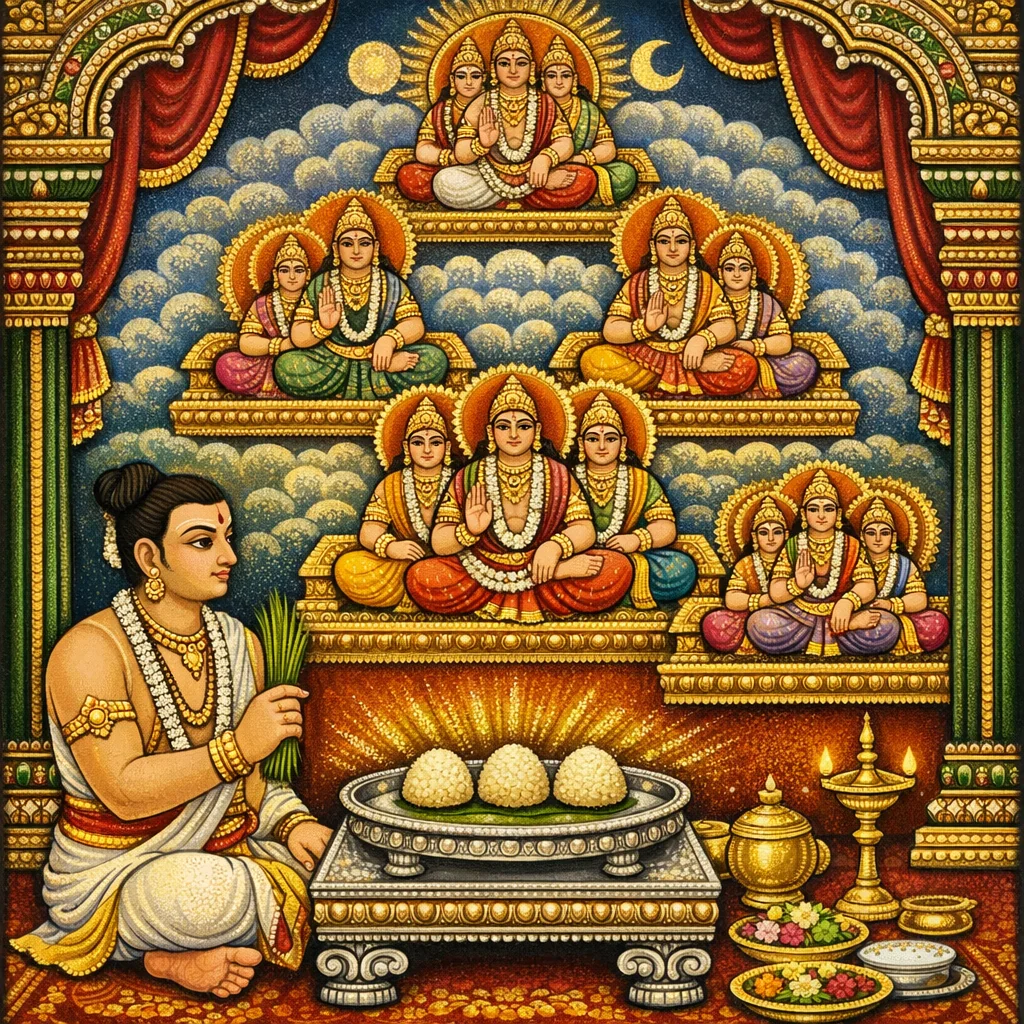
Adhyaya 20
Brahmaṇa-parīkṣā (Examination/Doctrine of the Pitṛs in Śrāddha Context)
This adhyāya, spoken by Bṛhaspati within a śrāddha-kalpa setting, teaches the ontological standing and ritual centrality of the Pitṛs (ancestors). The Pitṛs are described as enduring, established in seven abodes, and as “deities even of the gods,” so that in practice pitṛ-kārya is given priority over deva-kārya. It classifies groups connected with Prajāpati’s progeny and aligns worship across varṇa and āśrama, explicitly stating that all social orders—including mixed communities and mlecchas—perform some form of pitṛ worship. The chapter then explains efficacy: offerings (especially three piṇḍas) made with name-and-gotra identification and mantra reach the intended recipients, illustrated by analogies of nourishment and recognition, like a calf finding its mother. Ritual details are noted—placement of kuśa, apasavya orientation, and the purifying suitability of silver vessels—and it concludes with a metaphysical point that satisfaction can follow beings through many births, grounded in the stable ordinance of Brahmā (Parameṣṭhin).
Shlokas
Verse 1
इति श्रीब्रह्माण्डे महापुराणे वायुप्रोक्ते मध्यभागे तृतीय उपोद्धातपादे श्राद्धकल्पे ब्रह्मणपरीक्षा नाम एकोनविंशो ऽध्यायः // १९// बृहस्पतिरुवाच इत्येते पितरो देवा देवानामपि देवताः / सप्तस्वेते स्थिता नित्यं स्थानेषु पितरो ऽव्ययाः
Thus, in the Śrī Brahmāṇḍa Mahāpurāṇa, proclaimed by Vāyu, in the middle section, the third Upoddhāta-pāda, within the Śrāddha-kalpa, is the nineteenth chapter called “Brahmaṇa-parīkṣā”. Bṛhaspati said: These Pitṛs are divine, deities even for the gods; the imperishable Pitṛs abide eternally in seven appointed stations.
Verse 2
प्रजापतिसुता ह्येते सर्वेषां तु महात्मनाम् / आद्यो गणस्तु योगानामनुयोगविवर्द्धनः
These indeed are the sons of Prajāpati, pertaining to all the great-souled ones; among the hosts of yoga this is the first company, which increases anuyoga—the onward continuity of sacred practice.
Verse 3
द्वितीयो देवतानां तु तृतीयो दानवादिनाम् / शेषास्तु वर्णिंनां ज्ञेया इति सर्वे प्रकीर्त्तिताः
The second company belongs to the Devas, the third to the Dānavas and their like; the remaining companies are to be known as pertaining to the varṇas—thus have they all been declared.
Verse 4
देवास्छैतान्यजन्ते वै सर्वज्ञानेष्ववस्थितान् / आश्रमश्च यजन्त्येनांश्चत्वारस्तु यथाक्रमम्
The Devas too worship these Pitṛs, who are established in all-knowing wisdom; and the four āśramas likewise venerate them, each in due order.
Verse 5
सर्वे वर्णा यजन्त्येनांश्चत्वारस्तु यथागमम् / तथा संकरजात्यश्च म्लेच्छाश्चापि यजन्ति वै
All the varṇas worship them in accordance with the āgamas, in four prescribed ways; so too do the mixed-born communities, and even the mlecchas, indeed, render them reverence.
Verse 6
पितृंस्तु यो यजेद्भक्त्या पितरः प्रीणयन्ति ते / पितरः पुष्टिकामस्य प्रजाकामस्य वा पुनः
Whoever worships the Pitṛs with devotion gladdens those Ancestors. The Pitṛs grant nourishment and prosperity, and likewise offspring to one who desires it.
Verse 7
पुष्टिं प्रजां तु स्वर्गं च प्रयच्छन्ति पितामहाः / देवकार्यादपि तथा पितृकार्यं विशिष्यते
The Pitāmahas bestow nourishment, progeny, and heaven. Thus, even above rites for the gods, the rite owed to the Pitṛs is declared more excellent.
Verse 8
देवतानां हि पितरः पूर्वमाप्यायनं स्मृताः / न हि योगगतिः सूक्ष्मा पितॄणां ज्ञायते नरैः
Even for the gods, the Pitṛs are remembered as the prior source of nourishment. For the subtle yogic course of the Pitṛs is not known to human beings.
Verse 9
तपसा हि प्रसिद्धेन किं पुनर्मांसचक्षुषा / सर्वेषां राजतं पात्रमथ वा रजतान्वितम्
If it is known through renowned austerity, what need to speak of the fleshly eye? For all, a vessel of silver—or one adorned with silver—is deemed fitting.
Verse 10
पावनं ह्युत्तमं प्रोक्तं देवानां पितृभिः सह / येषां दास्यन्ति पिण्डांस्त्रीन्बान्धवा नामगोत्रतः
This rite, performed with the gods together with the Pitṛs, is declared supremely purifying. For them, kinsmen will offer three piṇḍas, according to name and gotra.
Verse 11
भूमौ कुशोत्तरायां च अपसव्यविधानतः / सर्वत्र वर्त्तमानास्ते पिण्डाः प्रीणन्ति वै पितॄन्
On the ground, with kuśa grass set to the north and according to the apasavya rite, those piṇḍa offerings, wherever they are placed, truly gladden and satisfy the Pitṛs (ancestral spirits).
Verse 12
यदाहारो भवेज्जन्तुराहारः सो ऽस्य जायते / यथा गोष्ठे प्रनष्टां वै वत्सो विन्दति मातरम्
Whatever food is allotted to a being, that very sustenance comes to it—just as a calf lost in the cowshed finds its mother.
Verse 13
तथा तं नयते मन्त्रो जन्तुर्यत्रावतिष्ठति / नामगोत्रं च मन्त्रं च दत्तमन्नं नयन्ति तम्
So too the mantra leads that being to the very place where it abides; the mantra uttered with name and gotra, and the food that is offered, are conveyed to it.
Verse 14
अपि योनिशतं प्राप्तांस्तृप्तिस्ताननुगच्छति / एवमेषा स्थिता सत्ता ब्रह्मणः परमेष्ठिनः
Even if they attain hundreds of womb-born states (yonis), satisfaction still follows them; thus stands this steadfast ordinance of Brahmā, the Parameṣṭhin.
Verse 15
पितॄणमादिसर्गेतु लोकानामक्षयार्थिनाम् / इत्येते पितरश्चैव लोका दुहितरस्तथा
In the primal creation, for the sake of the Pitṛs and for the imperishability of the worlds—thus are spoken of these Pitṛs and these lokas, and likewise as the ‘duhitars’ (daughters).
Verse 16
दौहित्रा यजमानश्च प्रोक्ताश्चैव मयानघ / कीर्त्तिताः पितरस्ते वै तव पुत्र यथाक्रमम्
O blameless one, I have also spoken of the dauhitra (daughter’s sons) and of the yajamāna; O son, your Pitṛs have been recounted in due order.
Verse 17
शंयुरुवाच अहो दिव्यस्त्वया तात पितृसर्गस्तु कीर्तितः / लोका दुहितरश्चैव दोहित्राश्च श्रुतास्तथा
Śaṃyu said: “O father, divinely have you proclaimed the creation of the Pitṛs; and likewise we have heard of the worlds, the daughters, and the dauhitra.”
Verse 18
दानानि सह शौचेन कीर्त्तितानि फलानि च / अक्षय्यत्वं द्विजांश्चैव सर्वमेतदुदाहृतम् / अद्यप्रभृति कर्त्तास्मि सर्वमेतद्यथातथम्
Gifts given with purity have been praised, and their fruits as well; imperishable merit and due honor to the dvijas—everything has been declared. From this day onward, I shall do all of it exactly as prescribed.
Verse 19
बृहस्पतिरुवाच इत्येतदङ्गिराः पूर्वमृषीणामुक्तवान्प्रभुः / पृष्टश्च संशयान्सर्वानृषीनाह नृसंसदि
Bṛhaspati said: “Thus did the lord Aṅgiras formerly speak to the ṛṣis; and when all their doubts were asked, he answered the ṛṣis in the assembly of men.”
Verse 20
सत्रे तु वितते पूर्वं तथा वर्षसहस्रके / यस्मिन्सदस्पतिस्नातो ब्रह्मा सीद्देवताप्रभुः
In former times, at a satra extended for a thousand years, wherein Brahmā—the lord of the gods—having performed the purificatory bath as master of the session (sadaspati-snāta), sat in the assembly.
Verse 21
गतानि तत्र वर्षाणां पञ्चाशच्च शतानि वै / श्लोकाश्चात्र पुरा गीता ऋषिभिर्ब्रह्मवादिभिः
There, five hundred and fifty years passed; and there of old the seers who proclaim Brahman sang sacred ślokas.
Verse 22
दीक्षितस्य पुरा सत्रे ब्रह्ममः परमात्मनः / तत्रैव दत्तमन्नाग्रं पितॄणामक्षयर्थिनाम् / लोकानां च हितार्थाय ब्रह्मणा परमेष्ठिना
In ancient times, when one was consecrated in the satra of Brahmā, the Supreme Self, there itself the first portion of food was bestowed for the Pitṛs, seeking imperishable merit; for the welfare of the worlds, Brahmā the Parameṣṭhin ordained it.
Verse 23
सूत उवाच एवं बृहस्पतिः पूर्वं पृष्टः पुत्रेण धीमता / प्रोवाच पितृसर्गं तु यश्चैव समुदाहृत
Sūta said: Thus, when formerly questioned by his wise son, Bṛhaspati expounded the creation of the Pitṛs, as it has been recounted.
Frequently Asked Questions
They are described as eternal, established in seven stations, and treated as divinities even for the gods—supporting the claim that pitṛ-kārya can be ritually weightier than deva-kārya.
By emphasizing nāma-gotra and mantra: the offered food/piṇḍa is ‘guided’ through identificatory formulas, likened to a calf recognizing and finding its mother, ensuring correct recipient linkage.
Use of kuśa with specified placement, apasavya orientation, three piṇḍas offered by relatives, and the purificatory preference for silver vessels (or silver-adorned vessels).