Adhyaya 9
Viśvarūpa’s Death, Vṛtrāsura’s Manifestation, and the Devas’ Surrender to Nārāyaṇa
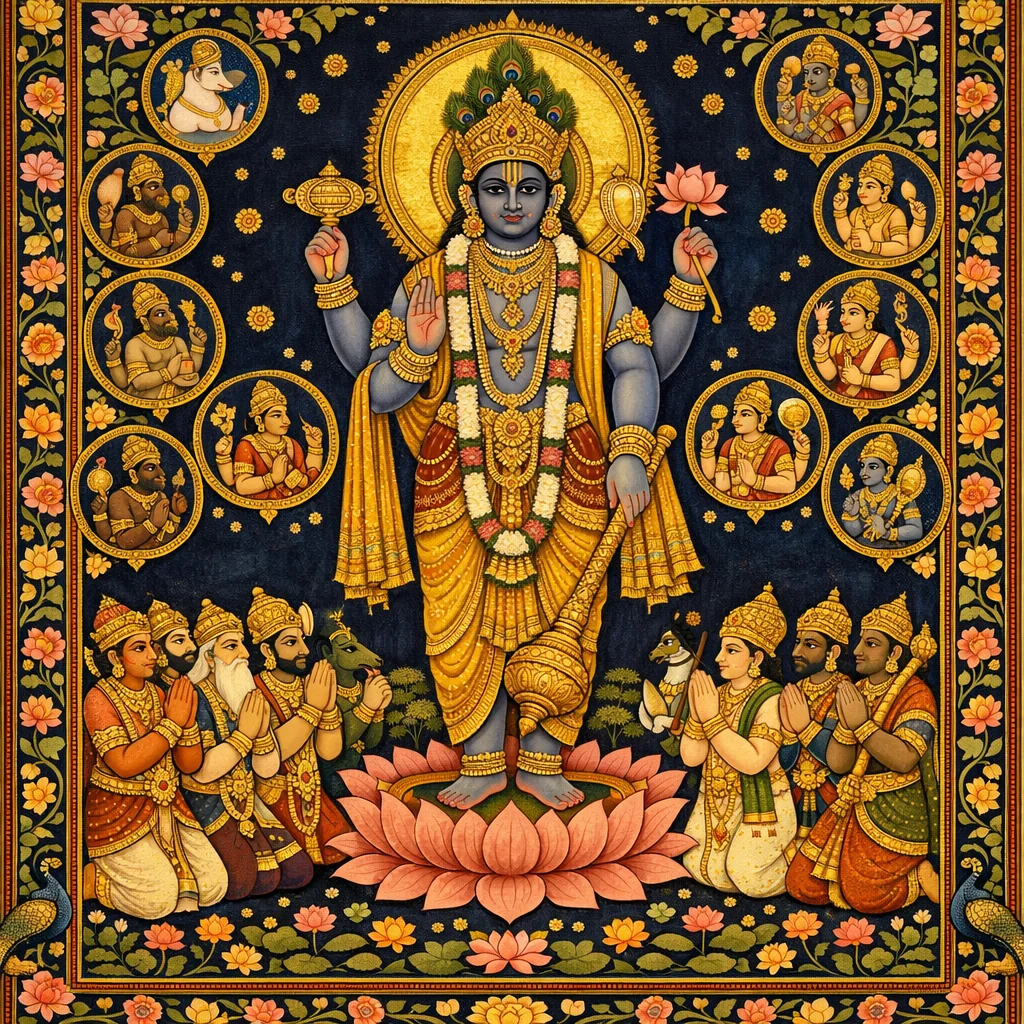
Śukadeva narrates how Viśvarūpa, while serving as the priest for the devas, secretly offered oblations to the asuras. Indra killed him, incurring brahma-hatyā, which he later distributed among earth, trees, women, and water. In revenge, Tvaṣṭā created the terrifying Vṛtrāsura from the sacrificial fire. Overwhelmed, the devas surrendered to Lord Nārāyaṇa. Lord Hari appeared and instructed Indra to request the bones of the sage Dadhīci to fashion a vajra, revealing that this weapon would slay Vṛtra, who is actually a devotee of the Lord.
Shlokas
Verse 1
श्रीशुक उवाच तस्यासन् विश्वरूपस्य शिरांसि त्रीणि भारत । सोमपीथं सुरापीथमन्नादमिति शुश्रुम ॥ १ ॥
Śrī Śukadeva Gosvāmī continued: O Bhārata, Parīkṣit, Viśvarūpa had three heads. From authoritative sources I have heard that with one he drank soma-rasa, with another he drank surā, and with the third he ate food.
Verse 2
स वै बर्हिषि देवेभ्यो भागं प्रत्यक्षमुच्चकै: । अददद्यस्य पितरो देवा: सप्रश्रयं नृप ॥ २ ॥
O Mahārāja Parīkṣit, upon the sacrificial altar Viśvarūpa openly offered each deva his proper share, pouring clarified butter into the fire while loudly chanting mantras such as “indrāya idaṁ svāhā” and “idam agnaye.” Being related to the devas through his father, he respectfully satisfied each of them with their due portion.
Verse 3
स एव हि ददौ भागं परोक्षमसुरान् प्रति । यजमानोऽवहद् भागं मातृस्नेहवशानुग: ॥ ३ ॥
He offered clarified butter into the sacrificial fire in the name of the devas; yet, without the devas’ knowledge, moved by affection for his maternal kin, he also offered a share of oblations to the asuras.
Verse 4
तद्देवहेलनं तस्य धर्मालीकं सुरेश्वर: । आलक्ष्य तरसा भीतस्तच्छीर्षाण्यच्छिनद् रुषा ॥ ४ ॥
Indra, lord of heaven, perceived that Viśvarūpa was slighting the devas and falsifying dharma by secretly offering oblations for the asuras. Fearing defeat by the demons, Indra, in fierce anger, cut off Viśvarūpa’s three heads from his shoulders.
Verse 5
सोमपीथं तु यत्तस्य शिर आसीत् कपिञ्जल: । कलविङ्क: सुरापीथमन्नादं यत् स तित्तिरि: ॥ ५ ॥
Thereafter, the head meant for drinking soma-rasa became a kapiñjala (francolin). The head meant for drinking wine became a kalaviṅka (sparrow), and the head meant for eating food became a tittiri (partridge).
Verse 6
ब्रह्महत्यामञ्जलिना जग्राह यदपीश्वर: । संवत्सरान्ते तदघं भूतानां स विशुद्धये । भूम्यम्बुद्रुमयोषिद्भ्यश्चतुर्धा व्यभजद्धरि: ॥ ६ ॥
Though Indra was powerful enough to neutralize the sin incurred by killing a brāhmaṇa, he repentantly accepted its burden with folded hands. He suffered for one year, and then, to purify himself, he apportioned that sinful reaction in four parts among the earth, water, trees, and women.
Verse 7
भूमिस्तुरीयं जग्राह खातपूरवरेण वै । ईरिणं ब्रह्महत्याया रूपं भूमौ प्रदृश्यते ॥ ७ ॥
In exchange for Indra’s boon that ditches and hollows in the earth would fill of their own accord, the land accepted one fourth of the sinful reaction for killing a brāhmaṇa. From that reaction, many barren deserts are seen upon the earth’s surface.
Verse 8
तुर्यं छेदविरोहेण वरेण जगृहुर्द्रुमा: । तेषां निर्यासरूपेण ब्रह्महत्या प्रदृश्यते ॥ ८ ॥
In exchange for Indra’s boon that their cut branches and twigs would grow again, the trees accepted one fourth of the sinful reaction for the killing of a brāhmaṇa. That sin is seen as the sap that oozes from trees.
Verse 9
शश्वत्कामवरेणांहस्तुरीयं जगृहु: स्त्रिय: । रजोरूपेण तास्वंहो मासि मासि प्रदृश्यते ॥ ९ ॥
In exchange for Indra’s boon that women could continually enjoy sensual desire, they accepted one fourth of the sinful reactions. Thus, month after month, the sign of menstruation appears in them.
Verse 10
द्रव्यभूयोवरेणापस्तुरीयं जगृहुर्मलम् । तासु बुद्बुदफेनाभ्यां दृष्टं तद्धरति क्षिपन् ॥ १० ॥
And in exchange for Indra’s boon that water would increase the volume of whatever it was mixed with, water accepted one fourth of the impure sinful reaction. Therefore bubbles and foam appear in water, and when collecting it one should avoid them.
Verse 11
हतपुत्रस्ततस्त्वष्टा जुहावेन्द्राय शत्रवे । इन्द्रशत्रो विवर्धस्व मा चिरं जहि विद्विषम् ॥ ११ ॥
After Viśvarūpa was slain, his father Tvaṣṭā performed sacrificial rites to destroy Indra. Casting oblations into the fire, he declared, “O enemy of Indra, grow in strength; without delay, strike down your foe.”
Verse 12
अथान्वाहार्यपचनादुत्थितो घोरदर्शन: । कृतान्त इव लोकानां युगान्तसमये यथा ॥ १२ ॥
Thereafter, from the southern side of the sacrificial fire known as Anvāhārya arose a fearsome being, resembling Kṛtānta, the destroyer of worlds at the end of the age.
Verse 13
विष्वग्विवर्धमानं तमिषुमात्रं दिने दिने । दग्धशैलप्रतीकाशं सन्ध्याभ्रानीकवर्चसम् ॥ १३ ॥ तप्तताम्रशिखाश्मश्रुं मध्याह्नार्कोग्रलोचनम् ॥ १४ ॥ देदीप्यमाने त्रिशिखे शूल आरोप्य रोदसी । नृत्यन्तमुन्नदन्तं च चालयन्तं पदा महीम् ॥ १५ ॥ दरीगम्भीरवक्त्रेण पिबता च नभस्तलम् । लिहता जिह्वयर्क्षाणि ग्रसता भुवनत्रयम् ॥ १६ ॥ महता रौद्रदंष्ट्रेण जृम्भमाणं मुहुर्मुहु: । वित्रस्ता दुद्रुवुर्लोका वीक्ष्य सर्वे दिशो दश ॥ १७ ॥
Like arrows loosed to the four quarters, the demon’s body expanded day by day. Tall and dark as a burnt hill, he shone like a radiant mass of evening clouds; his hair, beard, and moustache were the color of molten copper, and his eyes were fierce like the midday sun.
Verse 14
विष्वग्विवर्धमानं तमिषुमात्रं दिने दिने । दग्धशैलप्रतीकाशं सन्ध्याभ्रानीकवर्चसम् ॥ १३ ॥ तप्तताम्रशिखाश्मश्रुं मध्याह्नार्कोग्रलोचनम् ॥ १४ ॥ देदीप्यमाने त्रिशिखे शूल आरोप्य रोदसी । नृत्यन्तमुन्नदन्तं च चालयन्तं पदा महीम् ॥ १५ ॥ दरीगम्भीरवक्त्रेण पिबता च नभस्तलम् । लिहता जिह्वयर्क्षाणि ग्रसता भुवनत्रयम् ॥ १६ ॥ महता रौद्रदंष्ट्रेण जृम्भमाणं मुहुर्मुहु: । वित्रस्ता दुद्रुवुर्लोका वीक्ष्य सर्वे दिशो दश ॥ १७ ॥
He seemed unconquerable, as though he bore the two worlds upon the points of his blazing three-pronged trident. Dancing and roaring aloud, he made the earth quake beneath his feet like an earthquake.
Verse 15
विष्वग्विवर्धमानं तमिषुमात्रं दिने दिने । दग्धशैलप्रतीकाशं सन्ध्याभ्रानीकवर्चसम् ॥ १३ ॥ तप्तताम्रशिखाश्मश्रुं मध्याह्नार्कोग्रलोचनम् ॥ १४ ॥ देदीप्यमाने त्रिशिखे शूल आरोप्य रोदसी । नृत्यन्तमुन्नदन्तं च चालयन्तं पदा महीम् ॥ १५ ॥ दरीगम्भीरवक्त्रेण पिबता च नभस्तलम् । लिहता जिह्वयर्क्षाणि ग्रसता भुवनत्रयम् ॥ १६ ॥ महता रौद्रदंष्ट्रेण जृम्भमाणं मुहुर्मुहु: । वित्रस्ता दुद्रुवुर्लोका वीक्ष्य सर्वे दिशो दश ॥ १७ ॥
With a mouth as deep as a cavern he yawned again and again, as though he would swallow the very sky. He seemed to lick up the stars with his tongue and to devour the three worlds with his long, sharp teeth.
Verse 16
विष्वग्विवर्धमानं तमिषुमात्रं दिने दिने । दग्धशैलप्रतीकाशं सन्ध्याभ्रानीकवर्चसम् ॥ १३ ॥ तप्तताम्रशिखाश्मश्रुं मध्याह्नार्कोग्रलोचनम् ॥ १४ ॥ देदीप्यमाने त्रिशिखे शूल आरोप्य रोदसी । नृत्यन्तमुन्नदन्तं च चालयन्तं पदा महीम् ॥ १५ ॥ दरीगम्भीरवक्त्रेण पिबता च नभस्तलम् । लिहता जिह्वयर्क्षाणि ग्रसता भुवनत्रयम् ॥ १६ ॥ महता रौद्रदंष्ट्रेण जृम्भमाणं मुहुर्मुहु: । वित्रस्ता दुद्रुवुर्लोका वीक्ष्य सर्वे दिशो दश ॥ १७ ॥
Seeing his vast, dreadful fangs and his repeated yawning, all beings were seized with terror. Panic-stricken, they fled in every direction, scattering to the ten quarters.
Verse 17
विष्वग्विवर्धमानं तमिषुमात्रं दिने दिने । दग्धशैलप्रतीकाशं सन्ध्याभ्रानीकवर्चसम् ॥ १३ ॥ तप्तताम्रशिखाश्मश्रुं मध्याह्नार्कोग्रलोचनम् ॥ १४ ॥ देदीप्यमाने त्रिशिखे शूल आरोप्य रोदसी । नृत्यन्तमुन्नदन्तं च चालयन्तं पदा महीम् ॥ १५ ॥ दरीगम्भीरवक्त्रेण पिबता च नभस्तलम् । लिहता जिह्वयर्क्षाणि ग्रसता भुवनत्रयम् ॥ १६ ॥ महता रौद्रदंष्ट्रेण जृम्भमाणं मुहुर्मुहु: । वित्रस्ता दुद्रुवुर्लोका वीक्ष्य सर्वे दिशो दश ॥ १७ ॥
Thus, beholding that colossal demon, all were shaken with fear and fled to the ten directions. At the sight of his dreadful form, it seemed as though the whole world trembled in terror.
Verse 18
येनावृता इमे लोकास्तपसा त्वाष्ट्रमूर्तिना । स वै वृत्र इति प्रोक्त: पाप: परमदारुण: ॥ १८ ॥
That most dreadful demon, the son of Tvaṣṭā, by the power of his austerity covered all the worlds; therefore he was called Vṛtra—“the one who covers everything.”
Verse 19
तं निजघ्नुरभिद्रुत्य सगणा विबुधर्षभा: । स्वै: स्वैर्दिव्यास्त्रशस्त्रौघै: सोऽग्रसत्तानि कृत्स्नश: ॥ १९ ॥
The demigods, led by Indra, rushed upon him with their troops and struck him with their own celestial weapons, yet Vṛtrāsura swallowed all those weapons entirely.
Verse 20
ततस्ते विस्मिता: सर्वे विषण्णा ग्रस्ततेजस: । प्रत्यञ्चमादिपुरुषमुपतस्थु: समाहिता: ॥ २० ॥
Seeing the demon’s might, they were all astonished and disheartened, their own splendor diminished; thus, with collected minds, they assembled to worship the Ādipuruṣa, the Paramātmā—Lord Nārāyaṇa.
Verse 21
श्रीदेवा ऊचु: वाय्वम्बराग्न्यप्क्षितयस्त्रिलोका ब्रह्मादयो ये वयमुद्विजन्त: । हराम यस्मै बलिमन्तकोऽसौ बिभेति यस्मादरणं ततो न: ॥ २१ ॥
The demigods said: The three worlds are fashioned from the five elements—ether, air, fire, water, and earth—ruled by various devas beginning with Brahmā. Fearing that time will end our existence, we offer tribute to time by acting as it ordains; yet time itself fears the Supreme Personality of Godhead. Therefore let us worship that Supreme Lord alone, who can grant us complete protection.
Verse 22
अविस्मितं तं परिपूर्णकामं स्वेनैव लाभेन समं प्रशान्तम् । विनोपसर्पत्यपरं हि बालिश: श्वलाङ्गुलेनातितितर्ति सिन्धुम् ॥ २२ ॥
The Lord is never astonished by anything; He is fulfilled in all desires and ever joyful, satisfied by His own spiritual perfection, steady and serene. Free from material designations, He is firm and unattached—the sole shelter of all. One who seeks protection from others is surely a fool, like one trying to cross the ocean by holding a dog’s tail.
Verse 23
यस्योरुशृङ्गे जगतीं स्वनावं मनुर्यथाबध्य ततार दुर्गम् । स एव नस्त्वाष्ट्रभयाद्दुरन्तात् त्राताश्रितान्वारिचरोऽपि नूनम् ॥ २३ ॥
May that Matsya-avatāra, upon whose mighty horn Manu Satyavrata bound the little boat bearing the whole world and thus crossed the peril of the flood, surely protect us who take shelter—from the dreadful, inescapable fear born of the son of Tvaṣṭā.
Verse 24
पुरा स्वयम्भूरपि संयमाम्भ- स्युदीर्णवातोर्मिरवै: कराले । एकोऽरविन्दात् पतितस्ततार तस्माद् भयाद्येन स नोऽस्तु पार: ॥ २४ ॥
At the dawn of creation, a furious wind raised dreadful waves in the waters of devastation, roaring terribly; even Svayambhū Brahmā nearly fell from his lotus seat, yet by the Lord’s help he was saved. May that same Lord carry us across this fearful danger.
Verse 25
य एक ईशो निजमायया न: ससर्ज येनानुसृजाम विश्वम् ।
The one Supreme Lord created us by His own māyā, and by His mercy we expand the creation of the universe. Yet He, the Paramātmā dwelling within all beings, stands ever before us, and still we do not behold His form—because we imagine ourselves separate and independent gods.
Verse 26
यो न: सपत्नैर्भृशमर्द्यमानान् देवर्षितिर्यङ्नृषु नित्य एव । कृतावतारस्तनुभि: स्वमायया कृत्वात्मसात् पाति युगे युगे च ॥ २६ ॥ तमेव देवं वयमात्मदैवतं परं प्रधानं पुरुषं विश्वमन्यम् । व्रजाम सर्वे शरणं शरण्यं स्वानां स नो धास्यति शं महात्मा ॥ २७ ॥
He is the one Lord who, by His own inner potency, descends in many transcendental bodies—Vāmana among the devas, Paraśurāma among the sages, Nṛsiṁha and Varāha among animals, and Matsya and Kūrma among aquatics—and, making us His own, protects us devas, sorely oppressed by foes, age after age.
Verse 27
यो न: सपत्नैर्भृशमर्द्यमानान् देवर्षितिर्यङ्नृषु नित्य एव । कृतावतारस्तनुभि: स्वमायया कृत्वात्मसात् पाति युगे युगे च ॥ २६ ॥ तमेव देवं वयमात्मदैवतं परं प्रधानं पुरुषं विश्वमन्यम् । व्रजाम सर्वे शरणं शरण्यं स्वानां स नो धास्यति शं महात्मा ॥ २७ ॥
To Him alone—the Deva who is our indwelling Lord, the supreme cause (pradhāna), the Puruṣa, distinct from the universe yet present as the cosmic form (virāṭ)—we all go for refuge, for He is the Refuge of the refuge-seekers. That great Lord will surely grant His own auspiciousness and fearless protection.
Verse 28
श्रीशुक उवाच इति तेषां महाराज सुराणामुपतिष्ठताम् । प्रतीच्यां दिश्यभूदावि: शङ्खचक्रगदाधर: ॥ २८ ॥
Śrī Śukadeva Gosvāmī said: O great King, as all the demigods worshiped Him with prayers, Lord Hari, bearing conchshell, disc, and club, appeared first within their hearts and then before them in the western direction.
Verse 29
आत्मतुल्यै: षोडशभिर्विना श्रीवत्सकौस्तुभौ । पर्युपासितमुन्निद्रशरदम्बुरुहेक्षणम् ॥ २९ ॥ दृष्ट्वा तमवनौ सर्व ईक्षणाह्लादविक्लवा: । दण्डवत् पतिता राजञ्छनैरुत्थाय तुष्टुवु: ॥ ३० ॥
Around Nārāyaṇa, the Supreme Lord, stood sixteen personal attendants, ornamented and resembling Him in every way, yet without the Śrīvatsa mark and the Kaustubha jewel. O King, seeing the Lord smiling, His eyes like autumn lotus petals, all the demigods were overwhelmed with joy, fell in daṇḍavat obeisance, then slowly rose and pleased Him with prayers.
Verse 30
आत्मतुल्यै: षोडशभिर्विना श्रीवत्सकौस्तुभौ । पर्युपासितमुन्निद्रशरदम्बुरुहेक्षणम् ॥ २९ ॥ दृष्ट्वा तमवनौ सर्व ईक्षणाह्लादविक्लवा: । दण्डवत् पतिता राजञ्छनैरुत्थाय तुष्टुवु: ॥ ३० ॥
Around Nārāyaṇa, the Supreme Lord, stood sixteen personal attendants, ornamented and resembling Him in every way, yet without the Śrīvatsa mark and the Kaustubha jewel. O King, seeing the Lord smiling, His eyes like autumn lotus petals, all the demigods were overwhelmed with joy, fell in daṇḍavat obeisance, then slowly rose and pleased Him with prayers.
Verse 31
श्रीदेवा ऊचु: नमस्ते यज्ञवीर्याय वयसे उत ते नम: । नमस्ते ह्यस्तचक्राय नम: सुपुरुहूतये ॥ ३१ ॥
The demigods said: O Lord, obeisances to You, the power of sacrifice who grants its fruits; and obeisances to You as Time, who in due course destroys those fruits. O You who hurl the cakra to slay the demons, O Lord of many holy names, we bow to You.
Verse 32
यत्ते गतीनां तिसृणामीशितु: परमं पदम् । नार्वाचीनो विसर्गस्य धातर्वेदितुमर्हति ॥ ३२ ॥
O supreme controller, You govern the three destinations—heavenly promotion, human birth, and hellish fall—yet Your highest abode is Vaikuṇṭha-dhāma. Since we arose only after You created this cosmos, we cannot fathom Your divine acts. Therefore we offer You nothing but our humble obeisances.
Verse 33
ॐ नमस्तेऽस्तु भगवन्नारायण वासुदेवादिपुरुष महापुरुष महानुभाव परममङ्गल परमकल्याण परमकारुणिक केवल जगदाधार लोकैकनाथ सर्वेश्वर लक्ष्मीनाथ परमहंसपरिव्राजकै: परमेणात्मयोगसमाधिना परिभावितपरिस्फुटपारमहंस्यधर्मेणोद्घाटिततम:कपाट द्वारे चित्तेऽपावृत आत्मलोके स्वयमुपलब्धनिजसुखानुभवो भवान् ॥ ३३ ॥
O Supreme Lord, Nārāyaṇa, Vāsudeva, original Person! O Mahāpuruṣa—supreme auspiciousness, supreme welfare, supremely merciful! You are the sole support of the universe, the one Lord of all worlds, the master of all, and the consort of Lakṣmī. The foremost paramahaṁsa sannyāsīs, absorbed in the samādhi of bhakti-yoga, realize Your personal form within the purified heart; when the darkness there is fully dispelled, You reveal Yourself, and the transcendental bliss they taste is Your own divine form. Therefore we offer You our reverent obeisances.
Verse 34
दुरवबोध इव तवायं विहारयोगो यदशरणोऽशरीर इदमनवेक्षितास्मत्समवाय आत्मनैवाविक्रियमाणेन सगुणमगुण: सृजसि पासि हरसि ॥ ३४ ॥
O Lord, Your līlā—Your wondrous manner of acting—seems exceedingly difficult to comprehend. You depend on no support, have no material body, and require no cooperation from us. Remaining unchanged, You supply the ingredients of nature and by Yourself create, maintain, and dissolve this universe. Though You appear to engage with the guṇas, You are wholly beyond all material qualities; therefore Your transcendental activities are most hard to understand.
Verse 35
अथ तत्र भवान् किं देवदत्तवदिह गुणविसर्गपतित: पारतन्त्र्येण स्वकृतकुशलाकुशलं फलमुपाददात्याहोस्विदात्माराम उपशमशील: समञ्जसदर्शन उदास्त इति ह वाव न विदाम: ॥ ३५ ॥
These are our inquiries: Do You, like Devadatta and other conditioned beings, dwell in this world within a body born of the guṇas and, in dependence, accept the fruits of Your own good and bad deeds? Or, on the contrary, are You present only as the impartial Witness—ātma-rāma, peaceful, of perfect vision, fully self-sufficient? O Bhagavān, we cannot understand Your actual position.
Verse 36
न हि विरोध उभयं भगवत्यपरिमितगुणगण ईश्वरेऽनवगाह्यमाहात्म्येऽर्वाचीनविकल्पवितर्कविचारप्रमाणाभासकुतर्कशास्त्रकलिलान्त:करणाश्रयदुरवग्रहवादिनां विवादानवसर उपरत समस्तमायामये केवल एवात्ममायामन्तर्धाय को न्वर्थो दुर्घट इव भवति स्वरूपद्वयाभावात् ॥ ३६ ॥
O Bhagavān, in You there is no contradiction at all, for You are the Lord endowed with unlimited spiritual qualities, whose greatness is unfathomable to conditioned souls. Those whose minds are muddled by false proofs, speculative reasoning, and sophistic scriptures find only occasion for dispute, not entrance into Your truth. When the entire fabric of māyā is stilled, You remain the One without a second, veiled by Your own ātma-māyā-śakti; since there is no duality in Your nature, what could be impossible for You? By Your energy You may do, or not do, exactly as You will.
Verse 37
समविषममतीनां मतमनुसरसि यथा रज्जुखण्डः सर्पादिधियाम् ॥ ३७ ॥
Just as a rope frightens the bewildered who mistake it for a snake, but does not frighten the clear-minded who know it to be only a rope, so You, as Paramātmā within everyone’s heart, awaken fear or fearlessness according to one’s understanding—yet in You Yourself there is no duality.
Verse 38
स एव हि पुन: सर्ववस्तुनि वस्तुस्वरूप: सर्वेश्वर: सकलजगत्कारणकारणभूत: सर्व प्रत्यगात्मत्वात् सर्वगुणाभासोपलक्षित एक एव पर्यवशेषित: ॥ ३८ ॥
He alone is the Paramātmā—the very essence of all things, the Supreme Lord, and the cause of all causes. As the indwelling Self of everyone, in the end He alone remains.
Verse 39
अथ ह वाव तव महिमामृतरससमुद्रविप्रुषा सकृदवलीढया स्वमनसि निष्यन्दमानानवरतसुखेन विस्मारितदृष्टश्रुतविषयसुखलेशाभासा: परमभागवता एकान्तिनो भगवति सर्वभूतप्रियसुहृदि सर्वात्मनि नितरां निरन्तरं निर्वृतमनस: कथमु ह वा एते मधुमथन पुन: स्वार्थकुशला ह्यात्मप्रियसुहृद: साधवस्त्वच्चरणाम्बुजानुसेवां विसृजन्ति न यत्र पुनरयं संसारपर्यावर्त: ॥ ३९ ॥
O Madhumathana, for those who have even once tasted a single drop from the nectar-ocean of Your glories, unbroken transcendental bliss pours within the mind, and even the faint shadow of sense-born happiness is forgotten. Those great devotees, exclusively devoted to Bhagavān—the dear friend of all beings and the Soul of all—how could they abandon service to Your lotus feet, where there is no return to saṁsāra?
Verse 40
त्रिभुवनात्मभवन त्रिविक्रम त्रिनयन त्रिलोकमनोहरानुभाव तवैव विभूतयो दितिजदनुजादयश्चापि तेषामुपक्रमसमयोऽयमिति स्वात्ममायया सुरनरमृगमिश्रित जलचराकृतिभिर्यथापराधं दण्डं दण्डधर दधर्थ एवमेनमपि भगवञ्जहि त्वाष्ट्रमुत यदि मन्यसे ॥ ४० ॥
O Lord—Soul and shelter of the three worlds; Trivikrama, the three-eyed One, the beauty of the three realms—gods, humans, Daityas and Dānavas are all expansions of Your own energy. When the unrighteous grow strong, by Your Yogamāyā You appear in divine, human, animal, mixed, and aquatic forms and punish them according to their offense. Therefore, Bhagavān, if You so desire, slay today this Vṛtrāsura, the son of Tvaṣṭā.
Verse 41
अस्माकं तावकानां तततत नतानां हरे तव चरणनलिनयुगल ध्यानानुबद्धहृदयनिगडानां स्वलिङ्गविवरणेनात्मसात्कृतानामनुकम्पानुरञ्जितविशदरुचिरशिशिरस्मितावलोकेन विगलित मधुरमुख रसामृत कलया चान्तस्तापमनघार्हसि शमयितुम् ॥ ४१ ॥
O Hari, we are surrendered at Your lotus feet; our hearts are bound to meditation on those feet by chains of love. Please manifest Your incarnation and accept us as Your own eternal servants. With Your compassion-filled, cool, radiant glance—adorned with a gentle smile—and with the sweet, nectarean words from Your beautiful face, soothe the inner burning caused by Vṛtrāsura.
Verse 42
अथ भगवंस्तवास्माभिरखिलजगदुत्पत्तिस्थितिलयनिमित्तायमानदिव्यमायाविनोदस्य सकलजीवनिकायानामन्तर्हृदयेषु बहिरपि च ब्रह्मप्रत्यगात्मस्वरूपेण प्रधानरूपेण च यथादेशकालदेहावस्थानविशेषं तदुपादानोपलम्भकतयानुभवत: सर्वप्रत्ययसाक्षिण आकाशशरीरस्य साक्षात्परब्रह्मण: परमात्मन: कियानिह वार्थविशेषो विज्ञापनीय: स्याद्विस्फुलिङ्गादिभिरिव हिरण्यरेतस: ॥ ४२ ॥
O Bhagavān, just as tiny sparks cannot perform the work of the whole fire, we—mere sparks of You—cannot truly inform You of our life’s needs. You are the original cause of the universe’s creation, maintenance, and dissolution, and You sport with Your spiritual and material energies as their supreme controller. You dwell within all hearts as Brahman and Paramātmā, and outwardly as the elements of pradhāna. Vast as the sky, the witness of all cognition and untouched by action—what could ever be unknown to You?
Verse 43
अत एव स्वयं तदुपकल्पयास्माकं भगवत: परमगुरोस्तव चरणशतपलाशच्छायां विविधवृजिन संसारपरिश्रमोपशमनीमुपसृतानां वयं यत्कामेनोपसादिता: ॥ ४३ ॥
O omniscient Lord, supreme spiritual master, we have taken shelter in the shade of Your lotus feet, which relieves the toil and disturbances of this material world. You know our purpose in coming; please counteract our present distress and grant us instruction and refuge at Your feet.
Verse 44
अथो ईश जहि त्वाष्ट्रं ग्रसन्तं भुवनत्रयम् । ग्रस्तानि येन न: कृष्ण तेजांस्यस्त्रायुधानि च ॥ ४४ ॥
Therefore, O Lord, supreme controller, O Śrī Kṛṣṇa, please destroy Vṛtrāsura, Tvaṣṭā’s son, who is swallowing the three worlds and has already devoured our weapons and our strength.
Verse 45
हंसाय दह्रनिलयाय निरीक्षकाय कृष्णाय मृष्टयशसे निरुपक्रमाय । सत्सङ्ग्रहाय भवपान्थनिजाश्रमाप्ता- वन्ते परीष्टगतये हरये नमस्ते ॥ ४५ ॥
Obeisances to You, O pure Hamsa, dwelling within the heart and witnessing all; to You, O Kṛṣṇa, whose spotless fame shines, who has no beginning yet is the beginning of all. You are the refuge of the saintly; souls who wander the road of saṁsāra and at last, liberated, take shelter at Your lotus feet attain the supreme perfection. O Hari, we bow to You.
Verse 46
श्रीशुक उवाच अथैवमीडितो राजन् सादरं त्रिदशैर्हरि: । स्वमुपस्थानमाकर्ण्य प्राह तानभिनन्दित: ॥ ४६ ॥
Śrī Śukadeva Gosvāmī said: O King Parīkṣit, when the demigods thus offered their prayers with reverence, Hari, by His causeless mercy, heard them. Pleased, He then replied to the demigods.
Verse 47
श्रीभगवानुवाच प्रीतोऽहं व: सुरश्रेष्ठा मदुपस्थानविद्यया । आत्मैश्वर्यस्मृति: पुंसां भक्तिश्चैव यया मयि ॥ ४७ ॥
The Supreme Lord said: O best of the devas, I am greatly pleased by your praises, offered with true knowledge of worshiping Me. By such knowledge one remembers My supreme majesty beyond material conditions, and from it devotion (bhakti) to Me arises and steadily grows.
Verse 48
किं दुरापं मयि प्रीते तथापि विबुधर्षभा: । मय्येकान्तमतिर्नान्यन्मत्तो वाञ्छति तत्त्ववित् ॥ ४८ ॥
O best among the wise demigods, when I am pleased, what is difficult to obtain? Yet a pure devotee, whose mind is fixed exclusively upon Me, asks for nothing else but the chance to engage in devotional service.
Verse 49
न वेद कृपण: श्रेय आत्मनो गुणवस्तुदृक् । तस्य तानिच्छतो यच्छेद्यदि सोऽपि तथाविध: ॥ ४९ ॥
Those who take material assets to be everything and the ultimate goal of life are called kṛpaṇas, misers. They do not know the soul’s highest welfare. Moreover, one who grants such fools what they desire must also be considered foolish.
Verse 50
स्वयं नि:श्रेयसं विद्वान् न वक्त्यज्ञाय कर्म हि । न राति रोगिणोऽपथ्यं वाञ्छतोऽपि भिषक्तम: ॥ ५० ॥
A pure devotee, fully accomplished in the science of bhakti and knowing the highest good, never instructs a foolish person to pursue fruitive work for material enjoyment, nor does he assist him. He is like an expert physician who will not give a patient harmful food even if the patient desires it.
Verse 51
मघवन् यात भद्रं वो दध्यञ्चमृषिसत्तमम् । विद्याव्रततप:सारं गात्रं याचत मा चिरम् ॥ ५१ ॥ H
O Maghavan (Indra), may good fortune be upon you. I advise you to approach the exalted sage Dadhyañca (Dadhīci). He is highly accomplished in knowledge, vows, and austerity, and his body is very strong. Go and ask him for his body without delay.
Verse 52
स वा अधिगतो दध्यङ्ङश्विभ्यां ब्रह्म निष्कलम् । यद्वा अश्वशिरो नाम तयोरमरतां व्यधात् ॥ ५२ ॥
The saint Dadhyañca (Dadhīci) personally realized the pure spiritual science and then bestowed it upon the Aśvinī-kumāras. It is said he gave them the mantras through the head of a horse; therefore they are called Aśvaśira. Having received these mantras of spiritual knowledge, the Aśvinī-kumāras became jīvan-mukta—liberated even in this very life.
Verse 53
दध्यङ्ङाथर्वणस्त्वष्ट्रे वर्माभेद्यं मदात्मकम् । विश्वरूपाय यत्प्रादात् त्वष्टा यत्त्वमधास्तत: ॥ ५३ ॥
Dadhyañca, the son of Atharvā, gave Tvaṣṭā the inviolable protective armor known as the Nārāyaṇa-kavaca, which is of My own nature. Tvaṣṭā passed it to his son Viśvarūpa, and from Viśvarūpa you have received it. By the power of that kavaca, Dadhīci’s body is now exceedingly strong; therefore beg him for his body.
Verse 54
युष्मभ्यं याचितोऽश्विभ्यां धर्मज्ञोऽङ्गानि दास्यति । ततस्तैरायुधश्रेष्ठो विश्वकर्मविनिर्मित: । येन वृत्रशिरो हर्ता मत्तेजउपबृंहित: ॥ ५४ ॥
When the Aśvinī-kumāras beg Dadhyañca on your behalf, Dadhyañca, well versed in dharma, will surely give his limbs out of affection—do not doubt it. Then Viśvakarmā will fashion from his bones the finest weapon, the vajra; empowered by My own potency, it will certainly take Vṛtrāsura’s head.
Verse 55
तस्मिन् विनिहते यूयं तेजोऽस्त्रायुधसम्पद: । भूय: प्राप्स्यथ भद्रं वो न हिंसन्ति च मत्परान् ॥ ५५ ॥
When Vṛtrāsura is slain by My spiritual power, you will regain your strength, your weapons, and your wealth; may auspiciousness be upon you all. Though he could destroy the three worlds, do not fear he will harm you—he too is a devotee and never envies those devoted to Me.
Frequently Asked Questions
Indra killed Viśvarūpa upon discovering that oblations were being offered to asuras as well as devas, driven by fear of losing sovereignty. The moral teaching is that fear-based, adharmic action—especially violence against a brāhmaṇa—creates heavy reaction even for powerful administrators, and that cosmic power cannot replace surrender and ethical restraint aligned with the Supreme.
Indra bore the reaction for a year and then apportioned one fourth each to earth, trees, women, and water, granting each a boon in exchange. The ‘signs’ are described as deserts on earth, sap flow in trees (hence restrictions), menstruation in women, and foam/bubbles in water—mythic-ethical markers linking cosmic history, ritual purity concerns, and karmic consequence.
Vṛtrāsura is the formidable being generated by Tvaṣṭā’s sacrificial rite to counter Indra; he becomes so vast by austerity that he ‘covers’ the planetary systems. Thus he is named Vṛtra—“one who covers”—signifying both his cosmic threat and the narrative pressure that drives the devas to take exclusive shelter of Nārāyaṇa.
Their stuti establishes that the Lord grants the fruits of sacrifice yet, as kāla, also dissolves those fruits—showing He is the ultimate controller of karma without being bound by it. This frames a key Bhagavata doctrine: the Supreme reconciles opposites through acintya-śakti, and therefore the safest refuge is bhakti rather than dependence on secondary protectors.
Because Viśvakarmā will fashion a vajra (thunderbolt) from Dadhīci’s bones, empowered by the Lord to kill Vṛtrāsura. The episode highlights yajña-dāna at its highest: voluntary self-sacrifice for dharma under divine instruction, while also stressing that victory comes from the Lord’s śakti, not merely from weapons.
Bhāgavata theology distinguishes external role from inner consciousness: one may appear as an antagonist in the cosmic drama yet possess devotion. By stating that Vṛtrāsura is a devotee and not envious, the text prepares the reader to interpret the coming conflict as spiritually meaningful—where bhakti, not mere faction, is the decisive identity.