Adhyaya 4
Soma Pacifies the Pracetās; Dakṣa’s Haṁsa-guhya Prayers; Hari Grants Creative Power
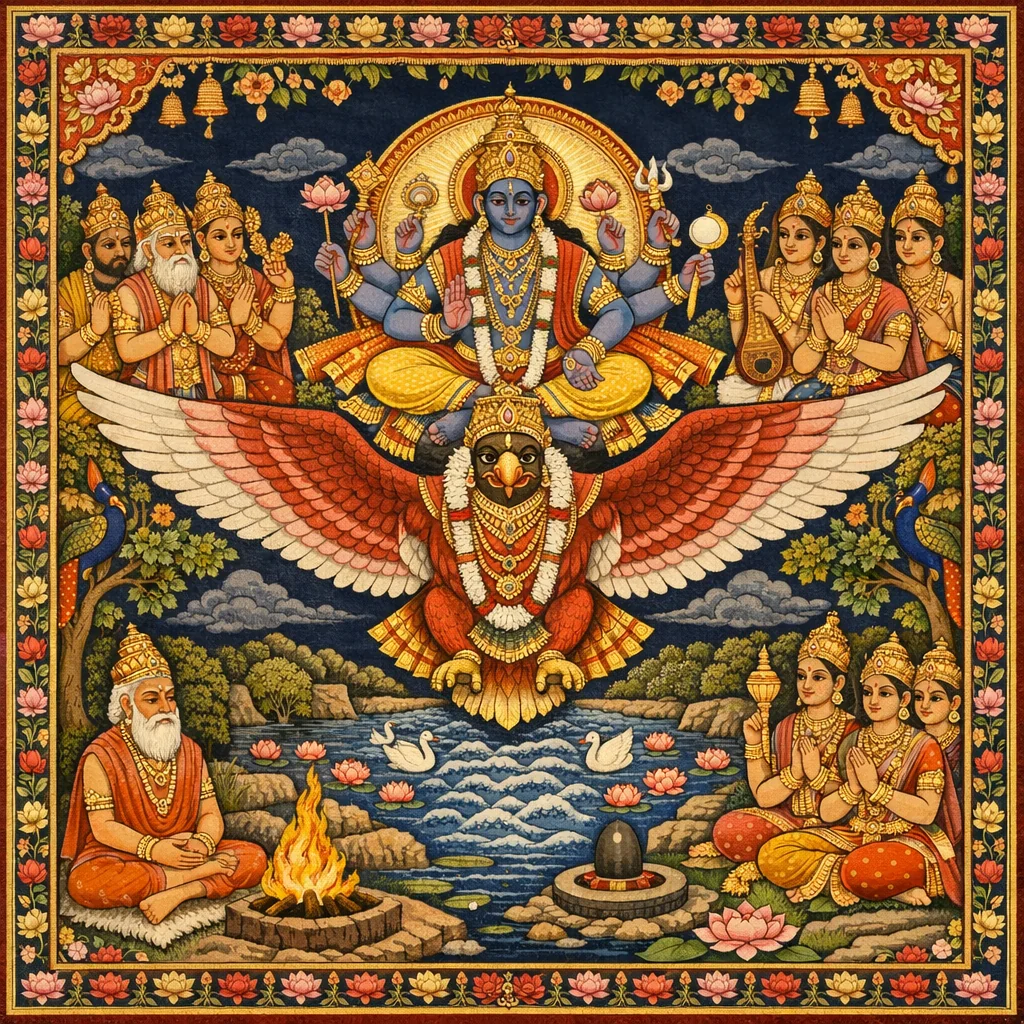
Answering King Parīkṣit’s wish to hear visarga (secondary creation) in detail, Śukadeva connects earlier creation accounts to the Pracetās’ return after long austerities. Finding the earth overrun by trees, the Pracetās flare in anger and unleash fire and wind to burn the forests. Soma—the moon-deity and lord of vegetation—intervenes, teaching that true kingship protects all prajā, including trees, and presenting a dharmic ecology rooted in Paramātmā’s presence within moving and nonmoving beings. He offers Māriṣā, raised by the trees, and through her the Pracetās beget Dakṣa, who will populate the worlds. Dakṣa first creates mentally, but seeing it insufficient performs severe tapas at Aghamarṣaṇa and offers the Haṁsa-guhya prayers, praising the Lord as beyond the guṇas and material measures yet immanent as the Supersoul. Pleased, Hari appears in a majestic eight-armed form, instructs Dakṣa on creation’s purpose, grants him Asiknī as wife, and empowers procreation—setting the stage for the next genealogies and expansion of beings.
Shlokas
Verse 1
श्रीराजोवाच देवासुरनृणां सर्गो नागानां मृगपक्षिणाम् । सामासिकस्त्वया प्रोक्तो यस्तु स्वायम्भुवेऽन्तरे ॥ १ ॥ तस्यैव व्यासमिच्छामि ज्ञातुं ते भगवन् यथा । अनुसर्गं यया शक्त्या ससर्ज भगवान् पर: ॥ २ ॥
The blessed King said: During the reign of Svāyambhuva Manu, the devas, asuras, human beings, Nāgas, beasts, and birds were created, and you have described this briefly. Now, O venerable one, I wish to know it in detail, and I also wish to understand by what potency the Supreme Bhagavān carried out the secondary creation (anusarga).
Verse 2
श्रीराजोवाच देवासुरनृणां सर्गो नागानां मृगपक्षिणाम् । सामासिकस्त्वया प्रोक्तो यस्तु स्वायम्भुवेऽन्तरे ॥ १ ॥ तस्यैव व्यासमिच्छामि ज्ञातुं ते भगवन् यथा । अनुसर्गं यया शक्त्या ससर्ज भगवान् पर: ॥ २ ॥
The blessed King said: During the reign of Svāyambhuva Manu, the devas, asuras, human beings, Nāgas, beasts, and birds were created, and you have described this briefly. Now, O venerable one, I wish to know it in detail, and I also wish to understand by what potency the Supreme Bhagavān carried out the secondary creation (anusarga).
Verse 3
श्रीसूत उवाच इति सम्प्रश्नमाकर्ण्य राजर्षेर्बादरायणि: । प्रतिनन्द्य महायोगी जगाद मुनिसत्तमा: ॥ ३ ॥
Sūta said: Hearing the inquiry of the saintly king, the great yogi Bādarāyaṇi (Śukadeva) praised it, and then the foremost of sages replied.
Verse 4
श्रीशुक उवाच यदा प्रचेतस: पुत्रा दश प्राचीनबर्हिष: । अन्त:समुद्रादुन्मग्ना ददृशुर्गां द्रुमैर्वृताम् ॥ ४ ॥
Śrī Śukadeva Gosvāmī said: When the ten sons of Prācīnabarhi, the Pracetās, rose from the waters where they had performed austerities, they saw that the whole surface of the world was covered with trees.
Verse 5
द्रुमेभ्य: क्रुध्यमानास्ते तपोदीपितमन्यव: । मुखतो वायुमग्निं च ससृजुस्तद्दिधक्षया ॥ ५ ॥
Having performed long austerities in the water, the Pracetās became angry at the trees. Wishing to burn them to ashes, they produced wind and fire from their mouths.
Verse 6
ताभ्यां निर्दह्यमानांस्तानुपलभ्य कुरूद्वह । राजोवाच महान् सोमो मन्युं प्रशमयन्निव ॥ ६ ॥
O best of the Kurus, when the great Soma—the king of trees and the presiding deity of the moon—saw wind and fire burning the trees, he felt compassion and, to pacify the Pracetās’ anger, spoke as follows.
Verse 7
न द्रुमेभ्यो महाभागा दीनेभ्यो द्रोग्धुमर्हथ । विवर्धयिषवो यूयं प्रजानां पतय: स्मृता: ॥ ७ ॥
O greatly fortunate ones, you should not destroy these poor trees by burning them to ashes. You are remembered as protectors of the prajās, meant to desire their prosperity and growth.
Verse 8
अहो प्रजापतिपतिर्भगवान् हरिरव्यय: । वनस्पतीनोषधीश्च ससर्जोर्जमिषं विभु: ॥ ८ ॥
Indeed, Bhagavān Śrī Hari—the master even of the prajāpatis, all-pervading and imperishable—created these trees and herbs to be food and sustaining nourishment for other living beings.
Verse 9
अन्नं चराणामचरा ह्यपद: पादचारिणाम् । अहस्ता हस्तयुक्तानां द्विपदां च चतुष्पद: ॥ ९ ॥
By nature’s ordained order, fruits and flowers are the food of insects and birds; grass and other legless beings are the food of four‑footed animals like cows and buffalo; creatures whose forelegs cannot serve as hands become the prey of clawed hunters like tigers; and deer, goats, and grains are the food of human beings.
Verse 10
यूयं च पित्रान्वादिष्टा देवदेवेन चानघा: । प्रजासर्गाय हि कथं वृक्षान्निर्दग्धुमर्हथ ॥ १० ॥
O pure‑hearted ones, your father Prācīnabarhi and Bhagavān, the Lord of lords, have commanded you to create progeny. How then can you burn to ashes these trees and herbs, which are needed to sustain your subjects and descendants?
Verse 11
आतिष्ठत सतां मार्गं कोपं यच्छत दीपितम् । पित्रा पितामहेनापि जुष्टं व: प्रपितामहै: ॥ ११ ॥
Stand upon the path of the righteous, trodden by your father, grandfather, and forefathers—the path of protecting and maintaining the subjects, including men, animals, and trees. Restrain this anger that has flared without cause; therefore I ask you to control your wrath.
Verse 12
तोकानां पितरौ बन्धू दृश: पक्ष्म स्त्रिया: पति: । पति: प्रजानां भिक्षूणां गृह्यज्ञानां बुध: सुहृत् ॥ १२ ॥
As father and mother are the friends and maintainers of their children, as the eyelid protects the eye, as a husband supports and shelters his wife, as a householder sustains beggars, and as the learned are friends to the ignorant—so the king is the protector and life‑giver of all his subjects. Trees too are subjects of the king; therefore they should be protected.
Verse 13
अन्तर्देहेषु भूतानामात्मास्ते हरिरीश्वर: । सर्वं तद्धिष्ण्यमीक्षध्वमेवं वस्तोषितो ह्यसौ ॥ १३ ॥
Hari, the Supreme Lord, dwells as the Paramātmā within the bodies of all beings—moving and unmoving, men, birds, animals, and even trees. Therefore behold every body as the Lord’s abode, as His temple; by such vision Bhagavān is pleased. Do not, in anger, slay living beings in the form of trees.
Verse 14
य: समुत्पतितं देह आकाशान्मन्युमुल्बणम् । आत्मजिज्ञासया यच्छेत्स गुणानतिवर्तते ॥ १४ ॥
One who, through inquiry into the Self, restrains the mighty anger that suddenly flares within the body as if fallen from the sky, transcends the modes of material nature.
Verse 15
अलं दग्धैर्द्रुमैर्दीनै: खिलानां शिवमस्तु व: । वार्क्षी ह्येषा वरा कन्या पत्नीत्वे प्रतिगृह्यताम् ॥ १५ ॥
There is no need to burn these poor trees any longer; may the trees that remain be blessed, and may you also be joyful. Here is Māriṣā, a beautiful and virtuous maiden raised by the trees as their daughter—accept her as your wife.
Verse 16
इत्यामन्त्र्य वरारोहां कन्यामाप्सरसीं नृप । सोमो राजा ययौ दत्त्वा ते धर्मेणोपयेमिरे ॥ १६ ॥
My dear King, having thus addressed and sent forth the apsarā-born maiden of lovely hips, King Soma bestowed her upon them and departed; and the Pracetās accepted her and married her according to dharma.
Verse 17
तेभ्यस्तस्यां समभवद् दक्ष: प्राचेतस: किल । यस्य प्रजाविसर्गेण लोका आपूरितास्त्रय: ॥ १७ ॥
In the womb of that girl, the Pracetās begot a son named Dakṣa Prācetasa, whose creation of progeny filled the three worlds with living beings.
Verse 18
यथा ससर्ज भूतानि दक्षो दुहितृवत्सल: । रेतसा मनसा चैव तन्ममावहित: शृणु ॥ १८ ॥
Hear from me with full attention how Prajāpati Dakṣa, greatly affectionate to his daughters, created various kinds of living beings—both through his semen and through his mind.
Verse 19
मनसैवासृजत्पूर्वं प्रजापतिरिमा: प्रजा: । देवासुरमनुष्यादीन्नभ:स्थलजलौकस: ॥ १९ ॥
Prajāpati Dakṣa first created, by the mind alone, all varieties of beings—demigods, demons, humans, and those who dwell in the sky, on land, and in the waters.
Verse 20
तमबृंहितमालोक्य प्रजासर्गं प्रजापति: । विन्ध्यपादानुपव्रज्य सोऽचरद्दुष्करं तप: ॥ २० ॥
But when Prajāpati Dakṣa saw that the generation of living beings was not proceeding properly, he went to a mountain near the Vindhya range and there performed very difficult austerities.
Verse 21
तत्राघमर्षणं नाम तीर्थं पापहरं परम् । उपस्पृश्यानुसवनं तपसातोषयद्धरिम् ॥ २१ ॥
Near that mountain was a supremely purifying holy place called Aghamarṣaṇa, which destroys sin. There Dakṣa performed the rites at each sacred time, and by great austerity he satisfied Hari, the Supreme Personality of Godhead.
Verse 22
अस्तौषीद्धंसगुह्येन भगवन्तमधोक्षजम् । तुभ्यं तदभिधास्यामि कस्यातुष्यद्यथा हरि: ॥ २२ ॥
Dakṣa offered praise to the Lord Adhokṣaja with the prayers known as Haṁsa-guhya. O King, I shall explain those prayers in full and how, by them, Hari became pleased with him.
Verse 23
श्रीप्रजापतिरुवाच नम: परायावितथानुभूतये गुणत्रयाभासनिमित्तबन्धवे । अदृष्टधाम्ने गुणतत्त्वबुद्धिभि- र्निवृत्तमानाय दधे स्वयम्भुवे ॥ २३ ॥
Prajāpati said: I offer my respectful obeisances to the Supreme Lord, whose realization is never illusory; who, through the manifestation of māyā in the three guṇas, presides over the bondage of the living beings; whose abode is beyond the reach of experimental proof; who transcends even the intellect that analyzes the guṇas, remaining unattached—self-manifest and self-sufficient, with no higher cause above Him.
Verse 24
न यस्य सख्यं पुरुषोऽवैति सख्यु: सखा वसन् संवसत: पुरेऽस्मिन् । गुणो यथा गुणिनो व्यक्तदृष्टे- स्तस्मै महेशाय नमस्करोमि ॥ २४ ॥
As sense objects cannot know how the senses perceive them, so the conditioned soul, though dwelling in this body along with the Paramātmā, cannot understand how the Supreme Purusha, Lord of creation, directs his senses. To that Supreme Controller, Mahā-īśa, I offer my respectful obeisances.
Verse 25
देहोऽसवोऽक्षा मनवो भूतमात्रा- मात्मानमन्यं च विदु: परं यत् । सर्वं पुमान् वेद गुणांश्च तज्ज्ञो न वेद सर्वज्ञमनन्तमीडे ॥ २५ ॥
Because they are mere matter, the body, life airs, outer and inner senses, the elements and the tan-mātras cannot know their own nature, one another, or their controllers. The living being, by spiritual nature, can know these and the three guṇas at their root; yet he cannot behold the all-knowing, unlimited Supreme Lord. Therefore I offer Him my respectful obeisances.
Verse 26
यदोपरामो मनसो नामरूप- रूपस्य दृष्टस्मृतिसम्प्रमोषात् । य ईयते केवलया स्वसंस्थया हंसाय तस्मै शुचिसद्मने नम: ॥ २६ ॥
When the mind ceases its fashioning of names and forms—neither agitated as in waking and dreaming, nor dissolved as in deep sleep—one attains samādhi. Only in that stainless trance is Bhagavān, the Paramahaṁsa, revealed. To Him, the abode of purity, I offer my obeisances.
Verse 27
मनीषिणोऽन्तर्हृदि सन्निवेशितं स्वशक्तिभिर्नवभिश्च त्रिवृद्भि: । वह्निं यथा दारुणि पाञ्चदश्यं मनीषया निष्कर्षन्ति गूढम् ॥ २७ ॥ स वै ममाशेषविशेषमाया निषेधनिर्वाणसुखानुभूति: । स सर्वनामा स च विश्वरूप: प्रसीदतामनिरुक्तात्मशक्ति: ॥ २८ ॥
As expert brāhmaṇas draw forth the fire hidden in wood by chanting the fifteen Sāmidhenī mantras, so yogīs of elevated consciousness, through meditation, discover the Paramātmā seated within the heart by His own potency. The heart is covered by the three guṇas, nine principles, the five elements, and the ten senses—this is the Lord’s external energy. May that Paramātmā be pleased with me.
Verse 28
मनीषिणोऽन्तर्हृदि सन्निवेशितं स्वशक्तिभिर्नवभिश्च त्रिवृद्भि: । वह्निं यथा दारुणि पाञ्चदश्यं मनीषया निष्कर्षन्ति गूढम् ॥ २७ ॥ स वै ममाशेषविशेषमाया निषेधनिर्वाणसुखानुभूति: । स सर्वनामा स च विश्वरूप: प्रसीदतामनिरुक्तात्मशक्ति: ॥ २८ ॥
That very Paramātmā negates the endless varieties of māyā and grants the experience of nirvāṇa’s bliss. He is invoked by many sacred names, and He is the Viśvarūpa as well. May the Lord, whose own spiritual potency is beyond the reach of the senses, be pleased with me.
Verse 29
यद्यन्निरुक्तं वचसा निरूपितं धियाक्षभिर्वा मनसोत यस्य । मा भूत्स्वरूपं गुणरूपं हि तत्तत् स वै गुणापायविसर्गलक्षण: ॥ २९ ॥
Whatever is spoken through material sound, concluded by material intelligence, or experienced and imagined by the material senses and mind is only a transformation of nature’s modes; it does not touch the true nature of the Supreme Personality of Godhead. The Supreme Lord stands beyond this creation, for He is the source of the material qualities and of creation itself; He exists before creation and after it. To that cause of all causes I offer my respectful obeisances.
Verse 30
यस्मिन्यतो येन च यस्य यस्मै यद्यो यथा कुरुते कार्यते च । परावरेषां परमं प्राक् प्रसिद्धं तद् ब्रह्म तद्धेतुरनन्यदेकम् ॥ ३० ॥
In Him everything rests; from Him and by Him everything proceeds. Everything belongs to Him, and everything is offered to Him. Whether acting Himself or causing others to act, He alone is the ultimate doer—the Supreme Brahman known before all activity. Though there are many higher and lower causes, He is the cause of all causes, one without a second, with no other cause. To Him I offer my respects.
Verse 31
यच्छक्तयो वदतां वादिनां वै विवादसंवादभुवो भवन्ति । कुर्वन्ति चैषां मुहुरात्ममोहं तस्मै नमोऽनन्तगुणाय भूम्ने ॥ ३१ ॥
I offer my respectful obeisances to the all-pervading Supreme Personality of Godhead, who possesses unlimited transcendental qualities. From within the hearts of philosophers who promote diverse views, He makes them sometimes agree and sometimes disagree, repeatedly casting them into forgetfulness of the self. Thus, in this world they cannot reach a final conclusion. To that infinitely glorious Lord I bow.
Verse 32
अस्तीति नास्तीति च वस्तुनिष्ठयो- रेकस्थयोर्भिन्नविरुद्धधर्मणो: । अवेक्षितं किञ्चन योगसाङ्ख्ययो: समं परं ह्यनुकूलं बृहत्तत् ॥ ३२ ॥
There are two camps—those who say “it exists” and those who say “it does not.” Yet their object is ultimately one: the Supreme Tattva, possessing diverse but noncontradictory attributes. The yogī, accepting the Paramātmā, finds the spiritual cause; the Sāṅkhya analyst, absorbed only in material elements, leans toward an impersonal conclusion and denies a supreme cause. Still, in the end both point to the same Absolute Truth, the Supreme Brahman. To that Parabrahman I offer my respectful obeisances.
Verse 33
योऽनुग्रहार्थं भजतां पादमूल- मनामरूपो भगवाननन्त: । नामानि रूपाणि च जन्मकर्मभि- र्भेजे स मह्यं परम: प्रसीदतु ॥ ३३ ॥
Although the infinite Bhagavān is truly beyond all material names, forms, and pastimes, out of mercy to the devotees who worship at the root of His lotus feet He reveals transcendental names and forms and enacts His līlās of birth and deeds. May that Supreme Lord, whose form is eternal, full of knowledge and bliss (sat-cit-ānanda), be gracious to me.
Verse 34
य: प्राकृतैर्ज्ञानपथैर्जनानां यथाशयं देहगतो विभाति । यथानिल: पार्थिवमाश्रितो गुणं स ईश्वरो मे कुरुतां मनोरथम् ॥ ३४ ॥
As the Lord, according to the hearts’ desires of all beings, appears within embodied forms through worldly paths of knowledge—just as the wind carries the qualities of the elements—may that Supreme Lord fulfill my innermost prayer.
Verse 35
श्रीशुक उवाच इति स्तुत: संस्तुवत: स तस्मिन्नघमर्षणे । प्रादुरासीत्कुरुश्रेष्ठ भगवान् भक्तवत्सल: ॥ ३५ ॥ कृतपाद: सुपर्णांसे प्रलम्बाष्टमहाभुज: । चक्रशङ्खासिचर्मेषुधनु:पाशगदाधर: ॥ ३६ ॥ पीतवासा घनश्याम: प्रसन्नवदनेक्षण: । वनमालानिवीताङ्गो लसच्छ्रीवत्सकौस्तुभ: ॥ ३७ ॥ महाकिरीटकटक: स्फुरन्मकरकुण्डल: । काञ्च्यङ्गुलीयवलयनूपुराङ्गदभूषित: ॥ ३८ ॥ त्रैलोक्यमोहनं रूपं बिभ्रत् त्रिभुवनेश्वर: । वृतो नारदनन्दाद्यै: पार्षदै: सुरयूथपै: । स्तूयमानोऽनुगायद्भि: सिद्धगन्धर्वचारणै: ॥ ३९ ॥
Śrī Śukadeva Gosvāmī said: Thus praised by Dakṣa, Bhagavān Hari—ever affectionate to His devotees—manifested Himself at the holy place called Aghamarṣaṇa, O Parīkṣit, best of the Kurus.
Verse 36
श्रीशुक उवाच इति स्तुत: संस्तुवत: स तस्मिन्नघमर्षणे । प्रादुरासीत्कुरुश्रेष्ठ भगवान् भक्तवत्सल: ॥ ३५ ॥ कृतपाद: सुपर्णांसे प्रलम्बाष्टमहाभुज: । चक्रशङ्खासिचर्मेषुधनु:पाशगदाधर: ॥ ३६ ॥ पीतवासा घनश्याम: प्रसन्नवदनेक्षण: । वनमालानिवीताङ्गो लसच्छ्रीवत्सकौस्तुभ: ॥ ३७ ॥ महाकिरीटकटक: स्फुरन्मकरकुण्डल: । काञ्च्यङ्गुलीयवलयनूपुराङ्गदभूषित: ॥ ३८ ॥ त्रैलोक्यमोहनं रूपं बिभ्रत् त्रिभुवनेश्वर: । वृतो नारदनन्दाद्यै: पार्षदै: सुरयूथपै: । स्तूयमानोऽनुगायद्भि: सिद्धगन्धर्वचारणै: ॥ ३९ ॥
Resting His lotus feet upon Garuḍa’s shoulders, the Lord appeared with eight long, mighty arms, bearing the disc, conchshell, sword, shield, arrow, bow, rope and club, each weapon shining in its own hand.
Verse 37
श्रीशुक उवाच इति स्तुत: संस्तुवत: स तस्मिन्नघमर्षणे । प्रादुरासीत्कुरुश्रेष्ठ भगवान् भक्तवत्सल: ॥ ३५ ॥ कृतपाद: सुपर्णांसे प्रलम्बाष्टमहाभुज: । चक्रशङ्खासिचर्मेषुधनु:पाशगदाधर: ॥ ३६ ॥ पीतवासा घनश्याम: प्रसन्नवदनेक्षण: । वनमालानिवीताङ्गो लसच्छ्रीवत्सकौस्तुभ: ॥ ३७ ॥ महाकिरीटकटक: स्फुरन्मकरकुण्डल: । काञ्च्यङ्गुलीयवलयनूपुराङ्गदभूषित: ॥ ३८ ॥ त्रैलोक्यमोहनं रूपं बिभ्रत् त्रिभुवनेश्वर: । वृतो नारदनन्दाद्यै: पार्षदै: सुरयूथपै: । स्तूयमानोऽनुगायद्भि: सिद्धगन्धर्वचारणै: ॥ ३९ ॥
He wore yellow garments and was deep blue like a raincloud, with a joyful face and eyes. A forest garland adorned His limbs, and upon His chest shone the Śrīvatsa mark and the Kaustubha jewel.
Verse 38
श्रीशुक उवाच इति स्तुत: संस्तुवत: स तस्मिन्नघमर्षणे । प्रादुरासीत्कुरुश्रेष्ठ भगवान् भक्तवत्सल: ॥ ३५ ॥ कृतपाद: सुपर्णांसे प्रलम्बाष्टमहाभुज: । चक्रशङ्खासिचर्मेषुधनु:पाशगदाधर: ॥ ३६ ॥ पीतवासा घनश्याम: प्रसन्नवदनेक्षण: । वनमालानिवीताङ्गो लसच्छ्रीवत्सकौस्तुभ: ॥ ३७ ॥ महाकिरीटकटक: स्फुरन्मकरकुण्डल: । काञ्च्यङ्गुलीयवलयनूपुराङ्गदभूषित: ॥ ३८ ॥ त्रैलोक्यमोहनं रूपं बिभ्रत् त्रिभुवनेश्वर: । वृतो नारदनन्दाद्यै: पार्षदै: सुरयूथपै: । स्तूयमानोऽनुगायद्भि: सिद्धगन्धर्वचारणै: ॥ ३९ ॥
Upon His head was a splendid crown, and from His ears flashed makara-shaped earrings. He was adorned with a golden belt, rings, bracelets, ankle bells, and armlets—ornaments of uncommon beauty.
Verse 39
श्रीशुक उवाच इति स्तुत: संस्तुवत: स तस्मिन्नघमर्षणे । प्रादुरासीत्कुरुश्रेष्ठ भगवान् भक्तवत्सल: ॥ ३५ ॥ कृतपाद: सुपर्णांसे प्रलम्बाष्टमहाभुज: । चक्रशङ्खासिचर्मेषुधनु:पाशगदाधर: ॥ ३६ ॥ पीतवासा घनश्याम: प्रसन्नवदनेक्षण: । वनमालानिवीताङ्गो लसच्छ्रीवत्सकौस्तुभ: ॥ ३७ ॥ महाकिरीटकटक: स्फुरन्मकरकुण्डल: । काञ्च्यङ्गुलीयवलयनूपुराङ्गदभूषित: ॥ ३८ ॥ त्रैलोक्यमोहनं रूपं बिभ्रत् त्रिभुवनेश्वर: । वृतो नारदनन्दाद्यै: पार्षदै: सुरयूथपै: । स्तूयमानोऽनुगायद्भि: सिद्धगन्धर्वचारणै: ॥ ३९ ॥
Śrī Śukadeva Gosvāmī said: Pleased by Dakṣa’s hymns, the Bhagavān Hari—ever affectionate to His devotees—manifested at the holy place called Aghamarṣaṇa. His lotus feet rested upon the shoulders of Garuḍa, and He appeared with eight long, mighty, beautiful arms. In His hands shone the cakra, śaṅkha, sword, shield, arrow, bow, noose, and club, each held separately and blazing with splendor. Clad in pītāmbara and dark blue like a raincloud, with a joyful face and eyes, He wore a forest garland; upon His chest gleamed the Śrīvatsa mark and the Kaustubha jewel. A great crown, makara-shaped earrings, a golden belt, bracelets, rings, anklets, and armlets adorned Him. Thus, in His Puruṣottama form that enchants the three worlds, the Lord was surrounded by Nārada, Nanda, the devas led by Indra, and the Siddhas, Gandharvas, and Cāraṇas, who ceaselessly praised and sang to Him.
Verse 40
रूपं तन्महदाश्चर्यं विचक्ष्यागतसाध्वस: । ननाम दण्डवद्भूमौ प्रहृष्टात्मा प्रजापति: ॥ ४० ॥
Seeing that great, wondrous, effulgent form of the Bhagavān, Prajāpati Dakṣa was at first somewhat afraid; then, filled with joy, he fell to the ground in daṇḍavat obeisance.
Verse 41
न किञ्चनोदीरयितुमशकत् तीव्रया मुदा । आपूरितमनोद्वारैर्ह्रदिन्य इव निर्झरै: ॥ ४१ ॥
As rivers are filled by streams descending from the mountains, all of Dakṣa’s senses were flooded with bliss. Overwhelmed by that exalted joy, he could not utter a word and remained stretched out upon the ground.
Verse 42
तं तथावनतं भक्तं प्रजाकामं प्रजापतिम् । चित्तज्ञ: सर्वभूतानामिदमाह जनार्दन: ॥ ४२ ॥
Though Dakṣa could not speak, the Lord Janārdana, knower of every heart, saw His devotee prostrate and desiring progeny, and addressed him as follows.
Verse 43
श्रीभगवानुवाच प्राचेतस महाभाग संसिद्धस्तपसा भवान् । यच्छ्रद्धया मत्परया मयि भावं परं गत: ॥ ४३ ॥
The Bhagavān said: O most fortunate Prācetasa, by your austerity you have become fully perfected. With supreme śraddhā and bhakti directed solely to Me, you have attained the highest bhāva toward Me; therefore your life is fulfilled, and you have achieved complete siddhi.
Verse 44
प्रीतोऽहं ते प्रजानाथ यत्तेऽस्योद्बृंहणं तप: । ममैष कामो भूतानां यद्भूयासुर्विभूतय: ॥ ४४ ॥
My dear Prajāpati Dakṣa, because you have performed severe austerity for the welfare and increase of the world, I am greatly pleased. My own desire is that all beings in this world be happy; therefore I am satisfied with you, for you strive to fulfill My will for the good of the entire universe.
Verse 45
ब्रह्मा भवो भवन्तश्च मनवो विबुधेश्वरा: । विभूतयो मम ह्येता भूतानां भूतिहेतव: ॥ ४५ ॥
Brahmā, Bhava (Śiva), the Manus, the lords of the demigods in the higher worlds, and you prajāpatis are all My vibhūtis—causes of the prosperity of beings—working for the welfare of every living entity.
Verse 46
तपो मे हृदयं ब्रह्मंस्तनुर्विद्या क्रियाकृति: । अङ्गानि क्रतवो जाता धर्म आत्मासव: सुरा: ॥ ४६ ॥
My dear brāhmaṇa, austerity as meditation is My heart; Vedic knowledge as hymns and mantras is My body; and spiritual acts together with ecstatic devotion are My very form. Properly performed rites and sacrifices are the limbs of My body; the unseen good fortune born of dharma and piety is My mind; and the demigods who carry out My orders in various departments are My life-breath and soul.
Verse 47
अहमेवासमेवाग्रे नान्यत् किञ्चान्तरं बहि: । संज्ञानमात्रमव्यक्तं प्रसुप्तमिव विश्वत: ॥ ४७ ॥
Before the creation of this cosmic manifestation, I alone existed; there was nothing else, within or without. At that time consciousness alone was unmanifest, as one’s awareness is unmanifest during sleep.
Verse 48
मय्यनन्तगुणेऽनन्ते गुणतो गुणविग्रह: । यदासीत्तत एवाद्य: स्वयम्भू: समभूदज: ॥ ४८ ॥
I am the reservoir of unlimited power and qualities, and thus I am known as the Unlimited, all-pervading Lord. From My material energy (māyā) this cosmic manifestation appeared within Me, and within that universal manifestation arose the foremost being, Lord Brahmā—Svayambhū, the unborn—your source, not born of any material mother.
Verse 49
स वै यदा महादेवो मम वीर्योपबृंहित: । मेने खिलमिवात्मानमुद्यत: स्वर्गकर्मणि ॥ ४९ ॥ अथ मेऽभिहितो देवस्तपोऽतप्यत दारुणम् । नव विश्वसृजो युष्मान् येनादावसृजद्विभु: ॥ ५० ॥
When the chief lord of the universe, Lord Brahma, having been inspired by My energy, was attempting to create, he thought himself incapable.
Verse 50
स वै यदा महादेवो मम वीर्योपबृंहित: । मेने खिलमिवात्मानमुद्यत: स्वर्गकर्मणि ॥ ४९ ॥ अथ मेऽभिहितो देवस्तपोऽतप्यत दारुणम् । नव विश्वसृजो युष्मान् येनादावसृजद्विभु: ॥ ५० ॥
Therefore I gave him advice, and in accordance with My instructions he underwent extremely difficult austerities. Because of these austerities, the great Lord Brahma was able to create nine personalities, including you, to help him in the functions of creation.
Verse 51
एषा पञ्चजनस्याङ्ग दुहिता वै प्रजापते: । असिक्नी नाम पत्नीत्वे प्रजेश प्रतिगृह्यताम् ॥ ५१ ॥
O My dear son Daksa, Prajapati Pancajana has a daughter named Asikni, whom I offer to you so that you may accept her as your wife.
Verse 52
मिथुनव्यवायधर्मस्त्वं प्रजासर्गमिमं पुन: । मिथुनव्यवायधर्मिण्यां भूरिशो भावयिष्यसि ॥ ५२ ॥
Now unite in sexual life as man and woman, and in this way, by sexual intercourse, you will be able to beget hundreds of children in the womb of this girl to increase the population.
Verse 53
त्वत्तोऽधस्तात्प्रजा: सर्वा मिथुनीभूय मायया । मदीयया भविष्यन्ति हरिष्यन्ति च मे बलिम् ॥ ५३ ॥
After you give birth to many hundreds and thousands of children, they will also be captivated by My illusory energy and will engage, like You, in sexual intercourse. But because of My mercy to you and them, they will also be able to give Me presentations in devotion.
Verse 54
श्रीशुक उवाच इत्युक्त्वा मिषतस्तस्य भगवान् विश्वभावन: । स्वप्नोपलब्धार्थ इव तत्रैवान्तर्दधे हरि: ॥ ५४ ॥
Śukadeva Gosvāmī said: Having spoken thus before Dakṣa, the Lord Hari, sustainer of the universe, vanished at once on that very spot, like an object perceived in a dream.
Frequently Asked Questions
After prolonged austerities in water, they emerged to find the earth’s surface densely covered by trees, obstructing intended habitation and agriculture. Their reaction is portrayed as krodha born from frustration; the episode becomes a dharma-lesson that population increase must not be pursued through destructive anger against other prajā.
Soma argues that a ruler’s dharma is poṣaṇa—protection and welfare of all subjects, including forests—because the Lord created vegetation as part of the maintenance system for embodied life. Since Paramātmā resides in trees as well, harming them in anger is spiritually offensive and socially self-defeating.
Māriṣā is presented as a virtuous maiden raised by the trees and offered to the Pracetās. Through her womb, the lineage produces Dakṣa, a major prajāpati. The narrative symbolically links ecological protection (trees) with legitimate population growth (prajā-vṛddhi) under dharma.
The Haṁsa-guhya stuti is Dakṣa’s esoteric praise emphasizing that Bhagavān is beyond material vibration, sense perception, and speculative intellect, yet is realized in purified consciousness and through loving service. The prayers function as a theological key: visarga succeeds when grounded in devotion and divine sanction, not mere technique.
The eight-armed form underscores Hari’s sovereignty over cosmic order and protection. The weapons signify governance, restraint of adharma, and the Lord’s capacity to maintain creation while empowering agents like Dakṣa to perform visarga within dharmic boundaries.
Hari states that before creation He alone existed with His potencies; from His material energy arises the cosmos and Brahmā, who then creates prajāpatis through tapas empowered by the Lord’s guidance. This frames all secondary creators as dependent instruments (śakti-āveśa in function), operating under Bhagavān’s will.