Adhyaya 8
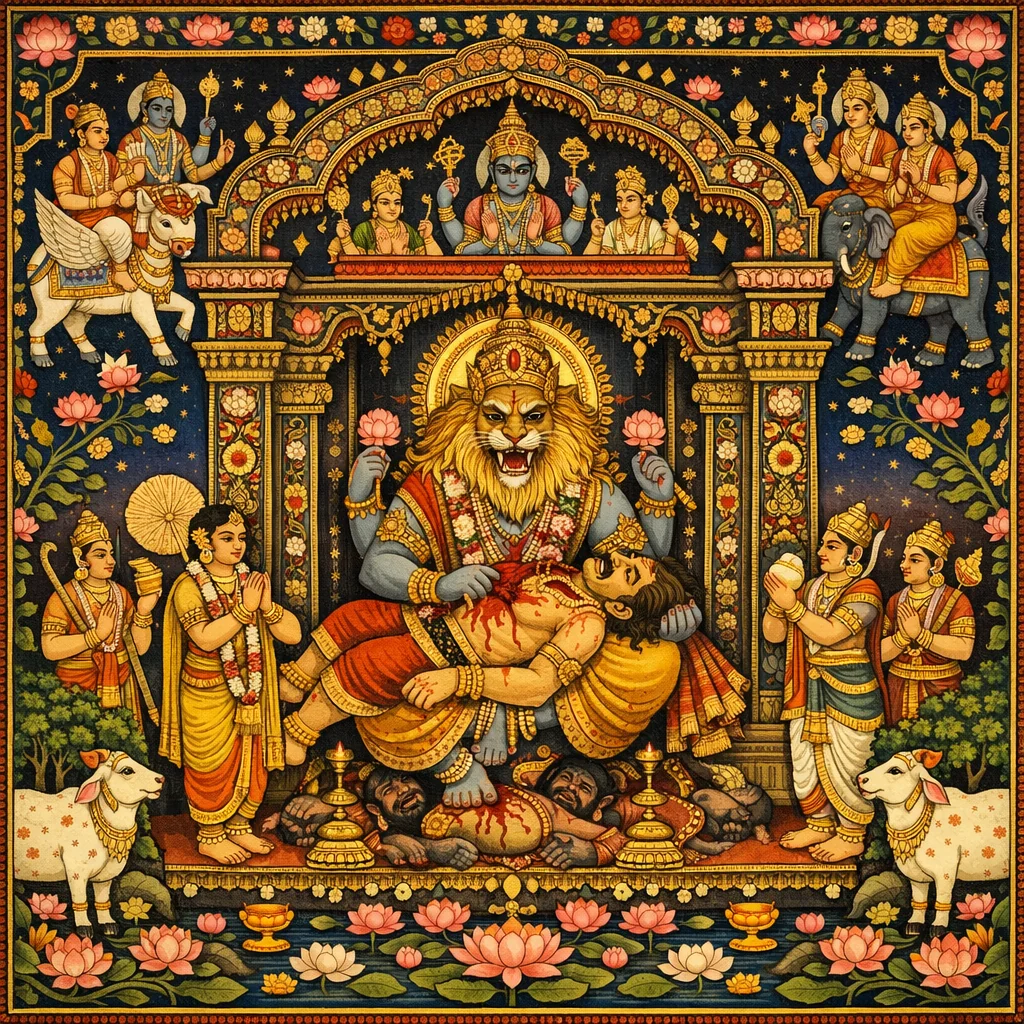
Nṛsiṁhadeva Appears from the Pillar and Slays Hiraṇyakaśipu
After Prahlāda transforms the sons of the demons—who reject the materialistic teaching of Ṣaṇḍa and Amarka—the teachers report to Hiraṇyakaśipu, turning the father–son dispute into a crisis of kingship and theology. Enraged, the king challenges Prahlāda’s claim that one Supreme Source empowers all beings and that the real enemy is the uncontrolled mind, not external foes. Mocking Viṣṇu’s omnipresence, he demands that Viṣṇu appear from a pillar and strikes it in fury. A universe-shaking roar erupts, and the Lord manifests in an unprecedented form—neither man nor lion—as Nṛsiṁhadeva, vindicating the devotee’s words and the truth of all-pervasiveness. Nṛsiṁhadeva battles the demon and kills him at the doorway, on His lap, with His nails, perfectly fulfilling the conditions of the demon’s boons and restoring cosmic order. The Lord’s wrath shakes the worlds; demigods and beings from many lokas gather to offer prayers and acknowledge divine protection, as the narrative moves toward the Lord’s pacification and Prahlāda’s forthcoming glorification and benediction.
Shlokas
Verse 1
श्रीनारद उवाच अथ दैत्यसुता: सर्वे श्रुत्वा तदनुवर्णितम् । जगृहुर्निरवद्यत्वान्नैव गुर्वनुशिक्षितम् ॥ १ ॥
Nārada Muni continued: All the sons of the demons appreciated the transcendental instructions of Prahlāda Mahārāja and took them very seriously. They rejected the materialistic instructions given by their teachers, Ṣaṇḍa and Amarka.
Verse 2
अथाचार्यसुतस्तेषां बुद्धिमेकान्तसंस्थिताम् । आलक्ष्य भीतस्त्वरितो राज्ञ आवेदयद्यथा ॥ २ ॥
When Ṣaṇḍa and Amarka, the sons of Śukrācārya, observed that all the students, the sons of the demons, were becoming advanced in Kṛṣṇa consciousness because of the association of Prahlāda Mahārāja, they were afraid. They approached the King of the demons and described the situation as it was.
Verse 3
कोपावेशचलद्गात्र: पुत्रं हन्तुं मनो दधे । क्षिप्त्वा परुषया वाचा प्रह्रादमतदर्हणम् । आहेक्षमाण: पापेन तिरश्चीनेन चक्षुषा ॥ ३ ॥ प्रश्रयावनतं दान्तं बद्धाञ्जलिमवस्थितम् । सर्प: पदाहत इव श्वसन्प्रकृतिदारुण: ॥ ४ ॥
When Hiraṇyakaśipu understood the entire situation, he was extremely angry, so much so that his body trembled. Thus he finally decided to kill his son Prahlāda. Hiraṇyakaśipu was by nature very cruel, and feeling insulted, he began hissing like a snake trampled upon by someone’s foot. His son Prahlāda was peaceful, mild and gentle, his senses were under control, and he stood before Hiraṇyakaśipu with folded hands. According to Prahlāda’s age and behavior, he was not to be chastised. Yet with staring, crooked eyes, Hiraṇyakaśipu rebuked him with the following harsh words.
Verse 4
कोपावेशचलद्गात्र: पुत्रं हन्तुं मनो दधे । क्षिप्त्वा परुषया वाचा प्रह्रादमतदर्हणम् । आहेक्षमाण: पापेन तिरश्चीनेन चक्षुषा ॥ ३ ॥ प्रश्रयावनतं दान्तं बद्धाञ्जलिमवस्थितम् । सर्प: पदाहत इव श्वसन्प्रकृतिदारुण: ॥ ४ ॥
When Hiraṇyakaśipu understood the entire situation, he was extremely angry, so much so that his body trembled. Thus he finally decided to kill his son Prahlāda. Hiraṇyakaśipu was by nature very cruel, and feeling insulted, he began hissing like a snake trampled upon by someone’s foot. His son Prahlāda was peaceful, mild and gentle, his senses were under control, and he stood before Hiraṇyakaśipu with folded hands. According to Prahlāda’s age and behavior, he was not to be chastised. Yet with staring, crooked eyes, Hiraṇyakaśipu rebuked him with the following harsh words.
Verse 5
श्रीहिरण्यकशिपुरुवाच हे दुर्विनीत मन्दात्मन्कुलभेदकराधम । स्तब्धं मच्छासनोद्वृत्तं नेष्ये त्वाद्य यमक्षयम् ॥ ५ ॥
Hiraṇyakaśipu said: O most impudent, most unintelligent disruptor of the family, O lowest of mankind, you have violated my power to rule you, and therefore you are an obstinate fool. Today I shall send you to the place of Yamarāja.
Verse 6
क्रुद्धस्य यस्य कम्पन्ते त्रयो लोका: सहेश्वरा: । तस्य मेऽभीतवन्मूढ शासनं किं बलोऽत्यगा: ॥ ६ ॥
My son Prahlāda, you rascal, you know that when I am angry all the planets of the three worlds tremble, along with their chief rulers. By whose power has a rascal like you become so impudent that you appear fearless and overstep my power to rule you?
Verse 7
श्रीप्रह्राद उवाच न केवलं मे भवतश्च राजन् स वै बलं बलिनां चापरेषाम् । परेऽवरेऽमी स्थिरजङ्गमा ये ब्रह्मादयो येन वशं प्रणीता: ॥ ७ ॥
Prahlāda Mahārāja said: My dear King, the source of my strength, of which you are asking, is also the source of yours. Indeed, the original source of all kinds of strength is one. He is not only your strength or mine, but the only strength for everyone. Without Him, no one can get any strength. Whether moving or not moving, superior or inferior, everyone, including Lord Brahmā, is controlled by the strength of the Supreme Personality of Godhead.
Verse 8
स ईश्वर: काल उरुक्रमोऽसा- वोज: सह: सत्त्वबलेन्द्रियात्मा । स एव विश्वं परम: स्वशक्तिभि: सृजत्यवत्यत्ति गुणत्रयेश: ॥ ८ ॥
The Supreme Personality of Godhead, who is the supreme controller and time factor, is the power of the senses, the power of the mind, the power of the body, and the vital force of the senses. His influence is unlimited. He is the best of all living entities, the controller of the three modes of material nature. By His own power, He creates this cosmic manifestation, maintains it and annihilates it also.
Verse 9
जह्यासुरं भावमिमं त्वमात्मन: समं मनो धत्स्व न सन्ति विद्विष: । ऋतेऽजितादात्मन उत्पथे स्थितात् तद्धि ह्यनन्तस्य महत्समर्हणम् ॥ ९ ॥
Prahlāda Mahārāja continued: My dear father, please give up your demoniac mentality. Do not discriminate in your heart between enemies and friends; make your mind equipoised toward everyone. Except for the uncontrolled and misguided mind, there is no enemy within this world. When one sees everyone on the platform of equality, one then comes to the position of worshiping the Lord perfectly.
Verse 10
दस्यून्पुरा षण् न विजित्य लुम्पतो मन्यन्त एके स्वजिता दिशो दश । जितात्मनो ज्ञस्य समस्य देहिनां साधो: स्वमोहप्रभवा: कुत: परे ॥ १० ॥
In former times there were many fools like you who did not conquer the six enemies that steal away the wealth of the body. These fools were very proud, thinking, “I have conquered all enemies in all the ten directions.” But if a person is victorious over the six enemies and is equipoised toward all living entities, for him there are no enemies. Enemies are merely imagined by one in ignorance.
Verse 11
श्रीहिरण्यकशिपुरुवाच व्यक्तं त्वं मर्तुकामोऽसि योऽतिमात्रं विकत्थसे । मुमूर्षूणां हि मन्दात्मन् ननु स्युर्विक्लवा गिर: ॥ ११ ॥
Hiraṇyakaśipu replied: You rascal, you are trying to minimize my value, as if you were better than me at controlling the senses. This is over-intelligent. I can therefore understand that you desire to die at my hands, for this kind of nonsensical talk is indulged in by those about to die.
Verse 12
यस्त्वया मन्दभाग्योक्तो मदन्यो जगदीश्वर: । क्वासौ यदि स सर्वत्र कस्मात् स्तम्भे न दृश्यते ॥ १२ ॥
O most unfortunate Prahlāda, you have always described a supreme being other than me, a supreme being who is above everything, who is the controller of everyone, and who is all-pervading. But where is He? If He is everywhere, then why is He not present before me in this pillar?
Verse 13
सोऽहं विकत्थमानस्य शिर: कायाद्धरामि ते । गोपायेत हरिस्त्वाद्य यस्ते शरणमीप्सितम् ॥ १३ ॥
Because you are speaking so much nonsense, I shall now sever your head from your body. Now let me see your most worshipable God come to protect you. I want to see it.
Verse 14
एवं दुरुक्तैर्मुहुरर्दयन् रुषा सुतं महाभागवतं महासुर: । खड्गं प्रगृह्योत्पतितो वरासनात् स्तम्भं तताडातिबल: स्वमुष्टिना ॥ १४ ॥
Thus, consumed by wrath, the immensely powerful Hiraṇyakaśipu repeatedly chastised his exalted devotee-son Prahlāda with harsh words. Then, seizing his sword, he rose from the royal throne and, in great fury, struck the pillar with his clenched fist.
Verse 15
तदैव तस्मिन्निनदोऽतिभीषणो बभूव येनाण्डकटाहमस्फुटत् । यं वै स्वधिष्ण्योपगतं त्वजादय: श्रुत्वा स्वधामात्ययमङ्ग मेनिरे ॥ १५ ॥
At once, from within the pillar arose a most dreadful roar, as though it would crack the very shell of the universe. O dear Yudhiṣṭhira, that sound reached even the abodes of Brahmā and the other demigods, and hearing it they thought, “Alas—our worlds are now being destroyed!”
Verse 16
स विक्रमन् पुत्रवधेप्सुरोजसा निशम्य निर्ह्रादमपूर्वमद्भुतम् । अन्त:सभायां न ददर्श तत्पदं वितत्रसुर्येन सुरारियूथपा: ॥ १६ ॥
Displaying his fierce prowess and intent on killing his own son, Hiraṇyakaśipu heard that wondrous, tumultuous roar, never heard before. Yet within the assembly none could discern its source, and the leaders of the asuras trembled in fear.
Verse 17
सत्यं विधातुं निजभृत्यभाषितं व्याप्तिं च भूतेष्वखिलेषु चात्मन: । अदृश्यतात्यद्भुतरूपमुद्वहन् स्तम्भे सभायां न मृगं न मानुषम् ॥ १७ ॥
To make true the words of His servant Prahlāda—proving that the Supreme Lord pervades all beings and is present even within the pillar of the assembly hall—Bhagavān Hari revealed a wondrous form never seen before. It was neither beast nor man, and in that marvelous form the Lord appeared from the pillar in the midst of the court.
Verse 18
स सत्त्वमेनं परितो विपश्यन् स्तम्भस्य मध्यादनुनिर्जिहानम् । नायं मृगो नापि नरो विचित्र- महो किमेतन्नृमृगेन्द्ररूपम् ॥ १८ ॥
As Hiraṇyakaśipu searched all around for the source of the sound, that wondrous being emerged from the middle of the pillar. It was neither lion nor man; astonished, he wondered, “What marvel is this—this Nṛsiṁha form, half man and half lion?”
Verse 19
मीमांसमानस्य समुत्थितोऽग्रतो । नृसिंहरूपस्तदलं भयानकम् ॥ १९ ॥ प्रतप्तचामीकरचण्डलोचनं स्फुरत्सटाकेशरजृम्भिताननम् । करालदंष्ट्रं करवालचञ्चल क्षुरान्तजिह्वं भ्रुकुटीमुखोल्बणम् ॥ २० ॥ स्तब्धोर्ध्वकर्णं गिरिकन्दराद्भुत- व्यात्तास्यनासं हनुभेदभीषणम् । दिविस्पृशत्कायमदीर्घपीवर- ग्रीवोरुवक्ष:स्थलमल्पमध्यमम् ॥ २१ ॥ चन्द्रांशुगौरैश्छुरितं तनूरुहै- र्विष्वग्भुजानीकशतं नखायुधम् । दुरासदं सर्वनिजेतरायुध- प्रवेकविद्रावितदैत्यदानवम् ॥ २२ ॥
Hiraṇyakaśipu stared at the form of Bhagavān Nṛsiṁhadeva standing before him, trying to discern who He was. That form was supremely fearsome—eyes blazing like molten gold, a face widened by a flashing mane, deadly fangs, and a razor-sharp tongue that moved like a dueling sword.
Verse 20
मीमांसमानस्य समुत्थितोऽग्रतो । नृसिंहरूपस्तदलं भयानकम् ॥ १९ ॥ प्रतप्तचामीकरचण्डलोचनं स्फुरत्सटाकेशरजृम्भिताननम् । करालदंष्ट्रं करवालचञ्चल क्षुरान्तजिह्वं भ्रुकुटीमुखोल्बणम् ॥ २० ॥ स्तब्धोर्ध्वकर्णं गिरिकन्दराद्भुत- व्यात्तास्यनासं हनुभेदभीषणम् । दिविस्पृशत्कायमदीर्घपीवर- ग्रीवोरुवक्ष:स्थलमल्पमध्यमम् ॥ २१ ॥ चन्द्रांशुगौरैश्छुरितं तनूरुहै- र्विष्वग्भुजानीकशतं नखायुधम् । दुरासदं सर्वनिजेतरायुध- प्रवेकविद्रावितदैत्यदानवम् ॥ २२ ॥
His ears stood erect and still; His nostrils and gaping mouth looked like mountain caves, and His jaws were fearfully parted. His body rose to touch the sky; His neck was short and thick, His chest broad, and His waist slender. Seeing this, the asura king was stunned.
Verse 21
मीमांसमानस्य समुत्थितोऽग्रतो । नृसिंहरूपस्तदलं भयानकम् ॥ १९ ॥ प्रतप्तचामीकरचण्डलोचनं स्फुरत्सटाकेशरजृम्भिताननम् । करालदंष्ट्रं करवालचञ्चल क्षुरान्तजिह्वं भ्रुकुटीमुखोल्बणम् ॥ २० ॥ स्तब्धोर्ध्वकर्णं गिरिकन्दराद्भुत- व्यात्तास्यनासं हनुभेदभीषणम् । दिविस्पृशत्कायमदीर्घपीवर- ग्रीवोरुवक्ष:स्थलमल्पमध्यमम् ॥ २१ ॥ चन्द्रांशुगौरैश्छुरितं तनूरुहै- र्विष्वग्भुजानीकशतं नखायुधम् । दुरासदं सर्वनिजेतरायुध- प्रवेकविद्रावितदैत्यदानवम् ॥ २२ ॥
The hairs on His body were white like moonbeams; His arms spread in all directions like ranks of soldiers, and His nails were His weapons. Unapproachable and unconquerable, the Lord scattered the daityas and dānavas with His conchshell, disc, club, lotus, and other innate arms.
Verse 22
मीमांसमानस्य समुत्थितोऽग्रतो । नृसिंहरूपस्तदलं भयानकम् ॥ १९ ॥ प्रतप्तचामीकरचण्डलोचनं स्फुरत्सटाकेशरजृम्भिताननम् । करालदंष्ट्रं करवालचञ्चल क्षुरान्तजिह्वं भ्रुकुटीमुखोल्बणम् ॥ २० ॥ स्तब्धोर्ध्वकर्णं गिरिकन्दराद्भुत- व्यात्तास्यनासं हनुभेदभीषणम् । दिविस्पृशत्कायमदीर्घपीवर- ग्रीवोरुवक्ष:स्थलमल्पमध्यमम् ॥ २१ ॥ चन्द्रांशुगौरैश्छुरितं तनूरुहै- र्विष्वग्भुजानीकशतं नखायुधम् । दुरासदं सर्वनिजेतरायुध- प्रवेकविद्रावितदैत्यदानवम् ॥ २२ ॥
Thus Nṛsiṁhadeva spread His arms in all directions, making His nails His weapons, and irresistibly drove away the daityas and dānavas. By His effulgence the wicked and the impious trembled. Seeing that form, Hiraṇyakaśipu was shaken by both anger and fear.
Verse 23
प्रायेण मेऽयं हरिणोरुमायिना वध: स्मृतोऽनेन समुद्यतेन किम् । एवं ब्रुवंस्त्वभ्यपतद् गदायुधो नदन् नृसिंहं प्रति दैत्यकुञ्जर: ॥ २३ ॥
Hiraṇyakaśipu muttered to himself, “Hari, possessed of vast mystic power, has devised this plan to kill me—but what use is such an attempt? Who can fight with me?” Saying this, he seized his club and, roaring, charged at Nṛsiṁha like a raging elephant.
Verse 24
अलक्षितोऽग्नौ पतित: पतङ्गमो यथा नृसिंहौजसि सोऽसुरस्तदा । न तद्विचित्रं खलु सत्त्वधामनि स्वतेजसा यो नु पुरापिबत् तम: ॥ २४ ॥
Just as a tiny insect, rushing into fire, becomes unseen, so Hiraṇyakaśipu, upon attacking the effulgent Lord Nṛsiṁha, became invisible. This is no wonder, for the Lord abides in pure goodness; at creation’s dawn He entered the dark universe and illumined it by His own spiritual splendor.
Verse 25
ततोऽभिपद्याभ्यहनन्महासुरो रुषा नृसिंहं गदयोरुवेगया । तं विक्रमन्तं सगदं गदाधरो महोरगं तार्क्ष्यसुतो यथाग्रहीत् ॥ २५ ॥
Thereafter the great demon Hiraṇyakaśipu, blazing with wrath, rushed at Nṛsiṁhadeva and struck Him with his club. Yet Lord Nṛsiṁha, the wielder of the club, seized the demon together with his weapon, just as Garuḍa captures a mighty serpent.
Verse 26
स तस्य हस्तोत्कलितस्तदासुरो विक्रीडतो यद्वदहिर्गरुत्मत: । असाध्वमन्यन्त हृतौकसोऽमरा घनच्छदा भारत सर्वधिष्ण्यपा: ॥ २६ ॥
O Yudhiṣṭhira, great son of Bharata, when Lord Nṛsiṁhadeva let Hiraṇyakaśipu slip from His hand—just as Garuḍa sometimes toys with a serpent and lets it slip from his beak—the demigods, bereft of their abodes and hiding behind the clouds in fear, did not deem it auspicious; they were greatly disturbed.
Verse 27
तं मन्यमानो निजवीर्यशङ्कितं यद्धस्तमुक्तो नृहरिं महासुर: । पुनस्तमासज्जत खड्गचर्मणी प्रगृह्य वेगेन गतश्रमो मृधे ॥ २७ ॥
Freed from Nṛsiṁhadeva’s hands, the great demon Hiraṇyakaśipu wrongly thought that Nṛhari feared his prowess. Therefore, after resting a moment from the fight, he took up sword and shield and again attacked the Lord with tremendous force.
Verse 28
तं श्येनवेगं शतचन्द्रवर्त्मभि श्चरन्तमच्छिद्रमुपर्यधो हरि: । कृत्वाट्टहासं खरमुत्स्वनोल्बणं निमीलिताक्षं जगृहे महाजव: ॥ २८ ॥
With hawk-like speed Hiraṇyakaśipu moved sometimes in the sky and sometimes on the earth, whirling sword and shield like the paths of a hundred moons, leaving no opening. Then the supremely powerful Lord Nārāyaṇa, uttering a piercing, thunderous aṭṭahāsa laugh, seized him; in fear of that laughter, Hiraṇyakaśipu’s eyes were shut.
Verse 29
विष्वक्स्फुरन्तं ग्रहणातुरं हरि- र्व्यालो यथाखुं कुलिशाक्षतत्वचम् । द्वार्यूरुमापत्य ददार लीलया नखैर्यथाहिं गरुडो महाविषम् ॥ २९ ॥
As a snake captures a mouse or Garuḍa captures a very venomous snake, Lord Nṛsiṁhadeva captured Hiraṇyakaśipu. In the doorway, the Lord placed the demon on His lap and tore him to pieces with His nails.
Verse 30
संरम्भदुष्प्रेक्ष्यकराललोचनो व्यात्ताननान्तं विलिहन्स्वजिह्वया । असृग्लवाक्तारुणकेशराननो यथान्त्रमाली द्विपहत्यया हरि: ॥ ३० ॥
Lord Nṛsiṁhadeva’s mouth and mane were sprinkled with blood, and His fierce eyes were impossible to look at. Decorated with a garland of intestines, He resembled a lion that has just killed an elephant.
Verse 31
नखाङ्कुरोत्पाटितहृत्सरोरुहं विसृज्य तस्यानुचरानुदायुधान् । अहन् समस्तान्नखशस्त्रपाणिभि- र्दोर्दण्डयूथोऽनुपथान् सहस्रश: ॥ ३१ ॥
The Supreme Lord, who had many arms, uprooted Hiraṇyakaśipu’s heart and threw him aside. He then killed thousands of armed soldiers merely with the ends of His nails.
Verse 32
सटावधूता जलदा: परापतन् ग्रहाश्च तद् दृष्टिविमुष्टरोचिष: । अम्भोधय: श्वासहता विचुक्षुभु- र्निर्ह्रादभीता दिगिभा विचुक्रुशु: ॥ ३२ ॥
The hair on Nṛsiṁhadeva’s head shook the clouds, His glaring eyes stole the effulgence of the luminaries, and His breathing agitated the oceans. His roaring made the elephants of the directions cry in fear.
Verse 33
द्यौस्तत्सटोत्क्षिप्तविमानसङ्कुला प्रोत्सर्पत क्ष्मा च पदाभिपीडिता । शैला: समुत्पेतुरमुष्य रंहसा तत्तेजसा खं ककुभो न रेजिरे ॥ ३३ ॥
Airplanes were thrown into outer space by the hair on Nṛsiṁhadeva’s head. The earth slipped from its position due to the pressure of His feet, and mountains sprang up. The sky and directions dimmed due to His effulgence.
Verse 34
तत: सभायामुपविष्टमुत्तमे नृपासने सम्भृततेजसं विभुम् । अलक्षितद्वैरथमत्यमर्षणं प्रचण्डवक्त्रं न बभाज कश्चन ॥ ३४ ॥
Then Lord Nṛsiṁha, blazing with full effulgence and a fearsome visage, sat in the assembly upon the excellent royal throne. In His intense wrath no challenger appeared, and out of fear and obedience none dared come forward to serve Him directly.
Verse 35
निशाम्य लोकत्रयमस्तकज्वरं तमादिदैत्यं हरिणा हतं मृधे । प्रहर्षवेगोत्कलितानना मुहु: प्रसूनवर्षैर्ववृषु: सुरस्त्रिय: ॥ ३५ ॥
When the wives of the demigods saw that Hiraṇyakaśipu—like a burning fever upon the head of the three worlds—had been slain in battle by the very hands of Bhagavān Hari, their faces blossomed with joy. Again and again they showered Lord Nṛsiṁhadeva with rains of heavenly flowers.
Verse 36
तदा विमानावलिभिर्नभस्तलं दिदृक्षतां सङ्कुलमास नाकिनाम् । सुरानका दुन्दुभयोऽथ जघ्निरे गन्धर्वमुख्या ननृतुर्जगु: स्त्रिय: ॥ ३६ ॥
At that time the sky became crowded with the vimānas of the demigods, eager to behold the deeds of the Supreme Lord Nārāyaṇa. The demigods beat drums and kettledrums, the celestial women danced to their sound, and the leaders of the Gandharvas sang sweetly.
Verse 37
तत्रोपव्रज्य विबुधा ब्रह्मेन्द्रगिरिशादय: । ऋषय: पितर: सिद्धा विद्याधरमहोरगा: ॥ ३७ ॥ मनव: प्रजानां पतयो गन्धर्वाप्सरचारणा: । यक्षा: किम्पुरुषास्तात वेताला: सहकिन्नरा: ॥ ३८ ॥ ते विष्णुपार्षदा: सर्वे सुनन्दकुमुदादय: । मूर्ध्नि बद्धाञ्जलिपुटा आसीनं तीव्रतेजसम् । ईडिरे नरशार्दुलं नातिदूरचरा: पृथक् ॥ ३९ ॥
My dear King Yudhiṣṭhira, the demigods then approached the Lord, led by Brahmā, Indra, and Girīśa (Śiva), along with ṛṣis, Pitṛs, Siddhas, Vidyādharas, and the residents of the serpent realms. The Manus and Prajāpatis came, as did Gandharvas, Apsarās, Cāraṇas, Yakṣas, Kimpuruṣas, Vetālas, and Kinnaras. Viṣṇu’s own attendants such as Sunanda and Kumuda also drew near; with hands folded above their heads, each offered separate obeisances and prayers to the intensely radiant Lord Narasiṁha.
Verse 38
तत्रोपव्रज्य विबुधा ब्रह्मेन्द्रगिरिशादय: । ऋषय: पितर: सिद्धा विद्याधरमहोरगा: ॥ ३७ ॥ मनव: प्रजानां पतयो गन्धर्वाप्सरचारणा: । यक्षा: किम्पुरुषास्तात वेताला: सहकिन्नरा: ॥ ३८ ॥ ते विष्णुपार्षदा: सर्वे सुनन्दकुमुदादय: । मूर्ध्नि बद्धाञ्जलिपुटा आसीनं तीव्रतेजसम् । ईडिरे नरशार्दुलं नातिदूरचरा: पृथक् ॥ ३९ ॥
My dear King Yudhiṣṭhira, the demigods then approached the Lord, led by Brahmā, Indra, and Girīśa (Śiva), along with ṛṣis, Pitṛs, Siddhas, Vidyādharas, and the residents of the serpent realms. The Manus and Prajāpatis came, as did Gandharvas, Apsarās, Cāraṇas, Yakṣas, Kimpuruṣas, Vetālas, and Kinnaras. Viṣṇu’s own attendants such as Sunanda and Kumuda also drew near; with hands folded above their heads, each offered separate obeisances and prayers to the intensely radiant Lord Narasiṁha.
Verse 39
तत्रोपव्रज्य विबुधा ब्रह्मेन्द्रगिरिशादय: । ऋषय: पितर: सिद्धा विद्याधरमहोरगा: ॥ ३७ ॥ मनव: प्रजानां पतयो गन्धर्वाप्सरचारणा: । यक्षा: किम्पुरुषास्तात वेताला: सहकिन्नरा: ॥ ३८ ॥ ते विष्णुपार्षदा: सर्वे सुनन्दकुमुदादय: । मूर्ध्नि बद्धाञ्जलिपुटा आसीनं तीव्रतेजसम् । ईडिरे नरशार्दुलं नातिदूरचरा: पृथक् ॥ ३९ ॥
O King Yudhiṣṭhira, the demigods then approached the Lord—led by Brahmā, Indra, and Girīśa (Śiva)—along with the sages, the Pitṛs, the Siddhas, the Vidyādharas, and the great serpents. The Manus and the rulers of many worlds came, as did the Gandharvas, Apsarās, Cāraṇas, Yakṣas, the Kimpuruṣas, Vetālas, Kinnaras, and Viṣṇu’s own attendants such as Sunanda and Kumuda. Drawing near to the Lord, who blazed with intense splendor, each one, with hands folded upon the head, offered obeisance and prayers.
Verse 40
श्रीब्रह्मोवाच नतोऽस्म्यनन्ताय दुरन्तशक्तये विचित्रवीर्याय पवित्रकर्मणे । विश्वस्य सर्गस्थितिसंयमान् गुणै: स्वलीलया सन्दधतेऽव्ययात्मने ॥ ४० ॥
Lord Brahmā prayed: O Ananta, Your potencies are unfathomable, Your prowess wondrous, and Your deeds ever pure. By the guṇas, in Your own līlā, You effortlessly create, sustain, and withdraw the universe, yet You remain the imperishable Self, unchanged and undiminished. Therefore I offer You my reverent obeisances.
Verse 41
श्रीरुद्र उवाच कोपकालो युगान्तस्ते हतोऽयमसुरोऽल्पक: । तत्सुतं पाह्युपसृतं भक्तं ते भक्तवत्सल ॥ ४१ ॥
Lord Śiva said: The time of Your wrath is like the end of an age. Now this insignificant asura has been slain. O Lord, so affectionate to Your devotees, please protect Prahlāda, Your fully surrendered bhakta, who stands nearby.
Verse 42
श्रीइन्द्र उवाच प्रत्यानीता: परम भवता त्रायता न: स्वभागा दैत्याक्रान्तं हृदयकमलं तद्गृहं प्रत्यबोधि । कालग्रस्तं कियदिदमहो नाथ शुश्रूषतां ते मुक्तिस्तेषां न हि बहुमता नारसिंहापरै: किम् ॥ ४२ ॥
Indra said: O Supreme Lord, You are our deliverer and protector. You have recovered our shares of sacrifice—truly Yours—from the daitya. So dreadful was Hiraṇyakaśipu that he overran the lotus of our hearts, Your constant abode; but by Your presence that darkness has been dispelled. O Narasiṁha, for those ever engaged in Your service, even liberation is of little account—what then to speak of kāma, artha, dharma, or worldly opulence?
Verse 43
श्रीऋषय ऊचु: त्वं नस्तप: परममात्थ यदात्मतेजो येनेदमादिपुरुषात्मगतं ससर्क्थ । तद्विप्रलुप्तममुनाद्य शरण्यपाल रक्षागृहीतवपुषा पुनरन्वमंस्था: ॥ ४३ ॥
The sages prayed: O Lord, protector of all who seek shelter, O original Personality! The supreme tapas You once taught us is the power of Your own spiritual tejas; by that austerity You manifest the world that lies dormant within You. This daitya’s deeds had nearly brought that path to ruin, but You appeared for our protection as Nṛsiṁhadeva, slew the demon, and once again affirmed and established the sacred way of austerity.
Verse 44
श्रीपितर ऊचु: श्राद्धानि नोऽधिबुभुजे प्रसभं तनूजै- र्दत्तानि तीर्थसमयेऽप्यपिबत्तिलाम्बु । तस्योदरान्नखविदीर्णवपाद्य आर्च्छत् तस्मै नमो नृहरयेऽखिलधर्मगोप्त्रे ॥ ४४ ॥
The inhabitants of Pitṛloka prayed: We offer our obeisances to Lord Nṛsiṁhadeva, guardian of all dharma. Hiraṇyakaśipu forcibly consumed the śrāddha offerings given by our sons and grandsons and even drank the sesame water offered at holy tīrthas. By tearing open his belly with Your nails, You recovered all that he had stolen. Therefore we bow to You again and again.
Verse 45
श्रीसिद्धा ऊचु: यो नो गतिं योगसिद्धामसाधु- रहार्षीद् योगतपोबलेन । नाना दर्पं तं नखैर्विददार तस्मै तुभ्यं प्रणता: स्मो नृसिंह ॥ ४५ ॥
The inhabitants of Siddhaloka prayed: O Lord Nṛsiṁha, though we of Siddhaloka naturally attain yogic perfections, the dishonest Hiraṇyakaśipu, by the strength of his austerity and mystic power, stole our siddhis and became arrogantly proud. Now that he has been torn apart by Your nails, we offer our respectful obeisances to You, O Nṛsiṁha.
Verse 46
श्रीविद्याधरा ऊचु: विद्यां पृथग्धारणयानुराद्धां न्यषेधदज्ञो बलवीर्यदृप्त: । स येन सङ्ख्ये पशुवद्धतस्तं मायानृसिंहं प्रणता: स्म नित्यम् ॥ ४६ ॥
The inhabitants of Vidyādhara-loka prayed: The power we had gained—appearing and disappearing through various meditative dhāraṇās—was forbidden by the foolish Hiraṇyakaśipu, proud of his strength and dominance. Now the Supreme Lord has slain him in battle as one would an animal. To that wondrous pastime form, Māyā-Nṛsiṁha, we offer eternal obeisances.
Verse 47
श्रीनागा ऊचु: येन पापेन रत्नानि स्त्रीरत्नानि हृतानि न: । तद्वक्ष:पाटनेनासां दत्तानन्द नमोऽस्तु ते ॥ ४७ ॥
The inhabitants of Nāgaloka said: The sinful Hiraṇyakaśipu stole the jewels from our hoods and carried off our beautiful wives. Now that his chest has been pierced by Your nails, You have become the giver of joy to our wives. Therefore we all offer our obeisances unto You.
Verse 48
श्रीमनव ऊचु: मनवो वयं तव निदेशकारिणो दितिजेन देव परिभूतसेतव: । भवता खल: स उपसंहृत: प्रभो करवाम ते किमनुशाधि किङ्करान् ॥ ४८ ॥
All the Manus prayed: O Lord, we Manus are the carriers of Your command and the lawgivers for human society, yet under the temporary dominance of the demon Hiraṇyakaśipu the ordinances of varṇāśrama-dharma we upheld were shattered. Now that You have destroyed that wicked one, we are restored to our proper station. Kindly instruct us, Your servants—what should we do now?
Verse 49
श्रीप्रजापतय ऊचु: प्रजेशा वयं ते परेशाभिसृष्टा न येन प्रजा वै सृजामो निषिद्धा: । स एष त्वया भिन्नवक्षा नु शेते जगन्मङ्गलं सत्त्वमूर्तेऽवतार: ॥ ४९ ॥
The prajāpatis offered their prayers as follows: O Supreme Lord, Lord of even Brahmā and Śiva, we, the prajāpatis, were created by You to execute Your orders, but we were forbidden by Hiraṇyakaśipu to create any more good progeny. Now the demon is lying dead before us, his chest pierced by You. Let us therefore offer our respectful obeisances unto You, whose incarnation in this form of pure goodness is meant for the welfare of the entire universe.
Verse 50
श्रीगन्धर्वा ऊचु: वयं विभो ते नटनाट्यगायका येनात्मसाद्वीर्यबलौजसा कृता: । स एष नीतो भवता दशामिमां किमुत्पथस्थ: कुशलाय कल्पते ॥ ५० ॥
The inhabitants of Gandharvaloka prayed: Your Lordship, we ever engage in Your service by dancing and singing in dramatic performances, but this Hiraṇyakaśipu, by the influence of his bodily strength and valor, brought us under his subjugation. Now he has been brought to this low condition by Your Lordship. What benefit can result from the activities of such an upstart as Hiraṇyakaśipu?
Verse 51
श्रीचारणा ऊचु: हरे तवाङ्घ्रिपङ्कजं भवापवर्गमाश्रिता: । यदेष साधुहृच्छयस्त्वयासुर: समापित: ॥ ५१ ॥
The inhabitants of the Cāraṇa planet said: O Lord, because You have destroyed the demon Hiraṇyakaśipu, who was always a stake in the hearts of all honest men, we are now relieved, and we eternally take shelter of Your lotus feet, which award the conditioned soul liberation from materialistic contamination.
Verse 52
श्रीयक्षा ऊचु: वयमनुचरमुख्या: कर्मभिस्ते मनोज्ञै- स्त इह दितिसुतेन प्रापिता वाहकत्वम् । स तु जनपरितापं तत्कृतं जानता ते नरहर उपनीत: पञ्चतां पञ्चविंश ॥ ५२ ॥
The inhabitants of Yakṣaloka prayed: O controller of the twenty-four elements, we are considered the best servants of Your Lordship because of rendering services pleasing to You, yet we engaged as palanquin carriers by the order of Hiraṇyakaśipu, the son of Diti. O Lord in the form of Nṛsiṁhadeva, You know how this demon gave trouble to everyone, but now You have killed him, and his body is mixing with the five material elements.
Verse 53
श्रीकिम्पुरुषा ऊचु: वयं किम्पुरुषास्त्वं तु महापुरुष ईश्वर: । अयं कुपुरुषो नष्टो धिक्कृत: साधुभिर्यदा ॥ ५३ ॥
The inhabitants of Kimpuruṣa-loka said: We are insignificant living entities, and You are the Supreme Personality of Godhead, the supreme controller. Therefore how can we offer suitable prayers unto You? When this demon was condemned by devotees because they were disgusted with him, he was then killed by You.
Verse 54
श्रीवैतालिका ऊचु: सभासु सत्रेषु तवामलं यशो गीत्वा सपर्यां महतीं लभामहे । यस्तामनैषीद् वशमेष दुर्जनो द्विष्टया हतस्ते भगवन्यथामय: ॥ ५४ ॥
The inhabitants of Vaitālika-loka said: O Lord, by singing Your spotless glories in great assemblies and sacrificial arenas, we used to receive great honor. But this wicked demon seized that position. Now, by Your grace, he has been slain—just as a chronic disease is cured.
Verse 55
श्रीकिन्नरा ऊचु: वयमीश किन्नरगणास्तवानुगा दितिजेन विष्टिममुनानुकारिता: । भवता हरे स वृजिनोऽवसादितो नरसिंह नाथ विभवाय नो भव ॥ ५५ ॥
The Kinnaras said: O supreme controller, we are Your eternal servants, yet this son of Diti forced us to serve him constantly, without reward. O Hari, You have slain that sinful man. O Lord Nṛsiṁha, our master, we offer our respectful obeisances; please remain our protector.
Verse 56
श्रीविष्णुपार्षदा ऊचु: अद्यैतद्धरिनररूपमद्भुतं ते दृष्टं न: शरणद सर्वलोकशर्म । सोऽयं ते विधिकर ईश विप्रशप्त- स्तस्येदं निधनमनुग्रहाय विद्म: ॥ ५६ ॥
The associates of Lord Viṣṇu said: O giver of shelter, bringer of auspiciousness to all worlds, today we have seen Your wondrous form as Hari-Nara, Lord Nṛsiṁha. We understand that Hiraṇyakaśipu was Jaya, once Your servant, who by the brāhmaṇas’ curse received a demonic body. His death now is Your special mercy upon him.
Frequently Asked Questions
The pillar functions as the narrative proof of sarva-vyāpitva (the Lord’s all-pervasiveness) in response to Hiraṇyakaśipu’s challenge. By manifesting from an inanimate object within the assembly hall, the Lord validates Prahlāda’s testimony that the Supreme is present everywhere—within moving and nonmoving beings—and that devotion rests on reality, not imagination.
The Lord’s līlā demonstrates transcendental mastery over conditional logic: He appears as neither man nor animal, kills the demon neither indoors nor outdoors but at the threshold (doorway), neither by day nor night (twilight context implied in the traditional telling), neither on earth nor in the sky (on His lap), and not with conventional weapons but with nails. The episode teaches that divine protection is not constrained by material contracts or demoniac cleverness.
Prahlāda teaches that all strength—of senses, mind, body, rulers, and even cosmic administrators—derives from one original source: the Supreme Personality of Godhead. This dismantles the demoniac assumption that power is self-generated and reframes sovereignty as dependent, accountable, and ultimately subordinate to Īśvara.
Brahmā, Śiva, Indra, sages, Pitṛs, Siddhas, Vidyādharas, Nāgas, Manus, Prajāpatis, Gandharvas, and many other beings offer prayers. Their diversity shows that Hiraṇyakaśipu’s oppression disrupted multiple cosmic jurisdictions (yajña shares, mystic powers, social laws, progeny creation). Their collective praise frames Nṛsiṁhadeva’s act as universal restoration of dharma and reaffirmation of the Lord as the shelter of all worlds.