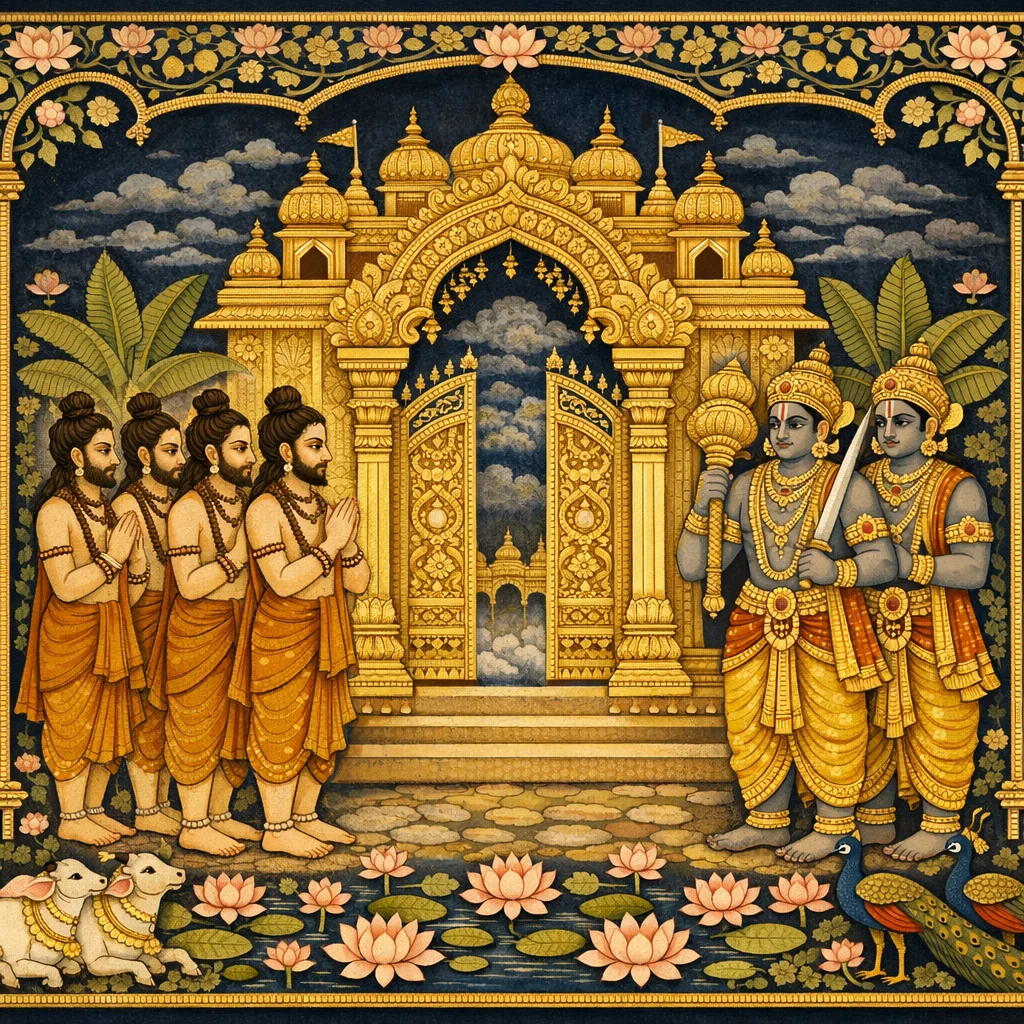
Adhyaya 1
Nārāyaṇa’s Impartiality, Absorption in Kṛṣṇa, and the Jaya–Vijaya Descent (Prelude to Prahlāda’s History)
This chapter begins with Parīkṣit’s doubt: if Viṣṇu is the well-wisher of all and equal to everyone, why does He seem to side with Indra and kill the asuras? Śukadeva answers by affirming the Lord’s nirguṇa nature—unborn, unattached, without hatred—while explaining that cosmic affairs proceed through the three guṇas under His supervision as Paramātmā. When sattva predominates, the devas flourish; when rajas and tamas rise, asuric and rākṣasic powers expand. The Lord’s apparent “favor” of the devas is only insofar as time (kāla) strengthens sattva; He remains impartial, acting for universal welfare. To illustrate, Śukadeva recounts Nārada’s reply to Yudhiṣṭhira about Śiśupāla’s liberation: praise and blame belong to embodied ignorance, but the Lord is unaffected and turns even chastisement into benefit. Nārada teaches that intense remembrance of Kṛṣṇa—through devotion, fear, lust, affection, or enmity—can grant liberation, as in the bhramara-kīṭa analogy. The theological backstory follows: Śiśupāla and Dantavakra are Jaya and Vijaya, cursed by the Kumāras to take three births (as Hiraṇyākṣa/Hiraṇyakaśipu, then Rāvaṇa/Kumbhakarṇa, then Śiśupāla/Dantavakra) and return after being slain by the Lord. The chapter closes by turning to the next inquiry: why Hiraṇyakaśipu became hostile to his devotee-son Prahlāda and how Prahlāda’s bhakti arose, setting the stage for the Prahlāda narrative.
Shlokas
Verse 1
श्रीराजोवाच सम: प्रिय: सुहृद्ब्रह्मन् भूतानां भगवान् स्वयम् । इन्द्रस्यार्थे कथं दैत्यानवधीद्विषमो यथा ॥ १ ॥
King Parīkṣit inquired: O brāhmaṇa, the Supreme Lord Viṣṇu is by nature equal to all beings, their well-wisher and most dear. How, then, for Indra’s sake did He become partial like an ordinary man and slay the daityas, Indra’s enemies? How can one who is equal to everyone favor some and be hostile to others?
Verse 2
न ह्यस्यार्थ: सुरगणै: साक्षान्नि:श्रेयसात्मन: । नैवासुरेभ्यो विद्वेषो नोद्वेगश्चागुणस्य हि ॥ २ ॥
Lord Viṣṇu Himself, the Supreme Personality of Godhead, is the very reservoir of bliss and the embodiment of the highest good. What could He possibly gain by siding with the devas, and what personal interest would be served thereby? Since the Lord is transcendental, beyond the material guṇas, why should He fear the asuras, and how could envy or hatred toward them arise in Him?
Verse 3
इति न: सुमहाभाग नारायणगुणान् प्रति । संशय: सुमहाञ्जातस्तद्भवांश्छेत्तुमर्हति ॥ ३ ॥
O greatly fortunate and learned brāhmaṇa, a grave doubt has arisen in us concerning the qualities of Nārāyaṇa—whether He is partial or impartial. Kindly cut through my doubt with decisive evidence, and show that Nārāyaṇa is ever neutral and equal toward all.
Verse 4
श्रीऋषिरुवाच साधु पृष्टं महाराज हरेश्चरितमद्भुतम् । यद् भागवतमाहात्म्यं भगवद्भक्तिवर्धनम् ॥ ४ ॥ गीयते परमं पुण्यमृषिभिर्नारदादिभि: । नत्वा कृष्णाय मुनये कथयिष्ये हरे: कथाम् ॥ ५ ॥
The sage said: O Mahārāja, you have asked most excellently; the wondrous deeds of Hari and the glory of Śrīmad-Bhāgavatam increase devotion to Bhagavān. This supreme piety is sung by sages such as Nārada; having bowed to Vyāsa (Kṛṣṇa-dvaipāyana), I shall now speak the Hari-kathā.
Verse 5
श्रीऋषिरुवाच साधु पृष्टं महाराज हरेश्चरितमद्भुतम् । यद् भागवतमाहात्म्यं भगवद्भक्तिवर्धनम् ॥ ४ ॥ गीयते परमं पुण्यमृषिभिर्नारदादिभि: । नत्वा कृष्णाय मुनये कथयिष्ये हरे: कथाम् ॥ ५ ॥
This supreme piety is sung by sages such as Nārada; having bowed to Vyāsa (Kṛṣṇa-dvaipāyana), I shall speak the Hari-kathā, by which devotion grows through hearing and chanting.
Verse 6
निर्गुणोऽपि ह्यजोऽव्यक्तो भगवान्प्रकृते: पर: । स्वमायागुणमाविश्य बाध्यबाधकतां गत: ॥ ६ ॥
Bhagavān is beyond material qualities—unborn and unmanifest—yet by His own yoga-māyā He enters His potency and performs līlā as though both bound and binding.
Verse 7
सत्त्वं रजस्तम इति प्रकृतेर्नात्मनो गुणा: । न तेषां युगपद्राजन् ह्रास उल्लास एव वा ॥ ७ ॥
O King, sattva, rajas, and tamas are qualities of material nature, not of the Supreme Self. These three guṇas cannot simultaneously increase or decrease at the same time.
Verse 8
जयकाले तु सत्त्वस्य देवर्षीन् रजसोऽसुरान् । तमसो यक्षरक्षांसि तत्कालानुगुणोऽभजत् ॥ ८ ॥
When sattva predominates, the devas and sages flourish; when rajas predominates, the asuras flourish; and when tamas predominates, the Yakṣas and Rākṣasas grow strong. Bhagavān dwells in the heart, fostering the results according to the time and the ruling guṇa.
Verse 9
ज्योतिरादिरिवाभाति सङ्घातान्न विविच्यते । विदन्त्यात्मानमात्मस्थं मथित्वा कवयोऽन्तत: ॥ ९ ॥
The Paramātmā, the all-pervading Supreme Personality of Godhead, dwells within the heart of every living being. As one discerns fire in wood or water in a pot, the wise perceive—by a person’s bhakti and conduct—how greatly the Lord’s favor rests upon him.
Verse 10
यदा सिसृक्षु: पुर आत्मन: परो रज: सृजत्येष पृथक् स्वमायया । सत्त्वं विचित्रासु रिरंसुरीश्वर: शयिष्यमाणस्तम ईरयत्यसौ ॥ १० ॥
When the Supreme Lord desires to create, He, by His own māyā, awakens the modes of nature and fashions diverse bodies for the jīvas. Then, as Paramātmā, He enters each body—using sattva for maintenance, rajas for creation, and tamas for annihilation.
Verse 11
कालं चरन्तं सृजतीश आश्रयं । प्रधानपुम्भ्यां नरदेव सत्यकृत् ॥ ११ ॥
O great King, the Supreme Lord—creator of the cosmos and master of material and spiritual energies—manifests the factor of time so that prakṛti and the jīva may act within its bounds. Yet He Himself is never subject to time or to material nature.
Verse 12
य एष राजन्नपि काल ईशिता सत्त्वं सुरानीकमिवैधयत्यत: । तत्प्रत्यनीकानसुरान् सुरप्रियो रजस्तमस्कान् प्रमिणोत्युरुश्रवा: ॥ १२ ॥
O King, the time factor increases sattva-guṇa; thus the Lord appears to favor the devas, who are mostly situated in goodness, and the tamasic asuras are destroyed. Yet the Lord is never partial—His deeds are supremely glorious, and therefore He is called Uruśravā.
Verse 13
अत्रैवोदाहृत: पूर्वमितिहास: सुरर्षिणा । प्रीत्या महाक्रतौ राजन् पृच्छतेऽजातशत्रवे ॥ १३ ॥
O King, in this very matter, long ago during Mahārāja Yudhiṣṭhira’s Rājasūya sacrifice, Devarṣi Nārada joyfully recounted a historical account. In reply to Ajātaśatru Yudhiṣṭhira’s question, he gave a vivid example showing that the Lord remains impartial even when slaying demons.
Verse 14
दृष्ट्वा महाद्भुतं राजा राजसूये महाक्रतौ । वासुदेवे भगवति सायुज्यं चेदिभूभुज: ॥ १४ ॥ तत्रासीनं सुरऋषिं राजा पाण्डुसुत: क्रतौ । पप्रच्छ विस्मितमना मुनीनां शृण्वतामिदम् ॥ १५ ॥
At the great Rājasūya sacrifice, Mahārāja Yudhiṣṭhira, son of Pāṇḍu, beheld a wondrous marvel: Śiśupāla, the king of Cedi, attained sāyujya and merged into Bhagavān Vāsudeva, Śrī Kṛṣṇa. Struck with amazement, he asked the cause from the devarṣi Nārada who was seated there, while all the assembled sages listened.
Verse 15
दृष्ट्वा महाद्भुतं राजा राजसूये महाक्रतौ । वासुदेवे भगवति सायुज्यं चेदिभूभुज: ॥ १४ ॥ तत्रासीनं सुरऋषिं राजा पाण्डुसुत: क्रतौ । पप्रच्छ विस्मितमना मुनीनां शृण्वतामिदम् ॥ १५ ॥
At the great Rājasūya, Yudhiṣṭhira, son of Pāṇḍu, saw Śiśupāla, king of Cedi, attain sāyujya and merge into Bhagavān Vāsudeva, Śrī Kṛṣṇa. Amazed, he asked the reason from the devarṣi Nārada seated there, as all the sages listened.
Verse 16
श्रीयुधिष्ठिर उवाच अहो अत्यद्भुतं ह्येतद्दुर्लभैकान्तिनामपि । वासुदेवे परे तत्त्वे प्राप्तिश्चैद्यस्य विद्विष: ॥ १६ ॥
Mahārāja Yudhiṣṭhira said: “How astonishing! Sāyujya-mukti is rare even for single-minded devotees; how, then, did Śiśupāla—an enemy of the Lord—attain such union with Vāsudeva, the Supreme Truth?”
Verse 17
एतद्वेदितुमिच्छाम: सर्व एव वयं मुने । भगवन्निन्दया वेनो द्विजैस्तमसि पातित: ॥ १७ ॥
O great sage, we all wish to know the reason. I have heard that King Vena once blasphemed Bhagavān and was cast into hell by the brāhmaṇas. Śiśupāla too was a blasphemer—so why was he not sent to hell, and how did he instead merge into the Lord?
Verse 18
दमघोषसुत: पाप आरभ्य कलभाषणात् । सम्प्रत्यमर्षी गोविन्दे दन्तवक्रश्च दुर्मति: ॥ १८ ॥
Śiśupāla, the sinful son of Damaghoṣa, began blaspheming Govinda from early childhood—even before he could speak properly—and remained envious of Śrī Kṛṣṇa until death. Likewise, his brother Dantavakra, of wicked mind, persisted in the same ways.
Verse 19
शपतोरसकृद्विष्णुं यद्ब्रह्म परमव्ययम् । श्वित्रो न जातो जिह्वायां नान्धं विविशतुस्तम: ॥ १९ ॥
Although Śiśupāla and Dantavakra repeatedly blasphemed Lord Viṣṇu (Kṛṣṇa), the imperishable Supreme Brahman, they remained healthy. Their tongues were not struck by white leprosy, nor did they fall into the darkest hell—this leaves us utterly astonished.
Verse 20
कथं तस्मिन् भगवति दुरवग्राह्यधामनि । पश्यतां सर्वलोकानां लयमीयतुरञ्जसा ॥ २० ॥
How could Śiśupāla and Dantavakra, before the eyes of all, so easily merge into the body of Kṛṣṇa, whose abode is so difficult to attain?
Verse 21
एतद्भ्राम्यति मे बुद्धिर्दीपार्चिरिव वायुना । ब्रूह्येतदद्भुततमं भगवान्ह्यत्र कारणम् ॥ २१ ॥
This is indeed most wondrous. My intelligence is shaken like a lamp-flame disturbed by the wind. O Nārada Muni, you know all things—please tell me the cause of this astonishing event.
Verse 22
श्रीबादरायणिरुवाच राज्ञस्तद्वच आकर्ण्य नारदो भगवानृषि: । तुष्ट: प्राह तमाभाष्य शृण्वत्यास्तत्सद: कथा: ॥ २२ ॥
Śrī Śukadeva Gosvāmī said: Hearing Mahārāja Yudhiṣṭhira’s request, Nārada Muni—the all-knowing and most powerful sage—was greatly pleased, and he replied before everyone assembled for the yajña.
Verse 23
श्रीनारद उवाच निन्दनस्तवसत्कारन्यक्कारार्थं कलेवरम् । प्रधानपरयो राजन्नविवेकेन कल्पितम् ॥ २३ ॥
Śrī Nārada said: O King, blame and praise, insult and honor, are felt because of ignorance. The body of the conditioned soul is arranged by the Lord, through His external energy (māyā), so that one undergoes suffering in the material world.
Verse 24
हिंसा तदभिमानेन दण्डपारुष्ययोर्यथा । वैषम्यमिह भूतानां ममाहमिति पार्थिव ॥ २४ ॥
My dear King, the conditioned soul, absorbed in bodily ego, takes the body to be the self and all that relates to the body to be “mine”; from this mistaken notion he is bound by dualities such as praise and blame, punishment and harshness.
Verse 25
यन्निबद्धोऽभिमानोऽयं तद्वधात्प्राणिनां वध: । तथा न यस्य कैवल्यादभिमानोऽखिलात्मन: । परस्य दमकर्तुर्हि हिंसा केनास्य कल्प्यते ॥ २५ ॥
Bound by bodily ego, the conditioned soul thinks that when the body is destroyed the living being is destroyed. But Lord Viṣṇu—the Supreme Personality of Godhead, the supreme controller and Paramātmā of all—has no material body and thus no false sense of “I and mine.” Therefore it is wrong to imagine that He feels pleasure or pain from prayers or blasphemy. He has neither enemy nor friend: when He chastises the asuras it is for their good, and when He accepts the devotees’ prayers it is for their good. He is touched by neither praise nor insult.
Verse 26
तस्माद्वैरानुबन्धेन निर्वैरेण भयेन वा । स्नेहात्कामेन वा युञ्ज्यात् कथञ्चिन्नेक्षते पृथक् ॥ २६ ॥
Therefore, whether through enmity or through devotion, through fear, affection, or even desire—by any of these—if a conditioned soul somehow fixes the mind upon the Lord, the result is the same, for the Lord, established in bliss, is never affected by hatred or friendship.
Verse 27
यथा वैरानुबन्धेन मर्त्यस्तन्मयतामियात् । न तथा भक्तियोगेन इति मे निश्चिता मति: ॥ २७ ॥
Nārada Muni continued: The intense absorption a mortal attains through the bond of enmity is not attained in the same way through bhakti-yoga. That is my settled opinion.
Verse 28
कीट: पेशस्कृता रुद्ध: कुड्यायां तमनुस्मरन् । संरम्भभययोगेन विन्दते तत्स्वरूपताम् ॥ २८ ॥ एवं कृष्णे भगवति मायामनुज ईश्वरे । वैरेण पूतपाप्मानस्तमापुरनुचिन्तया ॥ २९ ॥
A grassworm confined in a hole of a wall by a bee keeps remembering the bee in anger and fear, and later becomes a bee by that very remembrance. Similarly, if conditioned souls somehow constantly think of Śrī Kṛṣṇa—Bhagavān, the Īśvara who appears as a man under māyā, whose form is eternal, conscious, and blissful—then by such unbroken contemplation their sins are purified and they regain their spiritual bodies, whether they think of Him as their worshipful Lord or as an enemy.
Verse 29
कीट: पेशस्कृता रुद्ध: कुड्यायां तमनुस्मरन् । संरम्भभययोगेन विन्दते तत्स्वरूपताम् ॥ २८ ॥ एवं कृष्णे भगवति मायामनुज ईश्वरे । वैरेण पूतपाप्मानस्तमापुरनुचिन्तया ॥ २९ ॥
As a worm imprisoned in a wall’s crevice by a bee, remembering that bee in fear and hostility, ultimately attains the bee’s form, so too one who somehow or other constantly contemplates Bhagavān Śrī Kṛṣṇa—the Supreme Lord who appears in humanlike form by His māyā—whether with devotion or even with enmity, becomes purified of sin and regains one’s spiritual form.
Verse 30
कामाद् द्वेषाद्भयात्स्नेहाद्यथा भक्त्येश्वरे मन: । आवेश्य तदघं हित्वा बहवस्तद्गतिं गता: ॥ ३० ॥
By lust, by hatred, by fear, by affection, or by bhakti—absorbing the mind in the Lord and abandoning sin—many have attained the supreme destination. Now I shall explain how Kṛṣṇa’s mercy is received simply by fixing the mind upon Him.
Verse 31
गोप्य: कामाद्भयात्कंसो द्वेषाच्चैद्यादयो नृपा: । सम्बन्धाद् वृष्णय: स्नेहाद्यूयं भक्त्या वयं विभो ॥ ३१ ॥
My dear King Yudhiṣṭhira, the gopīs attained Him through ardent love; Kaṁsa through fear; Śiśupāla (the Caidya) and other kings through hatred; the Vṛṣṇis through family connection; you Pāṇḍavas through deep affection; and we ordinary devotees through bhakti—thus all have obtained the mercy of Śrī Kṛṣṇa.
Verse 32
कतमोऽपि न वेन: स्यात्पञ्चानां पुरुषं प्रति । तस्मात् केनाप्युपायेन मन: कृष्णे निवेशयेत् ॥ ३२ ॥
Among these five attitudes, one may turn the mind toward the Supreme Person; but atheists like King Vena, unable to contemplate Kṛṣṇa’s form in any of these ways, do not attain liberation. Therefore, by some means—friendly or even inimical—one should fix the mind upon Śrī Kṛṣṇa.
Verse 33
मातृष्वस्रेयो वश्चैद्यो दन्तवक्रश्च पाण्डव । पार्षदप्रवरौ विष्णोर्विप्रशापात्पदच्युतौ ॥ ३३ ॥
Nārada Muni continued: O best of the Pāṇḍavas, your two cousins Śiśupāla (the Caidya) and Dantavakra, sons of your maternal aunt, were formerly exalted associates of Lord Viṣṇu; but by the curse of brāhmaṇas they fell from Vaikuṇṭha into this material world.
Verse 34
श्रीयुधिष्ठिर उवाच कीदृश: कस्य वा शापो हरिदासाभिमर्शन: । अश्रद्धेय इवाभाति हरेरेकान्तिनां भव: ॥ ३४ ॥
Mahārāja Yudhiṣṭhira inquired: What kind of curse, and from whom, could even touch the servants of Hari? For those exclusively devoted to the Lord, a return to this material world is impossible; I cannot accept it.
Verse 35
देहेन्द्रियासुहीनानां वैकुण्ठपुरवासिनाम् । देहसम्बन्धसम्बद्धमेतदाख्यातुमर्हसि ॥ ३५ ॥
The bodies, senses, and life air of Vaikuṇṭha’s residents are wholly spiritual, untouched by matter. Therefore, please explain how the Lord’s associates could be cursed to descend into material bodies like ordinary persons.
Verse 36
श्रीनारद उवाच एकदा ब्रह्मण: पुत्रा विष्णुलोकं यदृच्छया । सनन्दनादयो जग्मुश्चरन्तो भुवनत्रयम् ॥ ३६ ॥
The great sage Nārada said: Once, Brahmā’s four sons—Sanaka, Sanandana, Sanātana, and Sanat-kumāra—while wandering through the three worlds, happened to come to Viṣṇuloka.
Verse 37
पञ्चषड्ढायनार्भाभा: पूर्वेषामपि पूर्वजा: । दिग्वासस: शिशून् मत्वा द्वा:स्थौ तान् प्रत्यषेधताम् ॥ ३७ ॥
Though those four sages were older than Brahmā’s other sons like Marīci, they appeared as naked children of five or six years. Seeing them attempt to enter Vaikuṇṭhaloka, the gatekeepers Jaya and Vijaya, thinking them ordinary boys, forbade their entry.
Verse 38
अशपन् कुपिता एवं युवां वासं न चार्हथ: । रजस्तमोभ्यां रहिते पादमूले मधुद्विष: । पापिष्ठामासुरीं योनिं बालिशौ यातमाश्वत: ॥ ३८ ॥
Checked by Jaya and Vijaya, Sanandana and the other sages, burning with anger, cursed them: “You foolish gatekeepers! Stirred by rajas and tamas, you are unfit to dwell at the shelter of Madhudviṣa’s lotus feet, which are free from such modes. Go at once to the material world and take birth among the most sinful asuras.”}]}
Verse 39
एवं शप्तौ स्वभवनात् पतन्तौ तौ कृपालुभि: । प्रोक्तौ पुनर्जन्मभिर्वां त्रिभिर्लोकाय कल्पताम् ॥ ३९ ॥
Thus, as Jaya and Vijaya—cursed by the sages—were falling from their abode, those same compassionate sages spoke to them: “O gatekeepers, after three births the term of the curse will end, and you will return to your posts in Vaikuṇṭha.”
Verse 40
जज्ञाते तौ दिते: पुत्रौ दैत्यदानववन्दितौ । हिरण्यकशिपुर्ज्येष्ठो हिरण्याक्षोऽनुजस्तत: ॥ ४० ॥
The two were born as sons of Diti, honored among the Daityas and Danavas: Hiraṇyakaśipu was the elder, and Hiraṇyākṣa the younger.
Verse 41
हतो हिरण्यकशिपुर्हरिणा सिंहरूपिणा । हिरण्याक्षो धरोद्धारे बिभ्रता शौकरं वपु: ॥ ४१ ॥
Śrī Hari, appearing as Nṛsiṁhadeva, slew Hiraṇyakaśipu. And when the Lord lifted the earth from the Garbhodaka Ocean, Hiraṇyākṣa tried to obstruct Him; then the Lord, as Varāha, killed Hiraṇyākṣa.
Verse 42
हिरण्यकशिपु: पुत्रं प्रह्लादं केशवप्रियम् । जिघांसुरकरोन्नाना यातना मृत्युहेतवे ॥ ४२ ॥
Desiring to kill his son Prahlāda, who was dear to Keśava, Hiraṇyakaśipu inflicted upon him many kinds of torment.
Verse 43
तं सर्वभूतात्मभूतं प्रशान्तं समदर्शनम् । भगवत्तेजसा स्पृष्टं नाशक्नोद्धन्तुमुद्यमै: ॥ ४३ ॥
The Lord, the Paramātmā within all beings, is sober, peaceful, and equal to all. Since the great devotee Prahlāda was touched and protected by Bhagavān’s divine splendor, Hiraṇyakaśipu could not kill him, despite many attempts.
Verse 44
ततस्तौ राक्षसौ जातौ केशिन्यां विश्रव:सुतौ । रावण: कुम्भकर्णश्च सर्वलोकोपतापनौ ॥ ४४ ॥
Thereafter, the two gatekeepers of Lord Viṣṇu, Jaya and Vijaya, were born from Keśinī’s womb as the sons of Viśravā, becoming Rāvaṇa and Kumbhakarṇa. They brought severe distress to all the worlds.
Verse 45
तत्रापि राघवो भूत्वा न्यहनच्छापमुक्तये । रामवीर्यं श्रोष्यसि त्वं मार्कण्डेयमुखात्प्रभो ॥ ४५ ॥
There too, to free them from the brāhmaṇas’ curse, the Lord appeared as Rāghava—Śrī Rāmacandra—and slew them. O King, hear the accounts of Rāma’s valor from the sage Mārkaṇḍeya.
Verse 46
तावत्र क्षत्रियौ जातौ मातृष्वस्रात्मजौ तव । अधुना शापनिर्मुक्तौ कृष्णचक्रहतांहसौ ॥ ४६ ॥
In their third birth, they were born in a kṣatriya family as the sons of your aunt—your cousins. Now, struck by Lord Kṛṣṇa’s disc, all their sinful reactions are destroyed, and they are freed from the curse.
Verse 47
वैरानुबन्धतीव्रेण ध्यानेनाच्युतसात्मताम् । नीतौ पुनर्हरे: पार्श्वं जग्मतुर्विष्णुपार्षदौ ॥ ४७ ॥
Bound by intense and prolonged enmity, they constantly meditated on Acyuta, and thus attained oneness with Him. Those two attendants of Viṣṇu returned again to Hari’s side—going back home, back to Godhead.
Verse 48
श्रीयुधिष्ठिर उवाच विद्वेषो दयिते पुत्रे कथमासीन्महात्मनि । ब्रूहि मे भगवन्येन प्रह्लादस्याच्युतात्मता ॥ ४८ ॥
Mahārāja Yudhiṣṭhira asked: O my lord Nārada Muni, how did such enmity arise in Hiraṇyakaśipu toward his beloved son, the great soul Prahlāda? And how did Prahlāda become so devoted to Acyuta, Lord Kṛṣṇa? Kindly explain this to me.
Frequently Asked Questions
It distinguishes the Lord’s transcendental nature from His līlā: He has no material body and thus no material attachment or hatred, but by His internal potency He appears to act within dharma and social obligation. His governance occurs through the guṇas and kāla, not through personal bias.
Nārada’s point is about psychological intensity (smaraṇa-eka-tānatā): hatred and fear can force continuous, undistracted remembrance, as in the bee-and-grassworm analogy. The Bhāgavata does not recommend envy as a sādhana; it demonstrates the Lord’s power to purify even distorted fixation when it is constant and centered on Him.
The four Kumāras cursed them after being blocked at Vaikuṇṭha’s gate. The curse functions as a līlā arrangement: Jaya and Vijaya take three births as great antagonists, intensify remembrance through enmity, are slain by the Lord’s incarnations, and return to Vaikuṇṭha—thereby displaying the Lord’s impartial mercy and the supremacy of His devotee-protection.