Adhyaya 6
Devas in Dvārakā, Brahmā’s Petition, and Uddhava’s Appeal (Prabhāsa Departure Set-Up)
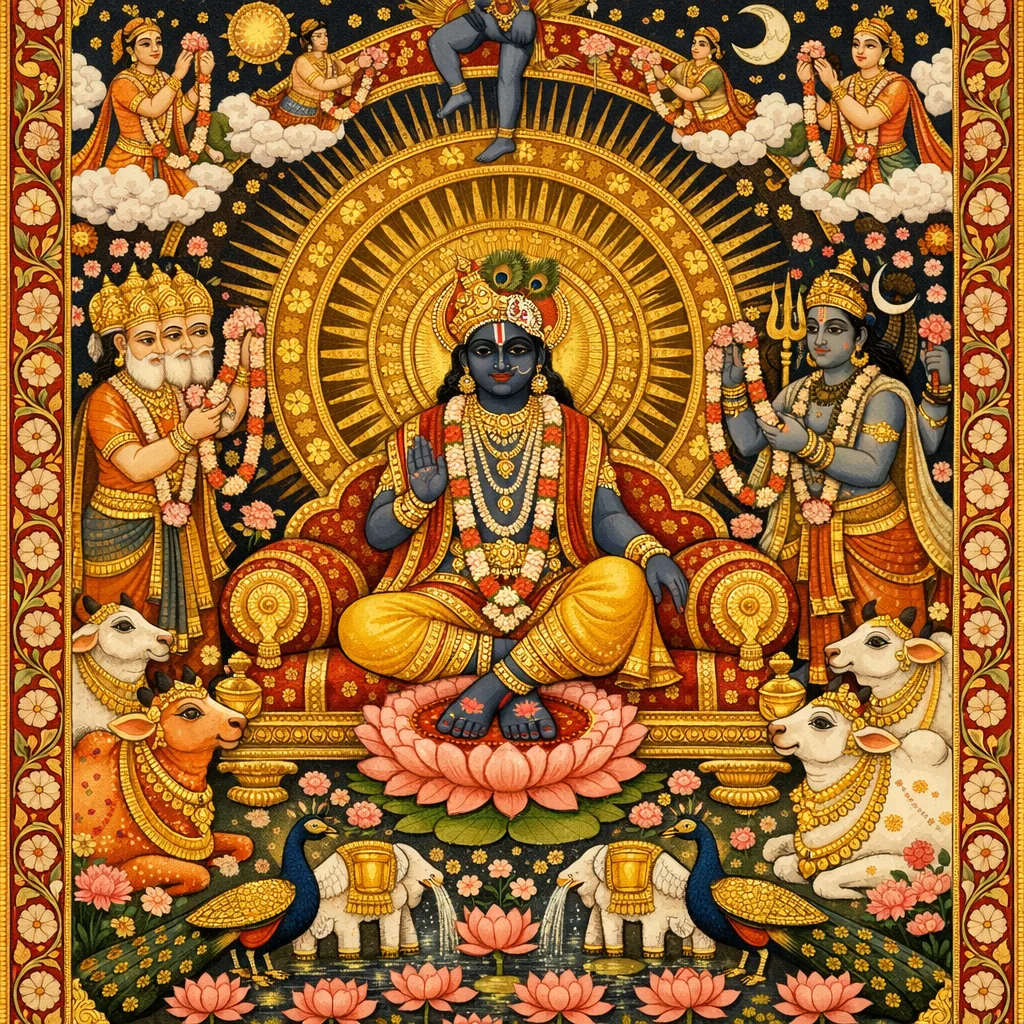
As the destined end of the Yādava dynasty nears, Brahmā arrives in Dvārakā with Śiva, Indra, and hosts of devas to behold and glorify Śrī Kṛṣṇa, whose fame purifies the universe. They offer layered stuti, praising Him as the untouched superintendent of māyā and the guṇas, the sole purifier beyond ordinary ritual merit, and the refuge whose lotus feet burn away material desire; they recall Trivikrama’s cosmic stride and acknowledge kāla as His regulating power over creation, maintenance, and dissolution. Brahmā confirms that earth’s burden has been removed and petitions the Lord to return to His own abode while still safeguarding cosmic administration. Kṛṣṇa replies that the devas’ purpose is fulfilled and that He has already begun the Yādavas’ withdrawal—through the brāhmaṇa curse—so their excessive power will not overwhelm the world. After the devas depart, ominous signs and disturbances intensify in Dvārakā; Kṛṣṇa orders the elders to leave at once for Prabhāsa-kṣetra to perform purification rites. As the Yādavas prepare to depart, Uddhava, shaken by the omens, approaches Kṛṣṇa privately and begins his heartfelt appeal to accompany the Lord, setting the stage for the confidential teachings to follow.
Shlokas
Verse 1
श्रीशुक उवाच अथ ब्रह्मात्मजै: देवै: प्रजेशैरावृतोऽभ्यगात् । भवश्च भूतभव्येशो ययौ भूतगणैर्वृत: ॥ १ ॥
Śrī Śukadeva Gosvāmī said: Then Lord Brahmā set out for Dvārakā, surrounded by his sons, the demigods, and the great Prajāpatis. Lord Śiva, bestower of auspiciousness to all beings and master of past and future, also went, encircled by hosts of bhūtas.
Verse 2
इन्द्रो मरुद्भिर्भगवानादित्या वसवोऽश्विनौ । ऋभवोऽङ्गिरसो रुद्रा विश्वे साध्याश्च देवता: ॥ २ ॥ गन्धर्वाप्सरसो नागा: सिद्धचारणगुह्यका: । ऋषय: पितरश्चैव सविद्याधरकिन्नरा: ॥ ३ ॥ द्वारकामुपसञ्जग्मु: सर्वे कृष्णदिदृक्षव: । वपुषा येन भगवान् नरलोकमनोरम: । यशो वितेने लोकेषु सर्वलोकमलापहम् ॥ ४ ॥
Indra with the Maruts; the Ādityas, Vasus, and Aśvinīs; the Ṛbhus, Aṅgirās, Rudras, Viśvedevas, and Sādhyas; along with Gandharvas, Apsarās, Nāgas, Siddhas, Cāraṇas, and Guhyakas; the ṛṣis, the forefathers (pitṛs), and also the Vidyādharas and Kinnaras—all arrived in Dvārakā, eager to behold Śrī Kṛṣṇa. By His transcendental form the Lord enchants the human world and spreads His fame through all realms, a glory that removes the impurity of the entire universe.
Verse 3
इन्द्रो मरुद्भिर्भगवानादित्या वसवोऽश्विनौ । ऋभवोऽङ्गिरसो रुद्रा विश्वे साध्याश्च देवता: ॥ २ ॥ गन्धर्वाप्सरसो नागा: सिद्धचारणगुह्यका: । ऋषय: पितरश्चैव सविद्याधरकिन्नरा: ॥ ३ ॥ द्वारकामुपसञ्जग्मु: सर्वे कृष्णदिदृक्षव: । वपुषा येन भगवान् नरलोकमनोरम: । यशो वितेने लोकेषु सर्वलोकमलापहम् ॥ ४ ॥
Powerful Lord Indra, together with the Maruts, Ādityas, Vasus, Aśvinīs, Ṛbhus, Aṅgirās, Rudras, Viśvedevas and Sādhyas; and also the Gandharvas, Apsarās, Nāgas, Siddhas, Cāraṇas, Guhyakas, the great sages and forefathers, as well as the Vidyādharas and Kinnaras—all came to the city of Dvārakā, longing to behold Lord Kṛṣṇa. By His transcendental form, Bhagavān Kṛṣṇa enchants the human world, and His fame spreads through all realms, destroying every taint within the universe.
Verse 4
इन्द्रो मरुद्भिर्भगवानादित्या वसवोऽश्विनौ । ऋभवोऽङ्गिरसो रुद्रा विश्वे साध्याश्च देवता: ॥ २ ॥ गन्धर्वाप्सरसो नागा: सिद्धचारणगुह्यका: । ऋषय: पितरश्चैव सविद्याधरकिन्नरा: ॥ ३ ॥ द्वारकामुपसञ्जग्मु: सर्वे कृष्णदिदृक्षव: । वपुषा येन भगवान् नरलोकमनोरम: । यशो वितेने लोकेषु सर्वलोकमलापहम् ॥ ४ ॥
Powerful Lord Indra, together with the Maruts, Ādityas, Vasus, Aśvinīs, Ṛbhus, Aṅgirās, Rudras, Viśvedevas and Sādhyas; and also the Gandharvas, Apsarās, Nāgas, Siddhas, Cāraṇas, Guhyakas, the great sages and forefathers, as well as the Vidyādharas and Kinnaras—all came to the city of Dvārakā, longing to behold Lord Kṛṣṇa. By His transcendental form, Bhagavān Kṛṣṇa enchants the human world, and His fame spreads through all realms, destroying every taint within the universe.
Verse 5
तस्यां विभ्राजमानायां समृद्धायां महर्द्धिभि: । व्यचक्षतावितृप्ताक्षा: कृष्णमद्भुतदर्शनम् ॥ ५ ॥
In that radiant city of Dvārakā, rich with all superior opulences, the demigods beheld with unsatiated eyes the wondrous form of Śrī Kṛṣṇa.
Verse 6
स्वर्गोद्यानोपगैर्माल्यैश्छादयन्तो यदूत्तमम् । गीर्भिश्चित्रपदार्थाभिस्तुष्टुवुर्जगदीश्वरम् ॥ ६ ॥
The demigods draped the best of the Yadu dynasty, Śrī Kṛṣṇa, with flower garlands brought from the gardens of heaven. Then, with charming words and graceful meanings, they praised Him, the Lord of the universe.
Verse 7
श्रीदेवा ऊचु: नता: स्म ते नाथ पदारविन्दं बुद्धीन्द्रियप्राणमनोवचोभि: । यच्चिन्त्यतेऽन्तर्हृदि भावयुक्तै- र्मुमुक्षुभि: कर्ममयोरुपाशात् ॥ ७ ॥
The demigods said: O Nātha, we bow to Your lotus feet, offering our intelligence, senses, vital air, mind, and speech. Those very feet are meditated upon within the heart by bhāva-filled yogīs who seek liberation from the harsh bondage of karma.
Verse 8
त्वं मायया त्रिगुणयात्मनि दुर्विभाव्यं व्यक्तं सृजस्यवसि लुम्पसि तद्गुणस्थ: । नैतैर्भवानजित कर्मभिरज्यते वै यत् स्वे सुखेऽव्यवहितेऽभिरतोऽनवद्य: ॥ ८ ॥
O unconquerable Lord, You employ Your māyā of three guṇas within Your own Self to manifest, maintain, and dissolve this inconceivable cosmos. Though You appear situated amid the modes of nature, You are never tainted by material action, for You abide directly in Your own eternal, uninterrupted spiritual bliss, flawless and pure.
Verse 9
शुद्धिर्नृणां न तु तथेड्य दुराशयानां विद्याश्रुताध्ययनदानतप:क्रियाभि: । सत्त्वात्मनामृषभ ते यशसि प्रवृद्ध- सच्छ्रद्धया श्रवणसम्भृतया यथा स्यात् ॥ ९ ॥
O Lord worthy of worship, those whose consciousness is stained by illusion and fixed in vain hopes are not purified merely by ordinary worship, Vedic study, charity, austerity, and ritual acts. O supreme Ṛṣabha, only the pure souls who, by hearing Your glories, have grown strong in true transcendental faith attain a purity forever beyond the faithless.
Verse 10
स्यान्नस्तवाङ्घ्रिरशुभाशयधूमकेतु: क्षेमाय यो मुनिभिरार्द्रहृदोह्यमान: । य: सात्वतै: समविभूतय आत्मवद्भि- र्व्यूहेऽर्चित: सवनश: स्वरतिक्रमाय ॥ १० ॥
For our highest good, may Your lotus feet be like a blazing fire that burns to ashes all inauspicious desires for sense pleasure. The great sages, their hearts melted with love, always cherish them within. Likewise, Your self-controlled Sātvata devotees, seeking to transcend heavenly enjoyment and attain opulence equal to Yours, worship Your feet morning, noon, and evening, contemplating You in Your fourfold expansion.
Verse 11
यश्चिन्त्यते प्रयतपाणिभिरध्वराग्नौ त्रय्या निरुक्तविधिनेश हविर्गृहीत्वा । अध्यात्मयोग उत योगिभिरात्ममायां जिज्ञासुभि: परमभागवतै: परीष्ट: ॥ ११ ॥
Those who, according to the injunctions of the Ṛg, Yajur, and Sāma Vedas, take up the oblation and are about to offer it into the sacrificial fire meditate upon Your lotus feet. Likewise, yogīs of inner spiritual discipline contemplate Your feet, longing to know Your divine mystic potency (ātma-māyā). And the most exalted Bhāgavata devotees worship Your lotus feet perfectly, desiring to pass beyond Your māyā.
Verse 12
पर्युष्टया तव विभो वनमालयेयं संस्पार्धिनी भगवती प्रतिपत्नीवच्छ्री: । य: सुप्रणीतममुयार्हणमाददन्नो भूयात् सदाङ्घ्रिरशुभाशयधूमकेतु: ॥ १२ ॥
O almighty Lord, You have kindly accepted even this withered forest garland we placed upon Your chest. Upon that transcendental chest Śrī Lakṣmī dwells eternally; seeing our offering also resting there, she may stir like a jealous co-wife. Yet You, out of mercy, as if neglecting Your eternal consort, receive our gift as the finest worship. O compassionate Lord, may Your lotus feet always blaze within us, consuming every inauspicious desire of the heart.
Verse 13
केतुस्त्रिविक्रमयुतस्त्रिपतत्पताको यस्ते भयाभयकरोऽसुरदेवचम्वो: । स्वर्गाय साधुषु खलेष्वितराय भूमन् पाद: पुनातु भगवन् भजतामघं न: ॥ १३ ॥
O Bhagavān! In Your Trivikrama incarnation You raised Your leg like a flagstaff and sent the Gaṅgā down in three streams like a banner of victory through the three worlds. Your lotus feet strike fear into the asuras and grant fearlessness to Your devotees; since we worship You, may those feet cleanse us of all sinful reactions.
Verse 14
नस्योतगाव इव यस्य वशे भवन्ति ब्रह्मादयस्तनुभृतो मिथुरर्द्यमाना: । कालस्य ते प्रकृतिपूरुषयो: परस्य शं नस्तनोतु चरण: पुरुषोत्तमस्य ॥ १४ ॥
Even Brahmā and the great demigods are embodied beings; under the strict rule of Your time factor they painfully contend with one another, like bulls dragged by ropes through their pierced noses. O Puruṣottama, beyond both material nature and its enjoyer, may Your lotus feet bestow transcendental joy upon us.
Verse 15
अस्यासि हेतुरुदयस्थितिसंयमाना- मव्यक्तजीवमहतामपि कालमाहु: । सोऽयं त्रिणाभिरखिलापचये प्रवृत्त: कालो गभीररय उत्तमपूरुषस्त्वम् ॥ १५ ॥
You are the cause of this universe’s creation, maintenance, and destruction; the sages call You Time, who regulates both the subtle and manifest states of material nature and controls every living being. As the threefold wheel of time You imperceptibly diminish all things; thus You are the Supreme Personality of Godhead.
Verse 16
त्वत्त: पुमान् समधिगम्य ययास्य वीर्यं धत्ते महान्तमिव गर्भममोघवीर्य: । सोऽयं तयानुगत आत्मन आण्डकोशं हैमं ससर्ज बहिरावरणैरुपेतम् ॥ १६ ॥
My Lord, the original puruṣa-avatāra Mahā-Viṣṇu receives His creative potency from You; with infallible energy He impregnates prakṛti and brings forth the mahat-tattva. Then the mahat-tattva, endowed with the Lord’s power, produces the primeval golden egg of the universe, covered by various layers of material elements.
Verse 17
तत्तस्थूषश्च जगतश्च भवानधीशो यन्माययोत्थगुणविक्रिययोपनीतान् । अर्थाञ्जुषन्नपि हृषीकपते न लिप्तो येऽन्ये स्वत: परिहृतादपि बिभ्यति स्म ॥ १७ ॥
O Hṛṣīkeśa, You are the supreme Lord of all moving and nonmoving beings. Though You oversee the objects presented by the transformations of the guṇas arising from Your māyā, You are never tainted or entangled. But other living beings—even yogīs and philosophers—are disturbed and afraid simply by remembering the objects they claim to have renounced.
Verse 18
स्मायावलोकलवदर्शितभावहारि- भ्रूमण्डलप्रहितसौरतमन्त्रशौण्डै: । पत्न्यस्तु षोडशसहस्रमनङ्गबाणै- र्यस्येन्द्रियं विमथितुं करणैर्न विभ्व्य: ॥ १८ ॥
My Lord, You dwell with sixteen thousand exquisitely beautiful and noble wives. Their coy, smiling glances and the graceful arch of their brows send messages of eager conjugal love, yet even Cupid’s arrows cannot disturb Your mind and senses.
Verse 19
विभ्व्यस्तवामृतकथोदवहास्त्रिलोक्या: पादावनेजसरित: शमलानि हन्तुम् । आनुश्रवं श्रुतिभिरङ्घ्रिजमङ्गसङ्गै- स्तीर्थद्वयं शुचिषदस्त उपस्पृशन्ति ॥ १९ ॥
My Lord, the nectar-bearing streams of discourse about You, and the holy rivers born from bathing Your lotus feet, can destroy all contamination within the three worlds. Those seeking purification associate with Your glories by hearing them, and with those sacred rivers by bathing in them.
Verse 20
श्रीबादरायणिरुवाच इत्यभिष्टूय विबुधै: सेश: शतधृतिर्हरिम् । अभ्यभाषत गोविन्दं प्रणम्याम्बरमाश्रित: ॥ २० ॥
Śrī Śukadeva Gosvāmī continued: Thus Brahmā, together with Lord Śiva and the other demigods, offered prayers to Hari, Govinda. Then Brahmā, situated in the sky, bowed down and addressed Govinda as follows.
Verse 21
श्रीब्रह्मोवाच भूमेर्भारावताराय पुरा विज्ञापित: प्रभो । त्वमस्माभिरशेषात्मन्तत्तथैवोपपादितम् ॥ २१ ॥
Lord Brahmā said: My dear Lord, previously we requested You to remove the burden of the earth. O unlimited Personality of Godhead, that request has indeed been fulfilled by You.
Verse 22
धर्मश्च स्थापित: सत्सु सत्यसन्धेषु वै त्वया । कीर्तिश्च दिक्षु विक्षिप्ता सर्वलोकमलापहा ॥ २२ ॥
My Lord, You have reestablished the principles of dharma among the pious, who are firmly bound to truth. You have also spread Your glories in all directions, so that by hearing about You the entire world may be purified.
Verse 23
अवतीर्य यदोर्वंशे बिभ्रद् रूपमनुत्तमम् । कर्माण्युद्दामवृत्तानि हिताय जगतोऽकृथा: ॥ २३ ॥
O Lord, descending into the Yadu dynasty, You manifested Your incomparable transcendental form and, for the welfare of the entire universe, performed mighty divine pastimes.
Verse 24
यानि ते चरितानीश मनुष्या: साधव: कलौ । शृण्वन्त: कीर्तयन्तश्च तरिष्यन्त्यञ्जसा तम: ॥ २४ ॥
My Lord, in the Age of Kali, saintly souls who hear of Your divine pastimes and glorify them in kīrtana will easily cross beyond the darkness of the age.
Verse 25
यदुवंशेऽवतीर्णस्य भवत: पुरुषोत्तम । शरच्छतं व्यतीयाय पञ्चविंशाधिकं प्रभो ॥ २५ ॥
O Supreme Lord, Purushottama, having descended into the Yadu dynasty, You spent one hundred and twenty-five autumns in the company of Your devotees.
Verse 26
नाधुना तेऽखिलाधार देवकार्यावशेषितम् । कुलं च विप्रशापेन नष्टप्रायमभूदिदम् ॥ २६ ॥ तत: स्वधाम परमं विशस्व यदि मन्यसे । सलोकाँल्लोकपालान् न: पाहि वैकुण्ठकिङ्करान् ॥ २७ ॥
O Support of all, nothing now remains for You to do on behalf of the devas, and by the brāhmaṇas’ curse this dynasty has been all but withdrawn. Therefore, if You so desire, enter Your supreme abode; yet always protect us—Your Vaikuṇṭha servants—together with the lokapālas, our worlds, and our followers.
Verse 27
नाधुना तेऽखिलाधार देवकार्यावशेषितम् । कुलं च विप्रशापेन नष्टप्रायमभूदिदम् ॥ २६ ॥ तत: स्वधाम परमं विशस्व यदि मन्यसे । सलोकाँल्लोकपालान् न: पाहि वैकुण्ठकिङ्करान् ॥ २७ ॥
O Support of all, nothing now remains for You to do on behalf of the devas, and by the brāhmaṇas’ curse this dynasty has been all but withdrawn. Therefore, if You so desire, enter Your supreme abode; yet always protect us—Your Vaikuṇṭha servants—together with the lokapālas, our worlds, and our followers.
Verse 28
श्रीभगवानुवाच अवधारितमेतन्मे यदात्थ विबुधेश्वर । कृतं व: कार्यमखिलं भूमेर्भारोऽवतारित: ॥ २८ ॥
The Supreme Lord said: O lord of the demigods, Brahmā, I understand your prayers and request. Having removed the burden of the earth, I have executed everything that was required on your behalf.
Verse 29
तदिदं यादवकुलं वीर्यशौर्यश्रियोद्धतम् । लोकं जिघृक्षद् रुद्धं मे वेलयेव महार्णव: ॥ २९ ॥
That very Yādava dynasty in which I appeared became greatly magnified in opulence, especially in their physical strength and courage, to the extent that they threatened to devour the whole world. Therefore I have stopped them, just as the shore holds back the great ocean.
Verse 30
यद्यसंहृत्य दृप्तानां यदूनां विपुलं कुलम् । गन्तास्म्यनेन लोकोऽयमुद्वेलेन विनङ्क्ष्यति ॥ ३० ॥
If I were to leave this world without withdrawing the overly proud members of the Yadu dynasty, the whole world would be destroyed by the deluge of their unlimited expansion.
Verse 31
इदानीं नाश आरब्ध: कुलस्य द्विजशापज: । यास्यामि भवनं ब्रह्मन्नेतदन्ते तवानघ ॥ ३१ ॥
Now due to the brāhmaṇas’ curse, the annihilation of My family has already begun. O sinless Brahmā, when this annihilation is finished and I am enroute to Vaikuṇṭha, I will pay a small visit to your abode.
Verse 32
श्रीशुक उवाच इत्युक्तो लोकनाथेन स्वयम्भू: प्रणिपत्य तम् । सह देवगणैर्देव: स्वधाम समपद्यत ॥ ३२ ॥
Śrī Śukadeva Gosvāmī said: Thus addressed by the Lord of the universe, the self-born Brahmā fell down in obeisances at the lotus feet of the Lord. Surrounded by all the demigods, the great Brahmā then returned to his personal abode.
Verse 33
अथ तस्यां महोत्पातान् द्वारवत्यां समुत्थितान् । विलोक्य भगवानाह यदुवृद्धान् समागतान् ॥ ३३ ॥
Thereafter, the Lord Bhagavān, seeing mighty portents and disturbances arising in the holy city of Dvārakā, spoke thus to the assembled elders of the Yadu dynasty.
Verse 34
श्रीभगवानुवाच एते वै सुमहोत्पाता व्युत्तिष्ठन्तीह सर्वत: । शापश्च न: कुलस्यासीद् ब्राह्मणेभ्यो दुरत्यय: ॥ ३४ ॥
The Supreme Lord said: These mighty disturbances are rising on every side, for our dynasty has been cursed by the brāhmaṇas, and such a curse cannot be counteracted.
Verse 35
न वस्तव्यमिहास्माभिर्जिजीविषुभिरार्यका: । प्रभासं सुमहत्पुण्यं यास्यामोऽद्यैव मा चिरम् ॥ ३५ ॥
My revered elders, if we wish to preserve our lives we must not remain here any longer. This very day, without delay, let us go to the supremely pious holy place of Prabhāsa.
Verse 36
यत्र स्नात्वा दक्षशापाद् गृहीतो यक्ष्मणोडुराट् । विमुक्त: किल्बिषात् सद्यो भेजे भूय: कलोदयम् ॥ ३६ ॥
There, at Prabhāsa-kṣetra, simply by bathing, even the Moon—stricken with consumption by Dakṣa’s curse—was at once freed from sinful reaction and again resumed the waxing of his phases.
Verse 37
वयं च तस्मिन्नाप्लुत्य तर्पयित्वा पितृन् सुरान् । भोजयित्वोषिजो विप्रान् नानागुणवतान्धसा ॥ ३७ ॥ तेषु दानानि पात्रेषु श्रद्धयोप्त्वा महान्ति वै । वृजिनानि तरिष्यामो दानैर्नौभिरिवार्णवम् ॥ ३८ ॥
We too shall bathe there, offer tarpaṇa to satisfy the forefathers and the devas, feed the worshipful vipra brāhmaṇas with many kinds of delicious foods, and with faith bestow great gifts upon them as worthy recipients of charity. By such charity—like boats—we shall surely cross these dreadful dangers, just as one crosses a vast ocean in a suitable vessel.
Verse 38
वयं च तस्मिन्नाप्लुत्य तर्पयित्वा पितृन् सुरान् । भोजयित्वोषिजो विप्रान् नानागुणवतान्धसा ॥ ३७ ॥ तेषु दानानि पात्रेषु श्रद्धयोप्त्वा महान्ति वै । वृजिनानि तरिष्यामो दानैर्नौभिरिवार्णवम् ॥ ३८ ॥
By bathing at the holy Prabhāsa-kṣetra, offering tarpaṇa and sacrifice to satisfy the forefathers and the devas, feeding the worshipful brāhmaṇas with many delicious foods, and bestowing upon them—worthy vessels of charity—great gifts with faith, we shall surely cross beyond these dreadful dangers, just as one crosses a vast ocean in a proper boat.
Verse 39
श्रीशुक उवाच एवं भगवतादिष्टा यादवा: कुरुनन्दन । गन्तुं कृतधियस्तीर्थं स्यन्दनान् समयूयुजन् ॥ ३९ ॥
Śukadeva Gosvāmī said: O beloved son of the Kurus, thus instructed by the Bhagavān, the Yādavas resolved to go to the holy tīrtha of Prabhāsa-kṣetra and yoked their horses to their chariots.
Verse 40
तन्निरीक्ष्योद्धवो राजन् श्रुत्वा भगवतोदितम् । दृष्ट्वारिष्टानि घोराणि नित्यं कृष्णमनुव्रत: ॥ ४० ॥ विविक्त उपसङ्गम्य जगतामीश्वरेश्वरम् । प्रणम्य शिरसा पादौ प्राञ्जलिस्तमभाषत ॥ ४१ ॥
O King, Uddhava—ever faithful to Śrī Kṛṣṇa—seeing the Yādavas’ imminent departure, hearing the Lord’s instructions, and observing fearful omens, approached the Supreme Controller of the universe in a secluded place. Bowing with his head at the Lord’s lotus feet, he addressed Him with folded hands as follows.
Verse 41
तन्निरीक्ष्योद्धवो राजन् श्रुत्वा भगवतोदितम् । दृष्ट्वारिष्टानि घोराणि नित्यं कृष्णमनुव्रत: ॥ ४० ॥ विविक्त उपसङ्गम्य जगतामीश्वरेश्वरम् । प्रणम्य शिरसा पादौ प्राञ्जलिस्तमभाषत ॥ ४१ ॥
O King, Uddhava—ever faithful to Śrī Kṛṣṇa—seeing the Yādavas’ imminent departure, hearing the Lord’s instructions, and observing fearful omens, approached the Supreme Controller of the universe in a secluded place. Bowing with his head at the Lord’s lotus feet, he addressed Him with folded hands as follows.
Verse 42
श्रीउद्धव उवाच देवदेवेश योगेश पुण्यश्रवणकीर्तन । संहृत्यैतत् कुलं नूनं लोकं सन्त्यक्ष्यते भवान् । विप्रशापं समर्थोऽपि प्रत्यहन्न यदीश्वर: ॥ ४२ ॥
Śrī Uddhava said: O Lord of lords, O master of yoga, merely hearing and chanting Your sacred glories bestows true piety. My Lord, it seems You will now withdraw this dynasty and thus bring Your pastimes in this universe to a close. You are the Supreme Controller, the possessor of all mystic power; yet though fully able to counteract the brāhmaṇas’ curse against Your line, You do not avert it—therefore Your disappearance is near.
Verse 43
नाहं तवाङ्घ्रिकमलं क्षणार्धमपि केशव । त्यक्तुं समुत्सहे नाथ स्वधाम नय मामपि ॥ ४३ ॥
O Keśava, my Lord and master, I cannot bear to abandon Your lotus feet even for a moment; please take me also to Your own abode.
Verse 44
तव विक्रीडितं कृष्ण नृणां परममङ्गलम् । कर्णपीयूषमासाद्य त्यजन्त्यन्यस्पृहां जना: ॥ ४४ ॥
O Kṛṣṇa, Your pastimes are supremely auspicious for all people and like nectar to the ears; tasting them, one abandons longing for anything else.
Verse 45
शय्यासनाटनस्थानस्नानक्रीडाशनादिषु । कथं त्वां प्रियमात्मानं वयं भक्तास्त्यजेमहि ॥ ४५ ॥
Whether lying down, sitting, walking, standing, bathing, playing, eating, or doing anything else—O beloved Supreme Soul—how could we, Your devotees, ever abandon You?
Verse 46
त्वयोपभुक्तस्रग्गन्धवासोऽलङ्कारचर्चिता: । उच्छिष्टभोजिनो दासास्तव मायां जयेमहि ॥ ४६ ॥
By adorning ourselves with the garlands, fragrances, garments, and ornaments You have already enjoyed, and by honoring the remnants of Your meal as prasāda, we, Your servants, will surely conquer Your māyā.
Verse 47
वातवसना य ऋषय: श्रमणा ऊर्ध्वमन्थिन: । ब्रह्माख्यं धाम ते यान्ति शान्ता: सन्न्यासीनोऽमला: ॥ ४७ ॥
Naked sages—śramaṇas who strive intensely, who have raised their vital seed upward, and who are peaceful, pure sannyāsīs—attain the spiritual abode known as Brahman.
Verse 48
वयं त्विह महायोगिन् भ्रमन्त: कर्मवर्त्मसु । त्वद्वार्तया तरिष्यामस्तावकैर्दुस्तरं तम: ॥ ४८ ॥ स्मरन्त: कीर्तयन्तस्ते कृतानि गदितानि च । गत्युत्स्मितेक्षणक्ष्वेलि यन्नृलोकविडम्बनम् ॥ ४९ ॥
O greatest of mystics, though we wander as conditioned souls upon the paths of karma, by hearing Your sacred glories in the company of Your devotees we shall surely cross the hard-to-pass darkness of samsara.
Verse 49
वयं त्विह महायोगिन् भ्रमन्त: कर्मवर्त्मसु । त्वद्वार्तया तरिष्यामस्तावकैर्दुस्तरं तम: ॥ ४८ ॥ स्मरन्त: कीर्तयन्तस्ते कृतानि गदितानि च । गत्युत्स्मितेक्षणक्ष्वेलि यन्नृलोकविडम्बनम् ॥ ४९ ॥
Thus we ever remember and glorify Your wondrous deeds and words, and in rapture we recall Your loving pastimes with Your confidential consorts—Your gait, bold smile, glances, and playful sports—so humanlike in appearance, yet bewildering to the world.
Verse 50
श्रीशुक उवाच एवं विज्ञापितो राजन् भगवान् देवकीसुत: । एकान्तिनं प्रियं भृत्यमुद्धवं समभाषत ॥ ५० ॥
Śukadeva Gosvāmī said: O King Parīkṣit, thus petitioned, Bhagavān Śrī Kṛṣṇa, the son of Devakī, began to reply confidentially to His dear, single-minded servant Uddhava.
Frequently Asked Questions
They come to directly behold the Lord and to formally conclude the cosmic mandate for His descent: the removal of the earth’s burden and the reestablishment of dharma. Their prayers also articulate siddhānta—Kṛṣṇa as the transcendental āśraya who controls māyā and kāla yet remains untouched—thereby making the impending withdrawal of His manifest līlā intelligible as divine arrangement rather than material compulsion.
They state that worship, Vedic study, charity, austerity, and ritual alone cannot fully cleanse consciousness polluted by illusion unless they mature into transcendental faith (śraddhā) in the Lord’s glories. Hearing and glorifying Kṛṣṇa (īśānukathā) is presented as uniquely potent because it directly connects the jīva to the āśraya, burning anarthas like fire at the Lord’s lotus feet.
Kṛṣṇa explains a governance principle: the Yādavas had become so empowered that, if left unchecked, their pride and expansion could devastate the world. The brāhmaṇa curse becomes the instrument of nirodha (withdrawal), ensuring cosmic balance. The Lord is fully capable of counteracting it, but chooses not to, demonstrating that His līlā follows purposeful divine orchestration rather than reactive necessity.
Prabhāsa is presented as a tīrtha where bathing and associated rites—sacrifice for devas and pitṛs, feeding brāhmaṇas, and dāna—help one cross danger like a boat across an ocean. Narratively, it moves the Yādavas out of Dvārakā and sets the stage for the culminating events of the Lord’s manifest departure, while thematically reinforcing purification (śuddhi) and the inevitability of kāla under divine supervision.
Uddhava is Kṛṣṇa’s intimate devotee and counsel-bearing associate, characterized by unwavering fidelity and deep spiritual aptitude. His private approach signals a shift from public, cosmic concerns (devas’ petitions; dynastic decisions) to the inner transmission of liberating instruction. This confidentiality frames Uddhava as the qualified recipient of teachings meant to guide devotees after the Lord’s visible līlā concludes.