Adhyaya 38
Akrūra’s Journey to Vraja and His Devotional Vision of Kṛṣṇa and Balarāma
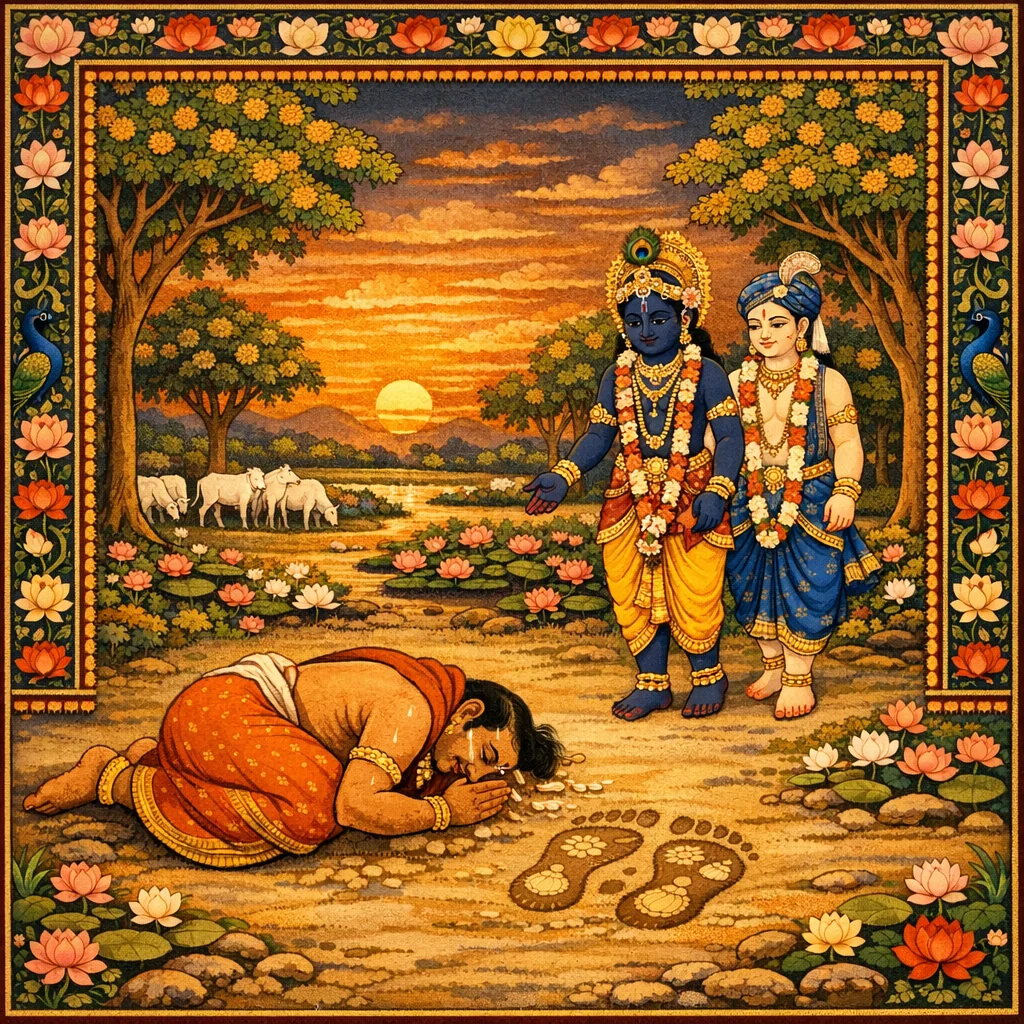
After Kaṁsa sends Akrūra as an emissary to bring Kṛṣṇa and Balarāma to Mathurā, Akrūra leaves Mathurā and journeys toward Nanda Mahārāja’s Gokula. On the way he becomes absorbed in bhakti-filled contemplation, lamenting his unworthiness yet affirming that even the fallen can reach the Lord’s shore by good fortune and the Lord’s grace. He glorifies the Lord’s lotus feet (worshiped by Brahmā, Śiva, Lakṣmī, and sages), the purifying power of hari-kathā, and the Lord’s impartial yet reciprocating nature. Reaching Vraja at sunset, Akrūra beholds the Lord’s footprints and rolls in their dust in ecstatic love. He then sees Kṛṣṇa and Balarāma—resplendent, youthful, and supremely beautiful—approaches, offers daṇḍavat praṇāma, and is embraced by Kṛṣṇa and honored by Balarāma with scriptural hospitality (washing the feet, seating, and food). Nanda questions Akrūra about the welfare of the Yadus under Kaṁsa, setting the stage for Akrūra’s message and the imminent departure to Mathurā in the next chapter.
Shlokas
Verse 1
श्रीशुक उवाच अक्रूरोऽपि च तां रात्रिं मधुपुर्यां महामति: । उषित्वा रथमास्थाय प्रययौ नन्दगोकुलम् ॥ १ ॥
Śukadeva Gosvāmī said: After spending the night in Mathurā, the noble-minded Akrūra mounted his chariot and set out for Nanda Mahārāja’s cowherd village, Gokula.
Verse 2
गच्छन्पथि महाभागो भगवत्यम्बुजेक्षणे । भक्तिं परामुपगत एवमेतदचिन्तयत् ॥ २ ॥
As he traveled along the road, the greatly fortunate Akrūra became filled with supreme devotion for the lotus-eyed Bhagavān, and he began to think as follows.
Verse 3
किं मयाचरितं भद्रं किं तप्तं परमं तप: । किं वाथाप्यर्हते दत्तं यद्द्रक्ष्याम्यद्य केशवम् ॥ ३ ॥
Akrūra thought: What auspicious deeds have I done, what supreme austerities have I endured, what worship or charity have I offered, that today I shall behold Lord Keśava?
Verse 4
ममैतद् दुर्लभं मन्य उत्तम:श्लोकदर्शनम् । विषयात्मनो यथा ब्रह्मकीर्तनं शूद्रजन्मन: ॥ ४ ॥
Absorbed in sense gratification, I deem it exceedingly rare for me to gain the vision of Lord Uttamaḥśloka—just as it is rare for one born a śūdra to be allowed to recite the Vedic mantras.
Verse 5
मैवं ममाधमस्यापि स्यादेवाच्युतदर्शनम् । ह्रियमाण: कालनद्या क्वचित्तरति कश्चन ॥ ५ ॥
Enough of such thoughts! Even a fallen soul like me may behold Acyuta, for one swept along by the river of time may sometimes reach the shore.
Verse 6
ममाद्यामङ्गलं नष्टं फलवांश्चैव मे भव: । यन्नमस्ये भगवतो योगिध्येयाङ्घ्रिपङ्कजम् ॥ ६ ॥
Today all my inauspiciousness is destroyed and my birth has borne fruit, for I shall bow to the lotus feet of Bhagavān, upon which the yogīs meditate.
Verse 7
कंसो बताद्याकृत मेऽत्यनुग्रहं द्रक्ष्येऽङ्घ्रिपद्मं प्रहितोऽमुना हरे: । कृतावतारस्य दुरत्ययं तम: पूर्वेऽतरन् यन्नखमण्डलत्विषा ॥ ७ ॥
Indeed, today King Kaṁsa has shown me great mercy by sending me to behold the lotus feet of Hari, who has descended into this world. By the radiance of His toenails, many souls in ages past crossed the insurmountable darkness of material existence and attained liberation.
Verse 8
यदर्चितं ब्रह्मभवादिभि: सुरै: श्रिया च देव्या मुनिभि: ससात्वतै: । गोचारणायानुचरैश्चरद्वने यद् गोपिकानां कुचकुङ्कुमाङ्कितम् ॥ ८ ॥
Those lotus feet are worshiped by Brahmā, Bhava (Śiva) and the other devas, by the goddess Śrī (Lakṣmī), and by great sages and Vaiṣṇavas. With those very feet the Lord roams the forest herding cows with His companions, and they are anointed with the kuṅkuma from the gopīs’ breasts.
Verse 9
द्रक्ष्यामि नूनं सुकपोलनासिकं स्मितावलोकारुणकञ्जलोचनम् । मुखं मुकुन्दस्य गुडालकावृतं प्रदक्षिणं मे प्रचरन्ति वै मृगा: ॥ ९ ॥
The deer are passing on my right in auspicious circumambulation; therefore I shall surely behold Lord Mukunda’s face—His lovely cheeks and nose, His smiling glances, His reddish lotus eyes, and His face framed by curling hair.
Verse 10
अप्यद्य विष्णोर्मनुजत्वमीयुषो भारावताराय भुवो निजेच्छया । लावण्यधाम्नो भवितोपलम्भनं मह्यं न न स्यात् फलमञ्जसा दृश: ॥ १० ॥
Today I shall see the Supreme Lord Viṣṇu, the abode of all beauty, who by His own sweet will has assumed a humanlike form to relieve the earth of her burden; thus my eyes will surely attain their perfect fulfillment.
Verse 11
य ईक्षिताहंरहितोऽप्यसत्सतो: स्वतेजसापास्ततमोभिदाभ्रम: । स्वमाययात्मन् रचितैस्तदीक्षया प्राणाक्षधीभि: सदनेष्वभीयते ॥ ११ ॥
He is the witness of cause and effect, yet He is ever free from false ‘I’-identification with them. By His internal potency He dispels the darkness of separation and confusion. The souls manifested when He glances upon His material creative energy perceive Him only indirectly, within the workings of their life airs, senses, and intelligence.
Verse 12
यस्याखिलामीवहभि: सुमङ्गलै- र्वाचो विमिश्रा गुणकर्मजन्मभि: । प्राणन्ति शुम्भन्ति पुनन्ति वै जगत् यास्तद्विरक्ता: शवशोभना मता: ॥ १२ ॥
The Lord’s qualities, deeds, and divine appearances are supremely auspicious; words that describe these three enliven, beautify, and purify the world, destroying sin and awakening good fortune. But words devoid of His glories are deemed mere ornaments upon a corpse.
Verse 13
स चावतीर्ण: किल सात्वतान्वये स्वसेतुपालामरवर्यशर्मकृत् । यशो वितन्वन् व्रज आस्त ईश्वरो गायन्ति देवा यदशेषमङ्गलम् ॥ १३ ॥
That same Supreme Lord has descended in the Sātvata dynasty to delight the exalted devas who uphold the bridge of dharma He established. Residing in Vraja, He spreads His fame; the gods sing of it, and that glory brings endless auspiciousness to all.
Verse 14
तं त्वद्य नूनं महतां गतिं गुरुं त्रैलोक्यकान्तं दृशिमन्महोत्सवम् । रूपं दधानं श्रिय ईप्सितास्पदं द्रक्ष्ये ममासन्नुषस: सुदर्शना: ॥ १४ ॥
Today I shall surely behold Him—the goal and spiritual master of the great souls, the beauty of the three worlds and a festival of joy for all who have eyes. His personal form is the shelter desired by Śrī Lakṣmī; now every dawn of my life has become auspicious.
Verse 15
अथावरूढ: सपदीशयो रथात् प्रधानपुंसोश्चरणं स्वलब्धये । धिया धृतं योगिभिरप्यहं ध्रुवं नमस्य आभ्यां च सखीन् वनौकस: ॥ १५ ॥
Then I will at once descend from my chariot and bow to the lotus feet of Śrī Kṛṣṇa and Balarāma, the Supreme Personalities of Godhead—those very feet the great yogīs hold within their minds in meditation. I will also offer obeisances to the Lords’ cowherd friends and to all the residents of Vṛndāvana.
Verse 16
अप्यङ्घ्रिमूले पतितस्य मे विभु: शिरस्यधास्यन्निजहस्तपङ्कजम् । दत्ताभयं कालभुजाङ्गरंहसा प्रोद्वेजितानां शरणैषिणां नृणाम् ॥ १६ ॥
And when I have fallen at His feet, the almighty Lord will place His lotus hand upon my head. For those who seek shelter in Him, greatly disturbed by the powerful serpent of time, that hand removes all fear.
Verse 17
समर्हणं यत्र निधाय कौशिक- स्तथा बलिश्चाप जगत्त्रयेन्द्रताम् । यद्वा विहारे व्रजयोषितां श्रमं स्पर्शेन सौगन्धिकगन्ध्यपानुदत् ॥ १७ ॥
By offering charity to that lotus hand, Purandara (Indra) and Kauśika, and also Bali, attained the rank of Indra, king of heaven, within the three worlds. And in the rāsa pastimes, that same hand—made fragrant by touching the gopīs’ faces—wiped away their perspiration and removed their fatigue.
Verse 18
न मय्युपैष्यत्यरिबुद्धिमच्युत: कंसस्य दूत: प्रहितोऽपि विश्वदृक् । योऽन्तर्बहिश्चेतस एतदीहितं क्षेत्रज्ञ ईक्षत्यमलेन चक्षुषा ॥ १८ ॥
The infallible Lord will not regard me as an enemy, even though Kaṁsa has sent me here as his messenger. For the all-seeing Lord is the true knower of the field of this body, and with His flawless vision He witnesses, within and without, every endeavor of the conditioned soul’s heart.
Verse 19
अप्यङ्घ्रिमूलेऽवहितं कृताञ्जलिं मामीक्षिता सस्मितमार्द्रया दृशा । सपद्यपध्वस्तसमस्तकिल्बिषो वोढा मुदं वीतविशङ्क ऊर्जिताम् ॥ १९ ॥
As I remain at His lotus feet, fallen in obeisance with joined palms and steady mind, the Lord will glance upon me with a smiling, affectionate, mercy-softened gaze. In that very instant all my taint will be dispelled, my doubts will vanish, and I will taste the most intense supreme bliss.
Verse 20
सुहृत्तमं ज्ञातिमनन्यदैवतं दोर्भ्यां बृहद्भ्यां परिरप्स्यतेऽथ माम् । आत्मा हि तीर्थीक्रियते तदैव मे बन्धश्च कर्मात्मक उच्छ्वसित्यत: ॥ २० ॥
Recognizing me as His intimate friend and kinsman, Śrī Kṛṣṇa will embrace me with His mighty arms. At once my very body will be sanctified, and all material bondage born of fruitive karma will be brought to nothing.
Verse 21
लब्ध्वाङ्गसङ्गं प्रणतं कृताञ्जलिं मां वक्ष्यतेऽक्रूर ततेत्युरुश्रवा: । तदा वयं जन्मभृतो महीयसा नैवादृतो यो धिगमुष्य जन्म तत् ॥ २१ ॥
Embraced by the all-renowned Lord Kṛṣṇa, I will stand before Him with bowed head and joined palms, and He will address me, “My dear Akrūra.” In that very moment my life’s purpose will be fulfilled; indeed, pitiable is the birth of one whom the Supreme Lord does not acknowledge.
Verse 22
न तस्य कश्चिद् दयित: सुहृत्तमो न चाप्रियो द्वेष्य उपेक्ष्य एव वा । तथापि भक्तान् भजते यथा तथा सुरद्रुमो यद्वदुपाश्रितोऽर्थद: ॥ २२ ॥
The Supreme Lord has no favorite and no dearmost friend, nor does He deem anyone undesirable, hateful, or fit to be neglected. Yet He lovingly reciprocates with His devotees according to the manner in which they worship Him, just as the heavenly wish-fulfilling trees grant the desires of whoever approaches them.
Verse 23
किं चाग्रजो मावनतं यदूत्तम: स्मयन् परिष्वज्य गृहीतमञ्जलौ । गृहं प्रवेष्याप्तसमस्तसत्कृतं सम्प्रक्ष्यते कंसकृतं स्वबन्धुषु ॥ २३ ॥
Then Kṛṣṇa’s elder brother, Balarāma—the foremost of the Yadus—will grasp my joined hands though my head remains bowed, smile, and embrace me. He will take me into His home, honor me with every proper rite of welcome, and ask how Kaṁsa has been treating His own family members.
Verse 24
श्रीशुक उवाच इति सञ्चिन्तयन्कृष्णं श्वफल्कतनयोऽध्वनि । रथेन गोकुलं प्राप्त: सूर्यश्चास्तगिरिं नृप ॥ २४ ॥
Śrī Śukadeva said: O King, as Śvaphalka’s son Akrūra traveled along the road, deeply meditating on Śrī Kṛṣṇa, he reached Gokula just as the sun began to set.
Verse 25
पदानि तस्याखिललोकपाल- किरीटजुष्टामलपादरेणो: । ददर्श गोष्ठे क्षितिकौतुकानि विलक्षितान्यब्जयवाङ्कुशाद्यै: ॥ २५ ॥
In the cowherd pasture Akrūra saw the Lord’s footprints, whose pure foot-dust the rulers of all worlds bear upon their crowns. Marked with signs like the lotus, barleycorn and elephant goad, those prints made the earth wondrously beautiful.
Verse 26
तद्दर्शनाह्लादविवृद्धसम्भ्रम: प्रेम्णोर्ध्वरोमाश्रुकलाकुलेक्षण: । रथादवस्कन्द्य स तेष्वचेष्टत प्रभोरमून्यङ्घ्रिरजांस्यहो इति ॥ २६ ॥
Overwhelmed with joy at seeing the Lord’s footprints, his hairs standing on end in pure love and his eyes brimming with tears, Akrūra leapt from his chariot and rolled among those prints, crying, “Ah! This is the dust of my master’s feet!”
Verse 27
देहंभृतामियानर्थो हित्वा दम्भं भियं शुचम् । सन्देशाद् यो हरेर्लिङ्गदर्शनश्रवणादिभि: ॥ २७ ॥
For all embodied beings, the true goal of life is this very ecstasy: casting aside pride, fear and sorrow, one becomes absorbed in seeing, hearing and glorifying whatever awakens remembrance of Hari—just as Akrūra did upon receiving Kaṁsa’s order.
Verse 28
ददर्श कृष्णं रामं च व्रजे गोदोहनं गतौ । पीतनीलाम्बरधरौ शरदम्बुरुहेक्षणौ ॥ २८ ॥ किशोरौ श्यामलश्वेतौ श्रीनिकेतौ बृहद्भुजौ । सुमुखौ सुन्दरवरौ बलद्विरदविक्रमौ ॥ २९ ॥ ध्वजवज्राङ्कुशाम्भोजैश्चिह्नितैरङ्घ्रिभिर्व्रजम् । शोभयन्तौ महात्मानौ सानुक्रोशस्मितेक्षणौ ॥ ३० ॥ उदाररुचिरक्रीडौ स्रग्विणौ वनमालिनौ । पुण्यगन्धानुलिप्ताङ्गौ स्नातौ विरजवाससौ ॥ ३१ ॥ प्रधानपुरुषावाद्यौ जगद्धेतू जगत्पती । अवतीर्णौ जगत्यर्थे स्वांशेन बलकेशवौ ॥ ३२ ॥ दिशो वितिमिरा राजन्कुर्वाणौ प्रभया स्वया । यथा मारकत: शैलो रौप्यश्च कनकाचितौ ॥ ३३ ॥
Akrūra then saw Kṛṣṇa and Balarāma in Vraja, going to milk the cows. Kṛṣṇa wore yellow garments and Balarāma blue, and Their eyes were like autumn lotuses. Those two mighty-armed youths, the abode of Śrī, were dark-blue and white in complexion, most beautiful of all, moving with the gait of strong young elephants. With compassionate, smiling glances They beautified the pasture with the impressions of Their feet, marked with the flag, thunderbolt, elephant goad and lotus. Their pastimes were noble and enchanting; adorned with necklaces and forest garlands, anointed with auspicious fragrance, freshly bathed and clothed in spotless raiment. They were the primeval Supreme Persons, the cause and lords of the universes, descended for the earth’s welfare as Keśava and Bala. O King Parīkṣit, by Their own effulgence They dispelled darkness in every direction, like two gold-adorned mountains—one emerald and one silver.
Verse 29
ददर्श कृष्णं रामं च व्रजे गोदोहनं गतौ । पीतनीलाम्बरधरौ शरदम्बुरुहेक्षणौ ॥ २८ ॥ किशोरौ श्यामलश्वेतौ श्रीनिकेतौ बृहद्भुजौ । सुमुखौ सुन्दरवरौ बलद्विरदविक्रमौ ॥ २९ ॥ ध्वजवज्राङ्कुशाम्भोजैश्चिह्नितैरङ्घ्रिभिर्व्रजम् । शोभयन्तौ महात्मानौ सानुक्रोशस्मितेक्षणौ ॥ ३० ॥ उदाररुचिरक्रीडौ स्रग्विणौ वनमालिनौ । पुण्यगन्धानुलिप्ताङ्गौ स्नातौ विरजवाससौ ॥ ३१ ॥ प्रधानपुरुषावाद्यौ जगद्धेतू जगत्पती । अवतीर्णौ जगत्यर्थे स्वांशेन बलकेशवौ ॥ ३२ ॥ दिशो वितिमिरा राजन्कुर्वाणौ प्रभया स्वया । यथा मारकत: शैलो रौप्यश्च कनकाचितौ ॥ ३३ ॥
Akrūra saw Śrī Kṛṣṇa and Balarāma in Vraja, going to milk the cows. Kṛṣṇa wore yellow garments and Balarāma blue, and Their eyes were like autumn lotuses. They were youthful and mighty-armed, the abode of Śrī (Lakṣmī): one dark-hued, the other fair; with beautiful faces, the most handsome of all, and with the gait of young elephants. Casting compassionate, smiling glances, those exalted Lords adorned the pastureland with the impressions of Their feet, marked with the flag, thunderbolt, elephant goad, and lotus. Wearing jeweled necklaces and flower garlands, anointed with auspicious fragrances, freshly bathed, and dressed in spotless cloth, the two were the primeval Supreme Persons—the cause and masters of the worlds—who had descended for the earth’s welfare as Keśava and Balarāma. O King Parīkṣit, by Their own effulgence They dispelled darkness in every direction, like two gold-adorned mountains, one emerald and the other silver.
Verse 30
ददर्श कृष्णं रामं च व्रजे गोदोहनं गतौ । पीतनीलाम्बरधरौ शरदम्बुरुहेक्षणौ ॥ २८ ॥ किशोरौ श्यामलश्वेतौ श्रीनिकेतौ बृहद्भुजौ । सुमुखौ सुन्दरवरौ बलद्विरदविक्रमौ ॥ २९ ॥ ध्वजवज्राङ्कुशाम्भोजैश्चिह्नितैरङ्घ्रिभिर्व्रजम् । शोभयन्तौ महात्मानौ सानुक्रोशस्मितेक्षणौ ॥ ३० ॥ उदाररुचिरक्रीडौ स्रग्विणौ वनमालिनौ । पुण्यगन्धानुलिप्ताङ्गौ स्नातौ विरजवाससौ ॥ ३१ ॥ प्रधानपुरुषावाद्यौ जगद्धेतू जगत्पती । अवतीर्णौ जगत्यर्थे स्वांशेन बलकेशवौ ॥ ३२ ॥ दिशो वितिमिरा राजन्कुर्वाणौ प्रभया स्वया । यथा मारकत: शैलो रौप्यश्च कनकाचितौ ॥ ३३ ॥
With feet marked by the flag, thunderbolt, elephant goad, and lotus, those two great souls beautified Vraja. Casting compassionate, smiling glances as They looked about, Akrūra thus beheld Kṛṣṇa and Balarāma.
Verse 31
ददर्श कृष्णं रामं च व्रजे गोदोहनं गतौ । पीतनीलाम्बरधरौ शरदम्बुरुहेक्षणौ ॥ २८ ॥ किशोरौ श्यामलश्वेतौ श्रीनिकेतौ बृहद्भुजौ । सुमुखौ सुन्दरवरौ बलद्विरदविक्रमौ ॥ २९ ॥ ध्वजवज्राङ्कुशाम्भोजैश्चिह्नितैरङ्घ्रिभिर्व्रजम् । शोभयन्तौ महात्मानौ सानुक्रोशस्मितेक्षणौ ॥ ३० ॥ उदाररुचिरक्रीडौ स्रग्विणौ वनमालिनौ । पुण्यगन्धानुलिप्ताङ्गौ स्नातौ विरजवाससौ ॥ ३१ ॥ प्रधानपुरुषावाद्यौ जगद्धेतू जगत्पती । अवतीर्णौ जगत्यर्थे स्वांशेन बलकेशवौ ॥ ३२ ॥ दिशो वितिमिरा राजन्कुर्वाणौ प्रभया स्वया । यथा मारकत: शैलो रौप्यश्च कनकाचितौ ॥ ३३ ॥
The two Lords, whose pastimes are generous and enchanting, wore flower garlands and the forest garland (vanamālā). Their bodies were anointed with auspicious fragrances; They were freshly bathed and dressed in spotless garments. Akrūra saw Them adorned with jeweled necklaces and garlands.
Verse 32
ददर्श कृष्णं रामं च व्रजे गोदोहनं गतौ । पीतनीलाम्बरधरौ शरदम्बुरुहेक्षणौ ॥ २८ ॥ किशोरौ श्यामलश्वेतौ श्रीनिकेतौ बृहद्भुजौ । सुमुखौ सुन्दरवरौ बलद्विरदविक्रमौ ॥ २९ ॥ ध्वजवज्राङ्कुशाम्भोजैश्चिह्नितैरङ्घ्रिभिर्व्रजम् । शोभयन्तौ महात्मानौ सानुक्रोशस्मितेक्षणौ ॥ ३० ॥ उदाररुचिरक्रीडौ स्रग्विणौ वनमालिनौ । पुण्यगन्धानुलिप्ताङ्गौ स्नातौ विरजवाससौ ॥ ३१ ॥ प्रधानपुरुषावाद्यौ जगद्धेतू जगत्पती । अवतीर्णौ जगत्यर्थे स्वांशेन बलकेशवौ ॥ ३२ ॥ दिशो वितिमिरा राजन्कुर्वाणौ प्रभया स्वया । यथा मारकत: शैलो रौप्यश्च कनकाचितौ ॥ ३३ ॥
They were the primeval Supreme Persons—the cause and masters of the worlds. For the earth’s welfare They had descended as Their own expansions in the forms of Balarāma and Keśava (Kṛṣṇa); thus Akrūra beheld Them.
Verse 33
ददर्श कृष्णं रामं च व्रजे गोदोहनं गतौ । पीतनीलाम्बरधरौ शरदम्बुरुहेक्षणौ ॥ २८ ॥ किशोरौ श्यामलश्वेतौ श्रीनिकेतौ बृहद्भुजौ । सुमुखौ सुन्दरवरौ बलद्विरदविक्रमौ ॥ २९ ॥ ध्वजवज्राङ्कुशाम्भोजैश्चिह्नितैरङ्घ्रिभिर्व्रजम् । शोभयन्तौ महात्मानौ सानुक्रोशस्मितेक्षणौ ॥ ३० ॥ उदाररुचिरक्रीडौ स्रग्विणौ वनमालिनौ । पुण्यगन्धानुलिप्ताङ्गौ स्नातौ विरजवाससौ ॥ ३१ ॥ प्रधानपुरुषावाद्यौ जगद्धेतू जगत्पती । अवतीर्णौ जगत्यर्थे स्वांशेन बलकेशवौ ॥ ३२ ॥ दिशो वितिमिरा राजन्कुर्वाणौ प्रभया स्वया । यथा मारकत: शैलो रौप्यश्च कनकाचितौ ॥ ३३ ॥
O King Parīkṣit, by Their own effulgence They drove away darkness in every direction. They appeared like two mountains adorned with gold—one emerald and the other silver.
Verse 34
रथात्तूर्णमवप्लुत्य सोऽक्रूर: स्नेहविह्वल: । पपात चरणोपान्ते दण्डवद् रामकृष्णयो: ॥ ३४ ॥
Overwhelmed with loving devotion, Akrūra quickly leapt down from his chariot and fell like a rod at the feet of Śrī Kṛṣṇa and Balarāma.
Verse 35
भगवद् दर्शनाह्लादबाष्पपर्याकुलेक्षण: । पुलकाचिताङ्ग औत्कण्ठ्यात्स्वाख्याने नाशकन्नृप ॥ ३५ ॥
The bliss of beholding Bhagavān flooded Akrūra’s eyes with tears and raised ecstatic hairs upon his limbs; so intense was his longing that, O King, he could not even speak to introduce himself.
Verse 36
भगवांस्तमभिप्रेत्य रथाङ्गाङ्कितपाणिना । परिरेभेऽभ्युपाकृष्य प्रीत: प्रणतवत्सल: ॥ ३६ ॥
Recognizing Akrūra, Lord Kṛṣṇa drew him close with His hand marked by the sign of the wheel and embraced him with delight, for He is ever affectionate to surrendered devotees.
Verse 37
सङ्कर्षणश्च प्रणतमुपगुह्य महामना: । गृहीत्वा पाणिना पाणी अनत्सानुजो गृहम् ॥ ३७ ॥ पृष्ट्वाथ स्वागतं तस्मै निवेद्य च वरासनम् । प्रक्षाल्य विधिवत् पादौ मधुपर्कार्हणमाहरत् ॥ ३८ ॥
The noble-hearted Saṅkarṣaṇa (Balarāma) embraced the bowed Akrūra, took his folded hands in His own, and—together with Śrī Kṛṣṇa—led him to Their home.
Verse 38
सङ्कर्षणश्च प्रणतमुपगुह्य महामना: । गृहीत्वा पाणिना पाणी अनत्सानुजो गृहम् ॥ ३७ ॥ पृष्ट्वाथ स्वागतं तस्मै निवेद्य च वरासनम् । प्रक्षाल्य विधिवत् पादौ मधुपर्कार्हणमाहरत् ॥ ३८ ॥
Then Balarāma welcomed him and inquired about the comfort of his journey, offered him an honored seat, washed his feet according to scriptural rule, and respectfully served madhuparka—milk mixed with honey.
Verse 39
निवेद्य गां चातिथये संवाह्य श्रान्तमादृत: । अन्नं बहुगुणं मेध्यं श्रद्धयोपाहरद् विभु: ॥ ३९ ॥
The almighty Lord Balarama presented Akrura with the gift of a cow, massaged his feet to relieve him of fatigue and then with great respect and faith fed him suitably prepared food of various fine tastes.
Verse 40
तस्मै भुक्तवते प्रीत्या राम: परमधर्मवित् । मखवासैर्गन्धमाल्यै: परां प्रीतिं व्यधात्पुन: ॥ ४० ॥
When Akrura had eaten to his satisfaction, Lord Balarama, the supreme knower of religious duties, offered him aromatic herbs for sweetening his mouth, along with fragrances and flower garlands. Thus Akrura once again enjoyed the highest pleasure.
Verse 41
पप्रच्छ सत्कृतं नन्द: कथं स्थ निरनुग्रहे । कंसे जीवति दाशार्ह सौनपाला इवावय: ॥ ४१ ॥
Nanda Maharaja asked Akrura: O descendant of Dasarha, how are all of you maintaining yourselves while that merciless Kamsa remains alive? You are just like sheep under the care of a butcher.
Verse 42
योऽवधीत्स्वस्वसुस्तोकान्क्रोशन्त्या असुतृप्खल: । किं नु स्वित्तत्प्रजानां व: कुशलं विमृशामहे ॥ ४२ ॥
That cruel, self-serving Kamsa murdered the infants of his own sister in her presence, even as she cried in anguish. So why should we even ask about the well-being of you, his subjects?
Verse 43
इत्थं सूनृतया वाचा नन्देन सुसभाजित: । अक्रूर: परिपृष्टेन जहावध्वपरिश्रमम् ॥ ४३ ॥
Honored by Nanda Maharaja with these true and pleasing words of inquiry, Akrura forgot the fatigue of his journey.
Frequently Asked Questions
His self-assessment is a classical bhakti-lakṣaṇa: humility (dainya) before Bhagavān. Akrūra contrasts his worldly entanglement with the Lord’s supreme purity to intensify surrender, illustrating that eligibility in bhakti ultimately depends on the Lord’s mercy and the devotee’s taking shelter, not on pride in status or prior merit.
Akrūra describes the feet as worshiped by devas and sages and as the means by which souls cross the darkness of saṁsāra—symbolized by the effulgence of the toenails and the sanctifying dust. The narrative then enacts this theology when Akrūra physically embraces the dust of the footprints, showing that reverence (pāda-sevā) and remembrance culminate in purification and fearlessness.
It refers to Bhagavān as the transcendent kṣetrajña—aware of prakṛti’s operations without being conditioned by them. The implication is that the jīva’s indirect perception through senses and prāṇa is incomplete, while direct devotion to the Lord (who dispels confusion by internal potency) grants clarity and spiritual certainty.
It asserts a Bhāgavata aesthetic and ethical principle: speech gains life, beauty, and purifying power when aligned with īśānukathā (glorification of the Lord’s qualities, acts, and descents). Eloquence devoid of divine reference may appear ornamented but lacks the animating purpose of human speech—awakening devotion and auspiciousness.
Balarāma models dharma through atithi-sevā: welcoming, washing feet, offering seating, milk with honey, food, and gifts. Theologically, it shows Bhagavān’s affectionate reception of a surrendered devotee and narratively it confirms Akrūra’s meditation that the Lord reciprocates with devotion, even when one arrives as an apparent messenger of an enemy.
Read Srimad Bhagavatam in the Vedapath app
Scan the QR code to open this directly in the app, with audio, word-by-word meanings, and more.