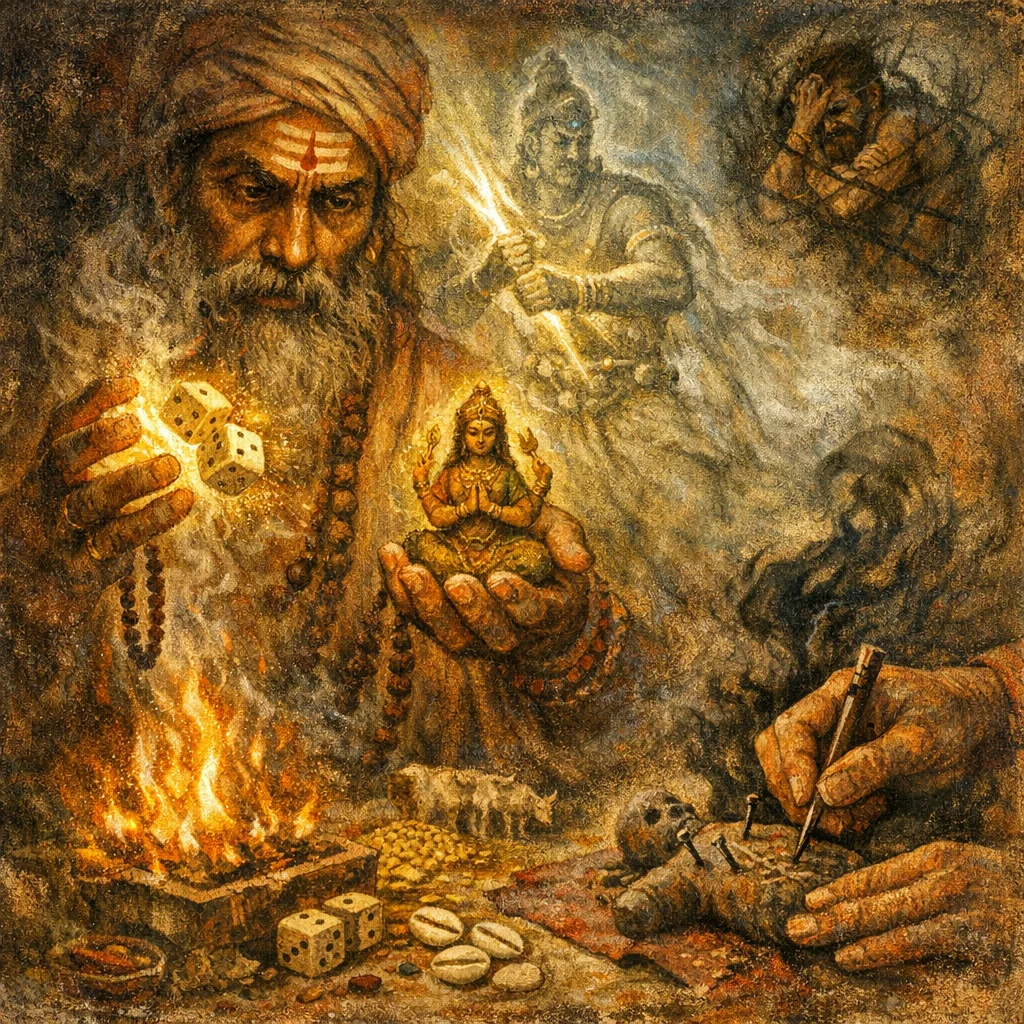
Sukta 50
Rishi: Atharvanic tradition (Anukramaṇī attribution for this victory/prosperity section; varies by ancillary lists)
Devata: Indra (puruhūta) with ‘All’ (viśve) as supporting powers
Chandas: Triṣṭubh-like cadence (as transmitted in this section)
Mantras
Mantra 1
विजयः। यथा वृक्षमशनिर्विश्वाहा हन्त्यप्रति। एवाहमद्य कितवानक्षैर्बध्यासमप्रति
As the thunderbolt ever smiteth the tree, resistless—so may I to-day, resistless, bind fast the gambler with his dice.
Mantra 2
तुराणामतुराणां विशामवर्जुषीणाम्। समैतु विश्वतो भगो अन्तर्हस्तं कृतं मम
Of the eager and the not-eager, of the peoples that are uninjuring—let Bhaga from every quarter come together, bringing into my hand the kṛta that is mine.
Mantra 3
ईडे अग्निं स्वावसुं नमोभिरिह प्रसक्तो वि चयत् कृतं नः । रथैरिव प्र भरे वाजयद्भिः प्रदक्षिणं मरुतां स्तोममृध्याम्
I laud Agni, of kindly succour; with reverent homage, here closely engaged, let him sift away the kṛta from us. As with chariots, with prize-winning powers would I bear forth—rightward and auspicious—the Maruts’ hymn, that I may thrive.
Mantra 4
वयं जयेम त्वया युजा वृतमस्माकमंशमुदवा भरेभरे । अस्मभ्यमिन्द्र वरीयः सुगं कृधि प्र शत्रूणां मघवन् वृष्ण्या रुज
May we conquer with thee for yoke-fellow the obstructing power; bring forth, bring down to us our portion in every encounter. For us, O Indra, make a wider, an easy way; with manly might, bounteous one, shatter the enemies.
Mantra 5
अजैषं त्वा संलिखितमजैषमुत संरुधम्। अविं वृको यथा मथदेवा मथ्नामि ते कृतम्
I have conquered thee, though scratched and inscribed; I have conquered thee, yea though shut in and confined. As a wolf crushes a sheep, even so do I crush down thy kṛta.
Mantra 6
उत प्रहामतिदीवा जयति कृतमिव श्वघ्नी वि चिनोति काले। यो देवकामो न धनं रुणद्धि समित् तं रायः सृजति स्वधाभिः
Moreover, the day-smiting power wins, as it were the kṛta; the dog-slayer at the fitting time picks it out. He who, god-desiring, doth not restrain wealth—him indeed riches set free, by their own svadhā-powers.
Mantra 7
गोभिष्टरेमामतिं दुरेवां यवेन वा क्षुधं पुरुहूत विश्वे । वयं राजसु प्रथमा धनान्यरिष्टासो वृजनीभिर्जयेम
With kine may we pass beyond the evil-minded plot, with barley too—or hunger itself—O Much-invoked, all ye Powers. Among kings may we be first; may we win the riches, unhurt, conquering with our bands.
Mantra 8
कृतं मे दक्षिणे हस्ते जयो मे सव्य आहितः । गोजिद् भूयासमश्वजिद् धनंजयो हिरण्यजित्
The winning cast is in my right hand; victory is for me, deposited in my left. May I be a winner of kine, a winner of horses, a winner of wealth, a winner of gold.
Mantra 9
अक्षाः फलवतीं द्युवं दत्त गां क्षीरिणीमिव । सं मा कृतस्य धारया धनुः स्नाव्नेव नह्यत
O Dice, grant the fruitful game—grant, as it were, a milk-rich cow. With the steady stream of the winning cast bind me fast, as a bow is bound with its sinew-string.
Frequently Asked Questions
It is used to secure victory and prosperity—especially before contests, assemblies, negotiations, or royal audiences—by overcoming hostile plans, avoiding hunger, and attracting winnings and rank.
Bhaga represents one’s allotted fortune and share. Calling him “from every quarter” ritualizes the idea that luck, support, and advantage are gathered from all directions and consolidated into the patron’s hand.
Not strictly, but the hymn itself highlights barley (yava) and cattle (go) as prosperity-signs. Holding a little barley while reciting the key verses is a traditional way to embody the request for abundance and victory.