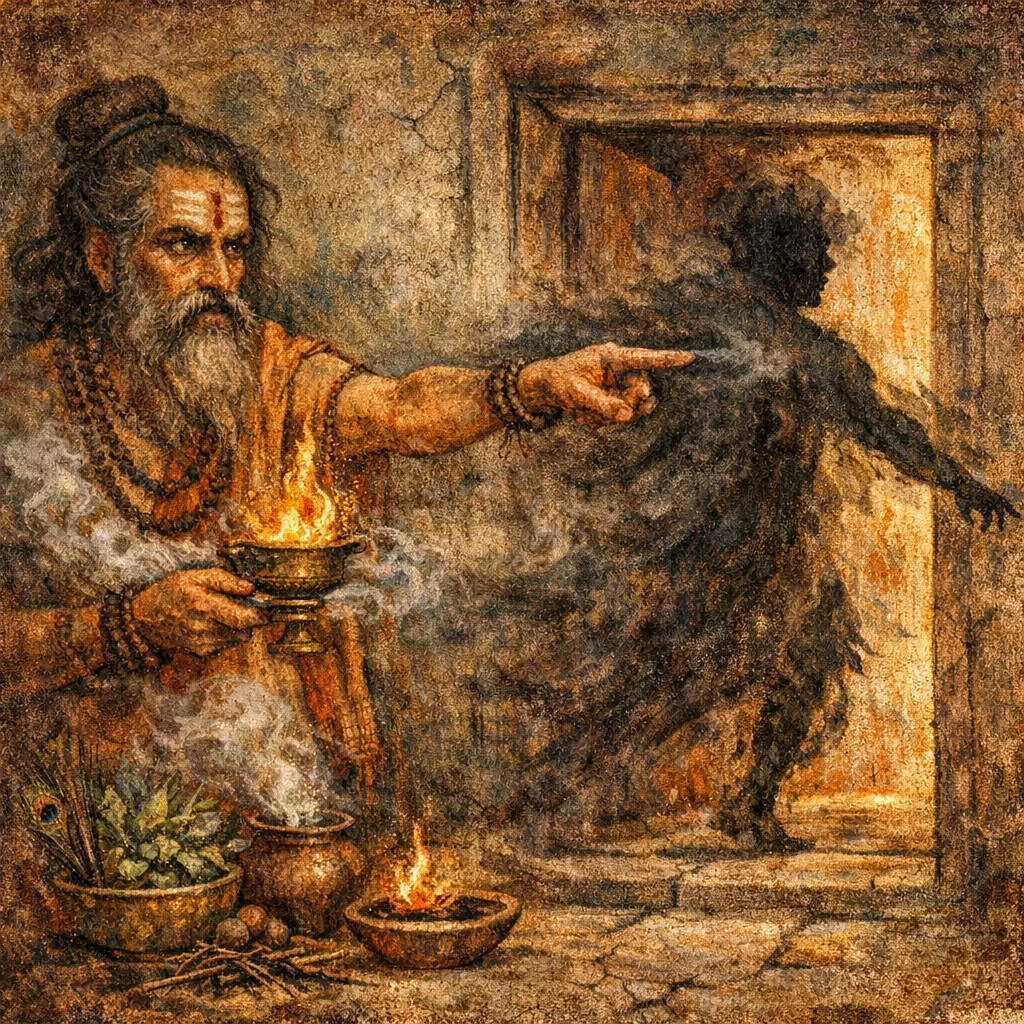
Sukta 75
Rishi: Atharvanic tradition (hymn classified by function: sapátna-kṣayaṇa)
Devata: Indra (as expeller/smasher of foes)
Chandas: Anuṣṭubh (typical for concise expulsive charms)
Mantras
Mantra 1
सपत्नक्षयणम्। निरमुं नुद ओकसः सपत्नो यः पृतन्यति । नैर्बाध्येऽन हविषेन्द्र एनं पराशरीत्
Drive forth from the dwelling that rival who makes battle; in the Nairbādhya, with oblation, may Indra utterly smite him away.
Mantra 2
परमां तं परावतमिन्द्रो नुदतु वृत्रहा। यतो न पुनरायति शश्वतीभ्यः समाभ्यः
To the farthest away-land let Indra, Vrtra-slayer, drive him—whence he comes not back again for everlasting years.
Mantra 3
एतु तिस्रः परावत एतु पञ्च जनाँ अति । एतु तिस्रोऽति रोचना यतो न पुनरायति । शश्वतीभ्यः समाभ्यो यावत् सूर्यो असद् दिवि
Let him go to the three far regions; let him go beyond the five peoples; let him go beyond the three luminous realms—whence he comes not back again for everlasting years, so long as the Sun shall be in heaven.
Frequently Asked Questions
It is used to drive a hostile rival out of one’s dwelling or settlement and to prevent that person from returning, by invoking Indra’s coercive power.
No. The text centers on command-formulae and boundary logic (the house/threshold), with a simple havis offering (often ghee or food) as the supporting ritual act.
These are totalizing boundaries: the ‘five peoples’ represent the full human social world, and the ‘three rocanā’ extend the banishment beyond luminous cosmic domains—so the rival is excluded from every sphere of return.