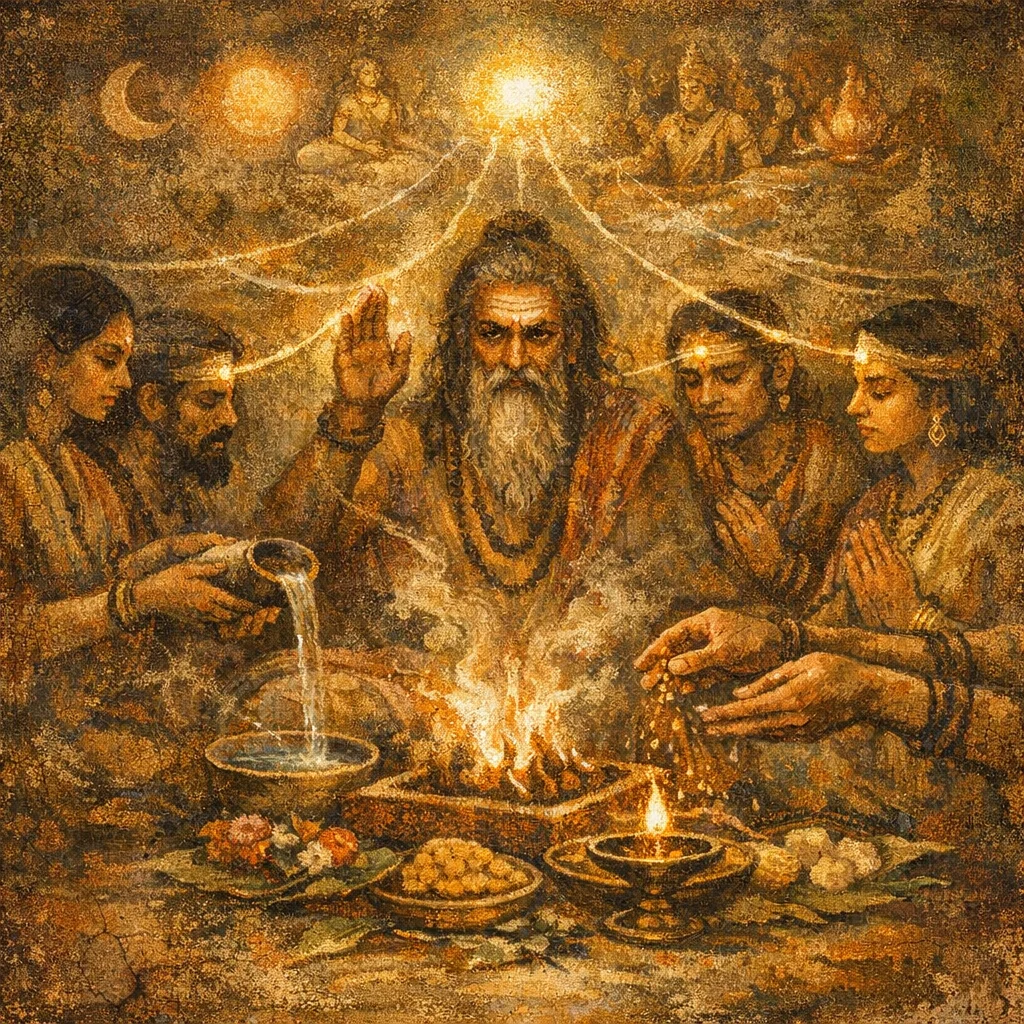
Sukta 94
Rishi: Atharvanic tradition (Saṃmanasya hymns often treated as communal charms)
Devata: Saṃmanasya (Concord) as an abstract power; implicitly the collective order (ṛta/dharma-like)
Chandas: Anuṣṭubh
Mantras
Mantra 1
सांमनस्यम्। सं वो मनांसि सं व्रता समाकूतीर्नमामसि । अमी ये विव्रता स्थन तान् वः सं नमयामसि
Concord of mind: your minds together, your vows together, your purposes in union—these we reverently salute. Those yonder who stand vowless, them among you we bend down into accord.
Mantra 2
अहं गृभ्णामि मनसा मनांसि मम चित्तमनु चित्तेभिरेत । मम वशेषु हृदयानि वः कृणोमि मम यातमनुवर्त्मान एत
I seize with mind your minds: after my thought, with your thoughts—come! Your hearts I make to be within my dominion: go ye my way, following my track—come!
Mantra 3
ओते मे द्यावापृथिवी ओता देवी सरस्वती । ओतौ म इन्द्रश्चाग्निश्चर्ध्यास्मेदं सरस्वति
Woven for me are Heaven and Earth; woven in is the Goddess Sarasvatī. Woven in for me are Indra and Agni: establish thou this for us, O Sarasvatī.
Frequently Asked Questions
It is used to create enforceable unity in a group—aligning everyone’s thoughts, vows, and shared purpose, and drawing non-cooperative members back into agreement.
Both. It begins with concord, but the second verse explicitly claims dominion over minds and hearts, showing a coercive harmonization typical of Atharvanic social-binding rites.
Sarasvatī represents sacred, ordering speech; she is asked to ‘establish’ the achieved state so the concord produced by the mantra does not dissolve after the recitation.