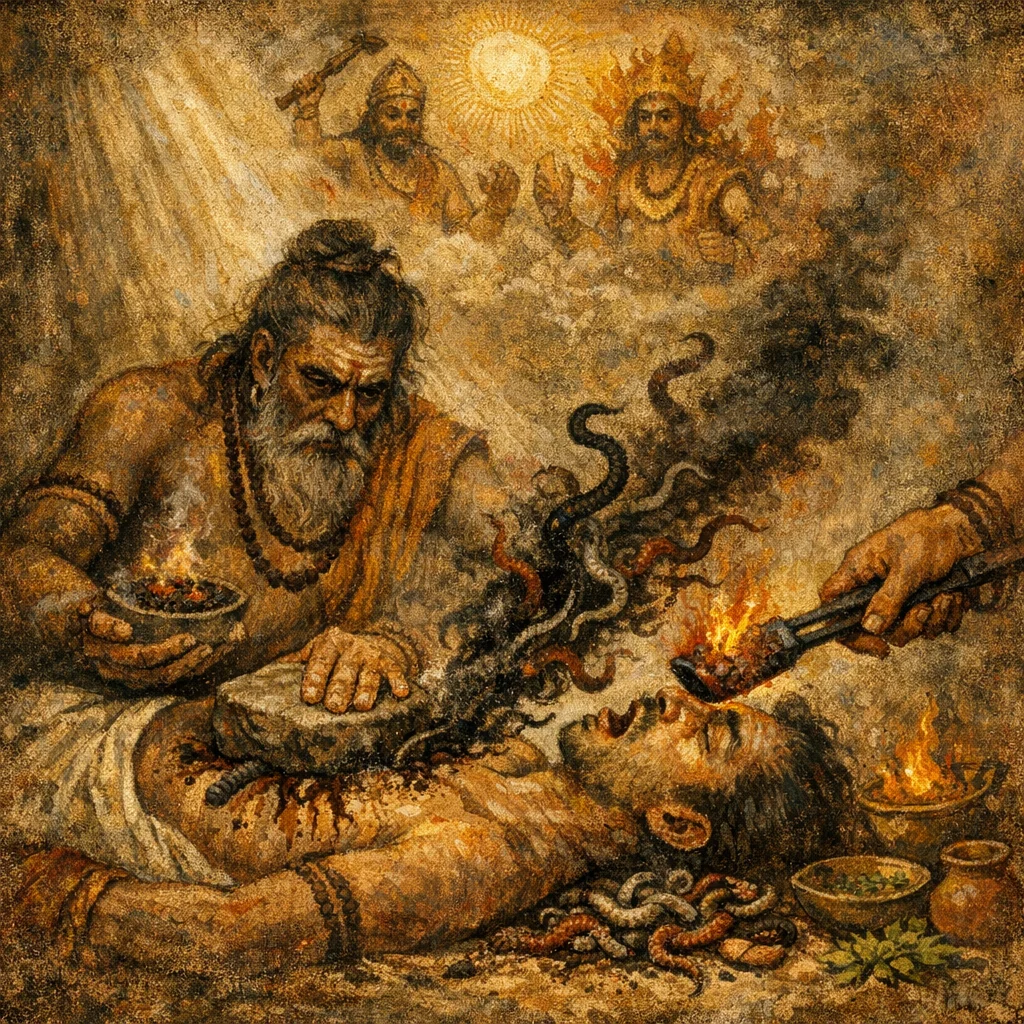
Sukta 23
Rishi: Atharvanic tradition (Krimi hymns; specific ṛṣi per anukramaṇī)
Devata: Dyāvā-Pṛthivī, Sarasvatī, Indra, Agni (as protectors and destroyers of krimi)
Chandas: Anuṣṭubh (mixed with Atharvanic cadence; tri-pāda structure in recitation practice)
Mantras
Mantra 1
क्रिमिघ्नम्। ओते मे द्यावापृथिवी ओता देवी सरस्वती । ओतौ म इन्द्रश्चाग्निश्च क्रिमिं जम्भयतामिति
A worm-slaying (charm). Woven round about me are Heaven and Earth; woven is the Goddess Sarasvatī. Woven round about me are Indra and Agni: let them crush the Worm—so (be it).
Mantra 2
अस्येन्द्र कुमारस्य क्रिमीन् धनपते जहि । हता विश्वा अरातय उग्रेण वचसा मम
O Indra, Lord of wealth, smite thou the Worms of this boy. Slain are all the malign harms by my fierce utterance.
Mantra 3
यो अक्ष्यौऽपरिसर्पति यो नासे परिसर्पति । दतां यो मध्यं गच्छति तं क्रिमिं जम्भयामसि
The Worm that creepeth in the eyes, the Worm that creepeth in the nose; the Worm that goeth into the midst of the teeth—him, that Worm, we crush.
Mantra 4
सरूपौ द्वौ विरूपौ द्वौ कृष्णौ द्वौ रोहितौ द्वौ। बभ्रुश्च बभ्रुकर्णश्च गृध्रः कोकश्च ते हताः
Two of like form, two of unlike form; two black, two ruddy. The Brown one and the Brown-eared, the Vulture and the Owl—these are slain.
Mantra 5
ये क्रिमयः शितिकक्षा ये कृष्णाः शितिबाहवः । ये के च विश्वरूपास्तान् क्रिमीन् जम्भयामसि
What worms be white-flanked, what worms be black with pallid arms, and whatsoever worms are multiform—those worms we cause to be crushed.
Mantra 6
उत् पुरस्तात् सूर्य एति विश्वदृष्टो अदृष्टहा। दृष्टांश्च घ्नन्नदॄष्टांश्च सर्वांश्च प्रमृणन् क्रिमीन्
Up from the east the Sun advanceth, all-beholding, slayer of the unseen; smiting the seen and smiting the unseen, yea crushing down all worms.
Mantra 7
येवाषासः कष्कषास एजत्काः शिपवित्नुकाः । दृष्टांश्च हन्यतां क्रिमिरुतादृष्टश्च हन्यताम्
The yevāṣa-worms, the kaṣkaṣa-worms, the wrigglers, the śipavitnuka—let the seen worm be slain, and let the unseen also be slain.
Mantra 8
हतो येवाषः क्रिमीणां हतो नदनिमोत। सर्वान् नि मष्मषाकरं दृषदा खल्वाँ इव
Slain is the yevāṣa among the worms, slain too the nadanī; all of them I grind down to a mash, as with a mill-stone in the mortar.
Mantra 9
त्रिशीर्षाणं त्रिककुदं क्रिमिं सारङ्गमर्जुनम्। शृणाम्यस्य पृष्टीरपि वृश्चामि यच्छिरः
The three-headed, three-humped worm, the spotted, the bright—him I shatter: his ribs I break; yea, I cut away that head of his.
Mantra 10
अत्रिवद् वः क्रिमयो हन्मि कण्ववज्जमदग्निवत्। अगस्त्यस्य ब्रह्मणा सं पिनष्म्यहं क्रिमीन्
Atri-like I smite you, O worms; Kaṇva-like, Jamadagni-like. With Agastya’s brahman I utterly crush the worms—I, in mine own person.
Mantra 11
हतो राजा क्रिमीणामुतैषां स्थपतिर्हतः । हतो हतमाता क्रिमिर्हतभ्राता हतस्वसा
Slain is the king of worms, and slain their house-lord too. Slain is the worm with mother slain, with brother slain, with sister slain.
Mantra 12
हतासो अस्य वेशसो हतासः परिवेशसः । अथो ये क्षुल्लका इव सर्वे ते क्रिमयो हताः
Slain are its lodged-in dwellers, slain are they that dwell around about; yea, even those that are, as it were, the petty ones—all those worms are slain.
Mantra 13
सर्वेषां च क्रिमीणां सर्वासां च क्रिमीनाम्। भिनद्म्यश्मना शिरो दहाम्यग्निना मुखम्
Of all the worms, of every worm—of all of them—I cleave the head with stone; I burn the mouth with fire.
Frequently Asked Questions
Krimi refers to worms/parasites and, more broadly, a disease force imagined as a living, hiding, multiplying enemy that must be exposed and destroyed.
They form a complete therapeutic ecology: cosmic enclosure (Heaven–Earth), purifying order and speech/waters (Sarasvatī), crushing force (Indra), and burning purification/expulsion (Agni).
The hymn’s core operation is mantric—protection plus extermination through speech. In practice, it may be paired with water sprinkling or a protective thread, but no specific herb is mandated by the cited verses.