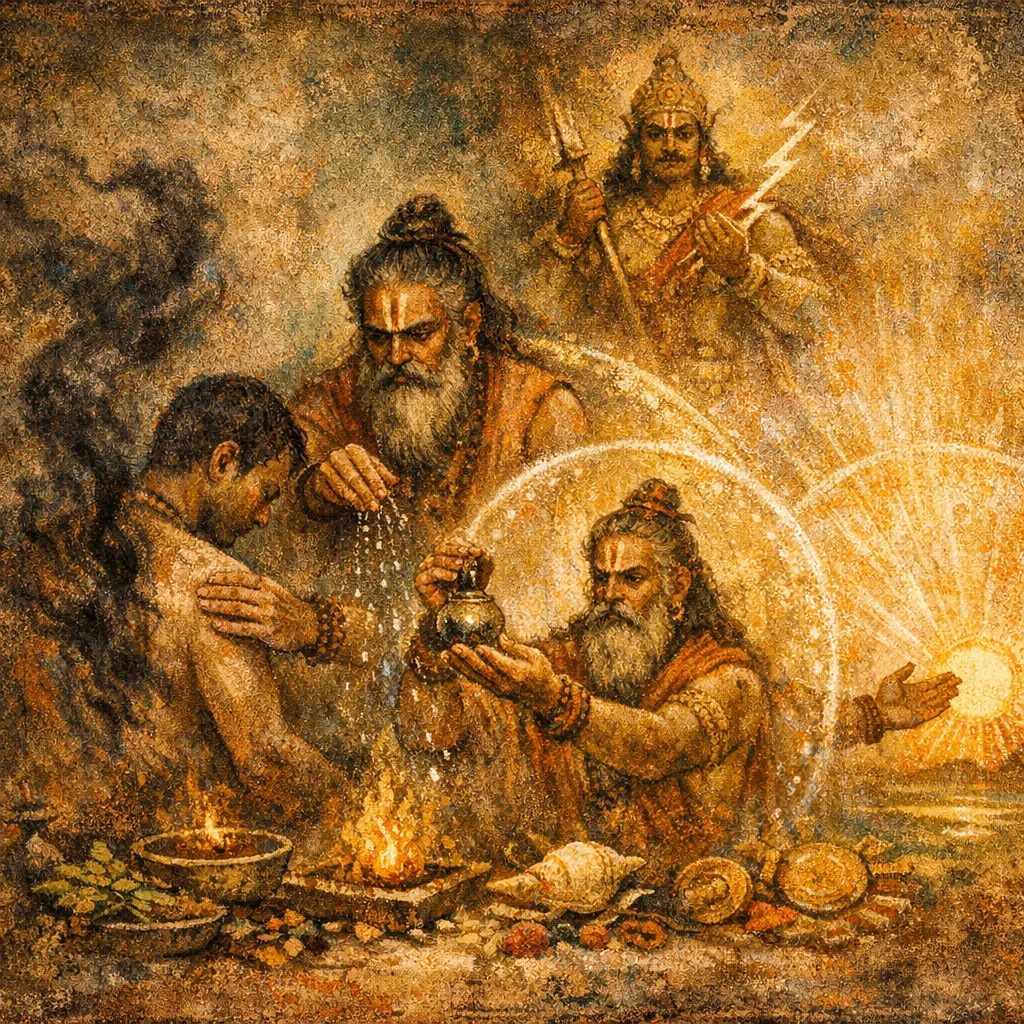
Sukta 107
Rishi: Ṛgvedic provenance; seer not determinable from the single verse without full hymn metadata.
Devata: Mányu (Wrath) / Indraic power (contextual)
Chandas: Likely Triṣṭubh-type (requires full hymn context for certainty).
Mantras
Mantra 1
समस्य मन्यवे विशो विश्वा नमन्त कुष्टयः । समुद्रायेव सिन्धवः
To his fierce wrath all peoples bow them down, and even the high peaks—like rivers running ocean-ward.
Mantra 2
ओजस्तदस्य तित्विष उभे यत् समवर्तयत्। इन्द्रश्चर्मेव रोदसी
This is his might, of the blazing one: that he rolled both worlds together—Indra, as with a hide, the twain of Heaven and Earth.
Mantra 3
वि चिद् वृत्रस्य दोधतो वज्रेण शतपर्वणा । शिरो बिभेद् वृष्णिना
Even when Vṛtra shook and strove, with thunderbolt of hundred joints he clave his head asunder—by his bull-like might.
Mantra 4
तदिदास भुवनेषु ज्येष्ठं यतो जज्ञ उग्रस्त्वेषनृम्णः । सद्यो जज्ञानो नि रिणाति शत्रूननु यदेनं मदन्ति विश्व ऊमाः
That verily was chiefest in the worlds, from whom was born the fierce one of flashing manly might. New-born, forthwith he driveth down the foes, whenso all exhilarating draughts do gladden him.
Mantra 5
वावृधानः शवसा भूर्योजाः शत्रुर्दासाय भियसं दधाति । अव्यनच्च व्यनच्च सस्नि सं ते नवन्त प्रभृता मदेषु
Waxing with might, of plenteous strength, he layeth fear upon the foe, upon the Dāsa. Unbowed himself, he boweth others: O Conqueror, to thee they wholly bend, when forth are brought the draughts of rapture.
Mantra 6
त्वे क्रतुमपि पृञ्चन्ति भूरि द्विर्यदेते त्रिर्भवन्त्यूमाः । स्वादोः स्वादीयः स्वादुना सृजा समदः सु मधु मधुनाभि योधीः
In thee they blend in purpose also, richly, when twice—yea, when these draughts are made thrice over. Sweeter than sweet, send forth with sweetness: O rapt one, with the honeyed drink fight thou full well against them.
Mantra 7
यदि चिन्नु त्वा धना जयन्तं रणेरणे अनुमदन्ति विप्राः । ओजीयः शुष्मिन्त्स्थिरमा तनुष्व मा त्वा दभन् दुरेवासः कशोकाः
Yea, even if the seers acclaim thee, winning prizes in battle after battle—be thou yet mightier, O vehement one; stretch forth thy steadfast strength. Let not the ill-disposed, the baleful, circumvent thee.
Mantra 8
त्वया वयं शाशद्महे रणेषु प्रपश्यन्तो युधेन्यानि भूरि । चोदयामि त आयुधा वचोभिः सं ते शिशामि ब्रह्मणा वयांसि
With thee we win in battles, looking forth and marking many a warlike enterprise. Thy weapons I incite with words; with holy prayer I whet for thee thy powers.
Mantra 9
नितद् दधिषेऽवरे परे च यस्मिन्नाविथावसा दुरोणे। आ स्थापयत मातरं जिगत्नुमत इन्वत कर्वराणि भूरि
Thou hast firmly set that power among the nearer and the farther folk, in the house wherein, with unfailing succour, it abideth. Set ye the Mother here in her place, the swift-approaching; urge ye forth—abundantly—the Kárvaras (the dark assailants).
Mantra 10
स्तुष्व वर्ष्मन् पुरुवर्त्मानं समृभ्वाणमिनतममाप्तमाप्त्यानाम्। आ दर्शति शवसा भूर्योजाः प्र सक्षति प्रतिमानं पृथिव्याः
Praise thou, O Lofty One, him of many pathways, the well-wrought, the most impelling, the most surely won among all attainments. With might he showeth him, of abundant strength; he presseth forth and overcometh the earth’s opposing measure.
Mantra 11
इमा ब्रह्म बृहद्दिवः कृणवदिन्द्राय शूषमग्नियः स्वर्षाः । महो गोत्रस्य क्षयति स्वराजा तुरश्चिद् विश्वमर्णवत् तपस्वान्
These potent words, of the wide heaven, hath the heaven-winning fiery one fashioned for Indra’s vehement might. As self-ruling lord he ruleth the great cow-pen; overpowering, yea, all he overwhelmeth like a flood, in ardent heat.
Mantra 12
एवा महान् बृहद्दिवो अथर्वावोचत् स्वां तन्व१मिन्द्रमेव। स्वसारौ मातरिभ्वरी अरिप्रे हिन्वन्ति चैने शवसा वर्धयन्ति च
Thus spake Atharvan of the wide heaven, making Indra great in his own embodied might. The two Sister-powers, mother-moving, in the press of foes, impel him, and with force they strengthen him.
Mantra 13
चित्रं देवानां केतुरनीकं ज्योतिष्मान् प्रदिशः सूर्य उद्यन्। दिवाकरोऽति द्युम्नैस्तमांसि विश्वातारीद् दुरितानि शुक्रः
Wondrous, the Gods’ bright banner and shining front, the Sun ariseth, light-possessing, filling the quarters. The Day-maker, with splendors passing over all darknesses, hath crossed beyond all evil ways—pure and radiant.
Mantra 14
चित्रं देवानामुदगादनीकं चक्षुर्मित्रस्य वरुणस्याग्नेः । आप्राद् द्यावापृथिवी अन्तरिक्षं सूर्य आत्मा जगतस्तस्थुषश्च
The wondrous countenance of the Gods hath risen aloft—the Eye of Mitra, Varuṇa, and Agni. It hath filled Heaven and Earth and the mid-air: the Sun, the very Soul of all that moveth and that standeth fast.
Mantra 15
सूर्यो देवीमुषसं रोचमानां मर्यो न योषामभ्येति पश्चात्। यत्रा नरो देवयन्तो युगानि वितन्वते प्रति भद्राय भद्रम्
The Sun draws on behind the Goddess Dawn as a young man followeth a maiden shining. Where men, god-seeking, stretch forth their ordered courses, there answereth good to good, for blessed welfare.
Frequently Asked Questions
To make opposition yield to the patron’s authority through Mányu (wrath-as-command), and then to purify and protect the act through Sūrya’s light that removes darkness and durita.
They function as a cleansing and stabilizing seal: solar radiance drives away misfortune and aligns the coercive intent with cosmic order—dawn followed by day—so the outcome is secured without spiritual residue.
At dawn into sunrise, especially before public assemblies, negotiations, or contests of authority, because the hymn itself emphasizes the Uṣas–Sūrya sequence and directional filling with light.