Sukta 103
Rishi: Ṛgvedic provenance (Agni-stotra material incorporated in AV 20)
Devata: Agni
Chandas: Mixed/Triṣṭubh-Jagatī style in RV sources; AV 20 preserves RV metrical texture (exact meter depends on RV locus)
Mantras
Mantra 1
अग्निमीलिष्वावसे गाथाभिः शीरशोचिषम्। अग्निं राये पुरुमील्ह श्रुतं नरोऽग्निं सुदीतये छर्दिः
Praise Agni for our aid with songs—him of keen-bright flame; Agni for wealth, bounteous, famed, O men; Agni for fair kindling—(as) sheltering protection.
Mantra 2
अग्न आ याह्यग्निभिर्होतारं त्वा वृणीमहे । आ त्वामनक्तु प्रयता हविष्मती यजिष्ठं बर्हिरासदे
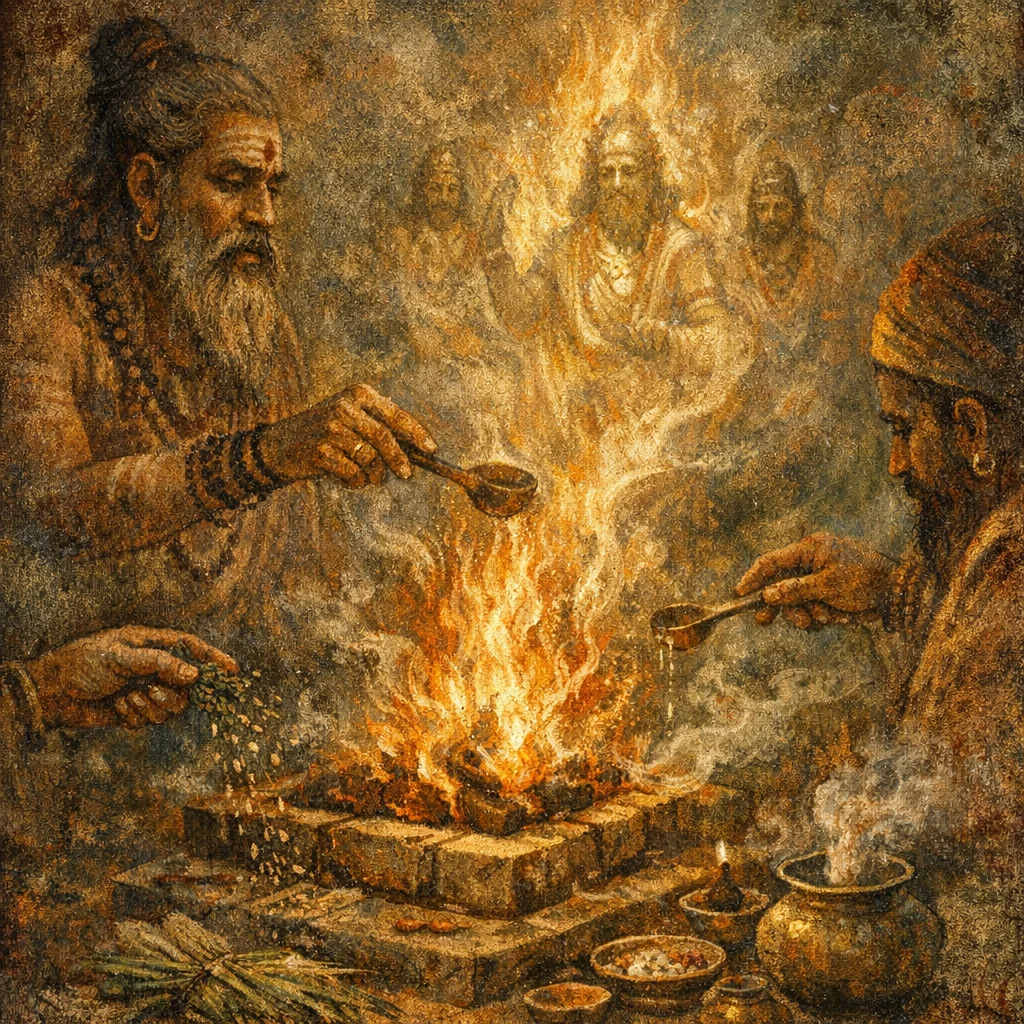
O Agni, come hither with the fires; thee as Hotṛ we choose. Let the duly-prepared, oblation-bearing (offering) anoint thee—most meet for sacrifice—to sit upon the sacred grass.
Mantra 3
अच्छा हि त्वा सहसः सूनो अङ्गिरः स्रुचश्चरन्त्यध्वरे। ऊर्जो नपातं घृतकेशमीमहेऽग्निं यज्ञेषु पूर्व्यम्
For unto thee, O Angiras, son of might, the ladles move within the sacrifice. We seek Agni, the offspring of nourishment, ghee-haired, the ancient one among sacrifices.
Frequently Asked Questions
To establish Agni firmly in the rite—bright, anointed, and seated—so he gives protective cover (chardiḥ) and supports prosperity/wealth.
They are the key ritual technologies: ghee strengthens and “anoints” Agni, barhis is his seat, and the ladles (sruc) enact the flow of offerings that draws his effective presence.
Yes. Even in a simple household fire-setting, it functions as a compact Agni-invocation for safety, steadiness of the rite, and increase—so long as a clean fire and a small offering (like ghee) are maintained.