Dashati 16
Agni’s ritual pre-eminence and the enlivening power that sustains the sacrifice
Agni
Elevated and proclamatory with a consecratory (abhisecana-like) undercurrent
Individual ṛṣi attributions require concordance with the corresponding Ṛgvedic sources; this dashati appears to combine Agni praise with Aindra/Soma ritual imagery typical of mixed Uttarārcika selections.
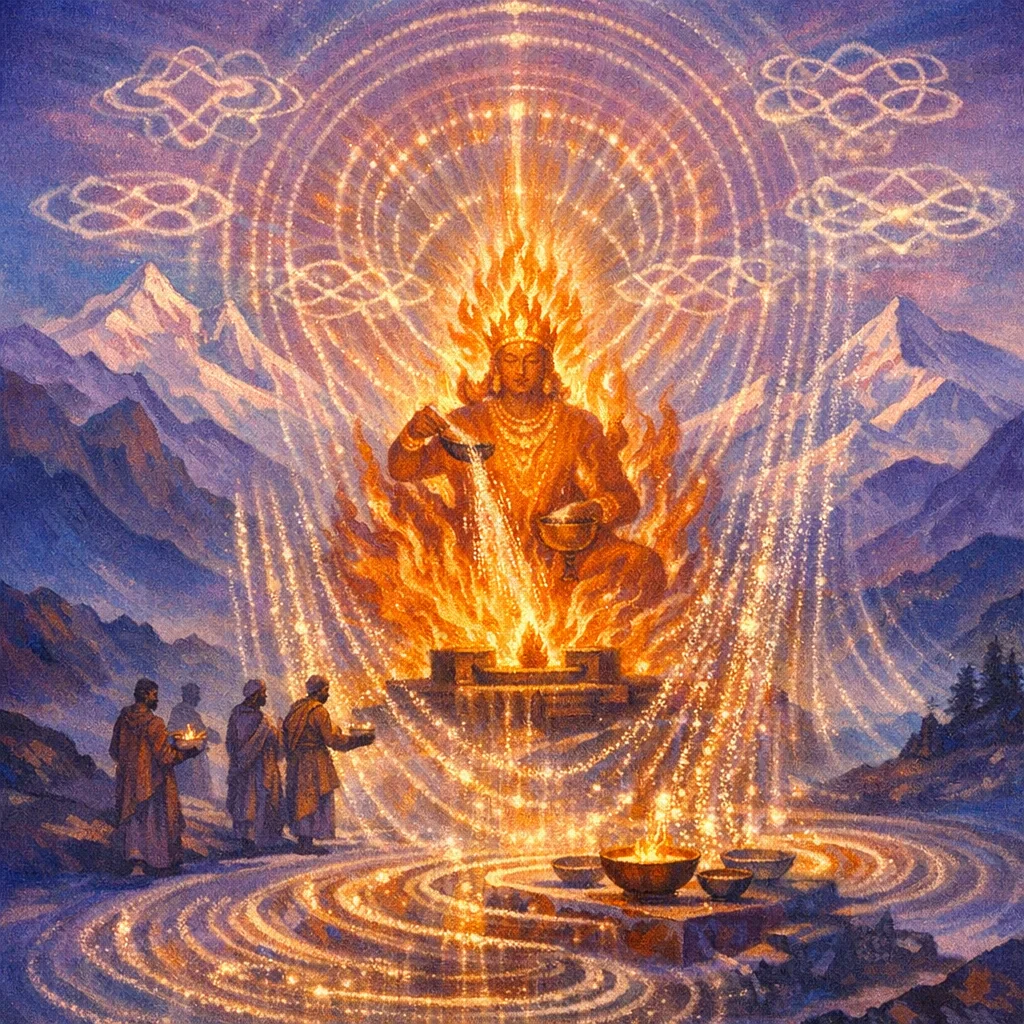
Agni wird als rituell Vorrangiger und als belebende Kraft verkündet, die das Opfer ununterbrochen trägt: Er ist das „Haupt“ und der Herr des Gipfels von Kosmos und Ritus. Seine Macht befruchtet und belebt die Wasser; Bilder des Soma-Pressens und des Besprengens aus Trog/Schacht begleiten den Vollzug. Glückverheißend nahen die „Kühe“ als Strahlen und Reichtum dem yajña, und die Unvergänglichkeit sowie die fehlerlose, unversehrte Kontinuität des Ritus (akṣita) werden zugesichert.
Mantras
Mantra 1
गाव उप वदावटे महि यज्ञस्य रप्सुदा उभा कर्णा हिरण्यया
Die Kühe treten heran zum Sänger am vadāvaṭa, schnelle Gaben spendend, das große Opfer schmückend; beide seine Ohren sind golden.
Mantra 2
अभ्यारमिदद्रयो निषिक्तं पुष्करे मधु अवटस्य विसर्जने
Ich trete heran zu den Standhaften (den Vollziehern des Ritus), wo der süße Soma in das Becken, den puṣkara, gegossen wird, beim Auslassen aus der Rinne (avaṭa).
Mantra 3
उदग्ने शुचयस्तव शुक्रा भ्राजन्त ईरते तव ज्योतींष्यर्चयः
Steig auf, o Agni: deine reinen, lichten Flammenzungen — glänzend setzen sie sich in Bewegung; deine Lichter sind wie strahlender Lobgesang.
Frequently Asked Questions
It presents Agni as the foremost power of the sacrifice—cosmic in stature and ritually central—who energizes the waters and ensures the rite proceeds effectively and without loss.
Samavedic selections often pair praise with ritual action imagery. Terms like sprinkling the trough/well and references to implements point to Soma-pressing procedures understood as sacred, power-bearing acts.
Stobhas mainly serve musical and liturgical purposes—marking structure, cadence, and expansion for melody. They usually do not change the core meaning of the ṛc-text, but they shape how it is sung in ritual.