There's a version of the Mahabharata story that people tell casually: Duryodhana was evil, the Pandavas were good, and Krishna orchestrated a war to destroy the wicked. It's clean, simple, and almost entirely wrong.
The actual text tells a different story. Krishna didn't push for war. He pushed for peace repeatedly, systematically, and with a persistence that borders on desperation. He negotiated. He compromised. He sent messengers. He traveled to the enemy capital himself, unarmed, into a court that was actively plotting to capture him. He reduced the Pandavas' demands from their full kingdom to five villages five, and was still refused.
The Mahabharata war didn't happen because Krishna allowed it. It happened because every single alternative was exhausted by a man who had the power to end the world, and he still chose diplomacy first. That the war happened anyway is not a failure of Krishna's strategy. It's the point of the entire epic.
This is the complete timeline of those efforts and the anatomy of why peace became impossible.
The Background - What the Pandavas Were Owed
Before tracing the diplomacy, the stakes need to be clear.
The Pandavas had been cheated out of their kingdom in a rigged dice game. Yudhishthira, the eldest Pandava, had been manipulated by Shakuni into wagering everything his wealth, his kingdom, his brothers, himself, and finally his wife Draupadi. The game was fixed. The dice were loaded (some versions say Shakuni used enchanted dice made from his father's bones). The entire court watched as Draupadi was dragged into the hall and publicly humiliated.
After the dice game, the Pandavas were exiled for thirteen years twelve in the forest, one in disguise. The condition was clear: complete the exile successfully, and the kingdom would be returned. They completed it. Every day, every condition, to the letter.
When they returned to claim what was theirs, Duryodhana refused. Not partially. Not with conditions. He refused. "I will not give them land enough to fit the point of a needle," he declared in the Sabha Parva.
This is the starting position. The Pandavas aren't aggressors asking for something new. They're exiles asking for what was stolen from them under fraudulent terms, after serving a sentence they didn't deserve.
Phase 1 - The Envoys Before Krishna
Krishna didn't personally intervene immediately. The first phase of diplomacy involved multiple messengers sent to Hastinapura to negotiate.
Drupada's Priest
Udyoga Parva, early chapters. King Drupada, father of Draupadi and father-in-law of the Pandavas sent his household priest as a formal envoy to Hastinapura. The priest carried a measured message: the Pandavas have completed their exile, they want their kingdom back, let's resolve this without bloodshed.
Bhishma, the Kuru patriarch, supported the demand. He told the court that the Pandavas' claim was legitimate and that returning Indraprastha was both legally and morally correct. Drona, the royal teacher, agreed. Even Vidura, who had opposed the dice game from the start, urged compliance.
Duryodhana's response was effectively silence dressed as defiance. He didn't engage with the substance of the demand. He treated it as an insult, the idea that he should return something implied he held it wrongfully, and he refused to accept that framing.
Sanjaya's Mission
Next, Sanjaya, Dhritarashtra's charioteer and personal advisor was sent by the blind king to the Pandavas. But Dhritarashtra's instructions to Sanjaya were deliberately vague. He didn't authorize Sanjaya to offer anything concrete. The mission was more diagnostic than diplomatic, Dhritarashtra wanted to know the Pandavas' mood, their military strength, and whether they could be talked into accepting something less than their full claim.
Sanjaya returned and described the Pandavas' resolve. He told Dhritarashtra plainly: they will fight if denied. Dhritarashtra, characteristically, responded with anxiety but no action.
| Envoy | Sent By | Message | Outcome |
|---|---|---|---|
| Drupada's Priest | King Drupada | Return Indraprastha; honor the exile terms | Ignored by Duryodhana |
| Sanjaya | Dhritarashtra | Assess Pandava resolve and strength | Confirmed: Pandavas will fight if denied |
Phase 2 - Krishna Goes Himself
When the envoys failed, Krishna made a decision that reveals everything about his priorities. He decided to go to Hastinapura personally.
This was not a casual visit. Krishna was the king of Dwaraka, a sovereign ruler, and the most powerful political figure in the story. For him to travel to the Kaurava court as a peace ambassador essentially putting himself in the position of a petitioner was an extraordinary gesture of good faith. He had nothing to gain. The Pandavas were already his allies. He was doing this because he genuinely wanted to avoid war.
Udyoga Parva, Chapters 70-138 this is the longest and most detailed diplomatic episode in the Mahabharata. It covers Krishna's arrival, his negotiations, Duryodhana's counteroffers, and the final breakdown.
The Arrival
Krishna arrived at Hastinapura and was received with formal hospitality. Duryodhana offered him lodging in his own palace, a calculated diplomatic move designed to create an obligation. Krishna refused. He stayed instead with Vidura, the one member of the court he trusted. He also visited Kunti, the Pandavas' mother, who was living in Hastinapura and had been separated from her sons for thirteen years.
Kunti's message to her sons, delivered through Krishna, was unambiguous: "Do not beg for peace at the cost of your honor. A kshatriya who accepts injustice to avoid conflict is already dead."
The Negotiation in the Court
The next morning, Krishna entered the Kaurava court. He addressed the full assembly Dhritarashtra, Bhishma, Drona, Vidura, Karna, Duryodhana, and the assembled nobles with a speech that the Udyoga Parva preserves in extensive detail.
Krishna's argument was structured, not emotional. He made three points:
1. Legal: The Pandavas completed their exile in full. The terms of the dice game which were illegitimate to begin with have been satisfied. Returning their kingdom is a legal obligation, not a favor.
2. Moral: The treatment of Draupadi in the court was a crime witnessed by every person in this room. The exile was punishment for a offense that was engineered by fraud. Justice demands restoration.
3. Practical: The Pandavas have assembled a massive alliance. War will destroy the Kuru dynasty not just the Pandavas' enemies, but Bhishma, Drona, Karna, and the sons and grandsons of every family in this room. Peace is not weakness. Peace is survival.
The Compromise Offer
Here is where Krishna's sincerity becomes undeniable. He didn't demand the full kingdom. He reduced the Pandavas' claim progressively:
First ask: Return Indraprastha, the kingdom the Pandavas built from a wasteland, which was legally theirs before the dice game.
Duryodhana refused.
Second ask: Give the Pandavas any five provinces of Duryodhana's choosing. Not specific territories. Any five.
Duryodhana refused.
Final ask: Give the Pandavas five villages. Not cities. Not provinces. Five villages. Avashtana, Vrikasthana, Makandi, Varanavata, and one other just enough land for five brothers to govern without being landless.
Duryodhana's response is recorded in the Udyoga Parva:
"I will not give them land that could be covered by the point of a needle."
| Negotiation Stage | Krishna's Demand | Duryodhana's Response |
|---|---|---|
| Full restoration | Return Indraprastha (legal right) | Refused |
| Major compromise | Any 5 provinces | Refused |
| Extreme concession | 5 villages | Refused "not even a needle-point of land" |
Phase 3 - The Vishvarupa Revelation
After the negotiation collapsed, something happened that shifts the story from political drama to metaphysical confrontation.
Duryodhana, emboldened by his refusal, decided to capture Krishna. His reasoning was strategic: if Krishna was held prisoner, the Pandavas would lose their most powerful ally and would be forced to accept whatever terms Duryodhana set. He discussed this plan openly in the court.
When Krishna learned of the plot, he didn't flee. He didn't fight. He did something that no one in the court had ever witnessed.
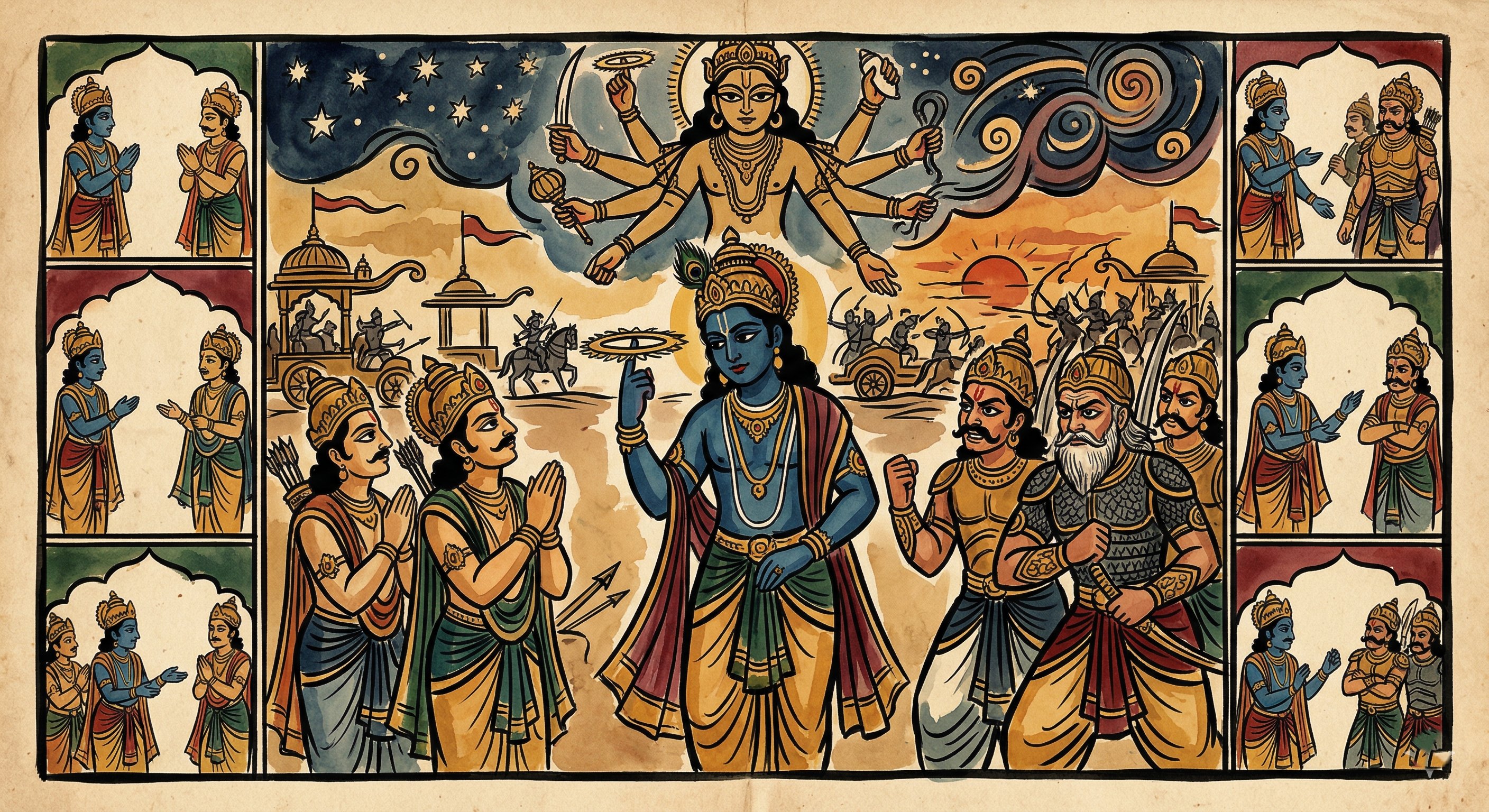
He revealed his Vishvarupa his cosmic form.
The Udyoga Parva describes this moment with the same weight that the Bhagavad Gita later gives to the battlefield Vishvarupa in Chapter 11. Krishna's body expanded beyond physical form. The court saw the entire universe within him gods, demons, the elements, the three worlds, time itself moving forward and backward, creation and destruction happening simultaneously.
Dhritarashtra, who was blind, was given temporary divine sight by Krishna specifically so he could witness this form and understand what his son was provoking.
The message was not subtle: you are attempting to imprison the being who contains the cosmos.
But what happened next is the part that most retellings omit. After the Vishvarupa, after visually demonstrating that he was not a man who could be captured but the fundamental reality behind all existence Krishna still did not force peace. He withdrew the form, returned to his human appearance, and walked out of the court without violence.
This is the crux of the entire question. Krishna had the power to end Duryodhana, end the war, and simply install the Pandavas on the throne. He chose not to. Not because he didn't care, but because forced peace is not peace. If dharma could only be maintained by a god overriding human will, then the concept of dharma itself becomes meaningless.
Why Krishna Couldn't Simply "Fix" It
The question "why didn't Krishna just stop the war?" assumes that preventing violence is always the highest moral act. The Mahabharata challenges that assumption directly.
The Dharma of Agency
In the Gita (which occurs on the battlefield, after all diplomacy has failed), Krishna tells Arjuna in Chapter 18, Verse 63: "Thus I have explained to you knowledge that is more secret than all secrets. Reflect on it fully, and then do as you wish."
"Do as you wish." Not "do as I command." Krishna, even as God, frames his guidance as advice that can be accepted or rejected. The Mahabharata's moral architecture requires that beings make their own choices and face the consequences. If Krishna simply eliminated every wrong by divine fiat, the concept of karma of cause and consequence would collapse.
Duryodhana was given every opportunity to choose differently. Bhishma begged him. Drona counseled him. His own mother Gandhari warned him. Krishna himself showed him the literal structure of the universe. Duryodhana chose war anyway, and that choice had to be honored not because it was right, but because the capacity to choose is what makes morality possible.
Accumulated Injustice
The war also wasn't only about the Pandavas' kingdom. The Mahabharata makes clear that decades of accumulated adharma had reached a critical mass:
- The attempted murder of the Pandavas in the lac house (Jatugriha)
- The rigged dice game and theft of a kingdom through fraud
- The public assault on Draupadi's dignity (vastra haran)
- Thirteen years of unjust exile
- The refusal to honor the exile's own terms
- Duryodhana's alliances with openly immoral figures (Shakuni, Dusshasana)
- The corruption of warriors like Karna, who was individually honorable but institutionally complicit
Each of these was an opportunity for course correction. None was taken. The Mahabharata presents war not as Krishna's choice but as the cumulative result of choices made by dozens of people over decades, each of whom could have altered the trajectory and didn't.
The Role of Karna
Karna deserves separate attention because Krishna made one final, private effort with him before the war and it nearly worked.
Udyoga Parva, Chapter 138-141. After leaving the Kaurava court, Krishna sought out Karna privately. He revealed a secret that Karna didn't know: Karna was actually the eldest Pandava. Born to Kunti before her marriage to Pandu, fathered by Surya (the sun god), and subsequently abandoned, Karna was the rightful eldest brother, senior even to Yudhishthira.
Krishna's offer was staggering: if Karna switched sides, he would be crowned king. Not Yudhishthira. Karna. The five Pandavas would serve him. Draupadi would honor him. He would receive everything he had been denied his entire life acknowledgment, status, legitimacy.
Karna refused.
His reasoning was not political. It was personal. Duryodhana had befriended him when the entire world rejected him as a charioteer's son. Duryodhana gave him a kingdom (Anga), standing, and unconditional loyalty. Karna knew that Duryodhana was wrong about the war, but he also knew that abandoning Duryodhana in his hour of need would make Karna's entire life a lie.
"I know this war is unjust," Karna told Krishna. "But Duryodhana trusted me when no one else did. I will stand with him and die."
This conversation is one of the most emotionally complex moments in the entire Mahabharata, a god offering a man everything he's ever wanted, and the man turning it down for loyalty he knows will kill him.
The Final Count - Every Attempt Krishna Made
For anyone who wants to read these passages in the original Sanskrit and trace each diplomatic effort verse by verse, Vedapath offers the complete Udyoga Parva with AI-powered search making it possible to locate specific conversations, speeches, and episodes across the Mahabharata's 100,000 verses.
Here is the complete sequence of Krishna's peace efforts:
| # | Action | Parva / Context | Outcome |
|---|---|---|---|
| 1 | Supported Drupada's envoy mission | Udyoga Parva | Ignored |
| 2 | Consulted with the Pandavas to exhaust diplomacy first | Udyoga Parva | Pandavas agreed to negotiate |
| 3 | Personally traveled to Hastinapura | Udyoga Parva, Ch. 70+ | Received but not heard |
| 4 | Made the legal case for restoration | Court assembly | Acknowledged by Bhishma/Drona, ignored by Duryodhana |
| 5 | Reduced demand to 5 provinces | Court assembly | Refused |
| 6 | Reduced demand to 5 villages | Court assembly | Refused "not a needle-point" |
| 7 | Revealed Vishvarupa to demonstrate cosmic stakes | Kaurava court | Awe without compliance |
| 8 | Private meeting with Karna, offered him the throne | After leaving court | Refused on grounds of loyalty |
| 9 | Continued restraint - left without violence | Departure from Hastinapura | War became the only remaining path |
Nine documented attempts. A legal argument, a moral argument, a practical argument, three rounds of progressively humiliating concessions, a metaphysical demonstration, and a private Hail Mary to the one person who could have changed Duryodhana's mind.
All of them failed. Not because Krishna failed. Because the people who needed to choose peace refused to.
What This Says About War in Hindu Philosophy
The Mahabharata is often called a war epic, but it's more accurately an anti-war text that concludes war is sometimes necessary. The eighteen-day Kurukshetra War kills millions. The Pandavas "win" but lose nearly everyone they love. Yudhishthira, the righteous king, is so broken by the carnage that he tries to abdicate. The victory is hollow, pyrrhic, and the text makes no effort to celebrate it.
Krishna's role in this is precise. He doesn't glorify war. He grieves for its necessity. In the Bhagavad Gita, delivered on the morning of the battle he doesn't tell Arjuna "war is good." He says, essentially: you have exhausted every alternative, the cause is just, the consequences of inaction are worse than the consequences of action, and your duty as a kshatriya in this specific moment is to fight. It's not a universal endorsement of violence. It's a situational judgment after all other options have been systematically eliminated.
The Mahabharata's position on war is closer to a surgeon's view of amputation: never the first option, always damaging, sometimes the only way to save the body.
Frequently Asked Questions
Did Krishna want the Mahabharata war?
No. The Udyoga Parva documents at least nine separate peace efforts Krishna made before the war, including personally traveling to Hastinapura, reducing the Pandavas' demands from their full kingdom to just five villages, and privately offering Karna the throne if he switched sides. Krishna exhausted every diplomatic avenue available. The war happened because Duryodhana refused every compromise.
Could Krishna have stopped the war with his powers?
Physically, yes Krishna demonstrated through his Vishvarupa that he possessed the power to destroy and recreate the universe. Philosophically, no. The Mahabharata's moral framework requires that beings exercise free will and face consequences. If Krishna had simply forced peace through divine power, it would have nullified the concept of dharma which depends on individuals choosing righteousness freely. Forced virtue is not virtue.
Why did Duryodhana refuse to give even five villages?
Duryodhana's refusal was rooted in ego and political calculation, not strategic logic. Accepting any demand from the Pandavas even a minimal one would have been an implicit admission that their exile was unjust and that he held their property illegitimately. For Duryodhana, the issue was never the land itself but the principle of conceding anything. He also believed, with some justification, that his military alliance (including Bhishma, Drona, Karna, and eleven Akshauhinis of troops) was strong enough to win.
What was Krishna's Vishvarupa in the Kaurava court?
During his peace mission in the Udyoga Parva, when Duryodhana plotted to capture him, Krishna revealed his cosmic form (Vishvarupa) to the entire court. This is a separate event from the more famous Vishvarupa in the Bhagavad Gita (Chapter 11), which occurred on the battlefield. In the court revelation, Krishna showed the assembly that he contained the entire universe within himself gods, demons, elements, time, creation, and destruction demonstrating that attempts to imprison him were futile.
Why did Karna refuse Krishna's offer to become king?
Krishna privately revealed to Karna that he was the eldest Pandava born to Kunti and fathered by Surya and offered him the Pandavas' allegiance and the throne. Karna refused because Duryodhana had befriended him when the world rejected him as a charioteer's son. Karna chose loyalty over legitimacy, knowing it would cost his life. He told Krishna he understood the war was unjust but could not betray the one person who had stood by him unconditionally.
Is the Mahabharata pro-war or anti-war?
Neither simplistically. The Mahabharata is best understood as a text that exhaustively demonstrates why war should be the last resort and then shows what happens when it becomes the only option left. The war results in the death of millions, the near-extinction of the Kuru dynasty, and a "victory" that leaves the Pandavas grief-stricken. The text does not celebrate the outcome. It presents it as a tragic necessity brought about by years of accumulated injustice that could have been corrected at dozens of points but never was.
Key Takeaways
- Krishna made at least nine documented attempts at peace before the Mahabharata war, including personal diplomacy, progressive concessions, the Vishvarupa revelation, and a private offer to Karna
- The Pandavas' demands were reduced from their full kingdom to just five villages, Duryodhana refused to concede even a needle-point of land
- Krishna possessed the power to end the conflict by force but chose not to, because the Mahabharata's moral framework requires that dharma be upheld through free choice, not divine coercion
- Karna's refusal of the throne choosing loyalty to Duryodhana over legitimacy represents one of the epic's most complex moral dilemmas and was the last realistic chance to avert war
- The Mahabharata presents war not as something Krishna orchestrated but as the cumulative result of decades of injustice, each representing a missed opportunity for course correction by those in power
Comments
Sign in to join the discussion