Grief has no instruction manual. When someone you love dies, when a relationship ends, when a phase of your life closes forever there is no algorithm that tells you what to feel next. Modern psychology has frameworks: the five stages, cognitive behavioral therapy, grief counseling. They are valuable. But they are also relatively new.
The ancient world had a different technology for processing loss: stories.
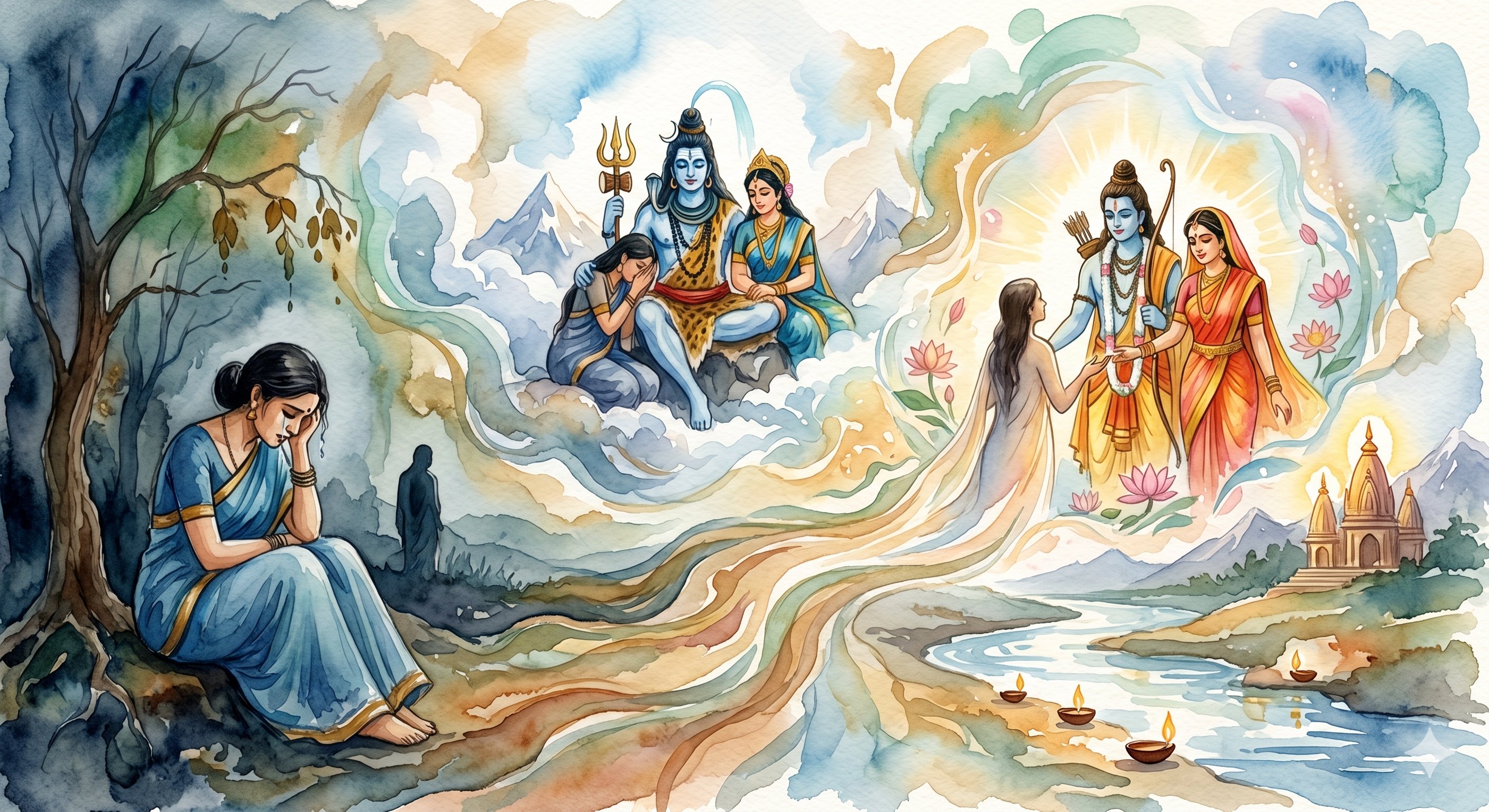
Not self-help books. Not clinical frameworks. Stories with characters who weep, rage, lose everything, and somehow find a way to continue living. Indian mythology helps process grief in ways that clinical language often cannot, because it doesn't explain grief from the outside. It places you inside it.
The Ramayana, the Mahabharata, and the Puranas are filled with some of the most devastating depictions of loss ever written. They don't flinch. They don't rush to resolution. And that is precisely what makes them therapeutic.
1. Rama Losing Sita - When the Divine Himself Weeps
The Ramayana offers the most emotionally raw portrait of grief in all of Indian literature, and it comes from the most unexpected source: God himself.
When Lord Rama returns to the forest after the hunt for the golden deer and discovers that Sita is gone, he does not remain composed. He does not philosophize. The Valmiki Ramayana describes him wandering through the forest in agony, asking the trees, the rivers, and the animals:
"O Kadamba tree, my beloved is fond of Kadamba flowers have you seen that lady? If you know, O Kadamba, tell me about Sita, whose face is beautiful." - Valmiki Ramayana, Aranya Kanda, Sarga 60, Verse 12
This is the Supreme Avatar of Vishnu, the upholder of cosmic order, reduced to begging nature for answers.
Why This Story Matters for Grief
Modern grief culture often pressures people, especially men to "be strong" and "hold it together." The Ramayana does the opposite. It shows the most powerful being in the universe falling apart, and it treats this falling apart as natural, dignified, and holy.
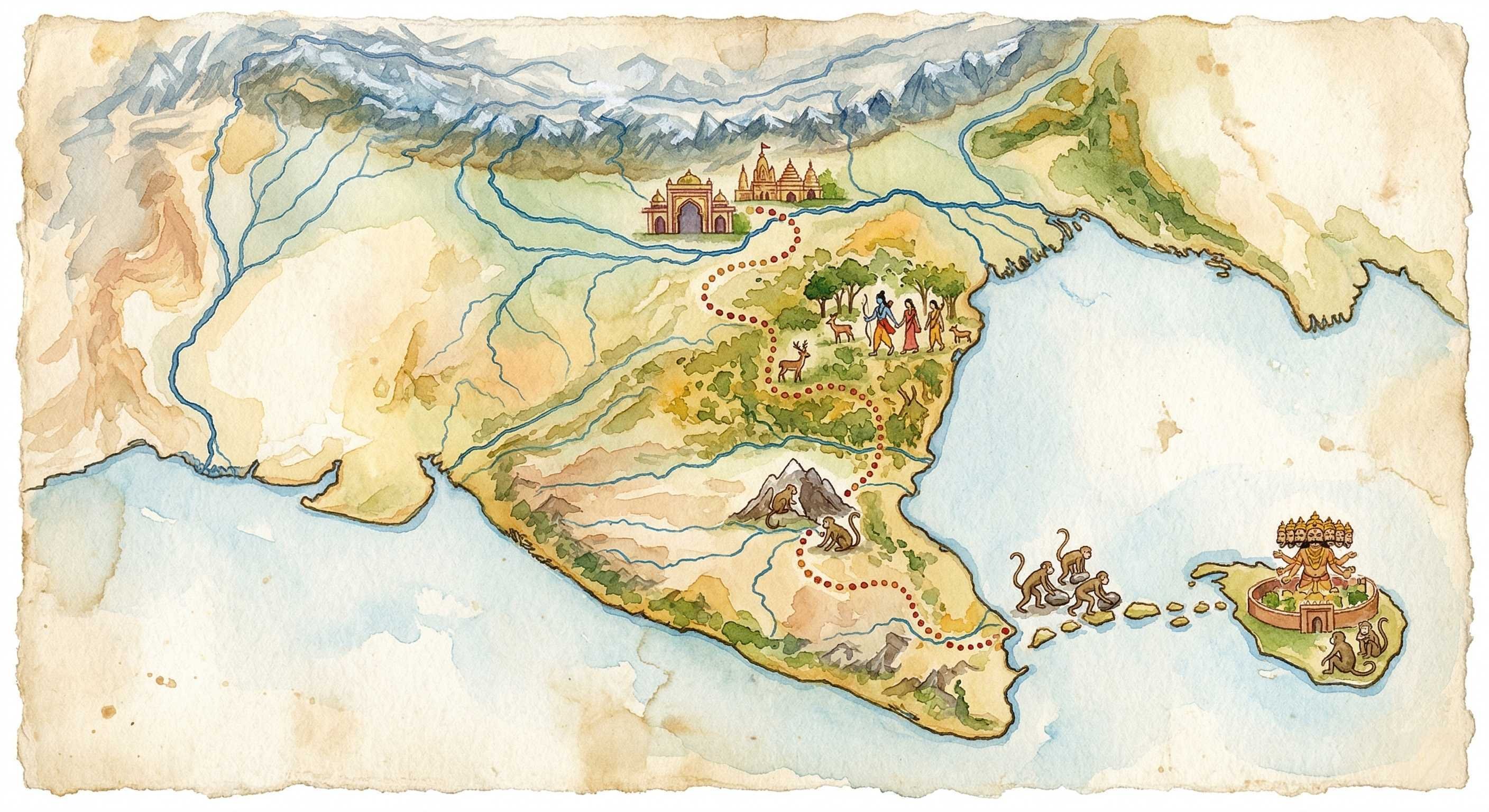
Rama doesn't suppress his grief. He moves through it. He weeps openly. He allows his companions to witness his pain. And only then, after the grief has been fully expressed, does he gather himself to act to mobilize an army and cross an ocean.
The sequence matters: feel first, then fight. The Ramayana teaches that grief skipped is grief delayed, not grief avoided.
2. Arjuna Losing Abhimanyu - The Unbearable Weight of a Father's Guilt
If Rama's grief is about absence, Arjuna's grief in the Mahabharata is about responsibility.
Abhimanyu, Arjuna's sixteen-year-old son, is trapped in the Chakravyuha a deadly military formation on the thirteenth day of the Kurukshetra war. The boy knew how to enter the formation but not how to exit it. He was taught the entry by his father while still in his mother Subhadra's womb, but the lesson was never completed.
Six warriors Drona, Karna, Ashwatthama, Dushasana, Kritavarma, and Shakuni surround the teenager and kill him in violation of every rule of war.
When Arjuna learns of his son's death, his grief is described in the Drona Parva (Book 7), Abhimanyu-badha Parva (Sections 71–75) as absolutely annihilating. He collapses. He screams. He blames himself. He swears an impossible oath: he will kill Jayadratha (who blocked the formation's exit) before sunset the next day, or immolate himself.
Why This Story Matters for Grief
Arjuna's grief carries a dimension that many modern grievers recognize but rarely see validated: guilt.
I should have been there. I should have taught him more. I should have protected him. Parents who lose children, siblings who couldn't prevent a tragedy, friends who weren't present at the critical moment they carry this specific, corrosive form of grief.
The Mahabharata doesn't tell Arjuna that his guilt is irrational. It doesn't minimize it. Instead, it gives him a channel. His grief transforms into a vow. The vow gives him purpose. And the next day, with Krishna's help, he fulfills it.
The lesson isn't that you should seek revenge. It's that grief without a forward direction becomes self-destruction. The ancients understood that after the weeping comes the question: What do I do now? And the story must provide a path.
3. Yashoda Losing Krishna - Loving What Was Never Yours
Of all the grief stories in Indian mythology, Yashoda's may be the most quietly devastating.
Yashoda, the foster mother of Krishna, raised him from infancy. She nursed him, chased him when he stole butter, scolded him, kissed him, and loved him with the fierce, consuming love of a mother. But Krishna was never hers to keep.
He was born to Devaki and Vasudeva in a prison cell in Mathura. He was smuggled to Gokul as a newborn to escape the murderous King Kamsa. Yashoda received a baby in the middle of the night and raised him as her own. And then, when Krishna was a young boy, the call came from Mathura. He had to return to fulfill his destiny to slay Kamsa, to lead empires, and eventually to guide the course of a world war.
The Bhagavata Purana (Srimad Bhagavatam), Canto 10, Chapter 39 describes Yashoda watching Krishna leave Gokul on Akrura's chariot. She stands at the village boundary, watching the dust settle behind the wheels. He never comes back to live with her again.
Why This Story Matters for Grief
Yashoda's story speaks to a form of grief that doesn't involve death: the grief of letting go.
Parents watching children leave home. Caregivers whose role ends when the patient recovers. People who pour their heart into a relationship that was always temporary. The loss is real, the love was real, but the person was never yours they were passing through your life on their way somewhere else.
Yashoda's grief also confronts the cruel irony of cosmic justice. She did nothing wrong. She loved selflessly. And her reward was separation. The Bhagavata Purana doesn't offer her a happy ending in the conventional sense. What it offers instead is a profound theological insight: the love itself was the gift, not the possession of the beloved.
Krishna later tells the Gopis of Vrindavan (and by extension, Yashoda) through Uddhava in Bhagavata Purana, Canto 10, Chapter 47 that his physical absence doesn't diminish his love. He is present in every act of devotion, in every memory, in every tear shed in his name. This is the Vaishnava theology of Viraha Bhakti devotion through the pain of separation and it reframes grief not as loss but as the deepest possible form of love.
4. Gandhari's Grief - When Loss Becomes Rage
Not all grief in mythology is noble. Some is furious.
Gandhari, the mother of the hundred Kauravas, watches all of her sons die over eighteen days of war. Every single one. She didn't condone their evil, she spent years warning Duryodhana that his path would lead to destruction. But he was her son. They all were.
After the war, when Krishna comes to offer condolences, Gandhari doesn't accept his sympathy. She turns on him with a curse (Stri Parva, Book 11, Section 25): "Just as the Kuru dynasty was destroyed, so shall your Yadu dynasty be destroyed. And you, Krishna, shall die alone, in the wilderness, struck down by a hunter's arrow."
And Krishna doesn't deflect the curse. He accepts it. The Yadava dynasty does destroy itself, and Krishna does die alone in a forest.
Why This Story Matters for Grief
Gandhari represents the grief that society is most uncomfortable with: anger. Not gentle acceptance, not philosophical surrender rage at the universe, at God, at the perceived architect of suffering.
Modern grief counseling recognizes anger as a critical stage. But culturally, bereaved people especially bereaved mothers are expected to be sad, not furious. Gandhari's story validates the fury. It says: you are allowed to be angry at God. You are even allowed to curse God. And God if the Mahabharata's portrayal of Krishna is any guide will stand there and take it, because He understands.
Why Stories Work When Logic Doesn't
There is a reason that grief finds more comfort in narrative than in prescription. A therapist might tell you, "Grief is a process. Give yourself time." That's true, but it's abstract. It's a map with no landmarks.
A story, on the other hand, gives you a mirror. When you read about Rama weeping for Sita, you recognize your own weeping. When you read about Arjuna's guilt, you recognize the voice in your head that says I should have done more. When you read about Yashoda watching Krishna leave, you feel the universal ache of loving something you cannot hold.
The ancient poets understood something that modern narrative therapy is only now articulating: telling stories about suffering makes suffering bearable. It transforms private agony into shared human experience. It proves that your grief, however isolating it feels, has been felt before, survived before, and woven into the most sacred stories humanity has ever told.
For those who want to explore these stories in their original depth, Vedapath offers the complete Ramayana, Mahabharata, and Bhagavata traditions with verse-by-verse translations and AI-powered explanations so you can sit with the grief the ancients wrote about and find your own meaning within it.
Frequently Asked Questions
Q: Can reading mythology actually help with grief? A: Yes. The field of narrative therapy, pioneered by Michael White and David Epston, demonstrates that engaging with stories especially ones that mirror a person's emotional experience helps individuals externalize grief, find meaning, and develop coping frameworks. Ancient myths function as naturally occurring narrative therapy.
Q: Why does Hindu mythology depict gods grieving? A: In the Hindu worldview, avatars (divine incarnations) take human form specifically to experience human emotions fully. Rama, Krishna, and Shiva all grieve in the texts not because they are limited, but because the tradition teaches that grief is a sacred, essential part of the human experience, not a flaw to be overcome.
Q: Is there a specific text for someone dealing with the death of a loved one? A: The Bhagavad Gita, Chapter 2 (Sankhya Yoga), Verses 2.11–2.30 offer the most direct philosophical framework for understanding death and the immortality of the soul. The Garuda Purana is traditionally read after a death in Hindu families and describes the journey of the soul after death.
Q: Are there stories about recovering from grief, not just experiencing it? A: Absolutely. Rama reunites with Sita after the war. Arjuna channels his grief into decisive action. Yudhishthira, after losing everything, eventually regains his kingdom and finds peace. The texts model the complete arc from devastation through endurance to renewal.
Key Takeaways
- Ancient Indian mythology doesn't avoid grief it centers it. Gods weep, warriors collapse, and mothers rage at the universe.
- Rama's grief teaches that expressing pain openly is natural and necessary, even for the most powerful.
- Arjuna's grief validates guilt and shows that forward action not suppression is the antidote to self-destructive sorrow.
- Yashoda's grief speaks to the pain of letting go and redefines love as something that transcends physical proximity.
- Gandhari's rage validates anger as a legitimate response to loss, even anger directed at God.
- Stories work as grief therapy because they transform private suffering into shared, recognized, human experience.
📖 Find the Stories That Speak to Your Pain
The next time grief visits you and it will, because that is the price of loving anything don't just scroll through platitudes. Open the stories the ancients told.
With the Vedapath app, you can explore the Ramayana, the Mahabharata, the Bhagavad Gita, and the Puranas all in one place, in 16 languages. Use the "I Am Feeling" feature to find verses matched to your emotional state, or simply read the ancient tales and let them remind you: this pain is old. It has been survived. And you are not alone in it.
Comments
Sign in to join the discussion