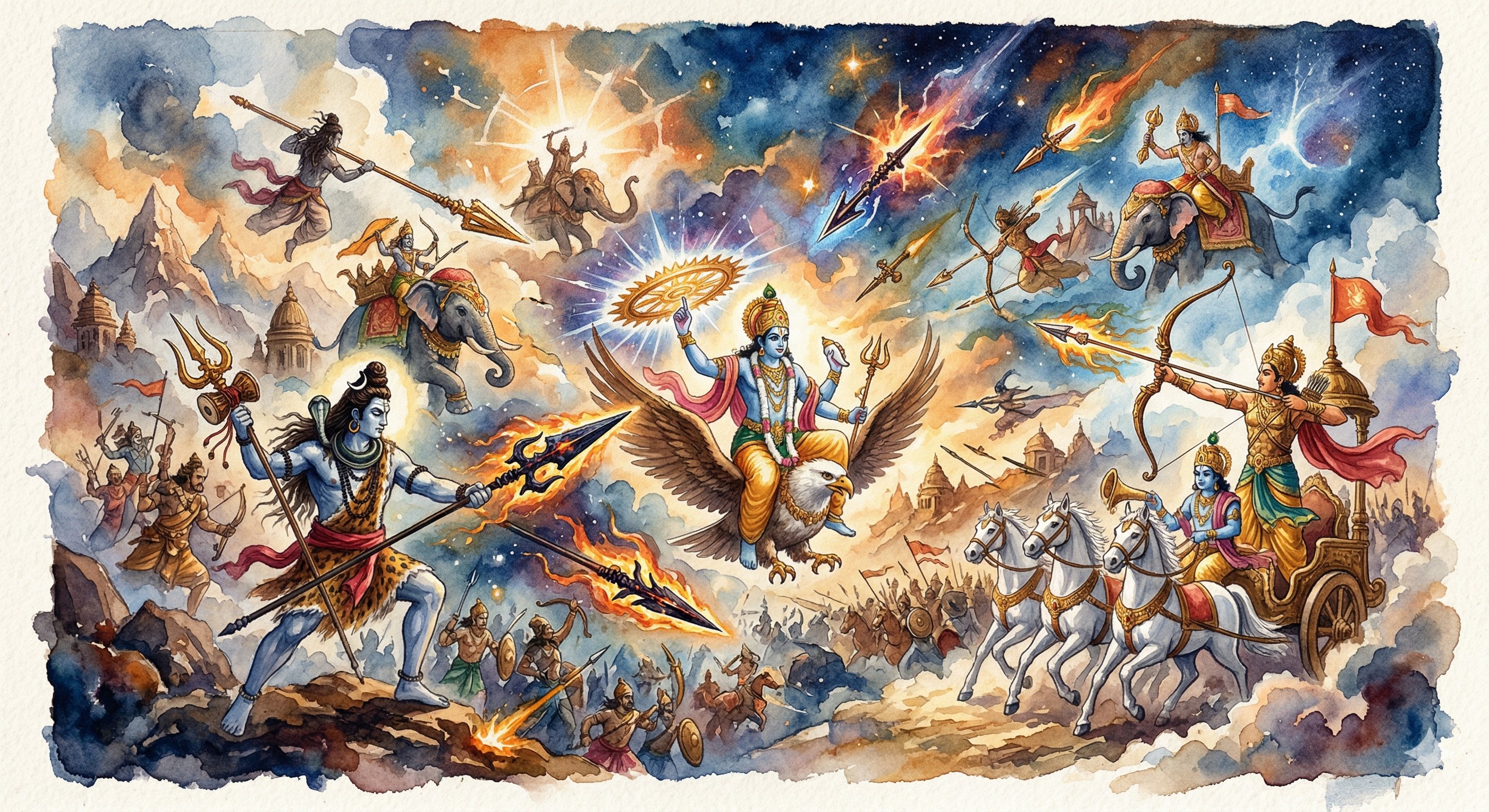
Modern military technology has given us nuclear warheads, hypersonic missiles, and electromagnetic pulse weapons. Impressive by human standards.
Now consider this: Hindu mythology describes weapons that can evaporate oceans, destroy entire planetary systems, reverse the flow of time, and annihilate the fabric of reality itself all invoked through mantras and mental discipline, wielded by warriors who obtained them through decades of penance, and governed by strict cosmic rules about when and how they could be deployed.
These are the Astras divine weapons of the Vedic and Puranic traditions. The word Astra comes from the Sanskrit root as (to throw/launch) and refers specifically to weapons empowered by mantras and presided over by specific deities. Unlike conventional weapons (Shastra), astras are consciousness-powered they require the wielder to know the invocation mantra, the deployment protocol, and critically, the withdrawal mantra to recall them.
Here are the ten most powerful, ranked by destructive capability, cosmic significance, and the sheer terror they inspired.
10. Agneyastra - The Weapon of Fire
Presiding Deity: Agni (God of Fire) Notable Wielders: Drona, Arjuna, Karna, Ashwatthama Source Texts: Mahabharata (Drona Parva, Karna Parva)
The Agneyastra is the entry-level divine weapon and even at the bottom of this list, it makes modern incendiary weapons look like birthday candles.
When invoked, the Agneyastra releases a torrent of supernatural fire that cannot be extinguished by water. It burns through armour, shields, and defensive formations, consuming everything in its path with flames that the texts describe as having the intensity of the fire at the end of a Yuga (cosmic age).
Why It Ranks Here
The Agneyastra is powerful but counterable. It can be neutralised by the Varunastra (weapon of water), which is why battles in the Mahabharata often feature these two astras being deployed in rapid succession fire answered by flood, flood answered by fire, in escalating cycles.
The key tactical limitation: It's an area-of-effect weapon with no precision targeting. In the dense, multi-army battlefields of Kurukshetra, the Agneyastra was a blunt instrument effective for breaking formations, but incapable of distinguishing friend from foe.
9. Varunastra The Weapon of the Cosmic Ocean
Presiding Deity: Varuna (God of Water and the Cosmic Ocean) Notable Wielders: Arjuna, Rama, Indrajit Source Texts: Ramayana (Yuddha Kanda), Mahabharata (multiple Parvas)
The direct counter to the Agneyastra, the Varunastra summons floods of cosmic water not ordinary rainfall, but torrents described as equivalent to the ocean itself being unleashed upon the battlefield.
In the Ramayana, Indrajit (Ravana's son) uses the Varunastra during the siege of Lanka, creating localized floods to disrupt Rama's army. Rama counters with his own Varunastra, leading to a standoff of competing aquatic forces.
The Deeper Significance
Varuna is not merely a water god in the Vedic framework he is the lord of cosmic order (Rita) in the Rig Veda, the judge of oaths, the guardian of moral law. The Varunastra therefore carries a judicial dimension: in some texts, it is described as being more effective against those who have broken oaths or violated dharma. Truth, in a sense, makes you resistant to it.
8. Nagastra - The Serpent Weapon
Presiding Deity: Nagas (Serpent beings) Notable Wielders: Karna, Indrajit, Ashwatthama Source Texts: Mahabharata (Karna Parva), Ramayana (Yuddha Kanda)
The Nagastra transforms the arrow into a living serpent or, more accurately, channels the destructive essence of the Nagas into a projectile that seeks its target with sentient intent.
The most famous deployment is by Karna against Arjuna during their final duel (Karna Parva). Karna fires the Nagastra with the intention of killing Arjuna. The weapon charged with the serpent Ashwasena's personal vendetta against Arjuna (whose burning of the Khandava forest killed Ashwasena's mother) flies straight at Arjuna's head.
Krishna, serving as Arjuna's charioteer, presses the chariot into the ground using the weight of his foot, sinking the wheels into the earth. The chariot drops just enough that the Nagastra strikes Arjuna's crown instead of his throat.
Karna asks to fire it again. The Nagastra itself, insulted at being recalled, refuses to cooperate a second time. A weapon with ego.
Why It Ranks Here
The Nagastra is terrifying for its sentient homing capability it doesn't just fly; it hunts. But its intelligence is also its limitation: it can be dodged, and its cooperation is not guaranteed. A weapon that can refuse its own wielder is, by definition, unreliable.
7. Vajra - Indra's Thunderbolt
Presiding Deity: Indra (King of the Gods) Notable Wielders: Indra, Arjuna (as Indra's son) Source Texts: Rig Veda, Mahabharata, multiple Puranas
The Vajra is arguably the most famous weapon in all of Hindu mythology and one of the oldest, appearing extensively in the Rig Veda, the world's oldest literary text.
Made from the bones of the sage Dadhichi (who voluntarily gave up his life so that his skeleton could be fashioned into a weapon capable of killing the demon Vritra), the Vajra is described as an indestructible thunderbolt that can shatter mountains, split the sky, and destroy any fortification.
Indra uses the Vajra to kill Vritra, the serpent-demon who had imprisoned all the world's waters in one of the Rig Veda's most important mythological events (Rig Veda 1.32). This battle is repeated in over 20 hymns, making it the central narrative of Vedic mythology.
The Vajra's Unique Properties
- Indestructible it cannot be broken, blunted, or degraded
- Returns to the wielder after being thrown (like a cosmic boomerang)
- Carries divine authority using the Vajra is equivalent to wielding the executive power of the King of Gods himself
Why It Ranks Here
The Vajra is immensely powerful and symbolically central, but it is ultimately Indra's weapon and Indra, in the post-Vedic tradition (Puranas, Epics), is repeatedly shown as inferior to the Trimurti (Brahma, Vishnu, Shiva). The weapons bestowed by the Trimurti consistently outclass the Vajra.
6. Brahmandastra - The Weapon of Cosmic Dissolution
Presiding Deity: Brahma (Creator God) Notable Wielders: Extremely rare only the most advanced warriors Source Texts: Mahabharata (references), various Puranas
If the Brahmastra (ranked higher see below) is a nuclear warhead, the Brahmandastra is the detonation of reality itself.
The texts describe the Brahmandastra as capable of destroying the entire Brahmanda literally, the "Egg of Brahma," which is the Hindu cosmological term for the universe. It doesn't destroy a city, an army, or a continent. It destroys everything.
Why It Ranks Here (And Not Higher)
The Brahmandastra exists more in theoretical description than in narrative deployment. The texts warn that its use would end creation itself, which means it functions as a deterrent rather than an operational weapon, the mythological equivalent of Mutually Assured Destruction. No warrior in the major epics actually fires it, because doing so would end the story.
5. Vaishnavastra - The Weapon of Vishnu's Preservation
Presiding Deity: Vishnu (The Preserver) Notable Wielders: Krishna, rare Vishnu devotees Source Texts: Mahabharata (Drona Parva)
The Vaishnavastra is the personal weapon of Vishnu and, unlike many astras that can be obtained through penance or teaching, this one is granted only by Vishnu's direct grace.
Its described effect is absolute: upon deployment, the Vaishnavastra releases a shower of divine discuses and maces that home in on every enemy within the wielder's intention. It cannot be blocked, dodged, or countered by any other astra with one critical exception (the Narayanastra, below).
In the Mahabharata, Bhagadatta (King of Pragjyotisha, riding a war elephant) deploys the Vaishnavastra against Arjuna. The weapon, described as unstoppable, flies towards Arjuna but Krishna intercepts it, receiving it upon his own chest, where it transforms into a garland of flowers. The weapon, recognising its own presiding deity, cannot harm Vishnu himself.
The Theological Point
This moment illustrates a critical principle of the astra system: no weapon can harm its own source deity. The Vaishnavastra, born from Vishnu's power, returns to Vishnu as adornment. It's a beautifully circular piece of cosmic logic.
4. Narayanastra - The Weapon That Punishes Resistance
Presiding Deity: Narayana (Vishnu in his cosmic form) Notable Wielders: Ashwatthama, Drona Source Texts: Mahabharata (Drona Parva)
The Narayanastra is one of the most terrifyingly intelligent weapons in mythology. Its power scales with the resistance of its targets. The more the enemy fights back, the more they raise weapons, the more aggression they show the more destructive the astra becomes.
The only way to survive the Narayanastra is to lay down all weapons, dismount, and offer complete mental and physical submission. Any resistance amplifies its destructive power exponentially.
The Deployment at Kurukshetra
Ashwatthama fires the Narayanastra at the Pandava army in a moment of rage after his father Drona's death. The sky darkens. Thousands of flaming arrows and discuses materialise, raining destruction on every soldier who fights back.
Krishna immediately instructs the Pandava army to disarm and lie flat on the ground in surrender. Those who obey survive. Those who resist out of ego, reflex, or misunderstanding are destroyed.
Bhima, characteristically, refuses to surrender and continues fighting. The weapon's power intensifies around him specifically, nearly killing him, until Arjuna and Krishna physically restrain him and force him to the ground.
The Philosophical Dimension
The Narayanastra is a theological weapon: it embodies the Vedantic principle that ego and resistance cause suffering, while surrender to the divine brings protection. It is, in essence, the weaponised version of the Gita's teaching on Sharanagati (total surrender to God).
Why It Ranks Here
It is extraordinarily powerful but has a built-in counter: surrender. A weapon with an escape clause however psychologically difficult that escape may be cannot rank at the very top.
3. Sudarshana Chakra The Discus That Orbits the Universe
Presiding Deity: Vishnu Notable Wielders: Vishnu / Krishna exclusively Source Texts: Multiple Puranas, Mahabharata, Bhagavata Purana
The Sudarshana Chakra is Vishnu's personal weapon a spinning discus with 108 serrated edges that moves at the speed of thought, can pursue its target across any distance in any realm (including crossing between the 14 worlds of Hindu cosmology), and cannot be stopped by any force in existence.
It is not an astra in the conventional sense it is not invoked by mantra or obtained through penance. It is a permanent attribute of Vishnu, as fundamental to his identity as his conch (Panchajanya) or his mace (Kaumodaki).
Key Deployments
- Krishna uses it to behead Shishupala after 100 insults (Shishupala had a divine boon of 100 pardons from Vishnu the 101st offence triggered automatic execution via Sudarshana Chakra)
- Krishna displays it at the Kuru court during peace negotiations to warn the Kauravas, the discus appears on his finger, blazing, and the entire assembly is terrified
- Used to block the sun by Krishna to create artificial darkness for the killing of Jayadratha (Arjuna had sworn to kill Jayadratha before sunset or self-immolate)
What Makes It Unique
The Sudarshana Chakra has cosmological functions beyond combat. The Vishnu Purana describes it as continuously orbiting around Vishnu and the entire cosmos, representing the wheel of time (Kalachakra). It is simultaneously a weapon and a fundamental structure of the universe destruction and cosmic order encoded in the same spinning disc.
Why It Ranks Here
It has no known counter, no withdrawal mantra needed (it returns on its own), and it cannot miss. However, it is restricted to Vishnu/Krishna alone, it cannot be granted, lent, or stolen. This exclusivity limits its narrative significance compared to the top two, which were wielded by multiple warriors with devastating consequences.
2. Pashupatastra - Shiva's Weapon of Total Annihilation
Presiding Deity: Shiva (The Destroyer) Notable Wielders: Arjuna, (potentially) Atikaya, Meghnad Source Texts: Mahabharata (Vana Parva, specifically the Kiratarjuniya episode)
The Pashupatastra is the personal weapon of Shiva and it is described as the most destructive astra that can be wielded by a mortal.
Its acquisition by Arjuna is one of the Mahabharata's most famous episodes. During the Pandavas' exile, Arjuna performs extreme penance in the Himalayas to obtain divine weapons. Shiva appears disguised as a Kirata (mountain hunter) and engages Arjuna in combat over a hunted boar. Arjuna, not recognising Shiva, fights him with his full power and is defeated. When Shiva reveals his true form, an awestruck Arjuna worships him, and Shiva grants the Pashupatastra as a reward for his valour.
Destructive Capability
The Pashupatastra can be launched by mind, eyes, words, or a bow four distinct delivery mechanisms, making it the most versatile astra in the mythological arsenal.
Its described effects:
- Complete annihilation of the target not just physical death but the destruction of the target's karmic trace, preventing rebirth
- Capability to destroy the entire universe if aimed without a specific target
- No counter exists unlike most astras, the Pashupatastra cannot be neutralised by any other weapon
The Strict Rules
Shiva imposes severe restrictions on its use:
- It must never be used against a weaker opponent or an army of mortals
- It should only be deployed as an absolute last resort, when all other options have failed
- Misuse will destroy the user and everything around them
Arjuna, notably, never uses it in the Mahabharata war despite possessing it. This restraint is itself a powerful narrative choice: the most dangerous weapon in the epic remains sheathed, its mere existence serving as a final insurance policy.
If you want to read the full Kiratarjuniya episode Arjuna's encounter with Shiva in the forest Vedapath offers the complete Mahabharata with searchable translations, letting you explore the exact verses describing this legendary acquisition.
1. Brahmastra - The Weapon That Remembers
Presiding Deity: Brahma (The Creator) Notable Wielders: Drona, Ashwatthama, Arjuna, Karna, Rama, Indrajit, Atikaya Source Texts: Mahabharata (multiple Parvas), Ramayana (Yuddha Kanda, Uttara Kanda)
The Brahmastra is the most narratively significant weapon in Hindu mythology not necessarily because it is the most destructive (the Pashupatastra and Brahmandastra arguably surpass it), but because it is the weapon whose deployment and consequences drive the most critical events in both epics.
It is created by Brahma, the creator god, and is described as an astra of absolute, irreversible destruction. Once fired, it cannot be recalled (with extremely rare exceptions), and it never misses its target.
The Destructive Profile
When a Brahmastra is launched:
- The sky cracks open, the earth trembles, and all water bodies near the impact zone evaporate
- Vegetation withers in the surrounding area and the land remains barren for years afterward
- The heat generated is compared to "twelve suns rising simultaneously"
- All living beings in the blast radius experience complete cellular destruction
Modern readers have noted the uncomfortable similarity to nuclear weapons, the flash of light, the long-term environmental contamination, the barren aftermath. Whether this is coincidence, metaphor, or something else entirely is one of mythology's great open questions.
The Ashwatthama Incident - Why It Ranks #1
The Brahmastra earns the top spot because of its most devastating deployment: Ashwatthama's firing of it at the Pandava camp after the war.
Enraged by the death of his father Drona (killed through Krishna's deceptive stratagem), Ashwatthama launches a Brahmastra targeting the wombs of all Pandava women specifically aimed at killing the unborn child of Abhimanyu's widow, Uttara, to end the Pandava lineage forever.
This is the single most morally horrific use of a divine weapon in either epic a weapon of creation's god, turned against the unborn.
The text describes its flight: a searing column of light, brighter than the sun, descending upon the Pandava camp. It is an extinction-level weapon aimed not at warriors but at a future that hasn't been born yet. It attacks potential. It attacks time itself.
Krishna intervenes. He cannot stop the Brahmastra (even he acknowledges that a Brahmastra, once launched, is irreversible). Instead, he deploys his own divine energy to protect the single fetus in Uttara's womb, the child Parikshit, who will become the future king and the last link of the Pandava dynasty.
As punishment, Krishna curses Ashwatthama to wander the earth for 3,000 years, immortal, suffering, unable to die or find peace with the Brahmastra's gemstone ripped from his forehead, leaving a wound that never heals.
Why #1?
The Brahmastra is not the most powerful weapon on this list in raw destructive terms. But it is the weapon that carries the most narrative weight, moral consequence, and theological significance. It is simultaneously:
- A weapon of the Creator God used for destruction (theological irony)
- The instrument of the epic's most horrific war crime (moral gravity)
- The catalyst for one of mythology's most famous curses (narrative consequence)
- The weapon that nearly ended the Pandava line and whose failure to do so allows the entire post-Mahabharata tradition to exist
Power is not just about destruction. Power is about consequence. And no weapon in Hindu mythology carries more consequence than the Brahmastra.
The Complete Ranking Table
| Rank | Weapon | Deity | Key Property | Can Be Countered? |
|---|---|---|---|---|
| 1 | Brahmastra | Brahma | Never misses; irrevocable; generational devastation | Only by another Brahmastra (mutual annihilation) |
| 2 | Pashupatastra | Shiva | Total annihilation including karmic trace; no counter | No known counter |
| 3 | Sudarshana Chakra | Vishnu | Infinite range; speed of thought; Vishnu-exclusive | No - returns to Vishnu |
| 4 | Narayanastra | Narayana | Power scales with enemy resistance | Yes - complete surrender |
| 5 | Vaishnavastra | Vishnu | Homing discus/mace shower; unstoppable | Only by Vishnu himself |
| 6 | Brahmandastra | Brahma | Destroys the entire universe | Theoretical - never deployed |
| 7 | Vajra | Indra | Indestructible thunderbolt; returns to wielder | Outclassed by Trimurti weapons |
| 8 | Nagastra | Nagas | Sentient homing serpent projectile | Can be dodged; can refuse wielder |
| 9 | Varunastra | Varuna | Cosmic floods; more effective vs. oath-breakers | Countered by Agneyastra |
| 10 | Agneyastra | Agni | Inextinguishable supernatural fire | Countered by Varunastra |
Frequently Asked Questions
Q: Are astras the same as regular weapons? A: No. In Sanskrit, Shastra refers to hand-held, physical weapons (swords, maces, spears). Astra refers specifically to weapons empowered by divine mantras and presided over by specific deities. An arrow becomes an astra only when the correct invocation mantra is recited, mentally or verbally. The wielder must also know the withdrawal mantra to recall it.
Q: Could any warrior use any astra? A: No. Each astra requires specific knowledge (the mantra), qualification (often granted by a guru or obtained through penance), and spiritual capacity. Using an astra without proper training or authorisation is described as suicidal in the texts. There are also ethical restrictions certain astras cannot be used against unarmed opponents, civilians, or retreating soldiers.
Q: What happens when two Brahmastras collide? A: The Mahabharata describes this scenario when Arjuna and Ashwatthama fire Brahmastras at each other after the war. The sages Vyasa and Narada intervene, warning that two colliding Brahmastras will cause total planetary destruction making the land barren for twelve years. Arjuna withdraws his astra (demonstrating superior training). Ashwatthama, who does not know the withdrawal mantra, redirects his at the Pandava wombs leading to the cursed outcome described above.
Q: Is there any connection between astras and modern nuclear weapons? A: Some researchers have drawn parallels between the descriptions of the Brahmastra (blinding light, extreme heat, long-term environmental devastation, genetic deformities in survivors) and nuclear weapon effects. J. Robert Oppenheimer famously quoted the Bhagavad Gita "Now I am become Death, the destroyer of worlds" after the Trinity test. Whether these textual descriptions reflect ancient knowledge, metaphor, or coincidence remains debated and unresolved.
Q: Why didn't Arjuna use the Pashupatastra in the Mahabharata war? A: The texts suggest two reasons. First, Shiva's explicit instructions prohibited its use against mortal armies it was meant only for threats of cosmic scale. Second, Arjuna's restraint is itself a moral statement: true power lies in the discipline of not using the ultimate weapon, even when you possess it. This perfectly mirrors the Gita's ethic of detachment from outcomes.
Key Takeaways
- Hindu mythology describes a complete weapons classification system: Shastra (physical weapons) vs. Astra (mantra-powered divine weapons), each with specific deities, activation protocols, and ethical restrictions.
- The Brahmastra ranks #1 not for raw destruction but for narrative consequence its deployment by Ashwatthama against the unborn Pandava heir is the epic's most horrific event and triggers one of mythology's most famous curses.
- The Pashupatastra (Shiva's weapon) is the most destructive weapon wieldable by a mortal capable of destroying the universe and erasing the target's karmic trace, preventing rebirth.
- The Sudarshana Chakra is unique as a permanent attribute of Vishnu rather than a grantable astra, it operates at the speed of thought and simultaneously functions as a cosmological structure (the wheel of time).
- The Narayanastra embodies Vedantic philosophy in weapon form, its power increases with resistance and can only be survived through complete surrender.
- The astra system includes ethical constraints misuse results in destruction of the wielder, and multiple weapons carry specific prohibitions against targeting the weak, unarmed, or retreating.
- Many astra descriptions contain parallels to modern weapons technology (homing missiles, nuclear effects, scaled response systems) that remain a fascinating area of interpretive debate.
Comments
Sign in to join the discussion