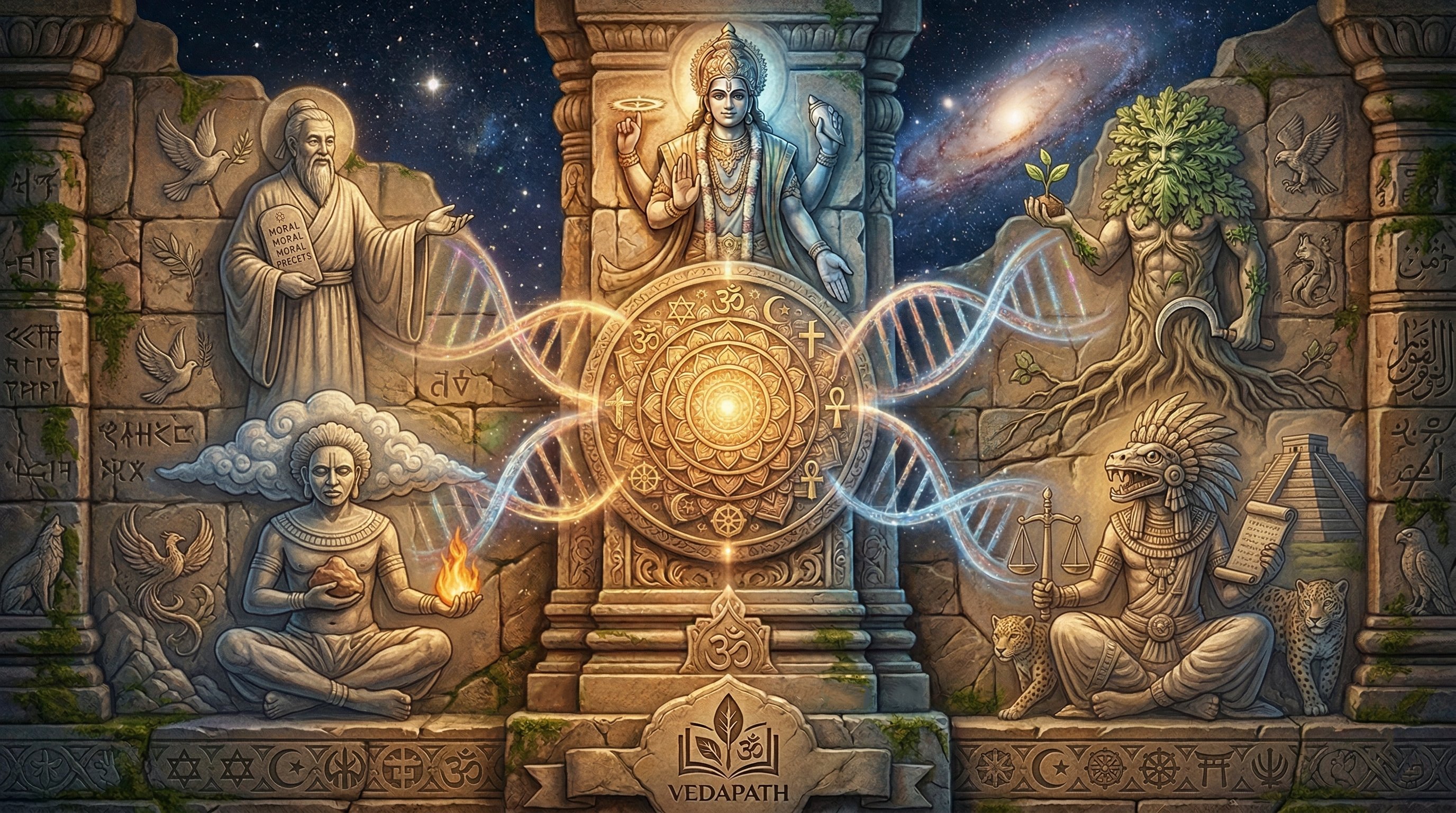

Long before science, before maps, before nations, humans sat under the same sky and asked the same questions:
- Who created all this?
- Why does suffering exist?
- Is anyone watching over us?
- What happens after we die?
And in different corners of the world, without ever meeting each other, they began to answer. Not with equations, but with stories. Stories of God Archetypes.
This study of comparative mythology reveals that whether we are reading ancient Indian scriptures or Greek legends, humanity has always been telling variations of the same story. From the protectors of the Vedas to the judges of the Nile, we find universal truths that bridge the gap between cultures, proving that while the names of Vedic deities may change, the search for meaning remains the same.
Every civilization imagines a protector, a creator, and a destroyer… The names change, the stories evolve, but something feels… familiar. It’s almost as if, across time and geography, humanity has been telling variations of the same story.
Not the Same Gods, but Similar Roles
At first glance, religions seem vastly different. Different rituals, different languages, different symbols. This is not about saying all religions are the same. It’s about noticing a deeper pattern: The divine is almost always imagined in recurring roles.
Not identical gods, but similar archetypes and roles, not randomness. It’s as if across geography and time, humanity is trying to understand existence using the same emotional framework. In roles that help us understand the world, cope with uncertainty, and find meaning. And these roles repeat across cultures.
Let’s explore these patterns, not to compare superiority, but to uncover shared human intuition.
The Protector: A Universe That Cares
In a world where life is uncertain and often fragile, the idea of a protecting force emerges almost instinctively. In the Hindu tradition, Vishnu is not merely a distant deity but an active sustainer of cosmic balance. Whenever dharma declines, he incarnates, entering the human world to restore order. Protection here is not passive. It is deeply involved, even personal.
यदा यदा हि धर्मस्य ग्लानिर्भवति भारत...
“Yada yada hi dharmasya glanir bhavati Bharata..."
When looking at the similarities between Hindu and Greek gods, we see this protective role mirrored in figures like Zeus (as a fatherly protector) or Jesus Christ in Christianity.
In Christianity, Jesus Christ embodies protection through sacrifice. The idea is not that suffering disappears, but that it is transformed through love and redemption. Protection becomes moral and spiritual rather than purely physical.
In Buddhist traditions, Avalokiteshvara listens to the cries of all beings. The divine here is not a ruler, but a compassionate presence that responds to suffering with infinite empathy.
This same thread appears in East Asian traditions through Guanyin, who represents mercy and gentle protection, and in Zoroastrianism through Ahura Mazda, who upholds truth and guides humanity toward righteousness.
What unites these figures is not their mythology, but their emotional role. They answer a deeply human need: the need to believe that existence is not indifferent, that there is something that sees, understands, and, in some form, protects. A force that protects, guides, and restores order when chaos takes over.
The Destroyer: Change Is Not the Enemy
If protection reflects hope, destruction reflects reality. Everything that exists eventually changes or ends. Rather than ignoring this, many traditions give destruction a sacred, necessary dimension.
In Hindu philosophy, Shiva is not a symbol of chaos, but of transformation. His cosmic dance represents the dissolution of the universe, not as an act of violence, but as part of a larger cycle that makes renewal possible. Similarly, Kali appears fierce, yet her role is to destroy illusion and ego.
In ancient Egypt, Sekhmet embodies divine wrath, but also purification.
In Norse mythology, Odin is tied to Ragnarok or the end of the world, that is not absolute annihilation but a transition into a new cycle.
Even in Aztec belief, Coatlicue represents both creation and destruction, reminding us that the two are inseparable.
Across these traditions, destruction is rarely meaningless. It is purposeful, often necessary. It reflects an acceptance that endings are not failures of existence, but essential parts of it. And also, a reminder that ancient wisdom for the digital age still teaches us that endings are just new beginnings.
The Creator: Where Did We Come From?
Every culture, at some point, asks: where did all of this begin? The impulse behind the answers is surprisingly consistent. In Hindu cosmology, Brahma emerges as the creator, bringing the universe into form as part of a larger cyclical process.
“Then even nothingness was not, nor existence…”
— Rig Veda (Nasadiya Sukta 10.129)
In the Abrahamic traditions, God creates the universe through divine will, often through the power of the word. The emphasis is on intentional creation, existence as something chosen, not accidental.
Ancient Egypt offers Ptah, who creates through thought and speech, while Chinese mythology speaks of Pangu, who separates chaos into heaven and earth.
In Aboriginal Australian traditions, Dreamtime presents creation not as a past event, but as an ongoing spiritual reality that continues to shape existence.
Despite their differences, these narratives share a deeper function. They do not simply explain how the world began. They assert that the world has meaning. They transform existence from randomness into something intentional, something that belongs to a larger story.
The Judge: A Moral Universe
If creation explains beginnings and destruction explains endings, the idea of judgment addresses something even more personal—fairness.
Life, as experienced, often feels unjust. Good people suffer, while others’ wrongdoing sometimes goes unpunished. Across cultures, this tension leads to a powerful belief: that justice exists, even if it is not immediately visible.
In Hindu tradition, Yama evaluates the actions of a soul through the law of karma. Justice is not arbitrary. It is a direct consequence of one’s own deeds.
In ancient Egypt, Anubis weighs the heart against truth, determining the fate of the soul. The symbolism is precise that truth has weight, and the soul must align with it.
Christian belief expresses this through Judgment Day, where ultimate accountability is revealed, while in Japanese Buddhist tradition, Enma determines the soul’s path after death.
Even in Aztec cosmology, Mictlantecuhtli governs the realm of the dead, reinforcing the idea that death is not the end of moral consequence.
These traditions differ in structure, but they share a conviction that is deeply human: that actions matter, and that justice, in some form, will prevail.
Why Do These Patterns Repeat?
When viewed together, these archetypes begin to feel less like isolated religious ideas and more like a shared language. They reflect the same concerns, the same fears, and the same hopes:
- Humans seek protection because they feel vulnerable.
- They accept destruction because they experience loss.
- They imagine creation because they question existence.
- They believe in judgment because they long for fairness.
In this sense, the divine becomes more than an object of worship. It becomes a way of understanding life itself. We create stories, not just to explain the world, but to live in it with courage.
A Vedapath Perspective
In Indian traditions, particularly in texts like the Ramayana and the Puranas, these archetypes are not abstract, they are lived through stories.
The divine does not remain distant. It takes form, enters the world, and interacts with human lives. This makes the exploration of these patterns even more meaningful. When placed alongside global traditions, we can stop seeing stories as separate and start seeing them as connected reflections of the same search. They become part of a larger, shared exploration of existence.
For those curious to explore these character arcs in the original text, Vedapath offers the complete library of Indian scriptures with AI-powered search, so you can find exactly how these archetypes are described in the Vedas, Upanishads, and Puranas.
A Final Reflection
These similarities do not mean that all religions are the same. Each tradition carries its own depth, context, and sacred identity. But beneath that diversity lies something quietly unifying.
Perhaps the value of seeing these patterns is not to reduce differences, but to deepen understanding and to recognize that behind every belief system lies a shared human impulse: The search for meaning, order, and connection with something greater…
The names may differ. The stories may change. But the search? That has always been the same.
“Vasudhaiva Kutumbakam” — The world is one family
— Mahopanishad
Frequently Asked Questions
What is a "Divine Archetype"?
An archetype is a recurring pattern or role that appears across different mythologies. For example, the "Protector" or the "Judge" are roles that exist in almost every culture, though the names of the gods filling those roles change.
How does Vishnu compare to global protectors?
Vishnu is a "Sustainer" who actively enters the world through Avatars. This is similar to the Greek Zeus who maintains cosmic order or the Christian Jesus who offers moral protection, though the methods (power vs. sacrifice) vary.
Is the "Destroyer" archetype negative?
In most traditions, no. The Destroyer (like Shiva or Kali) represents necessary change, transformation, and the clearing away of the old to make room for the new. It is seen as a sacred part of the life cycle.
Why do Egyptian and Indian mythologies have similar judges?
Both Yama (Hindu) and Anubis (Egyptian) represent the human longing for ultimate justice and the belief that our actions have consequences that transcend physical life.
How can I find these archetypes in original scriptures?
Tools like Vedapath allow you to search through texts like the Rig Veda or Srimad Bhagavad Gita to see exactly how these deities are described in their original Sanskrit context.
Key Takeaways
- Shared Framework: Humanity uses the same emotional framework (Protector, Destroyer, Creator, Judge) to understand existence.
- Beyond Geography: These parallels exist without direct contact, showing a universal human intuition.
- Purpose of Stories: Mythology isn't just about the past; it's a tool for living in the world with courage and meaning.
- Vedapath Integration: Comparing these global traditions highlights the richness of Indian scriptures as part of a global conversation.
Comments
Sign in to join the discussion