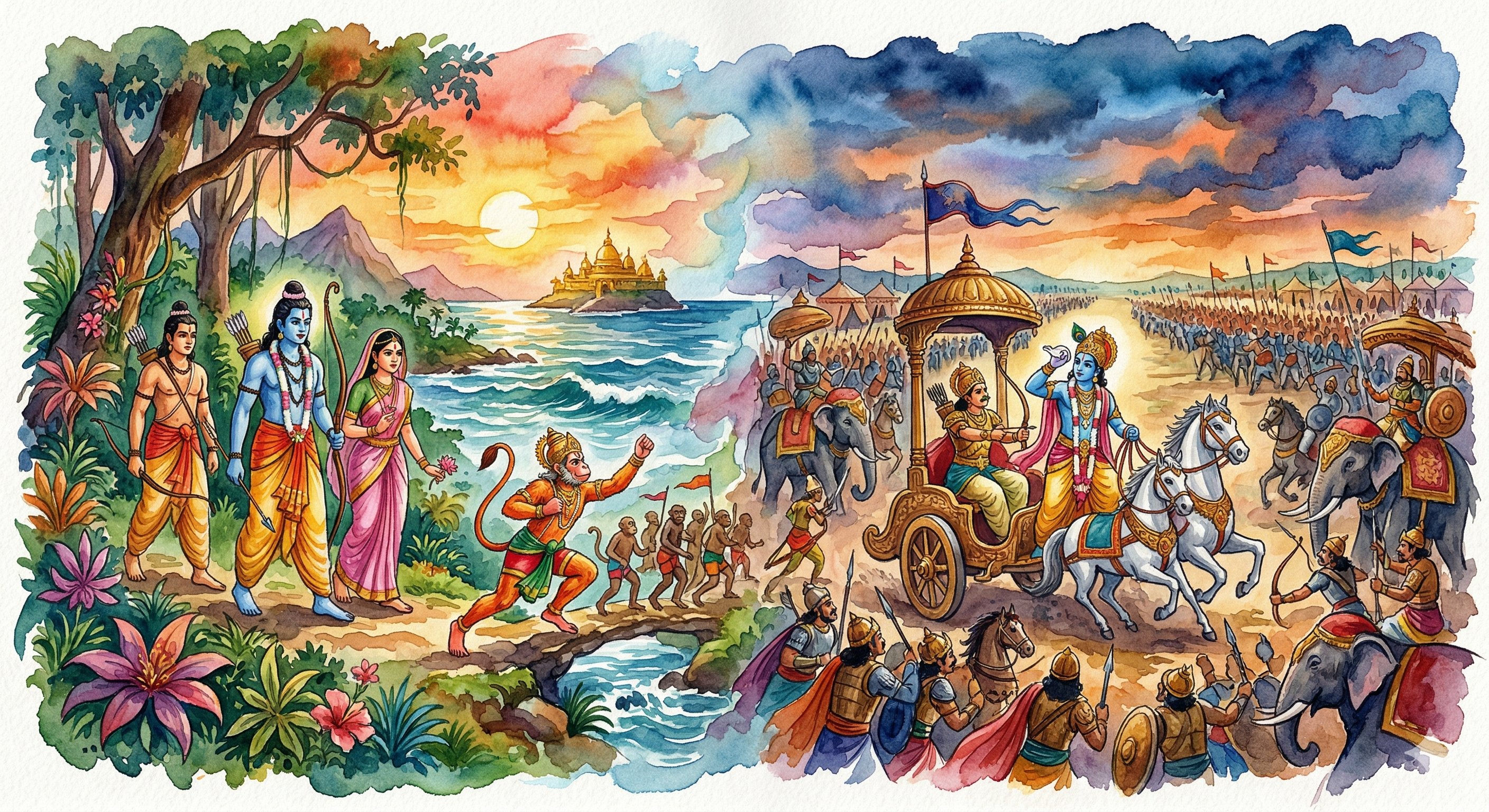
Two monumental epics form the backbone of Indian literature and philosophy: the Ramayana and the Mahabharata. Yet, for many people even those who grew up hearing the stories, the two can sometimes blur together. Exile in the forest? Both have it. A divine incarnation of Vishnu taking a human form? Both have it. A massive war to restore dharma? Both have it.
However, the difference between Ramayana and Mahabharata is profound. They are almost like two different lenses through which the ancients viewed the universe, human nature, and duty.
If you've ever mixed up the two or wondered why one feels like a story of absolute ideals while the other feels like a gritty political drama, this comprehensive guide will give you a clear comparison.
1. The Core Focus: Idealism vs. Realism
The most defining difference between the two epics is their philosophical tone.
The Ramayana: The World of Ideals
The Ramayana, composed by Valmiki, is a story of Maryada boundaries, limits, and rules. It features characters striving to be the absolute ideal in their roles. Rama is the ideal king and son. Sita is the ideal wife. Lakshmana is the ideal brother. Hanuman is the ideal devotee. Even Ravana, the antagonist, is an ideal villain with immense scholarship and power. The Ramayana shows us what humans should be.
The Mahabharata: The World of Reality
The Mahabharata, attributed to Ved Vyasa, is a deeply realistic, often messy exploration of human flaws. Almost no character is purely good or purely evil. Yudhishthira, the embodiment of dharma, has a tragic gambling addiction. Krishna, the divine guide, uses deception when necessary. The Mahabharata shows us what humans are and how complicated doing the right thing can be.
2. The Nature of Dharma
Dharma (righteousness or duty) is the central theme of both texts, but its application differs wildly.
In the Ramayana, dharma is straightforward. Rama obeys his father's command to go into exile without a second thought because the obedience of a son is his highest dharma. The rules are clear, and the challenge lies in having the strength to follow them.
In the Mahabharata, dharma is complex, situational, and often contradictory. If a warrior is sworn to protect the king (like Bhishma), but the king's son is committing evil, what is his dharma? When Arjuna drops his weapons in the Bhagavad Gita, unable to fight his family, Krishna must explain that dharma isn't just a set of rules; it must adapt to the need of the hour.
Apps like Vedapath make it easy to understand these complex themes, allowing you to read the original Sanskrit verses alongside English translations and deeply explore how dharma unfolds in both epics.
3. The Scale and Scope
The Ramayana: A Personal Journey
The conflict in the Ramayana is fundamentally a personal one that escalates into a war. It is about a prince, his wife, and his devotion to duty. The scale of the war in Lanka is grand, but the narrative remains tightly focused on the core characters and the personal loss of Rama and Sita.
The Mahabharata: A World War
The Mahabharata is a sprawling geopolitical conflict involving dozens of kingdoms across the Indian subcontinent. It features millions of soldiers, intricate political alliances, and a dizzying number of characters with intertwining backstories. It is famously said of the Mahabharata: "What is found here may be found elsewhere, but what is not found here is found nowhere."
4. The Role of the Divine Avatar
Both epics feature an avatar of Lord Vishnu, but their approaches are a study in contrasts.
Lord Rama in the Ramayana lives as a human man. He experiences human grief, cries for his lost wife, and fights as an honorable warrior. For much of the story, he does not openly wield cosmic powers, acting within the constraints of humanness to teach by example.
Lord Krishna in the Mahabharata, on the other hand, is entirely aware of his divinity. He doesn't fight directly in the war; instead, he serves as Arjuna's charioteer, a political strategist, and a philosophical guide. When necessary, he reveals his cosmic, universal form (Vishvarupa) to Arjuna to remind him of who is truly pulling the strings of the universe.
5. Time Periods: Treta Yuga vs. Dwapara Yuga
According to Hindu cosmology, time is divided into four cyclical ages (Yugas), each representing a decline in human morality.
- The Ramayana takes place in the Treta Yuga, the second age. Here, virtue and dharma are still prominent. People largely stick to their words, and conflicts are fought with honor.
- The Mahabharata occurs at the end of the Dwapara Yuga, right before the onset of the Kali Yuga (the current age of darkness). Morality has decayed. Oaths are manipulated, the righteous are silenced in public courts (like the disrobing of Draupadi), and war strategies become increasingly ruthless.
Which One is Right for You?
| Feature | The Ramayana | The Mahabharata |
|---|---|---|
| Tone | Poetic, Devotional, Idealistic | Complex, Political, Realistic |
| Central Conflict | Good vs. Evil | Right vs. Right (or Lesser Evil) |
| Dharma | Following the rules strictly | Navigating the gray areas |
| Avatar's Role | The exemplary hero (Rama) | The divine guide/strategist (Krishna) |
Frequently Asked Questions
Q: Which is older, Ramayana or Mahabharata? A: Both traditionally and historically, the Ramayana is considered much older. It is set in the Treta Yuga, while the Mahabharata is set in the later Dwapara Yuga.
Q: Did the characters of Ramayana and Mahabharata ever meet? A: Yes! Because Hanuman (from the Ramayana) is an immortal (Chiranjeevi), he famously appears in the Mahabharata during an encounter with Bhima and sits on Arjuna's chariot flag during the Kurukshetra war.
Q: Which epic contains the Bhagavad Gita? A: The Bhagavad Gita is a small but critical section found within the Bhishma Parva of the Mahabharata. It is the conversation between Lord Krishna and Arjuna right before the war begins.
Key Takeaways
- The Ramayana is a text of ideals and boundaries, highlighting what humanity should be.
- The Mahabharata is a text of complex reality and political intrigue, highlighting what humanity actually is.
- Both texts explore the critical concept of Dharma, but while Ramayana treats it as a strict set of rules, the Mahabharata shows its situational and nuanced nature.
📖 Deeply Explore the Epics on Vedapath
The best way to truly grasp the difference between the Ramayana and the Mahabharata is to read them. For modern readers, Vedapath brings these texts to life.
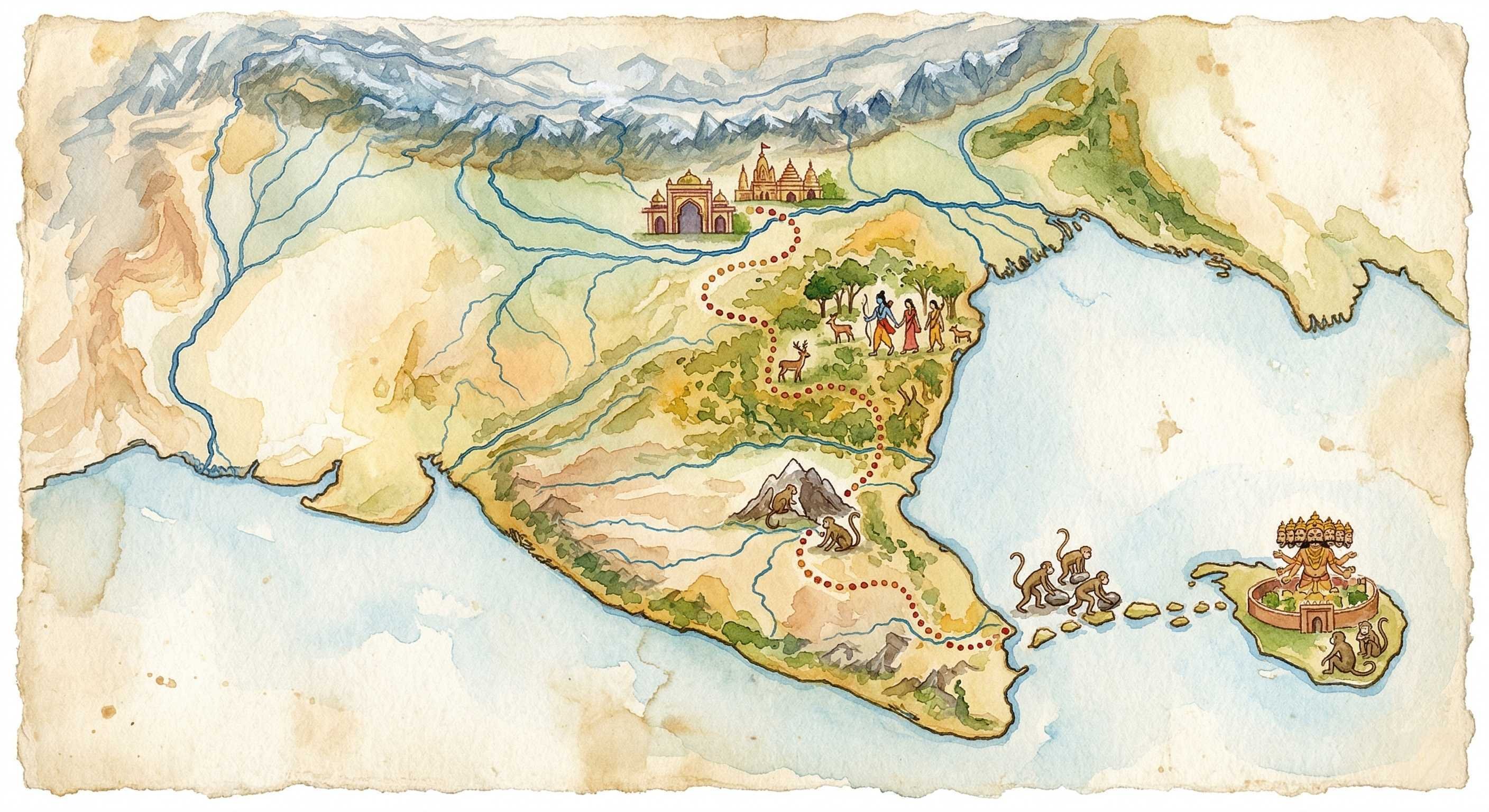
Whether you want to explore the exact verses where Krishna explains dharma to Arjuna or trace an interactive map of Lord Rama's 14-year exile, Vedapath provides all six major sacred texts in one app complete with meaning, translations in 16 languages, and AI-powered insights.
Don't just read history; experience the wisdom behind it.
Comments
Sign in to join the discussion