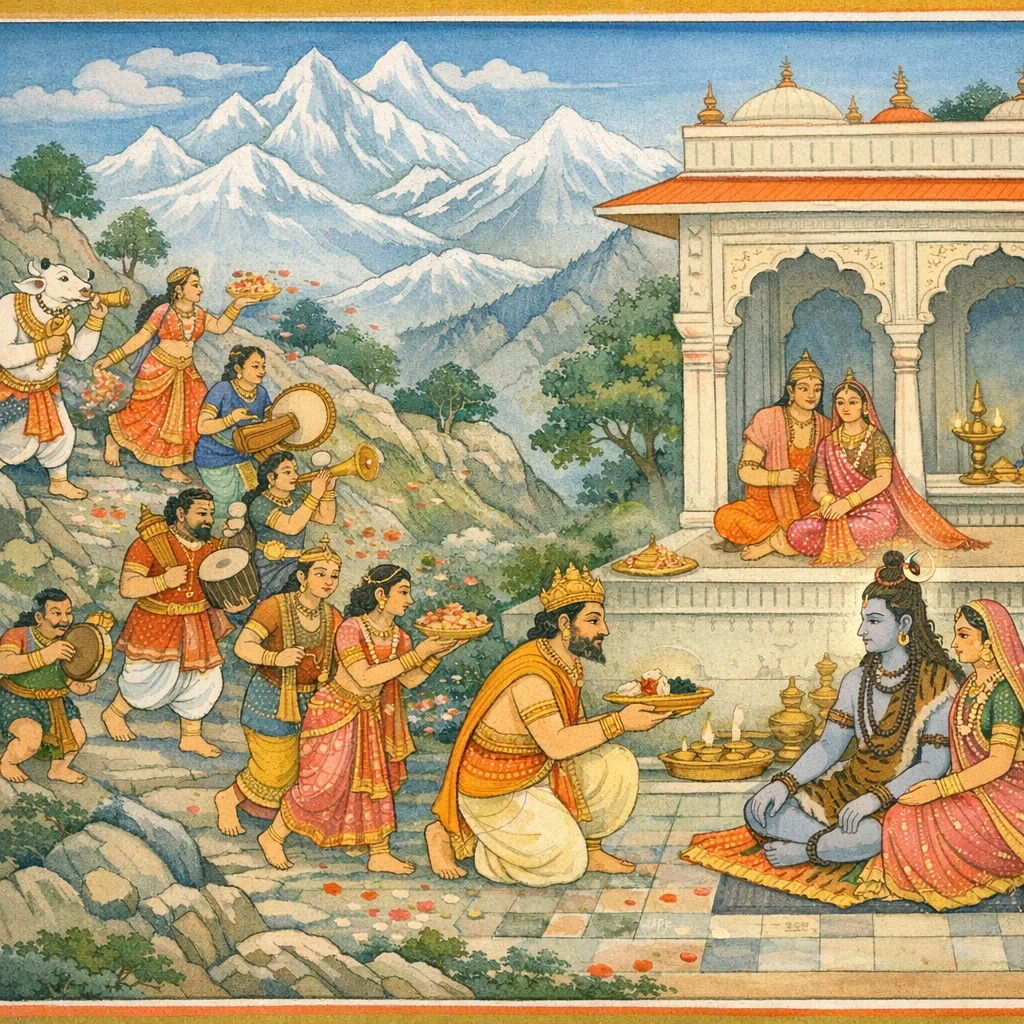
Adhyaya 26: Shiva’s Wedding Procession to Kailasa and the Marriage of Girija (Kali)
शिवविवाह-प्रकरणम् (Śiva-Vivāha-Prakaraṇam)
Marriage of Girija
Within the Pulastya–Nārada narrative frame, this adhyāya presents a ceremonially dense account of Śiva’s approach to Kailāsa for the divine marriage with Girijā (here styled Kālī/Ambikā). The text foregrounds syncretic theology: Viṣṇu (Janārdana) accompanies the procession with Lakṣmī, Brahmā is present as ritual authority, and Indra and the devas honor Śaṅkara with royal insignia, collectively staging a Harihara-compatible liturgical universe rather than a sectarian contest. Iconographic descriptions of Śiva (bone-crest, serpent-ornaments, vṛṣabha-vāhana, tri-netra, pināka) are integrated with social imagery—city women rushing to behold the deity—linking cosmic ritual to human affect. The marriage rites include madhuparka, agni-pradakṣiṇā, and lājā-homa, culminating in the emergence of the Vālakhilya sages from Brahmā’s disturbed seed, a mythic etiological moment embedded inside the wedding narrative. The chapter closes with the successful completion of the vivāha and Śiva’s return to Mandara, after honoring and dismissing the assembled gods.
Divine Beings
Sacred Geography
Mortal & Asura Figures
Key Content Points
- Śiva’s grand procession to Kailāsa for the vaivāhika-vidhi, with detailed iconographic portrayal and the participation of devas, gaṇas, gandharvas, apsarases, yakṣas, kinnaras, and ṛṣis.
- Explicit Shaiva–Vaishnava synthesis: Viṣṇu with Lakṣmī accompanies Śiva; Brahmā and Indra perform honorific and ritual roles, presenting a unified pantheon in a single sacramental event.
- Marriage ritual sequence and etiological episode: madhuparka reception by Himavān, agni-pradakṣiṇā and lājā offerings, Mālinī’s boon involving Viṣṇu’s saubhāgya, and the arising of the Vālakhilya sages (88,000) from Brahmā’s śukra.
Shlokas in Adhyaya 26
Verse 1
इति श्रीवामनपुराणे पञ्चविंशो ऽध्यायः पुलस्त्य उवाच ततः संपूजितो रुद्रः शैलेन प्रीतिमानभूत् सस्मार च महर्षिस्तु अरुन्धत्या समं ततः
Thus ends the twenty-fifth chapter of the revered Vāmana Purāṇa. Pulastya said: Then Rudra, having been duly worshipped by Śaila, became pleased; thereafter he called to mind the great sages, together with Arundhatī.
Verse 3
तानागतान् समीक्ष्यैव देवस्त्रिपुरनाशनः अभ्युत्थायाभिपूज्यैतानिदं वचनमब्रवीत्
Seeing them arrived, the god—the destroyer of Tripura—rose up, honored them, and spoke these words.
Verse 4
धन्यो ऽयं पर्वतश्रेष्ठः श्लाघ्यः पूज्यश्च दैवतैः धूतपापस्तथा जातो भवतां पादपङ्कजैः
Blessed is this best of mountains—praiseworthy and worthy of worship even by the gods—since, by your lotus-feet, it has become one whose sins are washed away.
Verse 5
स्थीयतां विस्तृते रम्ये गिरिप्रस्थे समे शुभे शिलासु पद्मवार्णासु श्लक्ष्णासु च मृदुष्वपि
Let (us/you) stay on this broad, delightful, level, auspicious mountain-plateau—upon rocks that are lotus-hued, smooth, and even soft.
Verse 6
पुलस्त्य उवाच इत्येवमुक्ता देवेन संकरेण महर्षयः सममेव त्वरुन्धत्या विविशुः शैलसानुनि
Pulastya said: Thus addressed by the god Śaṅkara, the great sages—together with Arundhatī—entered the mountain-grove/upper slope.
Verse 9
हर उवाच कश्यपात्रे वारुणेय गाधेय शृणु गौतम् भरद्वाज शृणुष्व त्वमङ्गिरस्त्वं शृणुष्व च
Hara said: ‘O descendant of Kaśyapa, O Vāruṇeya, O Gādheya—listen, O Gautama. O Bharadvāja, you listen; and you too, O Aṅgiras, listen.’
Verse 13
ततो ऽप्यरुन्धतीं शर्वः प्राह गच्छस्व सुन्दरि पुरन्ध्र्यो हि पुरन्ध्रीणां गतिं धर्मस्य वे विदुः
Then Śarva (Rudra) again said to Arundhatī: “Go, fair lady. For women indeed know the course (proper path) of dharma for women.”
Verse 14
इत्येवमुक्ता दुर्लङ्घ्यं लोकाचारं त्वरुन्धती नमस्ते रुद्र इत्युक्त्वा जगाम पतिना सह
Thus addressed, Arundhatī—(honoring) the social custom that is hard to transgress—said, “Homage to you, Rudra,” and departed together with her husband.
Verse 16
ततः संपूज्यमानास्ते शैलयोषिद्भिरादरात् सुनाभादिभिरव्यग्रैः पुज्यमानास्तु पर्वतैः
Then those (great ones) were respectfully honored by the women of the mountains; and they were also worshipped without distraction by the mountains—Sunābha and the others.
Verse 17
गन्धर्वैः किंनरैर्यक्षैस्तथान्यैस्तत्पुरस्सरैः विविशुर्भवनं रम्यं हिमाद्रेर्हाटकोज्जवलम्
Accompanied by Gandharvas, Kinnaras, Yakṣas, and other beings who went before them, they entered the delightful mansion of Himādri, shining with gold.
Verse 18
ततः सर्वे महात्मानास्तपसा धौतकल्मषाः समासाद्य महाद्वारं संतस्थुर्द्वाःस्थकारणात्
Then all those great-souled ones, whose sins had been washed away by austerity, reached the great gate and stood there because of the gatekeepers’ protocol (i.e., due to the presence/requirement of the doorkeepers).
Verse 19
ततस्तु त्वरितो ऽभ्यागाद् द्वाःस्थो ऽद्रिर्गन्धमादनः धारयन् वै करे दण्डं पद्मरागमयं महत्
Then, the doorkeeper—(the mountain) Gandhamādana—hurriedly came forward, holding in his hand a great staff made of ruby (padmarāga).
Verse 23
गन्धमादन उवाच इमे हि ऋषयः प्राप्ताः शैलराज तवार्थिनः द्वारे स्थैताः कार्यिणस्ते तव दर्शनलालसाः
Gandhamādana said: ‘Indeed, these sages have arrived, O king of mountains, seeking you. They are standing at the door on your business, eager for the sight of you.’
Verse 24
पुलस्त्य उवाच द्वाःस्थवाक्यं समाकर्ण्य समुत्थायाचलेश्वरः स्वयमभ्यागमद् द्वारि समादायार्घ्यमुत्तमम्
Pulastya said: Hearing the words of the doorkeeper, the lord of the mountain rose up and himself came to the doorway, taking in hand the finest arghya-offering.
Verse 25
तान्र्च्यार्घ्यादिना शैलः समानीय सभातलम् उवाच वाक्यं वाक्यज्ञः कृतासनपरिग्रहान्
Having honored them with (proper) reception—such as respectful salutations and offerings of arghya—Mount (Himavat) brought them to the floor of the assembly hall. Skilled in fitting speech, he addressed them after they had accepted their seats.
Verse 26
हिमवानुवाच अनभ्रवृष्टिः किमियमुताहो ऽकुसुमं फलम् अप्रतर्क्यमचिन्त्यं च भवदागमनं त्विदम्
Himavat said: “Is this a rain without clouds, or fruit without flowers? Indeed, this arrival of yours is beyond conjecture and beyond thought.”
Verse 28
आत्मसंसर्गसंशुद्धं कृतवन्तो द्विजोत्तमाः दृष्टिपूतं पदाक्रान्तं तीर्थं सारस्वतं यथा
O best of Brahmins, by your very association you have rendered (this place/person) purified—like the Sarasvata sacred ford, which becomes purified by being seen and by being trodden underfoot (by pilgrims).
Verse 30
सदारो ऽहं समं पुत्रैर्भृत्यैर्नप्तृभिरव्ययाः किङ्करो ऽस्मि स्थितो युष्मदाज्ञाकारी तदुच्यताम्
I, together with my wife, my sons, my servants, and my grandsons—O venerable ones—stand here as your attendant, ready to carry out your commands. Therefore, let that (which you wish) be stated.
Verse 35
जीमूतकेतुः शत्रुघ्नो यज्ञभोक्ता स्वयं प्रभुः यमीश्वरं वदन्त्येके शिवं स्थाणौ भवं हरम्
He is Jīmūtaketu, the slayer of foes, the enjoyer of sacrifices, the self-existent Lord. Some call him the lord over Yama (death); (others call him) Śiva, Sthāṇu, Bhava, and Hara.
Verse 36
भीममुग्रं महेशानं महादेवं पशोः पतिम् वयं तेन प्रेषिताः स्मस्त्वत्सकाशं गिरीश्वर
The Terrible and Fierce one—Maheśāna, Mahādeva, the Lord of beings (Paśupati)—by him we have been sent to your presence, O Lord of the Mountain.
Verse 37
इयं या त्वत्सुता काली सर्वलोकेषु सुन्दरी तां प्रार्थयति देवेशस्तां भवान् दातुमर्हति
“This Kāli—your daughter—who is beautiful in all the worlds: the Lord of the gods seeks her in marriage; therefore you ought to give her (to him).”
Verse 38
स एव धन्यो हि पिता यस्य पुत्री शुभं पतिम् रूपाभिजनसंपत्त्या प्राप्नोति गिरिसत्तम
“Indeed, only that father is blessed whose daughter obtains an auspicious husband, by virtue of her beauty, noble birth, and prosperity—O best of mountains.”
Verse 39
यावन्तो जङ्गमागम्या भूताः शैल चतुर्विधाः तेषां माता त्वियं देवी यतः प्रोक्तः पिता हरः
“All beings—mobile and immobile—of the fourfold kinds, O mountain: this Goddess is their mother, for Hara has been declared their father.”
Verse 40
प्रणम्य शङ्करं देवाः प्रणमन्तु सुतां तव कुरुष्व पादं शत्रूणां मूर्ध्नि भस्मपरिप्लुतम्
Having bowed to Śaṅkara, let the gods bow to your daughter (Umā). Place your foot upon the heads of the enemies, drenched with ashes.
Verse 41
याचितारो वयं शर्वो वरो दाता त्वमप्युमा वधूः सर्वजगन्माता कुरु यच्छ्रेयसे तव
We are the petitioners; O Śarva, you are the giver of boons—and you too, Umā, the bride, the mother of the entire world. Do that which is for your own highest good (and thereby for ours).
Verse 43
ततः शैलपतिः प्राह पर्वतं गन्धमादनम् गच्छ शैलानुपामन्त्र्य सर्वानागान्तुर्महसि
Then the Lord of the mountains spoke to the mountain Gandhamādana: “Go, invite the mountains, and you should have them all come.”
Verse 44
ततः शीघ्रतरः शैलो गृहाद् गृहमगाञ्जवी मेर्वादीन् पर्वतश्रेष्ठानाजुहाव समन्ततः
Then that mountain, moving very swiftly, went from dwelling to dwelling and summoned the best of mountains—beginning with Meru—on all sides.
Verse 45
ते ऽप्याजग्मुस्त्वरावन्तः कार्यं मत्वा महत्तदा विविशुर्विस्मयाविष्टाः सौवर्णेष्वासनेषु ते
They too arrived in haste, understanding that the task was great at that time; filled with wonder, they took their places upon golden seats.
Verse 46
उदयो हेमकूटश्च रम्यको मन्दरस्तथा उद्दालको वारुणश्च वराहो गरुडासनः
Udaya, Hemakūṭa, Ramyaka, and Mandara; likewise Uddālaka, Vāruṇa, Varāha, and Garuḍāsana—these are (named) mountains.
Verse 47
शुक्तिमान् वेगसानुश्च दृढशृङ्गो ऽथ शृङ्वान् चित्रकूटस्त्रिकूटश् च तथा मन्दरकाचलः
Śuktimān, Vegasānu, Dṛḍhaśṛṅga, and then Śṛṅvān; also Citrakūṭa, Trikūṭa, and likewise Mandarakācala—these are (named) mountains.
Verse 48
विन्ध्यश्च मलयश्चैव पारियात्रो ऽथ दुर्दरः कैलासाद्रिर्महेन्द्रश्च निषधो ऽञ्जनपर्वतः
Vindhya and Malaya, as well as Pāriyātra; then Durdara; Kailāsa mountain, Mahendra, Niṣadha, and Añjana—these are (named) mountains.
Verse 53
हिमवानुवाच इमे सप्तर्षयः पुण्या याचितारः सुतां मम महेश्वरार्थं कन्यां तु तच्चावेद्यं भवत्सु वै
Himavān said: ‘These holy Seven Sages are petitioners for my daughter—seeking the maiden for Maheśvara. This matter is to be made known and considered among you indeed.’
Verse 59
इत्येवं मेनया प्रोक्तः शैलैः शैलेश्वरः सुताम् प्रोवाच पुत्रि दत्तासि शर्वाय त्वं मयाधुना
“Thus addressed by Menā, the lord of mountains (Himavat) spoke to his daughter: ‘Daughter, you have now been given by me to Śarva (Śiva).’”
Verse 60
ऋषीनुवाच कालीयं मम पुत्री तपोधनाः प्रणामं संकरवधूर्भक्तिनम्रा करोति व
“(He) spoke to the sages: ‘This Kālikā, my daughter—O treasure-holders of austerity—Śaṅkara’s bride, bowed down in devotion (to you).’”
Verse 61
ततो ऽप्यरुन्धती कालीमह्कमारोप्य चाटुकैः लज्जमानां समाश्वास्य हरनामोदितैः शुभैः
Then Arundhatī, placing the dark (kālī) ornament/mark (mahka) upon her, with gentle flattering words, comforted the bashful one with auspicious utterances celebrating the names of Hara (Śiva).
Verse 62
ततः सप्तर्षयः प्रोचुः शैलराज निशामय जामित्रगुणसंयुक्तां तिथिं पुण्यां सुमङ्गलाम्
Then the Seven Sages said: “O king of mountains, listen—(we shall describe) the holy, highly auspicious lunar day (tithi) endowed with the qualities of ‘jāmitra’.”
Verse 64
तस्यां तिथ्यां हरः पाणिं ग्रहीष्यति समन्त्रकम् तव पुत्र्या वयं यामस्तदनुज्ञातुमर्हसि
“On that lunar day (tithi), Hara (Śiva) will take your daughter’s hand with the proper mantras. We shall go (there); you ought to grant permission for that.”
Verse 65
ततः संपूज्य विधिना फलमूलादिभिः शुभैः विसर्जयामास शनैः शैलराड् ऋषिपुङ्गवान्
“Then, having duly honored (them) according to rule with auspicious fruits, roots, and the like, the lord of the mountain (Śailarāṭ) gently/gradually took leave of (dismissed) the eminent sages.”
Verse 66
ते ऽप्याजग्मुर्महावेगात् त्वाक्रम्य मरुदालयम् आसाद्य मन्दरगिरिं भूयो ऽवन्दन्त शङ्करम्
“They too departed at great speed, crossing the abode/region of the Maruts; and upon reaching Mount Mandara, they once again bowed to Śaṅkara (Śiva).”
Verse 67
प्रणम्योचुर्महेशानं भवान् भर्त्ताद्रिजा वधुः सब्रह्यकास्त्रयो लोका द्रक्ष्यन्ति घनवाहनम्
Having bowed, they said to Maheśa: “You are the lord (bhartā), and the daughter of the mountain is your bride. Together with Brahmā (and his host), the three worlds shall behold the cloud-rider (i.e., the deity borne upon the cloud-like vehicle).”
Verse 68
ततो महेश्वरः प्रीतो मुनीन् सर्वाननुक्रमात् पूजयामास विधिना अरुन्धत्या समं हरः
Then Maheśvara, pleased, honored all the sages in due order, worshipping them according to proper rite—Hara together with Arundhatī.
Verse 69
ततः संपूजिता जग्मुः सुराणां मन्त्रणाय ते ते ऽप्याजग्मुर्हरं द्रष्टुं ब्रह्मविष्ण्विन्द्रभास्कराः
Thereafter, having been duly honored, they went for the consultation of the gods. Those too—Brahmā, Viṣṇu, Indra, and Bhāskara (the Sun)—came to see Hara.
Verse 70
गेहं ततो ऽभ्येत्य महेश्वरस्य कृतप्रणामा विविशुर्महर्षे सस्मार नन्दिप्रमुखांश्च सवानभ्येत्य ते वन्द्य हरं निषण्णाः
O great sage, then, having approached the dwelling of Maheśvara, they entered after offering obeisance. They remembered (and paid respects to) all the attendants beginning with Nandin; and, having approached the venerable Hara, they sat (in his presence).
Verse 71
देवैर्गणैश्चापि वृतो गिरीशः स शोभते मुक्तजटाग्रभारः यता वने सर्ज्जकदम्बमध्ये प्ररोहमूलो ऽथ वनस्पतिर्वै
Surrounded by the gods and by the gaṇas, Girīśa shone forth, with the mass of the ends of his matted locks loosened—like a tree in a forest, rising with its shoots and roots amid sarjja and kadamba trees.
Frequently Asked Questions
The chapter stages a deliberately non-competitive pantheon: Viṣṇu (with Lakṣmī) accompanies Śiva in the wedding procession, while Brahmā and Indra publicly honor Śaṅkara with ritual and royal insignia. This narrative choreography functions as syncretic theology—affirming Śiva’s supremacy in the rite without excluding Viṣṇu, and presenting shared participation as the normative devotional order.
While not a Kurukṣetra-focused tīrtha-māhātmya, the adhyāya still sacralizes geography by naming and personifying major rivers—Yamunā and Sarasvatī—who appear as honored participants in the divine ceremony. The primary sacred locales are Kailāsa and Mandara, framed as ritualized mountain-spaces (śailendra-veśman, śailarāja-pura) where cosmic marriage rites confer sanctity upon the landscape.
This adhyāya does not advance the Bali–Vāmana cycle. Its contribution is structural and theological: it reinforces the Purāṇa’s broader program of Shaiva–Vaishnava integration by embedding Viṣṇu within a Śaiva sacramental narrative, thereby preparing readers to interpret later avatāra and dharma episodes within a unified devotional cosmos.