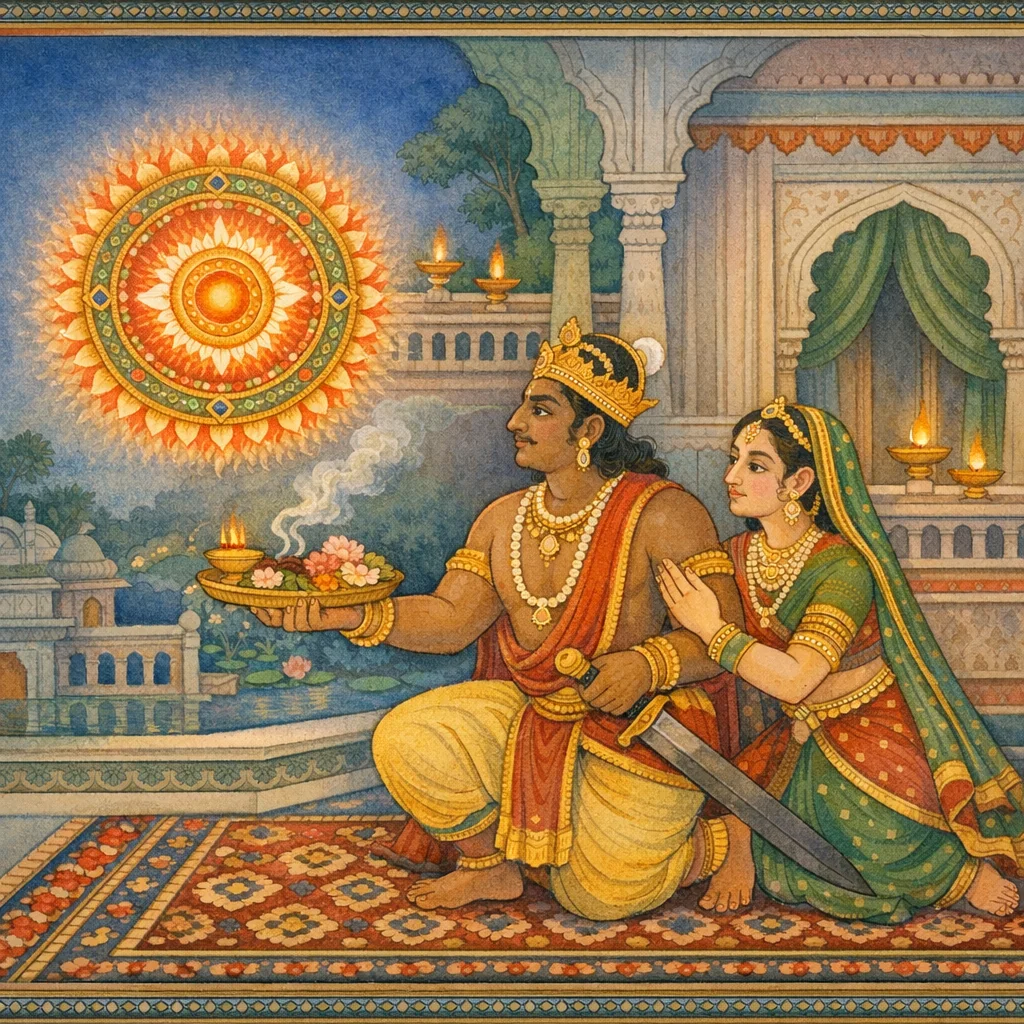
Adhyaya 67: Bali’s Worship of Sudarshana and Prahlada’s Teaching on Vishnu-Bhakti
सुदर्शन-स्तवः तथा प्रह्लादोपदेशः (Sudarśana-stavaḥ tathā Prahlādopadeśaḥ)
Prahlada's Teaching on Vishnu-Bhakti
Within the Pulastya–Nārada narrative frame, this adhyāya shifts from underworld royal splendor to a theology of refuge (śaraṇāgati) centered on Viṣṇu. Bali, dwelling in Sutala/Rasātala amid a jewel-inlaid city and a Viśvakarmā-built palace, is confronted by Viṣṇu’s Sudarśana entering Pātāla and draining asuric tejas. Vindhyāvalī restrains Bali from violence and instructs him to honor the divine discus; Bali then performs formal pūjā and recites an iconographic-cosmological stotra that situates gods, elements, and cosmic orders within the cakra’s structure. After Sudarśana departs, Bali—shaken—summons his grandsire Prahlāda, who articulates a syncretic Purāṇic ethic of asura-dharma transformed by bhakti: devotion supersedes ritualism, purifies bodily, verbal, and mental faults, and grants immunity from Yama’s jurisdiction. The chapter is primarily doctrinal rather than topographical, emphasizing nāma-smaraṇa, kīrtana, and arcana as the “boat” across saṃsāra.
Divine Beings
Sacred Geography
Mortal & Asura Figures
Key Content Points
- Bali’s Sutala/Rasātala residence is described with courtly and architectural detail (gem-inlay, crystal stairways, Viśvakarmā’s palace), establishing the underworld as a sanctified narrative stage.
- Sudarśana’s descent into Pātāla functions as a theophany that neutralizes daitya-tejas; Vindhyāvalī redirects Bali from martial reaction to ritual honor, leading to Bali’s Sudarśana-stotra and cakra-pūjā.
- Prahlāda’s instruction reframes liberation through Viṣṇu-bhakti: nārāyaṇa-namaskāra and constant remembrance eclipse tapas, mantra-multiplicity, and mere śāstra-learning; devotees are protected from Yama and attain Vaiṣṇava-pada.
Shlokas in Adhyaya 67
Verse 1
इति श्रीवामनपुराणे षट्षष्टितमो ऽध्यायः पुलस्त्य उवाच गत्वा रसातलं दैत्यो महार्हमणिचित्रितम् शुद्धस्फटिसोपानं कारयामास वै पुरम्
“Thus (ends) the sixty-sixth chapter in the Śrī Vāmana Purāṇa. Pulastya said: ‘Having gone to Rasātala, the Daitya caused a city to be built—adorned with precious jewels, with stairways of pure crystal.’”
Verse 2
तत्र मध्ये सुविस्तीर्मः प्रासादो वज्रवेदिकः मुक्ताजालान्तरद्वारो निर्मितो विश्वकर्मणा
In the midst of that realm stood a very spacious palace with a diamond-like (adamantine) altar-platform; its doorway was set within latticed pearl-work. It had been constructed by Viśvakarman.
Verse 4
तत्रास्ते विविधान् भोगान् भुञ्जन् दिव्यान् स मानुषान् नाम्ना विन्ध्यावलीत्येवं भार्यास्य दयिताभवत् 67.3 युवतीनां सहस्रस्य प्रधाना शीलमण्डिता तया सह महातेजा रेमे वैरोचनिर्मुने
There he remained, enjoying various pleasures—both divine and human. His beloved wife was known by the name Vindhyāvalī. She, adorned with good conduct, was foremost among a thousand young women; together with her, the radiant son of Virocana (Bali) sported there, O sage.
Verse 5
भोगासक्तस्य दैत्यस्य वसतः सुतले तदा दैत्यतेजोहरः प्राप्तः चपाताले वै सुदर्शनः
While that pleasure-attached Daitya dwelt in Sutala, then Sudarśana—who destroys the splendor/power of the Daityas—came to be present in Pātāla as well.
Verse 6
चक्रे प्रविष्टे पातालं दानवानां पुरे महान् बभै हलहलाशब्दः क्षुभितार्णवसंनिभः
When the Disc (cakra) entered Pātāla, into the great city of the Dānavas, there arose a tremendous “halahalā” roar, like the sound of an ocean churned into turmoil.
Verse 7
तं च श्रुत्वा महाशब्दं बलिः खङ्गं समाददे आः किमेतदितीत्थञ्च पप्रच्छासुरपुङ्गवः
Hearing that great sound, Bali took up his sword and exclaimed, ‘Ah! What is this?’—thus questioned the foremost of the Asuras.
Verse 8
ततो विन्ध्यावली प्राह सान्त्वयन्ती निजं पतिम् कोशे खङ्गं समावेश्य धर्मपत्नी शुचिव्रता
Then Vindhyāvalī spoke, soothing her own husband; and having placed the sword back into its sheath, that righteous wife—of pure vows—(addressed him).
Verse 9
एतद् भगवतश्चक्रं दैत्यचक्रक्षयङ्करम् संपूजनीयं दैत्येन्द्र वामनस्य महात्मनः इत्येवमुक्त्वा चार्वङ्गी सार्घपात्रा विनिर्ययौ
“This is the Blessed Lord’s discus, the bringer of destruction to the hosts (lit. ‘wheel/array’) of the Daityas. O lord of the Daityas, it should be duly worshipped—(for it belongs) to the great-souled Vāmana.” Having spoken thus, Cārvaṅgī went out, carrying the offering-vessel together with the arghya (ritual oblation).
Verse 10
अथाभ्यागात् सहस्रारं विष्णोश्चक्रं सुदर्शनम् ततो ऽसुरपतिः प्रह्वः कृताञ्जलिपुटो मुने संपूज्य विधिवच्चक्रमिदं स्तोत्रमुदीरयत्
Then there arrived the thousand-spoked Sudarśana, Viṣṇu’s discus. Thereupon the lord of the Asuras, bowing low, with hands joined in reverence, O sage, worshipped the discus according to rule and uttered this hymn.
Verse 11
बलिरुवाच नमस्यामि हरेश्चक्रं दैत्यचक्रविदारणम् सहस्रांशुं सहस्राभं सहस्रारं सुनिर्मलम्
Bali said: “I bow to Hari’s discus, the splitter of the Daityas’ host (lit. ‘wheel/array’); radiant with a thousand rays, shining with a thousandfold splendor, thousand-spoked, and perfectly pure.”
Verse 12
नमस्यामि हरेश्चक्रं यस्य नाभ्यां पितामहः तुण्डे त्रिशूलधृक् शर्व आरामूले महाद्रयः
I bow to Hari’s discus (cakra). In its hub (nābhi) is Pitāmaha (Brahmā); at its rim/edge (tuṇḍa) is Śarva (Śiva), bearer of the trident; and at the base of its spokes (ārā-mūla) are the great mountains.
Verse 13
अरेषु संस्थिता देवाः सेन्द्राः सार्काः सपावकाः जवे यस्य स्थितो वायुरापोग्निः पृथिवी नभः
Upon its spokes are stationed the gods—together with Indra, with the Sun, and with Pāvaka (Agni). In its swiftness/impulse (java) abide Wind, Water, Fire, Earth, and Space.
Verse 14
आरप्रान्तेषु जीमूताः सौदामिन्यृक्षतारकाः बाह्मतो मुनयो यस्य बालखिल्यादयस्तथा
At the ends of its spokes are the clouds, lightning, constellations, and stars. Along its circumference/outer expanse are sages—such as the Bālakhilyas and others.
Verse 15
तमायुधवरं वन्दे वासुदेवस्य भक्तितः यन्मे पापं शरीरोत्थं वाग्जं मानसमेव च
“With devotion I bow to that supreme weapon of Vāsudeva. Whatever sin of mine has arisen from the body, from speech, and likewise from the mind—(may it be removed).”
Verse 16
तन्मे दहस्व दीप्तांशो विष्णोश्चक्र सुदर्शन यन्मे कुलोद्भवं पापं पैतृकं मातृकं तथा
“Burn that (sin) of mine, O radiant one—O Sudarśana, the discus of Viṣṇu—whatever sin of mine is born of my lineage, whether paternal or maternal.”
Verse 17
तन्मे हरस्व तरसा नमस्ते अच्युतायुध आधयो मम नश्यन्तु व्याधयो यान्तु संक्षयम् त्वन्नामकीर्तनाच् चक्र दुरितं यातु संक्षयम्
“Swiftly remove that (evil) of mine; homage to you, O weapon of Acyuta. May my afflictions perish; may my diseases go to destruction. Through the chanting of your name, O Cakra, may misfortune/sin be brought to an end.”
Verse 18
इत्येवमुक्त्वा मतिमान् समभ्यर्च्याथ भक्तितः संस्मरन् पुण्डरीकाक्षं सर्वपापप्रणासनम्
Having spoken thus, the wise one then worshipped (Him) with devotion; and, remembering Puṇḍarīkākṣa (Viṣṇu, the Lotus‑eyed), the destroyer of all sins, (he remained absorbed in that recollection).
Verse 21
स चापि संस्मृतः प्राप्तः सुतलं दानवेश्वरः दृष्ट्वा तस्थौ महातेजाः सार्घपात्रो बलिस्तदा
And he too, being remembered, came to Sutala—the lord of the Dānavas. Seeing (Bali), that great-splendored one stood there; and Bali at that time stood with a vessel for offerings in his hand.
Verse ["kiṃ dadmi", "bhagavan brūhi", "mānada", "Bali dāna", "Vāmana boon request"]
तमर्च्य विधिना ब्रह्मन् पितुः पितरमीश्वरम् कृताञ्जलिपुटो भूत्वा इदं वचनमब्रवीत् 67.22 संस्मृतो ऽसि मया तात सुविषण्णेन चेतसा तन्मे हितं च पथ्यं च श्रेयोग्र्यं वद तात मे 67.23 किं कार्यं तात संसारे वसता पुरुषोण हि कृतेन येन वै नास्य बन्धः समुपजायते 67.24 संसारार्णवमग्नानां नराणामल्पचेतसाम् तरणे यो भवेत् पोतस्तन्मे व्याख्यातुमर्हसि
Having worshipped him according to rule, O Brāhmaṇa—him who is the lord, the father of his father (his grandsire)—Bali, with hands joined in reverence, spoke these words: “You have been remembered by me, dear grandfather, with a mind sunk in sorrow. Tell me what is beneficial andVamana Purana,65,5,VamP 65.5,praviṣṭamātraṃ deveśaṃ pratipūjya vadhānataḥ provāca bhagavan brūhi kiṃ dadmi tava mānada,प्रविष्टमात्रं देवेशं प्रतिपूज्य वधानतः प्रोवाच भगवन् ब्रूहि किं दद्मि तव मानद,Vamana–Bali Narrative,Dana (Charity) / Dialogue,Adhyaya 65 (Bali’s yajña and the request for a gift),65.5,praviṣṭamātraṃ deveśaṃ pratipūjya vadhānataḥ provāca bhagavan brūhi kiṃ dadmi tava mānada,praviṣṭa-mātraṃ deveśaṃ pratipūjya vadhānataḥ provāca: bhagavan brūhi—kiṃ dadmi tava
Verse 37
शारीरं मानसं वाग्जं मूर्तामूर्तं चराचरम् दृश्यं स्पृस्यमदृश्यञ्च तत्सर्वं केशवात्मकम्
Whatever is bodily, mental, or born of speech; whatever is with form or without form; whatever is moving or unmoving; whatever is visible, tangible, or invisible—all of that is of the very nature of Keśava.
Verse 38
येनार्चितो हि भगवान् चतुर्धा वै त्रिविक्रमः तेनार्चिता न संदेहो लोकाः सामरदानवाः
By whom the Blessed Lord Trivikrama is worshipped in a fourfold manner—by him, without doubt, all the worlds together with the Maruts and the Dānavas are (thereby) worshipped.
Verse 39
यता रत्नानि जलधेरसंख्येयानि पुत्रक तथा गुणा हि देवस्य त्वसंख्यातास्तु चक्रिणः
“Just as the jewels in the ocean are beyond counting, dear child, so indeed the qualities of the God—the Discus-bearer (Viṣṇu)—are also beyond counting.”
Verse 40
ये शङ्खचक्राब्जकरं सशार्ङ्गिणं खगेन्द्रकेतुं वरदं श्रियः पतिम् समाश्रयन्ते भवभीतिनाशनं संसारगर्ते न पतन्ति ते पुनः
“Those who take refuge in him—whose hands bear the conch, discus, and lotus; who wields the Śārṅga bow; whose banner bears the king of birds (Garuḍa); who grants boons; who is the Lord of Śrī (Lakṣmī); who destroys the fear of worldly becoming—those do not fall again into the pit of saṃsāra.”
Verse 41
येषां मनसि गोविन्दो निवासी सततं बले न ते परिभवं यान्ति न मृत्योरुद्विजन्ति च
“In whose mind Govinda dwells constantly, O mighty one—those do not meet with humiliation, and they do not tremble at death.”
Verse 42
देवं सार्ङ्गधरं विष्णुं ये प्रपन्नाः परायणम् न तेषां यमसालोक्यं न च ते नरकौकसः
Those who have taken refuge in the divine Viṣṇu, the bearer of the Śārṅga bow, making him their sole supreme resort—such persons do not attain even the realm of Yama, nor do they become dwellers in hell.
Verse 44
या गतिर्दैत्यशार्दूल हतानां तु महाहवे ततो ऽदिकां गतिं यान्ति विष्णुभक्ता नरोत्तमाः
O tiger among Daityas: whatever destination is attained by those slain in a great battle, the devotees of Viṣṇu—best among men—go to a destination higher than that.
Verse 45
या गतिर्धर्मशीलानां सात्त्विकानां महात्मनाम् सा गतिर्गदिता दैत्य भगवत्सेविनामपि
“O Daitya, the very same destination that belongs to great-souled people who are devoted to dharma and established in sattva—that destination is declared to be attained also by those who serve the Blessed Lord.”
Verse 46
सर्वावासं वासुदेवं सूक्ष्ममव्यक्तविग्रहम् प्रविशन्ति महात्मानं तद्भक्ता नान्यचेतसः
“Those devotees of that Great One, whose minds are fixed on none else, enter Vāsudeva—who is the abode of all, subtle, and of unmanifest form.”
Verse 47
अनन्यमनसो भक्त्या ये नमस्यन्ति केशवम् शुचयस्ते महात्मानस्तीर्थभूता भवन्ति ते
“Those who, with single-minded devotion, bow to Keśava—those pure great-souled ones become themselves ‘tīrthas’ (living places of sanctity).”
Verse 48
गच्छन् तिष्ठन् स्वपन् जाग्रत् पिबन्नश्चन्नभीक्ष्णशः ध्यायन् नारायणं यस्तु न ततो ऽन्यो ऽस्ति पुण्यभाक् वैकुण्ठं खड्गपरशुं भवबन्धसमुच्छिदम्
Whether walking, standing, sleeping, waking, drinking, eating—again and again—whoever meditates upon Nārāyaṇa: there is none more entitled to merit than that person. (Such a one attains) Vaikuṇṭha, and (the Lord as) the sword and the axe—He who cuts asunder the bondage of worldly becoming (saṃsāra).
Verse 49
प्रणिपत्य यथान्यायं संसारे न पुनर्भवेत् क्षेत्रेषु वसते नित्यं क्रीडन्नास्ते ऽमितद्युतिः
Having bowed down in the proper manner, one would not be born again in saṃsāra. The One of immeasurable splendor abides eternally in the sacred fields (kṣetras), dwelling there and sporting (in divine play).
Verse 50
आसीनः सर्वदेहेषु कर्मभिर्न स बध्यते येषां विष्णुः प्रियोन्त्यन्ते विष्णोः सततं प्रियाः
Though situated within all bodies, he is not bound by actions. Those for whom Viṣṇu is dear at the end (of life)—they are ever dear to Viṣṇu.
Verse 51
न ते पुनः सम्भवन्ति तद्भक्तास्तत्परायणाः ध्यायेद् दामोदरं यस्तु भक्तिनम्रोर्ऽचयेत वा
Those devotees of Him who are wholly devoted to Him do not come to rebirth again. Whoever meditates upon Dāmodara, or, bowing in devotion, worships Him—(such a one is freed from repeated embodiment).
Verse 52
न स संसारपङ्के ऽस्मिन् मज्जते दानवेश्वर कल्यमुत्थाय ये भक्त्या स्मरन्ति मधुसूदनम् स्तुवन्त्यप्यभिशृण्वन्ति दुर्गण्यतितरन्ति ते
O lord of the Dānavas, he does not sink into this mire of saṃsāra—those who, rising at dawn, remember Madhusūdana with devotion; who praise Him, and who also listen attentively (to His praises)—they cross beyond misfortunes and evil conditions.
Verse 53
हरिवाक्यामृतं पीत्वा विमलैः श्रोत्रभाजनैः प्रहृष्यति मनो येषां दुर्गाण्यतितरन्ति ते
Having drunk the nectar of Hari’s words with purified vessels of hearing (i.e., pure ears and attentive receptivity), those whose minds rejoice—such people cross beyond misfortunes and evil conditions.
Verse 54
येषां चक्रगदापाणौ भक्तिरव्यभिचारिणी ते यान्ति नियतं स्थानं यत्र योगेश्वरो हरिः
Those whose devotion to Hari—He who bears the discus and mace in His hands—is unwavering and undivided, they certainly go to that fixed abode where Hari, the Lord of Yoga, resides.
Verse 55
विष्णुकर्मप्रसक्तानां भक्तानां या परा गतिः सा तु जन्मसहस्रेण न तपोभिरवाप्यते
The supreme goal attained by devotees who are actively engaged in the works of Vishnu—that highest state—is not obtained even through a thousand births of austerities.
Verse 56
किं जप्यैस्तस्य मन्त्रैर्वा किं तपोभिः किमाश्रमैः यस्य नास्ति परा भक्तिः सततं मधुसूदने
Of what use to him are recitations, or mantras, or austerities, or even the disciplines of the āśramas, if he does not possess supreme devotion, constant toward Madhusūdana?
Verse 57
वृथा यज्ञा वृता वेदा वृथा दानं वृथा श्रुतम् वृथा तपश्च कीर्तिश्च यो द्वेष्टि मधुसूदनम्
Sacrifices are in vain, the Vedas are in vain, charity is in vain, and learning is in vain; austerity and fame too are in vain for the one who hates Madhusūdana (Viṣṇu).
Verse 58
किं तस्य बहुर्भर्मन्त्रैर्भक्तिर्यस्य जनार्दने नमो नारायणायेति मन्त्रः सर्वार्थसाधकः
What need has he of many mantras, whose devotion is in Janārdana? The mantra ‘namo nārāyaṇāya’ is the accomplisher of all aims.
Verse 59
विष्णुरेव गतिर्योषां कुतस्तेषां पराजयः येषामिन्दीवरश्यामो हृदयस्थो जनार्दनः
For those whose sole refuge is Viṣṇu, whence could defeat come to them?—those in whose heart abides Janārdana, dark-hued like the blue lotus.
Verse 60
सर्वमङ्गलमाङ्गल्यं वरेण्यं वरदं प्रभुम् नारायणं नमस्कृत्य सर्वकर्माणि कारयेत्
Having bowed to Nārāyaṇa—who is the auspiciousness of all that is auspicious, the most excellent, the bestower of boons, and the supreme Lord—one should undertake (or cause to be undertaken) all actions.
Verse 61
विष्टयो व्यतिपाताश्च ये ऽन्ये दुर्नीतिसम्भवाः ते नाम स्मरणाद्विष्णोर्नासं यान्ति महासुर
‘Viṣṭi’ (inauspicious karaṇa), ‘Vyatipāta’ (inauspicious astronomical conjunction), and other (evils) born of misrule—these, O great Asura, are destroyed merely by the remembrance of Viṣṇu’s name.
Verse 62
तीर्थकोटिसहस्राणि तीर्थकोटिशतानि च नारायणप्रणामस्य कलां नार्हन्ति षोडशीम्
Thousands of crores of tīrthas, and even hundreds of crores of tīrthas, do not equal even a sixteenth part of the merit (or efficacy) of bowing to Nārāyaṇa.
Verse 63
पृथिव्यां यानि तीर्थानि पुण्यान्यायतनानि च तानि सर्वाण्यवाप्नोति विष्णोर्नामानुकीर्तनात्
By the repeated recitation (kīrtana) of Viṣṇu’s names, one attains the full merit of all the sacred fords (tīrthas) and all holy abodes (puṇya-āyatanas) that exist upon the earth.
Verse 64
प्राप्नुवन्ति न तांल्लोकान् व्रतिनो वा तपस्विनः प्राप्यन्ते ये तु कृष्णस्य नमस्कारपरैर्न रैः
Those worlds which are attained by men devoted to bowing to Kṛṣṇa are not attained (so easily) by mere observers of vows (vratins) or even by ascetics practicing austerities (tapasvins).
Verse 65
यो ऽप्यन्यदेवताभक्तो मिथ्यार्चयति केशवम् सो/ऽपि गच्छति साधूनां स्थानं पुण्यकृतां महत्
Even one who is devoted to another deity, yet (in an improper or mistaken way) worships Keśava—he too goes to the great abode of the virtuous, the doers of merit.
Verse 66
सातत्येन हृषीकेशं पूजयित्वा तु यत्फलम् सुचीर्णतपसां नॄणां तता फलं न कदाचन
Whatever fruit is obtained by worshipping Hṛṣīkeśa with unbroken continuity—such a fruit is never attained (otherwise) even by men who have performed austerities well and for a very long time.
Verse 67
त्रिसन्ध्यं पद्मानाभं तु ये स्मरन्ति सुमेधसः ते लभन्त्युपवासस्य फलं नासत्यत्र संशयः
Those wise-minded persons who remember Padmanābha at the three junctions of the day obtain the fruit of fasting; of this there is no doubt.
Verse 68
सततं शास्त्रदृष्टेन कर्मणा हरिमर्चय तत्प्रसादात् परां सिद्धिं बले प्राप्स्यसि शाश्वतीम्
Worship Hari continually through actions sanctioned by the śāstras. By his grace you will attain the supreme, everlasting perfection—O Bala.
Verse 69
तन्मना भव तद्भक्तस्तद्याजी तं नमस्कुरु तमेवाश्रित्य देवेशं सुखं प्राप्यसि पुत्रक
“Let your mind be fixed on Him; become His devotee; be one who worships Him; bow to Him. Taking refuge in that Lord of the gods alone, you will attain happiness, my child.”
Verse 74
आद्यं ह्यनन्तमजरं हरिमव्ययं च ये वै स्मरन्त्यहरहर्नृवरा भुविस्थाः सर्वत्रगं शुभदं ब्रह्ममयं पुराणम् ते यान्ति वैष्णवपदं ध्रुवमक्षयञ्च वम्प्_67.70 ये मानवा विगतरागपरापरज्ञा नारायणं सुरगुरुं सततं स्मरन्ति ते धौतपाण्डुरपुटा इव राजहंसाः संसारसागरजलस्य तरन्ति पारम् // वम्प्_67.71 ध्यायन्ति ये सततमच्युतमीशितारं निष्कल्मषं प्रवरपद्मदलायताक्षम् ध्यानेन तेन हतकिल्बषवेदनास्ते मातुः पयोधररसं न पुनः पिबन्ति // वम्प्_67.72 ये कीर्तयन्ति वरदं वरपद्मनाभं शङ्खाब्जचक्रवरचापगदासिहस्तम् पद्मालयावदनपङ्कजषट्पदाख्यं नूनं प्रयान्ति सदनं मधुघातिनस्ते // वम्प्_67.73 शृण्वन्ति ये भक्तिपरा मनुष्याः संकीर्त्यमानं भगवन्तमाद्यम् ते मुक्तपापाः सुखिनो भवन्ति यथामृतप्राशनतर्पितास्तु
“Those best of men who, while living on earth, remember day after day Hari—the primordial, endless, undecaying, imperishable one—who is all-pervading, bestower of auspiciousness, and of the nature of Brahman, the ancient Lord: they attain the Vaiṣṇava state (Viṣṇu’s supreme abode), firm and imperishable. Those humans who, free from attachment and possessing knowledge of the higher and the lower, constantly remember Nārāyaṇa, the teacher of the gods—like royal swans with washed, pale wings—they cross beyond the waters of the ocean of saṃsāra. Those who continually meditate on Acyuta, the sovereign ruler—stainless, with eyes like excellent lotus-petals—by that meditation their painful burden of sin is destroyed; they do not again drink the milk of a mother’s breast (i.e., they are not reborn). Those who sing the praises of the boon-giver, the excellent lotus-naveled Lord, whose hands bear conch, lotus, discus, splendid bow, mace and sword, who is the ‘bee’ at the lotus-face of Padmā (Lakṣmī): surely they go to the dwelling of the slayer of Madhu. Those devoted people who listen as the primordial Bhagavān is being glorified become freed from sins and become happy—like those satisfied by tasting nectar.”
Verse 76
तस्माद् ध्यानं स्मरणं कीर्तनं वा नाम्नां श्रवणं पठतां सज्जनानाम् कार्यं विष्णोः श्रद्दधानैर्मनुष्यैः पूजातुल्यं तत् प्रशंसन्ति देवा // वम्प्_67.75 बाह्यैस्तथान्तःकरणैरविक्लवैर्यो नार्चयेत् केशवमीशितरम् पुष्पैश्च पत्रैर्जलपल्लवादिभिर्नूनं स मुष्टो विधितस्करेण
“Therefore, for faithful people, meditation, remembrance, praise (kīrtana), and hearing of the Names—by those who recite and by the virtuous—should be practiced with regard to Viṣṇu. The gods praise these as equal to worship (pūjā). He who does not worship Keśava, the sovereign Lord, with steady outer means and an unwavering inner instrument (mind/heart)—with flowers, leaves, water, sprouts and the like—surely has been robbed by a thief in the form of fate/ordained destiny.”
Frequently Asked Questions
The Sudarśana-stotra embeds a syncretic cosmology: Brahmā and Śiva are positioned within the cakra’s iconographic map (e.g., Brahmā at the nābhi and Śiva as triśūladhṛk), while the supreme salvific agency remains Viṣṇu/Nārāyaṇa. This is not a polemic but a hierarchical synthesis typical of the Vāmana Purāṇa—Śaiva presence is acknowledged inside a Vaiṣṇava theophany.
This adhyāya is not a Kurukṣetra/Sarasvatī tīrtha-catalogue; its geography is cosmographic and netherworld-focused. The named loci—Rasātala, Sutala, and Pātāla—function as narrative-sacral spaces where divine intervention (Sudarśana’s descent) and ritual response (cakra-pūjā) are dramatized rather than as pilgrimage sites with prescribed vratas.
Bali’s kingship is ethically redirected: from defensive martial reflex to devotional submission. His formal worship of Sudarśana marks a turning point where asura-dharma is refined through bhakti, and Prahlāda’s counsel supplies the soteriological rationale—constant remembrance and nāma-kīrtana of Nārāyaṇa become Bali’s “boat” across saṃsāra.