Adhyaya 9: Andhaka’s Coronation, Boons from Shiva, and the Daiva–Asura War (Vahana Catalogues)
अन्धकाभिषेक-शिववरप्राप्ति-दैवासुरयुद्ध-वर्णन (Andhakābhiṣeka–Śivavaraprāpti–Daivāsurayuddha–Varṇana)
Boons from Shiva and the Daiva-Asura War
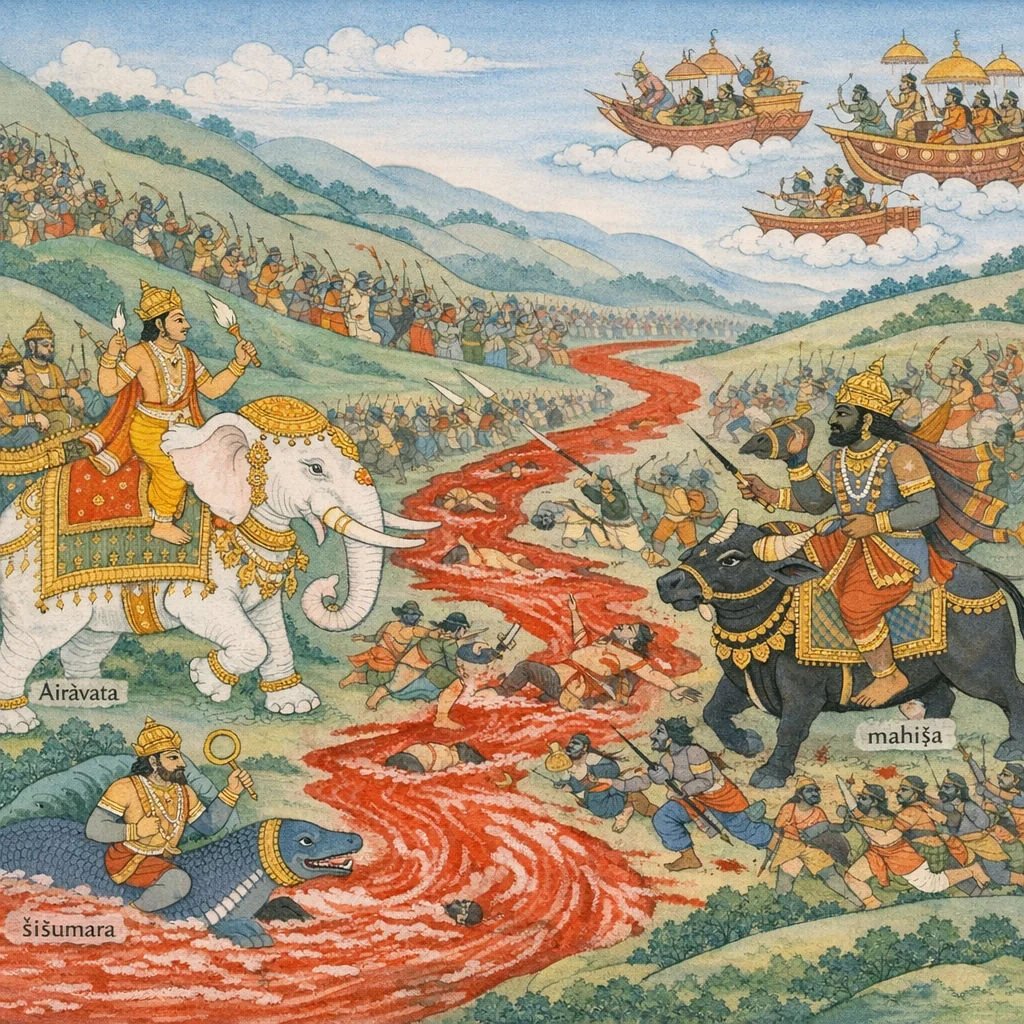
Within the Pulastya–Nārada dialogue-frame, this adhyāya explains how Andhaka, son of Hiraṇyākṣa, comes to rule and immediately seeks empowerment through tapas directed to Śiva (Śūlapāṇi, Trilocana). The narrative foregrounds syncretic theology: an asura-king’s political ascent is legitimated not by Vaiṣṇava intervention but by Śaiva boon-granting, showing the Purāṇa’s characteristic integration of sectarian spheres (rājadharma, asura-dharma, and Śaiva grace). After receiving near-invulnerability (against devas, siddhas, ṛṣis, nāgas; and immunity to fire and water), Andhaka expands dominion over the earth and provokes a full-scale daiva–asura mobilization. A distinctive iconographic catalogue follows: the vāhanas of Indra, Yama, Varuṇa, Kubera, Rudras, Ādityas, Vasus, Maruts, etc., and then the corresponding daitya/dānava vehicles (rathas, gajas, vimānas). The chapter culminates in a terrifying battlefield poetics—an ‘asṛg-nadī’ (river of blood) and cremation-ground imagery—before key duels are paired (Andhaka vs. Indra; Prahlāda vs. Yama; others vs. Varuṇa, Kubera, Vāyu, Agni).
Divine Beings
Sacred Geography
Mortal & Asura Figures
Key Content Points
- Pulastya answers Nārada’s query on Andhaka’s kingship: Andhaka is re-established and crowned; he performs tapas to Śiva (Śūlapāṇi, Trilocana) and receives boons of ajeyatva/avadhyatva and elemental invulnerability (fire, water).
- Military mobilization and iconographic descriptions: detailed vāhana lists for devas (Indra’s elephant, Yama’s buffalo, Varuṇa’s śiśumāra, Kubera’s vehicle; Rudra-gaṇa and other deva classes with mounts).
- Daitya/dānava vāhanas and the outbreak of daiva–asura war: Andhaka’s divine chariot; Prahlāda’s chariot; other asura mounts (gaja, turaga, vimāna, mahoraga), followed by graphic battlefield imagery (asṛg-nadī, śmaśāna-pratima yuddha) and paired single-combats among major leaders.
Shlokas in Adhyaya 9
Verse 1
इति श्रीवामनपुराणे अष्टमो ऽध्यायः नारद उवाच नेत्रहीनः कथं राज्ये प्रह्लादेनान्धको मुने अभिषिक्तो जानतापि राजधर्मं सनातनम्
Thus ends the eighth chapter of the Śrī Vāmana Purāṇa. Nārada said: ‘O sage, how was Andhaka—though blind—consecrated to the kingdom by Prahlāda, even while knowing the eternal law of kingship (rājadharma)?’
Verse 2
पुलस्त्य उवाच लब्धचक्षुरसौ भूयो हिरण्याक्षे ऽपि जीवति ललो ऽभिषिक्तो दैत्येन प्रह्लादेन निजे पदे
Pulastya said: When Hiraṇyākṣa was still alive, that one (Andhaka), having regained his sight, was anointed by the Daitya Prahlāda in his own position (as ruler).
Verse 3
नारद उवाच/ राज्ये ऽन्धको ऽभिषिक्तस्तु किमाचरत सुव्रत देवादिभिः सह कथं समास्ते तद् वदस्व मे
Nārada said: O you of good vow, once Andhaka had been anointed to the kingdom, what did he do? And how did he dwell together with the gods and others? Tell me that.
Verse 4
पुलस्त्य उवाच राज्ये ऽभिषिक्तो दैत्येन्द्रो हिरण्याक्षसुतो ऽन्धकः तपसाराध्य देवेशं शूलपाणिं त्रिलोचनम्
Pulastya said: Andhaka, the son of Hiraṇyākṣa—consecrated to the kingdom and lord among the Daityas—propitiated through austerity the Lord of the gods, the trident-bearing, three-eyed one (Śiva).
Verse 5
अजेयत्वमवध्यत्वं सुरसिद्धर्षिपन्नगैः अदाह्यत्वं हुताशेन अक्लेद्यत्वं जलेन च
Invincibility and immunity from being slain by the gods, Siddhas, Ṛṣis, and Nāgas; immunity from being burned by fire, and from being drenched (or harmed) by water as well.
Verse 6
एवं स वरलब्धस्तु दैत्यो राज्यमपालयत् शुक्रं पुरोहितं कृत्वा समध्यास्ते ततो ऽन्धकः
Thus, having obtained the boon, that Daitya ruled the kingdom; then Andhaka, having made Śukra his family priest, sat enthroned (and governed).
Verse 7
ततश्चक्रो समुद्योगं देवानामन्धको ऽसुरः आक्रम्य वसुधां सर्वां मनुजेन्द्रान् पराजयत्
Then Andhaka the Asura prepared an onslaught against the gods; having overrun the whole earth, he defeated the kings of men.
Verse 8
पराजित्य महीपालान् सहायार्थे नियोज्य चा तैः समं मेरुशिखरं जगामाद्भुतदर्शनम्
Having subdued the kings of the earth and appointing them as allies for assistance, he went together with them to the peak of Mount Meru, wondrous to behold.
Verse 9
शक्रो ऽपि सुरसैन्यानि समुद्योज्य महागजम् समारुह्यामरावत्यां गुप्तिं कृत्वा विनिर्ययौ
Śakra (Indra) too, having mobilized the armies of the gods, mounted the great elephant; and having arranged protection/guard in Amarāvatī, he set out.
Verse 10
शक्रस्यानु तथैवान्ये लोकपाला महौजसः आरुह्य वाहनं स्वं स्वं सायुधा निर्ययुर्बहिः
Following Śakra, the other mighty Lokapālas likewise mounted each his own vehicle, and—bearing weapons—went out.
Verse 11
देवसेनापि च समं शक्रोणाद्भुतकर्मणा निर्जगामातिवेगेन गजवाजिराथादिभिः
And the army of the gods, together with Śakra (Indra) of wondrous deeds, set forth at great speed, with elephants, horses, chariots, and the like.
Verse 12
अग्रतो द्वादशादित्याः पृष्ठतश्च त्रिलोचनाः मध्ये ऽष्टौ वसवो विश्वे साध्याश्विमरुतां गणाः यभविद्याधराद्याश्च स्वं स्वं वाहनमास्थिताः
In front were the twelve Ādityas; behind were the three-eyed ones (Rudras). In the middle were the eight Vasus, the Viśve-devas, the Sādhyas, and the hosts of the Aśvins and the Maruts; and the Yakṣas and Vidyādharas and others—each mounted upon his own vehicle.
Verse 13
नारद उवाच रुद्रादीनां वदस्वेह वाहनानि च सर्वशः एकैकस्यापि धर्मत्र परं कौतूहलं मम
Nārada said: Tell here, in full, the vehicles of Rudra and the others. With respect to each one, O righteous one, I have great curiosity.
Verse 14
पुलस्त्य उवाच शृणुष्व कथयिष्यामि सर्वेषामपि नारद वाहनानि समासेन एकैकस्यानुपूर्वशः
Pulastya said: Listen, Nārada. I shall briefly tell you, in proper sequence, the vehicles (mounts) of all (the deities), one by one.
Verse 15
रुद्रहस्तलोत्पन्नो महावीर्यो महाजवः श्वेतवर्णो गजपतिर्देवराजस्य वाहनम्
Born from Rudra’s palm, of great valor and great speed, white in color—(this) lord of elephants is the vehicle of the king of the gods (Indra).
Verse 16
रुद्रोरुसंभवो भीमः कृष्णवर्णो मनोजवः पौण्ड्रको नाम महिषो धर्मराजस्य नारद
Born from Rudra’s thigh, terrifying, black in color, swift as the mind—O Nārada, the buffalo named Pauṇḍraka is the vehicle of Dharmarāja (Yama).
Verse 17
रुद्रकर्ममलोद्भूतः श्यामो जलधिसंज्ञकः शिशुमारो दिव्यगतिः वाहनं वरुणस्य च
Born from the impurity (mala) of Rudra’s actions, there is a dark one named ‘Jaladhi’ (Ocean). The śiśumāra, of divine movement, is also the mount of Varuṇa.
Verse 18
रौद्रः शकटचक्राक्षः शैलाकारो नरोत्तमः अम्बिकापादसंभूतो वाहनं धनदस्य तु
There is (one) called Raudra, having eyes like cart-wheels, rock-shaped, an excellent being. Born from Ambikā’s foot, he is indeed the mount of Dhanada (Kubera).
Verse 19
एकादशानां रुद्राणां वाहनानि महामुने गन्धर्वाश्च महावीर्या भुजगोन्द्राश्च दारुणाः श्वेतानि सौरभेयाणि वृषाण्युग्रजवानि च
O great sage, (these are) the mounts of the eleven Rudras: mighty Gandharvas, dreadful lordly serpents, and white Saurabheya bulls of fierce speed.
Verse 20
रथं चन्द्रमसश्चार्द्धूसहस्रं हंसवाहनम् हरयो रथवाहाश्च आदित्या मुनिसत्तम
O best of sages, the Moon has a chariot (drawn by) half a thousand (steeds); it has a swan as its vehicle. The Haris and the Ādityas too are chariot-borne.
Verse 21
कुञ्जरस्थाश्च वसवो यक्षाश्च नरवाहनाः किन्नरा भुजगारूढा हयारूढौ तथाश्विनौ
The Vasus are stationed upon elephants; the Yakṣas have men as their conveyance. The Kinnaras ride upon serpents; likewise the two Aśvins are mounted on horses.
Verse 22
सारङ्गधिष्ठिता ब्रह्मन् मरुतो घोरदर्शनाः सुकारूढाश्च कवयो गन्धर्वाश्च पदातिनः
O Brahmin, the Maruts are seated upon sāraṅgas and appear fearsome. The Kavis are mounted upon parrots; and the Gandharvas proceed on foot.
Verse 23
आरुह्य वाहनान्येवं स्वानि स्वान्यमरोत्तमाः संनह्य निर्ययुर्हृष्टा युद्धाय सुमहौजसः
Thus, the foremost of the immortals mounted their respective vehicles; having armed themselves, those of great might set out joyfully for battle.
Verse 24
नारद उवाच/ गदितानि सुरादीनां वाहनानि त्वया मुने दैत्यानां वाहनान्येवं यथावद् वक्तुमर्हसि
Nārada said: “You have described the vehicles of the Devas and others, O sage. Now you should likewise tell, in due order, the vehicles of the Daityas.”
Verse 25
पुलस्त्य उवाच शृणुष्व दानवादीना वाहनानि द्विजोत्तम कथयिष्यामि तत्त्वेन यथावच्छ्रोतुमर्हसि
Pulastya said: “Listen, O best of twice-born, to the vehicles of the Dānavas and others. I shall explain them truthfully and in proper order, as you are fit to hear.”
Verse 26
अन्धकस्य रथो दिव्यो युक्तः परमवाजिभिः कृष्णवर्णैः सहस्रारस् त्रनल्वपरिमाणवान्
Andhaka’s chariot was divine, yoked with excellent horses of black color—having a thousand spokes and of a measure described as ‘traṇālva’.
Verse 27
प्रह्लादस्य रथो दिव्यश्चन्द्रवर्णैर्हयोत्तमैः उह्यमानस्तथाष्टाभिः श्वेतरुक्ममयः सुभः
Prahlāda’s chariot was divine, drawn by excellent horses of moon-like color; it was borne along by eight (horses), auspicious, and made of white gold.
Verse 28
विरोजनस्य च गजः कुजम्भस्य तुरङ्गमः जम्भस्य तु रथो द्वियो हयैः काञ्जनसन्निभैः
Virocana had an elephant (as his mount/vehicle); Kujambha had a horse. But Jambha had a divine chariot, drawn by horses resembling gold.
Verse 29
शङ्कुकर्णस्य तुरगो हयग्रीवस्य कुञ्जरः रथो मयस्य विख्यातो दुन्दुभेश्च महोरगः शम्बरस्य विमानो ऽभूदयः शङ्कोर्मृगाधिपः
Śaṅkukarṇa had a horse; Hayagrīva had an elephant. Maya was renowned for his chariot, and Dundubhi for his great serpent. Śambara possessed an aerial car (vimāna), and Ayaḥśaṅku had the lord of beasts (a lion) [as his mount].
Verse 30
वबलवृत्रौ च बलिनौ गदामुसलधारिणौ पद्भ्यां दैवतसैन्यानि अभिद्रवितुमुद्यतौ
Vabala and Vṛtra, both mighty, bearing a mace and a pestle, set out on foot to charge the armies of the gods.
Verse 31
ततो रणो ऽभूत् तुमुलः संकुलो ऽतिभयङ्करः रजसा संवृतो लोकी पिङ्गवर्णेन नारद
Then the battle became tumultuous, confused, and exceedingly terrifying. The world was covered with dust, tawny in color—O Nārada.
Verse 32
नाज्ञासीच्च पिता पुत्रं न पुत्रः पितरं तथा स्वानेवानये निजघ्नुर्वै परानन्ये च सुव्रत
In that confusion, a father did not recognize his son, nor did a son recognize his father. Some, through error, struck down even their own; others (mistaking them) struck down those who were not their foes—O suvrata.
Verse 33
अभिद्रुतो महावेगो रथोपरि रथस्तदा गजो मत्तगजेन्द्रं च सादी सादिनमभ्यगात्
Then, rushing forth at great speed, chariot met chariot; elephant met the lordly rutting elephant; and horseman advanced against horseman.
Verse 34
पदातिरपि संक्रुद्धः पदातिनमथोल्बणम् परस्परं तु प्रत्यघ्नन्नन्योन्यजयकाङ्क्षिणः
Even the infantry, enraged, fiercely struck the opposing infantry; desiring victory over one another, they beat each other in close combat.
Verse 35
ततस्तु संकुले तस्मिन् युद्धे दैवासुरे मुने प्रावर्तत नदी घोरा शमयन्ती रणाद्रजः
Then, O sage, in that confused battle between the Devas and Asuras, a dreadful river began to flow, quelling the dust raised by the fighting.
Verse 36
शोणितोदा रथावर्त्ता योधसंघट्टवाहिनी गजकुम्भमाहकूर्मा शरमीना दुरत्यया
Its waters were blood; its whirlpools were chariots; its current was the crush of masses of warriors. Elephant temples were its great turtles; arrows were its fish—hard to cross.
Verse 37
तीक्ष्णाग्रप्रासमकरा महासिग्राहवाहिनी अन्त्रशैवलसंकीर्णा पताकाफेनमालिननी
It had sharp-pointed spears as its makaras, and it carried mighty swords as its crocodiles. It was strewn with entrails like algae, and garlanded with the foam of banners.
Verse 38
गृध्रकङ्कमहाहंसा श्येनचक्रआह्वमण्डिता वनवायसकादम्बा गोमायुश्वापदाकुला
It was adorned with vultures, herons, and great swans; marked by hawks and birds of prey; filled with wild crows and ducks, and crowded with jackals and other beasts of prey.
Verse 39
पिशाचमुनिसंकीर्णा दुस्तरा प्राकृतैर्जनैः रथप्लवैः संतरन्तः शूरास्तां प्रजगाहिरे
Crowded with piśācas and ascetics, it was hard to cross for ordinary people; but the brave, crossing by means of raft-like chariots, entered it.
Verse 40
आगुल्फआदवमज्जन्तः सूदयन्तः परस्परम्ः समुत्तरन्तो वेगेन योधा जयधनेप्सवः
Sinking down to their ankles, striking one another down, the warriors—desiring victory and wealth—clambered up swiftly with speed.
Verse 41
ततस्तु रौद्रो सुरदैत्यसादने महाहवे भीरुभयङ्करे ऽथ रक्षांसि यक्षाश्च सुसप्रहृष्टाः पिशाचयूथास्त्वभिरेमिरे च
Then, in that great battle between the gods and the daityas—terrifying even to the timid—the rākṣasas and yakṣas became exceedingly delighted, and bands of piśācas also took pleasure (in it).
Verse 42
पिबन्त्यसृग्गाढतरं भटानामालिङ्ग्य मांसानि च भक्षयन्ति वसां विलुम्पन्ति च वनिस्फुरन्ति गर्जन्त्यथान्योन्यमथो वयांसि
They drink the thick blood of the warriors; embracing (the bodies), they devour the flesh. They plunder the fat and quiver with excitement; and the carrion-birds, too, cry out to one another with harsh calls.
Verse 43
मुञ्चन्ति फेत्काररवाञ्शिवाश्च क्रन्दन्ति योधा भुवि वेदनार्त्ताः शस्त्रप्रतप्ता निपतन्ति चान्ये युद्धं श्मशानप्रतिमं बभूव
Jackals let out yelping cries; warriors, afflicted by pain, weep upon the ground. Others, scorched/tormented by weapons, fall down. The battle became like a cremation-ground.
Verse 45
तस्मिञ्शिवाघोररवे प्रवृत्ते मुरासुराणां सुभयङ्करे ह युद्धं बभौ प्राणपणेपविद्धं द्वन्द्वे ऽतिशस्त्राक्षगतो दुरोदरः // वम्प्_9.44 हिरण्यचक्षुस्तनयो रणे ऽन्धको रथे स्थितो वाजिसहस्रयोजिते मत्तेभष्टष्टस्थितमुग्रतेजसं समेयिवान् देवपतिं शतक्रतुम्
When the dreadful roar of Śiva arose, terrifying the hosts of the Daityas, the battle blazed forth—each staking his very life. In the duel, the mighty (Durodara), whose eyes were fixed upon a multitude of weapons, advanced. Andhaka, son of Hiraṇyākṣa, stood in battle upon a chariot yoked with a thousand horses, furnished with eight rutting elephants and of fierce splendor, and he came forth to meet Śatakratu (Indra), the lord of the gods.
Verse 46
समापतन्तं महिषाधिरूढं यमं प्रतीच्छद् बलवान् दितीशः प्रह्लादनामा तुरगाष्टयुक्तं रथं समास्थाय समुद्यातास्त्रः
As Yama, mounted upon a buffalo, rushed forward, the powerful lord of the Daityas received him. Prahlāda by name, having mounted a chariot yoked with eight horses, advanced with weapons raised.
Verse 47
विरोचनश्चापि जलेश्वरं त्वगाज्जम्भस्त्वथागाद् धनदं बलाढ्यम् वायुं समभ्येत्य च शम्बरो ऽथ मयो हुताशं युयुधे मुनीन्द्र
Virocana too went against the lord of waters (Varuṇa). Jambha then went against the wealthy giver (Kubera), abounding in strength. Śambara, approaching Vāyu, fought; and Maya fought Hutāśa (Agni), O best of sages.
Verse 48
अन्ये हयग्रीवमुखा महाबला दितेस्तनूजा दनुपुङ्गवाश्च सुरान् हुताशार्कवसूरकेश्वरान् द्वन्द्वं समासाद्य महाबलान्विताः
Others—mighty Dānavas, sons of Diti, bull-like among the Dānavas, with faces like Hayagrīva—approached the gods for single combat, confronting Agni, Sūrya, the Vasus, and the lord of the Rākṣasas, being endowed with great strength.
Verse 49
गर्जन्त्यथान्योन्यमुपेत्य युद्धे चापानि कर्षन्त्यतिवेगिताश्च मुञ्चन्ति नाराचगणान् सहस्रश अगच्छ हे तिष्ठसि किं ब्रुवन्तः
Then, approaching one another in battle, they roared; swift with speed, they drew their bows and released hosts of iron arrows by the thousand, shouting, 'Go on! Hey—why do you stand? What are you saying?'
Verse 50
शरैस्तु तीक्ष्णैरतितापयन्तः शस्त्रैरमोघैरभिताडयन्तः मन्दाकिनीवेगनिभां वहन्तीम् प्रवर्तयन्तो भयदां नदीं च
With sharp arrows they caused intense torment; with unfailing weapons they struck all around—setting in motion a fear-giving 'river' (of battle), flowing like the rushing current of the Mandākinī.
Verse 51
त्रैलोक्यमाकाङ्क्षिभिरुग्रवेगैः सुरासुरैर्नारद संप्रयुद्धे पिशाचरक्षोगणपुष्टिवर्धनीमुत्तर्तुमिच्छद्भिरसृग्नदी बभै
O Nārada, when the gods and asuras—of fierce momentum and desiring the three worlds—joined in close battle, a river of blood appeared, and hosts of piśācas and rākṣasas, wishing to cross it, grew in strength and nourishment (from it).
Verse 52
वाद्यन्ति तूर्याणि सुरासुराणाम् पश्यन्ति खस्था मुनिसिद्धसंघाः नयन्ति तान्प्सरसां गणाग्र्या हता रणे ये ऽभिमुखास्तु शूराः
The war-instruments (trumpets/drums) of the devas and asuras resound. Companies of sages and siddhas, stationed in the sky, look on. The foremost bands of apsarases escort those heroes who, facing the enemy, were slain in battle.
Frequently Asked Questions
The chapter’s syncretic theology is implicit: an asura sovereign (Andhaka) secures political and military legitimacy through Śiva’s boon-granting (Śūlapāṇi/Trilocana), while the devas—often associated with broader Vaiṣṇava cosmic order—mobilize under Indra. The narrative thus normalizes cross-sectarian sacred power: Śaiva grace operates within a Purāṇic world that also accommodates deva-centric (and frequently Vaiṣṇava-aligned) cosmology, presenting divine agency as complementary rather than mutually exclusive.
This adhyāya is primarily martial and iconographic rather than tīrtha-oriented. The explicit place-markers are Amarāvatī (Indra’s city) and Meru-śikhara (the cosmic mountain peak), functioning as cosmographic anchors rather than pilgrimage topography; no Sarasvatī-basin tīrtha, lake, or forest sanctification is described in the received passage.
No. The focus is the Andhaka cycle: coronation, Śiva-derived boons, vahana catalogues, and the daiva–asura war with paired combats (e.g., Andhaka vs. Indra; Prahlāda vs. Yama). Bali and the Vāmana/Trivikrama episode are not developed in this section.