Sarga 42
लङ्काप्राकारारोहणम् / Assault on Lanka’s Ramparts and the Opening Clash
युद्धकाण्ड
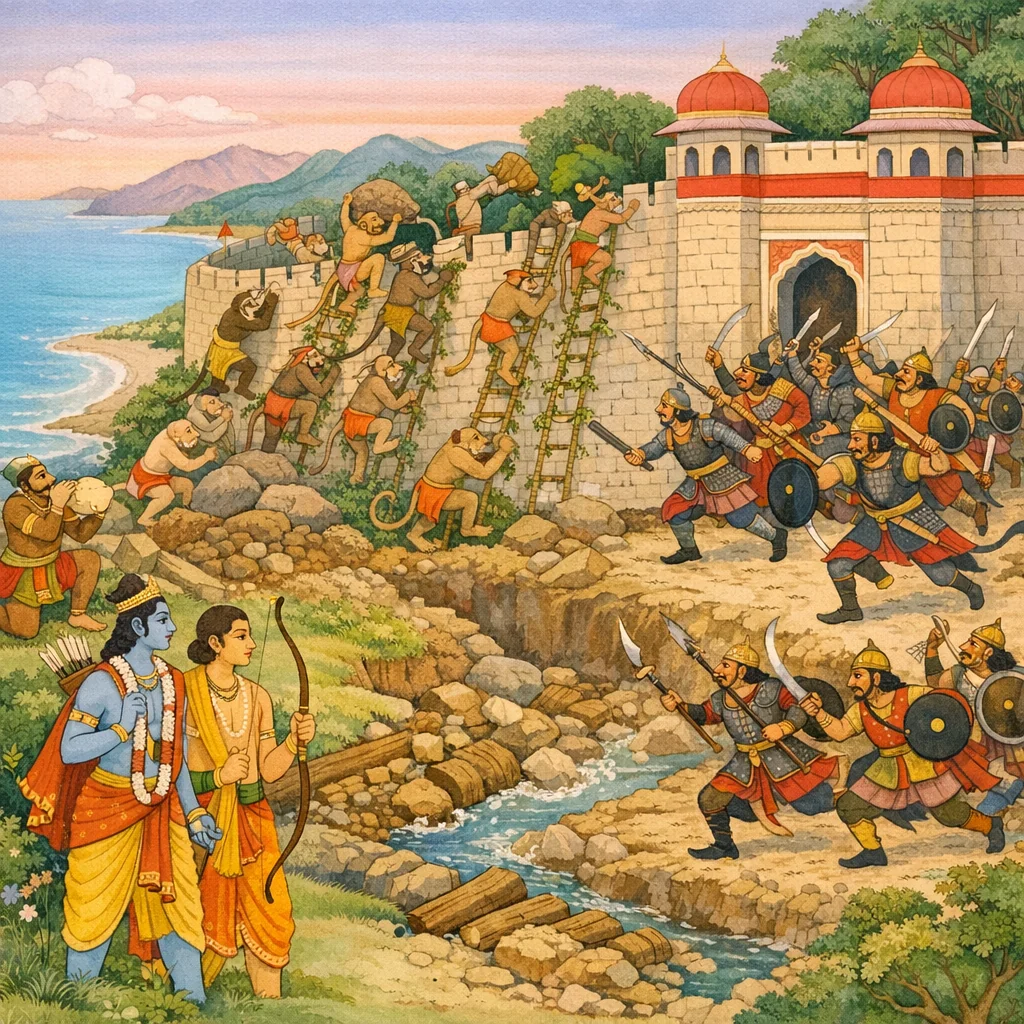
This sarga frames the transition from siege posture to open battle. Rakṣasa scouts report to Rāvaṇa that Rāma and the Vānara host have effectively occupied Laṅkā’s approaches, provoking Rāvaṇa’s fury and immediate militarization. Rāma, distressed by thoughts of Sītā’s suffering, orders swift action against enemy forces; the Vānaras respond with lion-like roars and improvised siege weaponry—trees, rocks, and mountain-peaks. Multiple tactical actions follow: scaling walls and gateways, filling water-filled moats with earth, timber, and debris, and breaching golden toranas and lofty gopuras likened to Kailāsa. The narrative then maps a structured encampment at the city gates: Kumuda at the east, Śatabalī at the south, Suṣeṇa at the west, and Rāma with Lakṣmaṇa and Sugrīva at the north; elite allies (Gavākṣa, Dhūmra, and Vibhīṣaṇa with ministers) are positioned for support and protection. Rāvaṇa orders a general sortie; drums and conches erupt, and the soundscape expands to mountains, earth, sky, and ocean. The chapter culminates in a dreadful mêlée—Rakṣasas striking with maces, javelins, tridents, swords, and bhindipālas; Vānaras counter with trees, rocks, nails, and teeth—producing an intense, blood-and-flesh mire described as astonishing in scale.
Shlokas
Verse 1
ततस्तेराक्षसास्तत्रगत्वारावणमन्दिरम् ।न्यवेदयन्पुरींरुद्धांरामेणसहवानरैः ।।।।
Then those rākṣasas went there to Rāvaṇa’s palace and reported that the city had been seized and hemmed in by Rāma together with the vānaras.
Verse 2
रुद्धांतुनगरींश्रुत्वाजातक्रोधोनिशाचरः ।विधानंद्विगुणंश्रुत्वाप्रासादंसोऽध्यरोहत ।।।।
Hearing that the city had been blocked and occupied, the night-ranging lord (Rāvaṇa) was seized with anger; learning the state of defenses, he ordered the arrangements to be doubled and then ascended to the palace-terrace.
Verse 3
सददर्शावृतांलङ्कांसशैलवनकाननाम् ।असङ्ख्येयैर्हरिगणैःसर्वतोयुद्धकाङ्क्षिभिः ।।।।
He beheld Laṅkā—together with its hills and forest-groves—covered on every side by countless companies of Vānaras, all eager for battle.
Verse 4
सदृष्ट्वावानरैःसर्वांवसुधांकवलीकृताम् ।कथंक्षपयितव्याःस्युरितिचिन्तापरोऽभवत् ।।।।
Seeing the Vānaras spread over the whole land as though they had swallowed it up, he fell into anxious thought: “How are they to be destroyed?”
Verse 5
सचिन्तयित्वासुचिरंधैर्यमालम्ब्यरावणः ।राघवंहरियूथांश्चददर्शायतलोचनः ।।।।
Rāvaṇa, after pondering for a long time and then gathering his courage, looked with steady, far-seeing eyes upon Rāghava and the hosts of Vānara warriors.
Verse 6
राघवःसहसैन्येनमुदितोनामपुप्लुवे ।लङ्कांददर्शगुप्तांवैसर्वतोराक्षसैर्वृताम् ।।।।
Rāghava, accompanied by his army and buoyed with confidence, advanced and beheld Laṅkā—well-guarded and ringed on every side by Rākṣasas.
Verse 7
दृष्ट्वादाशरथिर्लङ्कांचित्रध्वजपताकिनीम् ।जगामसहसासीतांदूयमानेनचेतसा ।।।।
When the son of Daśaratha saw Laṅkā adorned with varied banners and flags, his mind at once went to Sītā, and his heart burned with anxious sorrow.
Verse 8
अत्रसामृगशावाक्षीमत्कृतेजनकात्मजा ।पीड्यतेशोकसन्तप्ताकृशास्थण्डिलशायिनी ।।।।
“Here, Janaka’s daughter—doe-eyed Sītā—suffers because of me: scorched by grief, grown thin, and lying on the bare ground.”
Verse 9
पीड्यमानांसधर्मात्मावैदेहीमनुचिन्तयन् ।क्षिप्रमाज्ञापयामासवानरान्द्विषतांवधे ।।।।
That righteous-souled one, continually thinking of the suffering Vaidehī, swiftly commanded the Vānaras to strike down the hostile foe.
Verse 10
एवमुक्तेतुवचनेरामेणाक्लिष्टकर्मणा ।संघर्षमाणाःप्लवगाःसिम्हनादैरनादयन् ।।।।
When Rāma—whose deeds do not bring distress to the righteous—had spoken thus, the monkeys, bristling for battle, raised lion-like roars.
Verse 11
शिखरैर्विकिरामैनांलङ्कांमुष्टिभिरेववा ।इतिस्मदधिरेसर्वेमनांसिहरियूथपाः ।।।।
All the vānaras resolved in their hearts: “We will smash this Laṅkā—if not with torn mountain-peaks, then even with our bare fists.”
Verse 12
उद्यम्यगिरिशृङ्गाणिशिखराणिमहान्तिच ।तरूंश्चोत्पाट्यविविधांस्तिष्ठन्तिहरियूथपाः ।।।।
Hoisting mountain-horns and great peaks, and uprooting trees of many kinds, the leaders of the vānaras stood poised for combat.
Verse 13
प्रेक्षतोराक्षसेन्द्रस्यतान्यनीकानिभागशः ।राघवप्रियकामार्थंलङ्कामारुरुहुस्तदा ।।।।
While the lord of rākṣasas looked on, those divisions of the vānaras then climbed up into Laṅkā—eager to accomplish what would please Rāghava.
Verse 14
तेताम्रवक्त्राहेमाभारामार्थेत्यक्तजीविताः ।लङ्कामेवाभ्यवर्तन्तसालतालशिलायुधाः ।।।।
Those vānaras—some copper-faced, some radiant like gold—having staked their lives for Rāma’s cause, surged straight toward Laṅkā, bearing sāla and tāla trees and stones as weapons.
Verse 15
तेद्रुमैःपर्वताग्रैश्चमुष्टिभिश्चप्लवङ्गमाः ।प्राकाराग्राण्यरण्यानिममन्थुस्तोरणानिच ।।।।
With trees, mountain-summits, and even their fists, those vānaras battered the rampart-tops and smashed the city’s gateways.
Verse 16
पारिखाःपूरयन्तिस्मप्रसन्नसलिलायुताः ।पांसुभिःपर्वताग्रैश्चतृणैःकाष्ठैश्चवानराः ।। ।।
The vānaras began filling the moats—though they held clear water—with earth, mountain-summits, grass, and pieces of wood.
Verse 17
ततःसहस्रयूथाश्चकोटीयूथाश्चवानराः ।कोटीशतयुताश्चान्येलङ्कामारुरुहुस्तदा ।।।।
Then the vānaras—ranged in thousands of troops, crores of troops, and others in hundreds of crores—climbed up into Laṅkā.
Verse 18
काञ्चनानिप्रमृद्नन्तस्तोरणानिप्लवङ्गमाः ।कैलासशिखराभानिगोपुराणिप्रमथ्यच ।।।।
The vānaras crushed the golden gateways, and they also shattered the lofty gopuras—towers gleaming like the peaks of Kailāsa.
Verse 19
आप्लवन्तःप्लवन्तश्चगर्जन्तश्चप्लवङ्गमाः ।लङ्कांतामभिधावन्तिमहावारणसंनिभाः ।।।।
Leaping and bounding, roaring as they ran, the Vānara warriors surged toward Laṅkā, formidable in mass like great elephants.
Verse 20
जयत्यतिबलोरामोलक्ष्मणश्चमहाबलः ।राजाजयतिसुग्रीवोराघवेणाभिपालितः ।।।।
“Victory to mighty Rāma, and victory to great-strong Lakṣmaṇa! Victory to King Sugrīva as well—secure under the protection of Rāghava.”
Verse 21
इत्येवंघोषयन्तश्चगर्जन्तश्चप्लवङ्गमाः ।अभ्यधावन्तलङ्कायाःप्राकारंकामरूपिणः ।।।।
Proclaiming thus and roaring aloud, the shape-changing Vānaras rushed straight at Laṅkā’s ramparts.
Verse 22
वीरबाहुःसुबाहुश्चनलश्चवनगोचरः ।निपीड्योपनिविष्टास्तेप्राकारंहरियूथपाः ।एतस्मिन्नन्तरेचक्रुःस्कन्धावारनिवेशनम् ।। ।।
Vīrabāhu, Subāhu, and Nala—moving through the forest ways—pressed hard upon the rampart and took position there as Vānara commanders; in the meantime they established a military encampment (a division’s station).
Verse 23
पूर्वद्वारंतुकुमुदःकोटीभिर्दशभिर्वृतः ।आवृत्यबलवांस्तस्थौहरिभिर्जितकाशिभिः ।।।।
Kumuda, surrounded by ten crores of monkeys, took up his post to blockade the eastern gate, with troops gleaming as if already victorious.
Verse 24
साहाय्यार्थंतुतस्यैवनिविष्टःप्रघसोहरिः ।पनसश्चमहाबाहुर्वानरैर्बहुभिर्वृतः ।।।।
For his support, the monkey Praghasa took position there; and the strong-armed Panasa too—surrounded by many Vānaras—stood ready to assist.
Verse 25
दक्षिणंद्वारमागम्यवीरःशतबलिःकपिः ।आवृत्यबलवांस्तस्थौविंशत्याकोटिभिर्वृतः ।।।।
Reaching the southern gate, the valiant monkey Śatabali took his stand to blockade it, surrounded by twenty crores of troops.
Verse 26
सुषेणःपश्चिमद्वारंगतस्तारापिताहरिः ।आवृत्यबलवांस्तस्थौषष्टिकोटिभिरावृतः ।।।।
Suṣeṇa—Tārā’s father—went to the western gate and, mighty in strength, held it under blockade, surrounded by sixty crores of monkeys.
Verse 27
उत्तरंद्वारमासाद्यरामःसौमित्रिणासह ।आवृत्यबलवांस्तस्थौसुग्रीवश्चहरीश्वरः ।।।।
Reaching the northern gate, Rāma together with Saumitri (Lakṣmaṇa) stood firm to blockade it; and Sugrīva too—the lord of the Vānaras—held position there.
Verse 28
गोलाङ्गूलोमहाकायोगवाक्षोभीमदर्शनः ।वृतःकोट्यामहावीर्यस्तस्थौरामस्यपार्श्वतः ।।।।
Gavākṣa—of the Golāṅgūla kind, huge-bodied and fearsome to behold—stood at Rāma’s side, surrounded by a crore of exceedingly valiant monkeys.
Verse 29
ऋक्षाणांभीमवेगानांधूम्रःशत्रुनिबर्हणः ।वृतःकोट्यामहावीर्यस्तस्थौरामस्यपार्श्वतः ।।।।
Dhūmra, the foe-destroyer, stood by Rāma’s side—attended by a crore of bears of terrible speed and force, and renowned for great valor.
Verse 30
सन्नद्धस्तुमहावीर्योगदापाणिर्विभीषणः ।वृतोयस्तैस्तुसचिवैस्तस्थौतत्रमहाबलः ।।।।
Vibhīṣaṇa—mighty and of great valor—stood there fully armed, mace in hand, attended by those ministers of his.
Verse 31
गजोगवाक्षोगवयःशरभोगन्धमादनः ।समन्तात्परिधावन्तोररक्षुर्हरिवाहिनीम् ।।।।
Gaja, Gavākṣa, Gavaya, Śarabha, and Gandhamādana ranged all around and kept watch, protecting the Vānara host.
Verse 32
ततःकोपपरीतात्मारावणोराक्षसेश्वरः ।निर्याणंसर्वसैन्यानांद्रुतमाज्ञापयत्तदा ।।।।
Then Rāvaṇa, lord of the Rākṣasas, his mind overwhelmed by anger, ordered all his forces to march out at once.
Verse 33
एतच्छ्रुत्वाततोवाक्यंरावणस्यमुखोद्गतम् ।सहसाभीमनिर्घोषमुद्घुष्टंरजनीचरैः ।।।।
As soon as they heard those words issued from Rāvaṇa’s mouth, the night-rangers instantly raised a dreadful roar.
Verse 34
ततःप्रचोदिताभेर्यश्चन्द्रपाण्डरपुष्कराः ।हेमकोणाहताभीमाराक्षसानांसमन्ततः ।।।।
Then the kettledrums—white-faced like the moon—were beaten all around by the Rākṣasas with golden sticks, raising a terrifying din.
Verse 35
विनेदुश्चमहाघोषाःशङ्खाःशतसहस्रशः ।राक्षसानांसुघोराणांमुखमारुतपूरिताः ।।।।
And conches by the hundred-thousands, blown by the dreadful Rākṣasas with the wind of their mouths, resounded with a great roar.
Verse 36
तेबभुःशुभनीलाङ्गाःसशङ्खारजनीचराः ।विद्युन्मण्डलसन्नद्धाःसबलाकाइवाम्बुदाः ।।।।
Those night-rangers, dark-limbed and gleaming, bearing conches, appeared like clouds—girt with circles of lightning—like rain-clouds accompanied by cranes.
Verse 37
निष्पतन्तिततःसैन्याहृष्टारावणचोदिताः ।समयेपूर्यमाणस्यवेगाइवमहोदधेः ।।।।
Urged on by Rāvaṇa, the troops then surged forth in high spirits—swift and swelling like the heaving tides of the great ocean at the world-ending hour.
Verse 38
ततोवानरसैन्येनमुक्तोनादःसमन्ततः ।मलयःपूरितोयेनससानुप्रस्थकन्दरः ।।।।
Then the Vānara host let out a mighty roar on every side, and by it the Malaya mountain was filled—its slopes, ridges, and caves all resounding.
Verse 39
शङ्खदुन्दुभिसंघुष्टःसिम्हनादस्तरस्विनाम् ।पृथिवींचान्तरिक्षंचसागरंचैवनादयन् ।।।।
Blended with conch-blasts and the roll of drums, the lion-like roar of the mighty made earth and sky resound—and even the ocean rang with it.
Verse 40
गजानांबृंहितैःसार्धंहयानांहेषितैरपि ।रथानांनेमिघोषैश्चरक्षसाम्वदनस्वनः ।। ।।
Along with elephants’ trumpetings and horses’ neighs, with the rumble of chariot-wheels and the rākṣasas’ shouts, the din rose and spread.
Verse 41
एतस्मिन्नन्तरेघोरःसङ्ग्रामःसमवर्तत ।रक्षसांवानराणांचयथादेवासुरेपुरा ।।।।
Just then a dreadful battle broke out between the Rākṣasas and the Vānaras—like the ancient wars of Devas and Asuras.
Verse 42
तेगदाभिःप्रदीप्ताभिःशक्तिशूलपरश्वधैः ।निजघ्नुर्वानरान्घोराःकथयन्तःस्वविक्रमान् ।।।।
Boasting of their own prowess, those fearsome rākṣasas struck down the Vānaras with blazing maces, javelins, tridents, and axes.
Verse 43
राजाजयतिसुग्रीवइतिशब्दोमहानभूत् ।राजन्जयजयेत्युक्त्वास्वस्वनामकथान्ततः ।।।।
A great shout arose: “King Sugrīva is victorious!”—and crying, “Victory, O King, victory!” they called out their own names in the tumult of war.
Verse 44
तथावृक्षैर्महाकायाःपर्वताग्रैश्चवानराः ।निजघ्नुस्तानिरक्षांसिनखैर्दन्तैश्चवेगिताः ।।।।
So too the huge-bodied Vānaras struck those rākṣasas with trees and mountain-tops—and, rushing in, tore at them with nails and teeth.
Verse 45
राक्षसास्त्वपरेभीमाःप्राकारस्थामहीगतान् ।भिन्दिपालैश्चखड्गैश्चशूलैश्चैवव्यदारयन् ।।।।
But other dreadful rākṣasas, stationed upon the ramparts, tore into the Vānaras below on the ground with bhindipālas, swords, and tridents.
Verse 46
वानराश्चापिसङ्क्रुद्धाःप्राकारस्थान्महीगताः ।राक्षसान्पातयामासुःसमाप्लुत्यप्लवङ्गमाः ।।।।
The enraged Vānaras too, leaping up, dragged down to the earth the Rākṣasas who were stationed upon the ramparts.
Verse 47
ससम्प्रहारस्तुमुलोमांसशोणितकर्दमः ।रक्षसांवानराणांचसम्बभूवाद्भुतोपमाः।।।।
That clash between the Rākṣasas and the Vānaras grew into a tumult—like a mire of flesh and blood—terrible to behold and astonishing in its ferocity.
Frequently Asked Questions
Rāma’s pivotal action is to convert grief for Sītā into disciplined command: he orders immediate engagement against hostile forces, directing collective violence toward liberation and justice rather than personal rage—an applied model of rājadharma under emotional strain.
The sarga presents warfare as a moral test: inner sorrow is acknowledged, yet action must be regulated by purpose and duty. Leadership is shown through structured deployment and protection of allies, while uncontrolled fury (as in Rāvaṇa’s reaction) accelerates destructive escalation.
Laṅkā’s fortifications—ramparts, moats, gateways, and gopuras—are central, with evocative similes to Kailāsa and an acoustic expansion to Malaya mountain, earth, sky, and ocean, emphasizing the battle’s cosmological scale and the city’s engineered defenses.