Sarga 22
सागरप्रशमनम् / The Pacification of the Ocean and the Building of Nala’s Bridge
युद्धकाण्ड
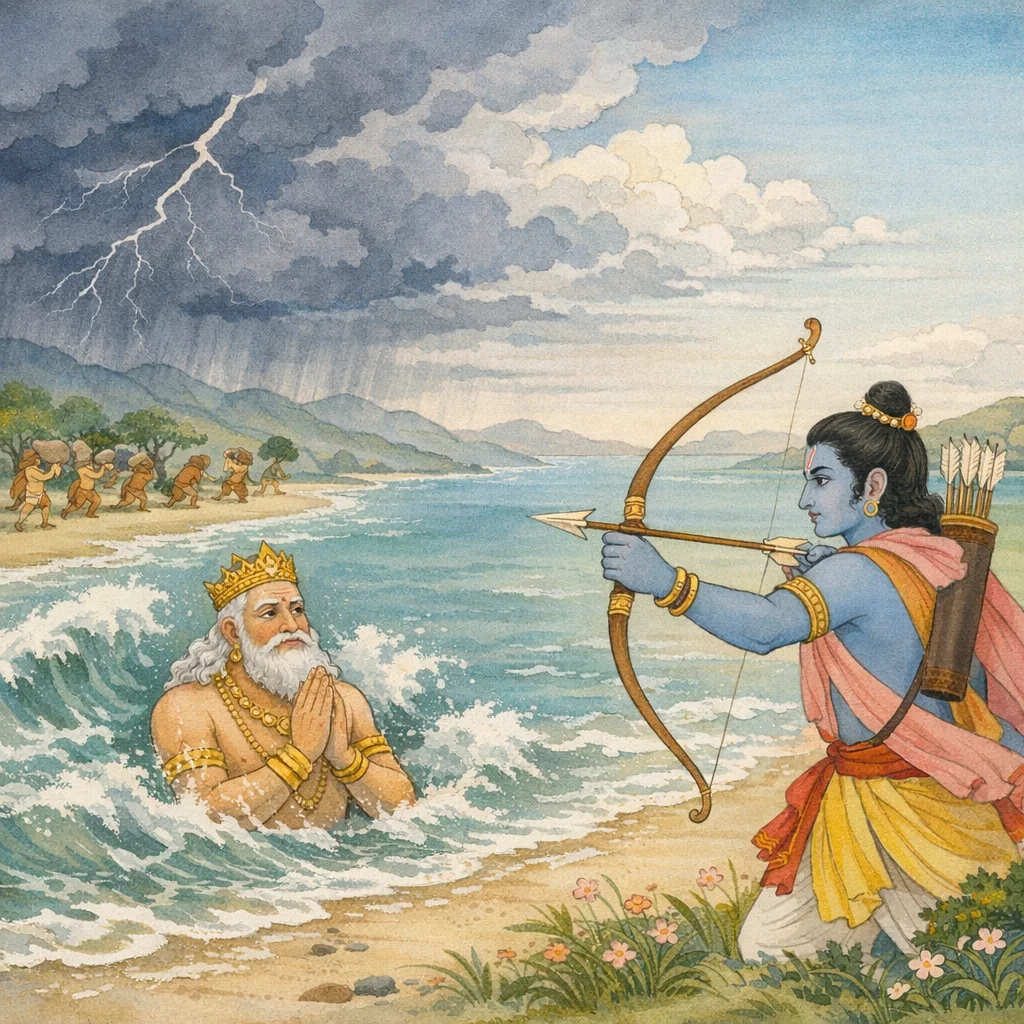
Sarga 22 stages a transition from impasse to engineered passage. Rāma, angered by the ocean’s obstruction, vows to dry the sea to the underworld with Brahmā-astra-charged force, and cosmic disturbances follow—winds, clouds, lightning, darkness, and terrified visible and invisible beings. The Ocean-lord (Sāgara/Varuṇālaya) rises in regal theophany, explains the inviolability of the five elements’ svabhāva, and offers a lawful alternative: a stable crossing via a bridge, while requesting Rāma’s unfailing arrow be redirected to punish sinful marauders at Drumakūlya. Rāma releases the missile accordingly, producing the famed desert tract (Marukāntāra), a ‘Vrana’ well with brackish upwelling, and a new auspicious route by boon. The Ocean then identifies Nala, son of Viśvakarmā, as the divinely competent architect; Nala accepts the commission. Vānara forces gather trees, boulders, and mountains, and the bridge is constructed rapidly across successive days, admired by gods and sages who bless Rāma. The chapter integrates ethical anger-management, cosmological doctrine (svabhāva), and infrastructural statecraft as instruments of dharma.
Shlokas
Verse 1
अथोवाचरघुश्रेष्टस्सागरंदारुणंवचः ।अद्यत्वांशोषयिष्यामिसपाताळंमहार्णव: ।।।।
Then the best of the Raghus spoke grim words to the Ocean: “Today I shall dry you up—even down to the nether regions, O vast sea.”
Verse 2
शरनिर्दग्धतोयस्यपरिशुष्कस्यसागर: ।मयाशोषितसत्त्वस्यपांसुरुत्पद्यतेमहान् ।।।।
“O Ocean! When I have scorched your waters with my arrows and dried you up utterly, a vast bed of sand will be laid bare.”
Verse 3
मत्कार्मुकविसृष्टेवशरवर्षेणसागर ।पारंतेऽद्यगमिष्यन्तिपदभिरेवप्लवङ्गमाः ।।।।
“O Ocean, with the rain of arrows released from my bow, you will be dried up; and today the vānaras will go to the far shore on foot.”
Verse 4
विचिन्वन्नाभिजानासिपौरुषंनापिविक्रमम् ।दानवालयसन्तापंमत्तोनाधिगमिष्यसि ।।।।
Though you deliberate, you do not truly know my manly valor or my prowess; O dwelling-place of demons, you will not escape the suffering that will come upon you from me.
Verse 5
ब्राह्मेणास्त्रेणसंयोज्यब्रह्मदण्डनिभम् शरम् ।संयोज्यधनुषिश्रेष्ठविचकर्षमहाबलः ।।।।
Empowering an arrow with the Brāhma weapon—like Brahmā’s rod of punishment—mighty Rāma fixed it to his excellent bow and drew it back.
Verse 6
तस्मिन्विविकृष्टेसहसाराघवेणशरासने ।रोदसीसम्पफालेवपर्वताश्चचकम्पिरे ।।।।
When Rāghava suddenly drew his bow, it was as though the two worlds shook; even the mountains trembled.
Verse 7
तमश्चलोकमाव्रतेदिशश्चवचकाशिरे ।प्रतिचुक्षुभिरेचाशुसरांसिसरितस्तथा ।।।।
Darkness covered the world; the directions no longer appeared clearly, and swiftly the lakes and the rivers too grew agitated.
Verse 8
तिर्यक्चसहानेक्षत्रैस्सङ्गतौचन्द्रभास्करौ ।भास्करांशुभिरादीप्तंतमसाचसमावृतम् ।।।।चकाशेतदाकाशमुल्काशतविदीपितम् ।अन्तरिक्षाच्चनिर्घातानिर्जग्मुरतुलस्वनाः ।।।।
The sun and the moon moved in a slanting course along with many stars; darkness spread so that even the sun’s rays did not blaze. Yet the sky shone, lit by hundreds of meteors, and from the heavens burst peals of thunder with incomparable sound.
Verse 9
तिर्यक्चसहानेक्षत्रैस्सङ्गतौचन्द्रभास्करौ ।भास्करांशुभिरादीप्तंतमसाचसमावृतम् ।।6.22.8।।चकाशेतदाकाशमुल्काशतविदीपितम् ।अन्तरिक्षाच्चनिर्घातानिर्जग्मुरतुलस्वनाः ।।6.22.9।।
The sun and moon, together with the stars, moved in an oblique course. Darkness spread so that even the sun’s rays were veiled; the sky shone, lit by hundreds of meteors, and from the mid-air burst forth thunderclaps of incomparable sound.
Verse 10
वपुस्फुरुश्चघनादिव्यादिविमारुतपङ् ख्कयः ।बभञ्जचतदावृक्षान्जलदानुद्वहन्नपिः ।।।।
Then a fierce wind, as though bursting from the very mass of clouds, surged forth—snatching up the rain-clouds and even shattering trees.
Verse 11
अरुजंश्चैनशैलाग्राशनिखराणिबभञ्जनः ।दिविस्पृशोमहमेघास्सङ्गतास्समहास्वनाः ।।।।मुमुचुर्वैद्युताननगींस्तेमहाशनयस्तदा ।
And the tumult broke mountain-peaks and crags apart. Great clouds, touching the sky, gathered together with thunderous roar; then they hurled forth lightning-fires with tremendous crashes.
Verse 12
यानिभूतानिदृश्यानिचुक्रुशुश्चाशनेसमम् ।।।।अदृश्यानिचभूतानिमुमुचुर्भैरवस्वनम् ।शिशियरेचाभिभूतानिसन्त्रस्ताम्यद्विजन्तिच ।।।।सम्प्रविव्यथिरेचापिवचपस्पन्दिरेभयात् ।
Creatures that were visible cried out and stood as if thunderstruck; and even unseen beings let loose dreadful, terrifying sounds.
Verse 13
यानिभूतानिदृश्यानिचुक्रुशुश्चाशनेसमम् ।।6.22.12।।अदृश्यानिचभूतानिमुमुचुर्भैरवस्वनम् ।शिशियरेचाभिभूतानिसन्त्रस्ताम्यद्विजन्तिच ।।6.22.13।।सम्प्रविव्यथिरेचापिवचपस्पन्दिरेभयात् ।
Overwhelmed, they shuddered; terrified, they sprang up in alarm. Even those gathered together trembled—yet, from fear, they could not so much as stir.
Verse 14
सहाभूतैस्सतोयोर्मिस्सनागस्सहराक्षसः ।।।।सहसाऽभूत्ततोवेगाबदीमवेगोमहोदधिः ।योजनंव्यतिचक्रामवेलामन्यत्रसम्ल्पवात् ।।।।
Then the great ocean—its waves along with their creatures, with serpents and with rākṣasas—was suddenly hurled into dreadful, unprecedented motion; in the surge it crossed beyond the shoreline by a yojana, overflowing elsewhere.
Verse 15
सहाभूतैस्सतोयोर्मिस्सनागस्सहराक्षसः ।।6.22.14।।सहसाऽभूत्ततोवेगाबदीमवेगोमहोदधिः ।योजनंव्यतिचक्रामवेलामन्यत्रसम्ल्पवात् ।।6.22.15।।
The great ocean, with its waves and all its beings—serpents and rākṣasas included—was suddenly driven into terrifying motion, and in that overflow it overran the shore by a yojana, inundating other places.
Verse 16
तंतदासमतिक्रान्तंनातिचक्रामराघवः ।समुद्धतममित्रघ्नोरामोनदनदीपतिम् ।।।।
But then Rāghava—Rāma, the slayer of foes—did not press further against the lord of rivers, though it had grown insolent and overstepped its bounds.
Verse 17
ततोमथ्यात्समुद्रस्यसागरस्स्वयमुत्थितः ।उदयन् हिमहाशैलान्मेरोरिवदिवाकरः ।।।।
Then Sāgara, the Lord of the Ocean, rose up by himself from the sea’s midst—like the sun ascending over the snowy mountains of mighty Meru.
Verse 18
पन्नगैस्सहदीप्तास्यैस्समुद्रःप्रत्यदृश्यत ।स्निग्धवैढूर्यसङ्काशोजाम्बूनदविभूषणः ।।।।
The Ocean-god appeared, accompanied by serpents with blazing faces—shining like polished vaidūrya (cat’s-eye gem) and adorned with ornaments of pure gold.
Verse 19
रक्तमाल्याम्बरधरःपद्मपत्रनिभेक्षणः ।सर्वपुष्पमयींदिव्यांशिरसाधारयन् स्रजम् ।।।।जातरूपमयैश्चैवतपनीयविभूषितैः ।आत्मजानांचरत्नानांभूषितोभूषणोत्तमैः ।।।।धातुभिर्मण्डितश्शैलोविविधैर्हिमवानिव ।एकावलीमध्यगतंतरलंपाटलप्रभम् ।।।।विपुलेनोरसा बिभ्रत्कौस्तुभस्य सहोदरम् ।अघूर्णिततरङ्गौघःकालिकानिलसङ्गुलः ।।।।गङ्गासिन्दुप्रधाननाभिरापगाभिस्समावृतः ।देवतानांसरूपाभिर्नानारूपाभिरीश्वरः ।।।।सागरस्समुपक्रम्यपूर्वमाम्नत्यरवीर्यवान् ।अब्रवीत्प्राञ्जलिर्वाक्यंराघवंशरपाणिनम् ।।।।
Wearing red garlands and robes, with lotus-petal eyes, and bearing upon his head a wondrous garland made of every kind of flower; adorned with gleaming gold and with the finest ornaments set with ocean-born gems; resplendent like Himavān, a mountain studded with many minerals; with a radiant, delicate necklace resting upon his broad chest, like a counterpart of the Kaustubha jewel; with hosts of waves swelling and winds thick with dark clouds; surrounded by great rivers such as Gaṅgā and Sindhu and by divine beings of many forms—Sāgara approached first, bowed in greeting, and with folded hands spoke to Rāghava, who held his arrow ready.
Verse 20
रक्तमाल्याम्बरधरःपद्मपत्रनिभेक्षणः ।सर्वपुष्पमयींदिव्यांशिरसाधारयन् स्रजम् ।।6.22.19।।जातरूपमयैश्चैवतपनीयविभूषितैः ।आत्मजानांचरत्नानांभूषितोभूषणोत्तमैः ।।6.22.20।।धातुभिर्मण्डितश्शैलोविविधैर्हिमवानिव ।एकावलीमध्यगतंतरलंपाटलप्रभम् ।।6.22.21।।विपुलेनोरसा बिभ्रत्कौस्तुभस्य सहोदरम् ।अघूर्णिततरङ्गौघःकालिकानिलसङ्गुलः ।।6.22.22।।गङ्गासिन्दुप्रधाननाभिरापगाभिस्समावृतः ।देवतानांसरूपाभिर्नानारूपाभिरीश्वरः ।।6.22.23।।सागरस्समुपक्रम्यपूर्वमाम्नत्यरवीर्यवान् ।अब्रवीत्प्राञ्जलिर्वाक्यंराघवंशरपाणिनम् ।।6.22.24।।
“Noble Rāma: earth, wind, space, water, and fire abide in their own natures, keeping to the eternal course appointed for them.”
Verse 21
रक्तमाल्याम्बरधरःपद्मपत्रनिभेक्षणः ।सर्वपुष्पमयींदिव्यांशिरसाधारयन् स्रजम् ।।6.22.19।।जातरूपमयैश्चैवतपनीयविभूषितैः ।आत्मजानांचरत्नानांभूषितोभूषणोत्तमैः ।।6.22.20।।धातुभिर्मण्डितश्शैलोविविधैर्हिमवानिव ।एकावलीमध्यगतंतरलंपाटलप्रभम् ।।6.22.21।।विपुलेनोरसा बिभ्रत्कौस्तुभस्य सहोदरम् ।अघूर्णिततरङ्गौघःकालिकानिलसङ्गुलः ।।6.22.22।।गङ्गासिन्दुप्रधाननाभिरापगाभिस्समावृतः ।देवतानांसरूपाभिर्नानारूपाभिरीश्वरः ।।6.22.23।।सागरस्समुपक्रम्यपूर्वमाम्नत्यरवीर्यवान् ।अब्रवीत्प्राञ्जलिर्वाक्यंराघवंशरपाणिनम् ।।6.22.24।।
Adorned with many kinds of minerals, he looked like Mount Himavān; and upon his chest there hung a shimmering pendant, set amid a single pearl-necklace, glowing with a rosy radiance.
Verse 22
रक्तमाल्याम्बरधरःपद्मपत्रनिभेक्षणः ।सर्वपुष्पमयींदिव्यांशिरसाधारयन् स्रजम् ।।6.22.19।।जातरूपमयैश्चैवतपनीयविभूषितैः ।आत्मजानांचरत्नानांभूषितोभूषणोत्तमैः ।।6.22.20।।धातुभिर्मण्डितश्शैलोविविधैर्हिमवानिव ।एकावलीमध्यगतंतरलंपाटलप्रभम् ।।6.22.21।।विपुलेनोरसा बिभ्रत्कौस्तुभस्य सहोदरम् ।अघूर्णिततरङ्गौघःकालिकानिलसङ्गुलः ।।6.22.22।।गङ्गासिन्दुप्रधाननाभिरापगाभिस्समावृतः ।देवतानांसरूपाभिर्नानारूपाभिरीश्वरः ।।6.22.23।।सागरस्समुपक्रम्यपूर्वमाम्नत्यरवीर्यवान् ।अब्रवीत्प्राञ्जलिर्वाक्यंराघवंशरपाणिनम् ।।6.22.24।।
With his broad chest he bore a jewel like the Kaustubha’s own twin. Around him surged unceasing masses of waves, thick with dark winds, as the Ocean (its lord) approached in awe.
Verse 23
रक्तमाल्याम्बरधरःपद्मपत्रनिभेक्षणः ।सर्वपुष्पमयींदिव्यांशिरसाधारयन् स्रजम् ।।6.22.19।।जातरूपमयैश्चैवतपनीयविभूषितैः ।आत्मजानांचरत्नानांभूषितोभूषणोत्तमैः ।।6.22.20।।धातुभिर्मण्डितश्शैलोविविधैर्हिमवानिव ।एकावलीमध्यगतंतरलंपाटलप्रभम् ।।6.22.21।।विपुलेनोरसा बिभ्रत्कौस्तुभस्य सहोदरम् ।अघूर्णिततरङ्गौघःकालिकानिलसङ्गुलः ।।6.22.22।।गङ्गासिन्दुप्रधाननाभिरापगाभिस्समावृतः ।देवतानांसरूपाभिर्नानारूपाभिरीश्वरः ।।6.22.23।।सागरस्समुपक्रम्यपूर्वमाम्नत्यरवीर्यवान् ।अब्रवीत्प्राञ्जलिर्वाक्यंराघवंशरपाणिनम् ।।6.22.24।।
The Lord of the Ocean stood surrounded by rivers—chief among them Gaṅgā and Sindhu—and attended by divine beings of many forms, some resembling the gods themselves.
Verse 24
रक्तमाल्याम्बरधरःपद्मपत्रनिभेक्षणः ।सर्वपुष्पमयींदिव्यांशिरसाधारयन् स्रजम् ।।6.22.19।।जातरूपमयैश्चैवतपनीयविभूषितैः ।आत्मजानांचरत्नानांभूषितोभूषणोत्तमैः ।।6.22.20।।धातुभिर्मण्डितश्शैलोविविधैर्हिमवानिव ।एकावलीमध्यगतंतरलंपाटलप्रभम् ।।6.22.21।।विपुलेनोरसा बिभ्रत्कौस्तुभस्य सहोदरम् ।अघूर्णिततरङ्गौघःकालिकानिलसङ्गुलः ।।6.22.22।।गङ्गासिन्दुप्रधाननाभिरापगाभिस्समावृतः ।देवतानांसरूपाभिर्नानारूपाभिरीश्वरः ।।6.22.23।।सागरस्समुपक्रम्यपूर्वमाम्नत्यरवीर्यवान् ।अब्रवीत्प्राञ्जलिर्वाक्यंराघवंशरपाणिनम् ।।6.22.24।।
Then Sāgara, the mighty Lord of the Ocean, approached Rāghava first, respectfully saluted him, and with folded hands spoke words to Rāma, who held an arrow in his hand.
Verse 25
पृथिवीवायुराकाशमापोज्योतिश्चराघव: ।स्वभावेसौम्य तिष्ठन्तिशाश्वतंमार्गमाश्रिताः ।।।।
“Noble Rāma: earth, wind, space, water, and fire abide in their own natures, keeping to the eternal course appointed for them.”
Verse 26
तत्स्वभावोममाप्येषयदगाधोऽहमप्लवः ।विकारस्तुभवेद्गाधएतत्तेप्रवदाम्यहम् ।।।।
“This too is my fixed nature: I am unfathomable and not meant to be swum across. If I were to become fordable, it would be a violation of my own order. Therefore I tell you what should be done.”
Verse 27
नकामान्नचलोभाद्वानभयातत्सापार्थिवात्मज: ।ग्राहनकाकुलजलंस्तम्बयेयंकथञ्जन ।।।।
“O prince, son of a king—neither out of desire, nor greed, nor even fear could I ever solidify these waters that are crowded with crocodiles and other creatures.”
Verse 28
विधास्येराम: येनापिविषहिष्येह्यहंतथा ।नग्राहाप्रहरिष्यन्तियावत्सेनातरिष्यति ।।।।हरीणांतरणेरामकरिष्यामियथास्थलम् ।
“O Rāma, I will arrange matters by some means: I shall restrain these harmful creatures, so that the crocodiles will not attack while your army is crossing. For the vānaras’ passage, I will make it as though there were firm ground.”
Verse 29
तमब्रवीत्तदारामःउद्यतोहिनदीपते ।अमोघोऽयंमहाबाणःकस्मिन् देशेनिपात्यताम् ।।।।
Then Rāma said to him, “O lord of rivers (Ocean), since this mighty arrow has been set in motion and is unfailing—where should it be made to fall?”
Verse 30
रामस्यवचनंश्रुत्वातंचदृष्टवामहाशरम् ।महोदधिर्महातेजाराघवंवाक्यमब्रवीत् ।।।।
Hearing Rāma’s words and seeing the mighty arrow, the splendid great Ocean spoke to Rāghava (Rāma).
Verse 31
उत्तरेणावकाशोऽस्तिकश्चित्पुण्यतमोमम ।द्रुमकुल्यइतिख्यातोलोकेयथाभवान् ।।।।
“To my north there is a certain very holy region—known in the world as Drumakulyā—renowned, just as you are.”
Verse 32
उग्रदर्शनकर्माणोबहवस्तत्रदस्यवः ।आभीरप्रमुखाःपापाःपिबन्तिसलिलंमम ।।।।
“There dwell many violent marauders of terrifying deeds—sinful men, with the Ābhīras as their leaders—who drink my waters.”
Verse 33
तैस्तुसंस्पर्शनंपापैर्नसहेपापकर्मभिः ।अमोघःक्रियतांराम: तत्रतेषुशरोत्तमः ।।।।
“I cannot endure contact with those sinners of wicked deeds. Therefore, O Rāma, let your excellent unfailing arrow be directed there—against them.”
Verse 34
तस्यतद्वचनंश्रुत्वासागरस्यराघवः ।मुमोचतंशरंदीप्तंवीरस्सागरदर्शनात् ।।।।
Hearing the Ocean’s words, the valiant Rāghava released that blazing arrow, directing it away from the sea (upon the indicated target).
Verse 35
तेनतन्मरुकान्तारंपृथिव्याखलुविश्रुतम् ।निपातितश्शरोयत्रवज्राशनिसमप्रभः ।।।।
By the falling of that arrow—radiant like Indra’s thunderbolt—this tract of land on earth came to be widely known as Marukāntāra.
Verse 36
ननादचतदातत्रवसुधाशल्यपीडिता ।तस्माद्ब्राणमुखात्तोयमुत्पपातरसातलात् ।।।।
Then, there, the earth—pierced and pained by the shaft—resounded; and from the arrow’s opening, water burst forth from the nether depths.
Verse 37
सबभूवतदाकूपोव्रणइत्येभिविश्रुतः ।सततंचोत्थितंतोयंसमुद्रस्येनदृश्यते ।।।।
Then that pit became known by the name ‘Vraṇa’ (“the Wound”). The water that rose from it continually was seen to be like the ocean’s water.
Verse 38
अवधारणशब्दश्चदारुणस्समपद्यत ।तस्मात्तद्बाणनिपातेनत्वपःकुक्षिष्वशोषयत् ।।।।
A dreadful cracking sound arose; and by that very fall of the arrow, the waters within the earth’s hollows were dried up.
Verse 39
विख्यातंत्रिषुलोकेषुमधुकान्तारमेवतत् ।।।।मोक्षयित्वाततःकुक्षिंरामोदशरथात्मजः ।वरंतस्मैददौविद्वान्मरवेऽमरविक्रमः ।।।।
That very tract—called Madhukāntāra—was famed in the three worlds. Then Rāma, Daśaratha’s learned son, whose valor was like that of the gods, having relieved and emptied the land’s hollows, granted a boon to Maru.
Verse 40
विख्यातंत्रिषुलोकेषुमधुकान्तारमेवतत् ।।6.22.39।।मोक्षयित्वाततःकुक्षिंरामोदशरथात्मजः ।वरंतस्मैददौविद्वान्मरवेऽमरविक्रमः ।।6.22.40।।
That tract called Madhukāntāra was famed in the three worlds. Then learned Rāma, Daśaratha’s son, of god-like valor, having relieved the land’s hollows, granted a boon to Maru.
Verse 41
पशव्यश्चाल्परोगश्चफलमूलरसायुतः ।बहुस्नेहोबहुक्षीरस्सुगधनिर्विविधौषधः ।।।।एवमेतैर्गुणैरुक्तोबहुभिस्संयुतोमरुः ।रामस्यवरदानाच्चशिवःपन्थाबभूवह ।।।।
By Rāma’s boon, Maru became fit for cattle, with few diseases, rich in fruits, roots, and nourishing juices; abundant in ghee and milk, fragrant, and full of diverse medicinal herbs. Endowed with these many virtues, it became an auspicious and safe route.
Verse 42
पशव्यश्चाल्परोगश्चफलमूलरसायुतः ।बहुस्नेहोबहुक्षीरस्सुगधनिर्विविधौषधः ।।6.22.41।।एवमेतैर्गुणैरुक्तोबहुभिस्संयुतोमरुः ।रामस्यवरदानाच्चशिवःपन्थाबभूवह ।।6.22.42।।
Through Rāma’s boon, Maru—endowed with many virtues such as good pasture, low disease, plentiful fruits and roots, abundant ghee and milk, fragrance, and varied medicinal herbs—became an auspicious route.
Verse 43
तस्मिन् दग्धेतदाकुक्षौसमुद्रस्सरितांपतिः ।राघवंसर्वशास्त्रज्ञमिदंवचनमब्रवीत् ।।।।
When that tract had thus been burnt, Samudra—the lord of rivers—addressed Rāghava, the knower of all śāstras, with these words.
Verse 44
अयंसौम्य: नलोनामतनयोविश्वकर्मणः ।पित्रादत्तवरशीमान्प्रतिमोविश्वकर्मणाः ।।।।
O noble Rāma, this prosperous one named Nala is the son of Viśvakarman. Endowed with boons granted by his father, he is equal to his father in the art of building.
Verse 45
एषसेतुंमहोत्साहःकरोतुमयिवानरः ।तमहंधारयिष्यामियथाह्येषपितातथा ।।।।
Let this zealous Vānara build the bridge upon me; I shall bear it—just as he is like his father in skill.
Verse 46
एवमुक्त्वोदधिर्नष्टस्समुत्थायनलस्तदा ।अब्रवीद्वानरश्रेष्ठोवाक्यंरामंमहाबलः ।।।।
Having spoken thus, the Ocean disappeared. Then Nala, the foremost among the Vānaras, rose and addressed mighty Rāma.
Verse 47
अहंसेतुंकरिष्यामिविस्तीर्णेवरुणालये ।पितुस्सामर्थ्यमास्थायतत्त्वमहामहोदधिः ।।6.22.47।।
“I shall build the bridge across this vast abode of Varuṇa, relying on my father’s mastery”—thus spoke Nala, declaring his true capability.
Verse 48
अयंहिसागरोभीमस्सेतुकर्मदिदृक्ष्याः ।ददौदण्डभयाद्गाधंराघवायमहोदधिः ।।।।
This fearsome ocean, wishing to witness the work of the bridge, granted Rāghava a passage—also out of fear of punishment.
Verse 49
मममातुर्वरोदत्तोमन्दरेविश्वकर्मणा ।औरसस्तस्यपुत्रोऽहंसदृशोविश्वकर्मणा ।।।।नचाप्यहमनुक्तोवःप्रब्रूयामात्मनोगुणान् ।समर्थश्चाप्यहंसेतुंकर्तुंवैवरुणालये ।।।।स्मारितोऽस्म्यहमेतेनतत्त्वमहामहोदधिः ।काममद्वैवबध्नन्तुसेतुंवानरपुङ्गवाः ।।।।
“On Mandara mountain, Viśvakarman granted a boon to my mother. I am his own true-born son, and in craft I am like Viśvakarman.”
Verse 50
मममातुर्वरोदत्तोमन्दरेविश्वकर्मणा ।औरसस्तस्यपुत्रोऽहंसदृशोविश्वकर्मणा ।।6.22.49।।नचाप्यहमनुक्तोवःप्रब्रूयामात्मनोगुणान् ।समर्थश्चाप्यहंसेतुंकर्तुंवैवरुणालये ।।6.22.50।।स्मारितोऽस्म्यहमेतेनतत्त्वमहामहोदधिः ।काममद्वैवबध्नन्तुसेतुंवानरपुङ्गवाः ।।6.22.51।।
“And unless you ask, I would not speak of my own qualities. Yet I am fully capable of building a bridge across the abode of Varuṇa.”
Verse 51
मममातुर्वरोदत्तोमन्दरेविश्वकर्मणा ।औरसस्तस्यपुत्रोऽहंसदृशोविश्वकर्मणा ।।6.22.49।।नचाप्यहमनुक्तोवःप्रब्रूयामात्मनोगुणान् ।समर्थश्चाप्यहंसेतुंकर्तुंवैवरुणालये ।।6.22.50।।स्मारितोऽस्म्यहमेतेनतत्त्वमहामहोदधिः ।काममद्वैवबध्नन्तुसेतुंवानरपुङ्गवाः ।।6.22.51।।
“By this I have been reminded of the ocean’s true nature. Let the foremost Vānaras, this very day, gather and bind together the materials needed for the bridge.”
Verse 52
ततोविसृष्टारामेणसर्वतोहरियूथपाः ।अभिपेतुर्महारण्यंहृष्टाश्शतसहस्रशः ।।।।
Then, dispatched by Rāma, the leaders of the Vānara troops—rejoicing in hundreds of thousands—rushed in all directions into the great forest.
Verse 53
तेनगान्नगसङ्काशाश्शाखामृगगणर्षभाः ।बभञ्जुःवानरास्तत्रप्रचकर्षुश्चसागरम् ।।।।
Then those bull-like leaders among the monkey-host—mountain-like in form—broke up (trees and their bases) there and dragged them down into the ocean.
Verse 54
तेसालैश्चाश्वकर्णैश्चधवैशैश्चवानराः ।कुटजैरर्जुनैस्तालैस्तिलकैस्न्तिशैरपि ।।।।बिल्वकैस्सप्तपर्णैश्चकर्णिकारैश्चसुपुष्पितैः ।चूतैश्चाशोकवृक्षैश्चसागरंसमपूरयन् ।।।।
Those vānaras (filled the sea) with sāla trees, aśvakarṇa, and dhava, and also with kuṭaja, arjuna, palm trees, tilaka, and triśira trees.
Verse 55
तेसालैश्चाश्वकर्णैश्चधवैशैश्चवानराः ।कुटजैरर्जुनैस्तालैस्तिलकैस्न्तिशैरपि ।।6.22.54।।बिल्वकैस्सप्तपर्णैश्चकर्णिकारैश्चसुपुष्पितैः ।चूतैश्चाशोकवृक्षैश्चसागरंसमपूरयन् ।।6.22.55।।
They filled the ocean with bilva trees and saptaparṇa, with richly blossoming karṇikāra, and with mango and aśoka trees as well.
Verse 56
समूलांश्चविमूलांश्चपादपान् हरिसत्तमाः ।इन्द्रकेतूनिवोद्यम्यप्रजह्रूर्वानरास्तरून् ।।।।
The foremost of the monkeys lifted trees—some with roots and some without—like Indra’s banner-staffs, and hurled those trunks down.
Verse 57
ताळानदाडिमगुल्मांश्चनारिकेळन्विभीतकान् ।वकुलान्कदिरान्निम्बान्समाजह्रुस्समन्ततः ।।।।
From all directions they gathered palmyra palms, pomegranate shrubs, coconut trees, vibhītaka, bakula, kadira, and nimba trees.
Verse 58
हस्तिमतान्महाकायाःपाषाणांश्चमहाबलाः ।पर्वतांश्चसमुत्पाट्ययन्स्सरैःपरिवहन्तिच ।।।।
Huge-bodied, mighty vānaras uprooted and carried stones as large as elephants, and even mountains too, transporting them with devices.
Verse 59
प्रक्षिप्यमाणैरचलैस्सहसाजलमुद्दृतम् ।समुत्ससर्पआकाशमवासर्पत्ततस्ततः ।।।।
As the mountains were hurled in, the water suddenly heaved up, surging toward the sky and then spreading outward again and again.
Verse 60
समुद्रंक्षोभयामासुर्वानराश्चस्समन्ततः ।सूत्राण्यन्येप्रगृह्णान्तिव्यायतंशतयोजनम् ।।।।
The vānaras churned the ocean on all sides; others held measuring lines stretched across a hundred yojanas, to keep the work aligned and even.
Verse 61
नलश्चक्रेमहासेतुंमध्येनदनदीपतेः ।सतदाक्रियतेसेतुर्वानरैर्घोरकर्मभिः ।।।।
Nala set about making the great bridge in the midst of the lord of rivers (the ocean); then that bridge was built by the vānaras, doers of formidable labor.
Verse 62
दण्डानन्येप्रगृह्णन्तिविचिन्वन्तितथापरे ।।।।वानरैश्शतशस्तत्ररामस्याज्ञापुरस्सराः ।मेघाभैःपर्वताग्रैश्चतृणैःकाष्ठैर्बबन्धिरे ।।।।
Some seized poles, while others gathered materials; there, in hundreds, the vānaras—acting with Rāma’s command before them—bound the bridge together with reeds and logs, massing like clouds and mountain-peaks.
Verse 63
दण्डानन्येप्रगृह्णन्तिविचिन्वन्तितथापरे ।।6.22.62।।वानरैश्शतशस्तत्ररामस्याज्ञापुरस्सराः ।मेघाभैःपर्वताग्रैश्चतृणैःकाष्ठैर्बबन्धिरे ।।6.22.63।।
Some took up poles, and others gathered supplies; in that place, hundreds of vānaras—moving with Rāma’s order as their guiding priority—fastened the bridge with reeds and timber, looming like clouds and mountain-crests.
Verse 64
पुष्पिताग्रैश्चतरुभिस्सेतुंबध्नन्तिवानराः ।पाषाणांश्चगिरिप्रख्यागनिरीणांशिखराणिच ।।।।दृश्यन्तेपरिधावन्तोगृह्यदानवसन्निभाः ।
The vānaras bound the bridge with flowering-topped trees; and, resembling dānavas in their might, they were seen running about, seizing boulders like mountains and even the very peaks of hills.
Verse 65
शिलानांक्षिप्यमाणानांशैलानांनिपात्यताम् ।बभूवतुमुलश्शब्दस्तदातस्मिन्महोदधौ ।।।।
As stones were hurled and mountains were cast down, a great, tumultuous roar arose then in that vast ocean.
Verse 66
कृतानिप्रथमेनाह्नायोजनानिचतुर्दश ।प्रहृष्टैर्गजसङ्काश्चैस्त्वरमाणैःप्लवङ्गमैः ।।।।
On the first day itself, fourteen yojanas were completed—by the plavaṅgamas, elephant-like in stature, rejoicing and working in haste.
Verse 67
द्वितीयेनतथैचाह्नायोजनानितुविंशतिः ।कृतानिप्लवगैस्तूर्णंभीमकायैर्महाबलैः ।।।।
Then, on the second day, twenty yojanas were swiftly completed by the plavagas—fearsome in form and mighty in strength.
Verse 68
अह्नातृतयेनतथायोजनानिकृतानिच ।त्वरमाणैर्महाकायैरेकविंशतिरेवच ।।।।
Likewise, on the third day, twenty-one yojanas were completed by the huge-bodied vānaras, working with urgency.
Verse 69
चतुर्थेनतथाचाह्नाद्वाविंशतिरथासिवा ।योजनानिमहावेगैःकृतानित्वरितस्तुतैः ।।।।
So too on the fourth day, twenty-two yojanas were completed—by those swift vānaras of great speed.
Verse 70
पञ्चमेनतथाचाह्नाप्लवगैःक्षिप्रकारिभिः ।योजनानित्रयोविंशत्सुवेलमधिकृत्यवै ।।।।
Likewise, on the fifth day, the plavagas—quick in action—completed twenty-three yojanas, reaching up to (and beyond) Suvela mountain.
Verse 71
सवानरवरश्रशीमान्विश्वकर्मात्माजोबली ।बबन्धसागरेसेतुंयथाचाप्यतथापिता ।।।।
Nala—glorious, the foremost among the Vānaras, and the strong son of Viśvakarmā—built a bridge across the sea, even as his father was famed to do such works.
Verse 72
सनलेनकृतस्सेतुस्सागरेमकरालये ।शुशुभेसुभगश्रशीमान् स्वातीपथइवाम्बरे ।।।।
That bridge, built by Nala upon the sea—the abode of makaras—shone forth auspicious and splendid, like the starry path in the heavens.
Verse 73
ततोदेवस्सगन्धर्वास्सिद्दाश्चपरमर्षयः ।आगम्यगगनेतस्थुर्द्रष्टुकामास्तदद्बुतम् ।।।।
Then the gods, together with the Gandharvas, and the Siddhas and great seers came and stood in the sky, eager to behold that wonder.
Verse 74
दशयोजनविस्तीर्णंशतयोजनमायतम् ।ददृशुर्देवगन्धर्वानलसेतुंसुदुष्करम् ।।।।
The gods and Gandharvas beheld Nala’s bridge—ten yojanas wide and a hundred yojanas long—an achievement exceedingly hard to accomplish.
Verse 75
आप्लवन्तःप्लवन्तश्चगर्जन्तश्चप्लवङ्गमाः ।।।।तदच्नित्यमसह्यंचह्यद्भुतंरोमहर्षणम् ।ददृशुस्सर्वभूतानिसागरेसेतुबन्धनम् ।।622.76।।
The monkey-warriors leapt and bounded about, roaring with joy; and all beings beheld the bridge-building in the sea—an undertaking inconceivable, seemingly impossible, wondrous, and hair-raising in its grandeur.
Verse 76
आप्लवन्तःप्लवन्तश्चगर्जन्तश्चप्लवङ्गमाः ।।6.22.75।।तदच्नित्यमसह्यंचह्यद्भुतंरोमहर्षणम् ।ददृशुस्सर्वभूतानिसागरेसेतुबन्धनम् ।।622.76।।
The monkey-warriors leapt and bounded about, roaring with joy; and all beings beheld the bridge-building in the sea—an undertaking inconceivable, seemingly impossible, wondrous, and hair-raising in its grandeur.
Verse 77
तानिकोटिसहस्राणिवानराणांमहौजसाम् ।बध्नन्तस्सागरेसेतुंजुग्मुःपारंमहोदधेः ।।।।
Those mighty Vānaras—numbering in thousands of crores—having bound the bridge across the sea, went over to the farther shore of the great ocean.
Verse 78
विशालस्सुकृतश्रशीमान् सुभूमिस्सुसमाहितः ।अशोभतमहान् सेतुस्सीमन्तइवसागरे ।।।।
That great bridge appeared splendid—broad, well-made, with ample ground and evenly set—adorning the sea like a parting-line in the hair.
Verse 79
ततःपारेसमुद्रस्यगदापाणिर्विभीषणः ।परेषामभिघातार्थमतिष्ठत्सचिवैस्सहा ।।।।
Then, on the far side of the ocean, Vibhīṣaṇa—mace in hand—stood with his counselors, intent on striking down the enemy.
Verse 80
सुग्रीवस्तुततःप्राहरामंसत्यपराक्रमम् ।हनूमन्तंत्वमारोहअङ्गदंचापिलक्ष्मणः ।।।।अयंहिविपुलोवीरसागरोमकरालयः ।वैहायपौयुवामेतौवानरौतारयिष्यतः ।।।।
Then Sugrīva spoke to Rāma, whose valor is steadfast in truth: “You should mount Hanūmān; and let Lakṣmaṇa mount Aṅgada.”
Verse 81
सुग्रीवस्तुततःप्राहरामंसत्यपराक्रमम् ।हनूमन्तंत्वमारोहअङ्गदंचापिलक्ष्मणः ।।6.22.80।।अयंहिविपुलोवीरसागरोमकरालयः ।वैहायपौयुवामेतौवानरौतारयिष्यतः ।।6.22.81।।
“For this vast ocean, O hero, is the abode of makaras; these two vānaras will carry you both through the sky and help you cross.”
Verse 82
अग्रतस्तस्यसैन्यस्यश्रीमान्रामस्सलक्ष्मणः ।जगामधन्वीधर्मात्मासुग्रीवेणसमन्वितः ।।।।
Glorious Rāma—righteous, bearing his bow, and accompanied by Lakṣmaṇa—advanced at the head of that army, joined by Sugrīva.
Verse 83
न्येमध्येनगच्छन्तिपार्श्वतोऽन्येप्लवङ्गमाः ।सलिलंप्रपतन्तन्येमार्गमन्येनलेभिरे ।।।।केचिद्वैहायसगतास्सुपर्णाइवपुप्लुवुः ।
Some monkeys moved along the middle, others along the sides; some, finding no footing, fell into the water, while others sought another route. A few took to the sky-path and leapt like birds.
Verse 84
घोषेणमहतातस्यसिन्धोर्घोषंसमुच्छ्रितम् ।भीमन्तर्दधेभीमातरन्तीहरिवाहिनी ।।।।
With their immense roar, the fearsome monkey-host crossing over drowned out even the ocean’s own thunderous sound.
Verse 85
वानराणांहिसातीर्णावाहिनीनलसेतुना ।तीरेनिविविशेराज्ञाबहुमूलफलोदके ।।।।
That vānara host, having crossed by Nala’s bridge, settled on the far shore—rich with roots, fruits, and water—by the king’s command.
Verse 86
तदद्बुतंराघवकर्मदुष्करंसमीक्ष्यदेवास्सहसिद्धचारणैः ।उपेत्यरामसहसामहार्षिभिस्समभ्यषिञ्चन् सुशुभैर्जलैःपृथक् ।।6.2 2.86।।
Seeing that wondrous and difficult deed of Rāghava, the gods—together with siddhas, cāraṇas, and great seers—approached Rāma at once and sprinkled him, each in turn, with auspicious waters.
Verse 87
जयस्वशत्रून्नरदे व:मेदिनींससागरांपालयशाश्वतीस्समाः ।इतीवरामंनरदेवसत्कृ तंशुभैर्वचोभिर्विविधैरपूजयन् ।।।।
“Conquer your enemies, O lord among men, and protect the earth with its oceans for endless years!”—thus they honored Rāma, who is revered as a king among men, with many kinds of auspicious praises.
Frequently Asked Questions
Rāma’s righteous anger reaches a punitive extreme—drying the ocean with an unfailing Brahmā-astra—yet the narrative pivots to dharmic restraint when the Ocean-lord appears and proposes a lawful solution (a bridge), while redirecting the missile toward confirmed wrongdoers at Drumakūlya.
The Ocean articulates svabhāva: the elements maintain their fixed nature and cannot be coerced without cosmic deviation; therefore, leadership must align power with natural law, choosing engineered, cooperative solutions over indiscriminate destruction.
Drumakūlya (a northern holy region identified for the arrow’s descent), Marukāntāra (the desert tract created/renowned after the missile’s impact), and Vraṇa (the well-like wound with brackish upwelling), along with Suvela and the sea-crossing Setu attributed to Nala.