Sarga 58
सुन्दरकाण्डे अष्टपञ्चाशः सर्गः — हनुमद्वृत्तान्तकथनम्, सीताभिज्ञान-प्रदानम्, लङ्कादाह-वर्णनम्
सुन्दरकाण्ड
This sarga is structured as a mission debrief on Mahendra’s summit: the vānaras rejoice and Jāmbavān formally elicits Hanumān’s full report, including what should be disclosed or tactfully withheld. Hanumān recounts the oceanic trials (Surasā’s test and Siṃhikā’s ambush), clandestine entry into Laṅkā, and the discovery of Sītā in Aśokavanikā under rākṣasī surveillance. He narrates Rāvaṇa’s coercion and Sītā’s steadfast refusal, the prognostic counsel of Trijaṭā, and his own method of initiating dialogue by invoking the Ikṣvāku lineage. The account culminates in mutual recognition: Hanumān bows to Sītā and offers Rāma’s signet ring as abhijñāna; Sītā reciprocates by giving a precious jewel as a token for Rāma and instructs Hanumān to narrate in a manner that brings Rāma swiftly, warning of her two-month limit. The sarga then shifts to calibrated escalation: Hanumān destroys the pleasure-garden, defeats successive rākṣasa contingents (including Akṣa), is captured by Indrajit’s Brahmāstra, debates envoy-immunity through Vibhīṣaṇa’s intervention, and is punished via the burning of his tail—an act that becomes the instrument for the burning of Laṅkā. Finally, Hanumān’s anxiety over Sītā’s safety is resolved by auspicious signs and heavenly proclamation that she is unharmed, after which he returns toward the vānaras to complete the report and prompt the next strategic phase.
Shlokas
Verse 1
ततस्तस्य गिरेः शृङ्गे महेन्द्रस्य महाबलाः।हनुमत्प्रमुखाः प्रीतिं हरयो जग्मुरुत्तमाम्।।।।
Then, upon the peak of Mount Mahendra, the mighty Vānara warriors—led by Hanumān—attained the highest joy.
Verse 2
तं ततः प्रीतिसंहृष्टः प्रीतिमन्तं महाकपिम्।जाम्बवान्कार्यवृत्तान्तमपृच्छदनिलात्मजम्।।।।
Then Jāmbavān, overjoyed, affectionately questioned Hanumān—the great monkey—about the full account of what had occurred.
Verse 3
कथं दृष्टा त्वया देवी कथं वा तत्र वर्तते।तस्यां वा स कथंवृत्तः क्रूरकर्मा दशाननः।।।।
How did you find the divine lady Sītā? How is she faring there? And how is the ten-headed one—cruel in deed—conducting himself toward her? Please tell us what took place.
Verse 4
तत्त्वतस्सर्वमेतन्नः प्रब्रूहि त्वं महाकपे।श्रुतार्थाश्चिन्तयिष्यामो भूयः कार्यविनिश्चयम्।।।।
“Tell us truly and in full, O great ape, all that has happened. Having heard the matter, we shall reflect again and determine the proper course of action.”
Verse 5
यश्चार्थस्तत्त्र वक्तव्यो गतैरस्माभिरात्मवान्।रक्षितव्यं च यत्तत्र तद्भवान्व्याकरोतु नः।।।।
When we return, you—being prudent—should explain to us what ought to be reported there, and what should be kept guarded (unspoken).
Verse 6
स नियुक्तस्ततस्तेन सम्प्रहृष्टतनूरुहः।प्रणम्य शिरसा देव्यै सीतायै प्रत्यभाषत।।।।
Thus commissioned by him, he—his body thrilled with joy—bowed his head in reverence to Queen Sītā and began to speak.
Verse 7
प्रत्यक्षमेव भवतां महेन्द्राग्रात्खामाप्लुतः।उदधेर्दक्षिणं पारं काङ्क्षमाण स्समाहितः।।।।
“You yourselves witnessed it directly: leaping up into the sky from the peak of Mahendra, intent and composed, I sought to reach the southern shore of the ocean.”
Verse 8
गच्छतश्च हि मे घोरं विघ्नरूपमिवाभवत्।काञ्चनं शिखरं दिव्यं पश्यामि सुमनोहरम्।।।।
And as I was going on, there appeared before me something dreadful—like an embodied obstacle: I saw a divine, golden mountain-peak, exceedingly beautiful.
Verse 9
स्थितं पन्धानमावृत्य मेने विघ्नं च तं नगम्।उपसङ्गम्य तं दिव्यं काञ्चनं नगसत्तमम्।।।।कृता मे मनसा बुद्धिर्भेत्तव्योऽयं मयेति च।
Turning toward my path, that mountain stood as an obstacle. Approaching that splendid golden best of mountains, I resolved in my mind: “This must be broken through by me.”
Verse 10
प्रहतं च मया तस्य लाङ्गूलेन महागिरेः।।।।शिखरं सूर्यसङ्काशं व्यशीर्यत सहस्रधा।
Struck by me with my tail, the sun-bright peak of that great mountain shattered into a thousand fragments.
Verse 11
व्यवसायं च तं बुद्ध्वा स होवाच महागिरिः।।।पुत्त्रेति मधुरां वाणीं मनः प्रह्लादयन्निव।
Perceiving his intent and resolve, that great mountain spoke in a sweet voice, as though delighting the heart, addressing him as ‘son’.
Verse 12
पितृव्यं चापि मां विद्धि सखायं मातरिश्वनः।।।।मैनाकमिति विख्यातं निवसन्तं महोदधौ।
Know me also as one like a paternal uncle to you—a friend of Mātariśvan (the Wind). I am famed as Maināka, dwelling in the great ocean.
Verse 13
पक्षवन्तः पुरा पुत्त्र बभूवुः पर्वतोत्तमाः।।।।छन्दतः पृथिवीं चेरुर्बाधमानाः समन्ततः।
‘O son, in ancient times the foremost mountains had wings; moving as they pleased, they ranged over the earth on every side, causing distress.’
Verse 14
श्रुत्वा नगानां चरितं महेन्द्रः पाकशासनः।।।।चिच्छेद भगवान् पक्षान्वज्रेणैषां सहस्रशः।
Hearing of the mountains’ deeds, Mahendra—the divine slayer of Pāka—sheared off their wings with his thunderbolt, shattering them into a thousand pieces.
Verse 15
अहं तु मोक्षितस्तस्मात्तव पित्रा महात्मना।।।।मारुतेन तदा वत्स प्रक्षिप्तोऽस्मि महार्णवे।
“But I was saved from that danger by your great-souled father, Māruta. Then, dear child, I was cast into the vast ocean.”
Verse 16
रामस्य च मया साह्ये वर्तितव्यमरिन्दम।।।।रामो धर्मभृतां श्रेष्ठो महेन्द्रसमविक्रमः।
O subduer of enemies, I must exert myself in Rama’s service and support—for Rama is foremost among the upholders of dharma, and his valor is equal to Mahendra’s.
Verse 17
एतच्छ्रुत्वा वचस्तस्य मैनाकस्य महात्मनः।।।।कार्यमावेद्य तु गिरेरुद्यतं च मनो मम।तेन चाहमनुज्ञातो मैनाकेन महात्मना।।।।
Having heard the words of that great-souled Maināka, I informed the mountain of my mission and of my resolved intent to proceed; and by that great Maināka I was granted leave.
Verse 18
एतच्छ्रुत्वा वचस्तस्य मैनाकस्य महात्मनः।।5.58.17।।कार्यमावेद्य तु गिरेरुद्यतं च मनो मम।तेन चाहमनुज्ञातो मैनाकेन महात्मना।।5.58.18।।
This is a duplicated/renumbered presentation of the same statement: having heard Maināka’s words, I declared my mission and resolve to proceed, and Maināka granted me leave.
Verse 19
स चाप्यन्तर्हितः शैलो मानुषेण वपुष्मता।शरीरेण महाशैलः शैलेन च महोदधौ।।।।
And that mountain, having assumed a human form, vanished again—so that the great mountain remained concealed in the great ocean in its mountain-body.
Verse 20
उत्तमं जवमास्थाय शेषं पन्थानमास्थितः।ततोऽहं सुचिरं कालं वेगेनाभ्यागमं पथि।।।।
Then, taking up my best speed and setting out upon the remaining stretch of the route, I continued swiftly along the way for a long time.
Verse 21
ततः पश्याम्यहं देवीं सुरसां नागमातरम्।समुद्रमध्ये सा देवी वचनं मामभाषत।।।।
Then I saw the goddess Surasā, the mother of serpents, in the midst of the ocean; and that goddess addressed me with these words.
Verse 22
मम भक्षः प्रदिष्टस्त्वममरैर्हरिसत्तम।अतस्त्वां भक्षयिष्यामि विहितस्त्वं चिरस्य मे।।।।
“O best of monkeys, you have been appointed by the immortals as my food; therefore I shall eat you—after a long time you have been allotted to me.”
Verse 23
एवमुक्त स्सुरसया प्राञ्जलिः प्रणतः स्थितः।विवर्णवदनो भूत्वा वाक्यं चेदमुदीरयम्।।।।
Thus addressed by Surasā, I stood with folded palms, bowing low; my face turned pale, and I spoke these words.
Verse 24
रामो दाशरथिः श्रीमान् प्रविष्टो दण्डकावनम्।लक्ष्मणेन सह भ्रात्रा सीतया च परन्तपः।।।।
“Rāma, the illustrious son of Daśaratha, the foe-scorcher, entered the Daṇḍaka forest together with his brother Lakṣmaṇa and with Sītā.”
Verse 25
तस्य सीता हृता भार्या रावणेन दुरात्मना।तस्या स्सङ्काशं दूतोऽहं गमिष्ये रामशासनात्।।।।
“His wife Sītā was abducted by the wicked Rāvaṇa. By Rāma’s command, I go as his messenger to meet her.”
Verse 26
कर्तुमर्हसि रामस्य साहाय्यं विषये सती।अथवा मैथिलीं दृष्ट्वा रामं चाक्लिष्टकारिणम्।।।।आगमिष्यामि ते वक्त्रं सत्यं प्रतिशृणोमि ते।
“Since you dwell within Rāma’s domain, it is fitting that you aid Rāma’s cause. Otherwise, after I have seen Maithilī and reported to Rāma—who acts without faltering—I shall return and enter your mouth; I promise you this as truth.”
Verse 27
एवमुक्ता मया सा तु सुरसा कामरूपिणी।5.58.27।।अब्रवीन्नातिवर्तेत कश्चिदेष वरो मम।
Thus spoken to by me, Surasā—able to assume forms at will—said: “None may pass beyond me; such is my boon.”
Verse 28
एवमुक्तस्सुरसया दशयोजनमायतः।।।।ततोर्थगुणविस्तारो बभूवाहं क्षणेन तु।
When Surasā spoke thus, I—ten yojanas in length—at once expanded in a moment to a greater measure (in keeping with my purpose).
Verse 29
मत्प्रमाणानुरूपं च व्यादितं च मुखं तया।।।।तद्दृष्ट्वा व्यादितं चास्यं ह्रस्वं ह्यकरवं वपुः।तस्मिन्मुहूर्ते च पुनर्बभूवाङ्गुष्ठमात्रकः।।।।
She opened her mouth wide, matching my own measure (as I had enlarged myself).
Verse 30
मत्प्रमाणानुरूपं च व्यादितं च मुखं तया।।5.58.29।।तद्दृष्ट्वा व्यादितं चास्यं ह्रस्वं ह्यकरवं वपुः।तस्मिन्मुहूर्ते च पुनर्बभूवाङ्गुष्ठमात्रकः।।5.58.30।।
Seeing her mouth thus opened wide, I immediately made my body small; and in that very moment I became again no bigger than a thumb.
Verse 31
अभिपत्याशु तद्वक्त्रं निर्गतोऽहं ततः क्षणात्।अब्रवीत्सुरसा देवी स्वेन रूपेण मां पुनः।।।।
Darting swiftly into her mouth, I came out again in an instant. Then the goddess Surasā, resuming her own form, spoke to me once more.
Verse 32
अर्थसिद्ध्यै हरिश्रेष्ठ गच्छ सौम्य यथासुखम्।समानय च वैदेहीं राघवेण महात्मना।।।।सुखी भव महाबाहो प्रीताऽस्मि तव वानर।
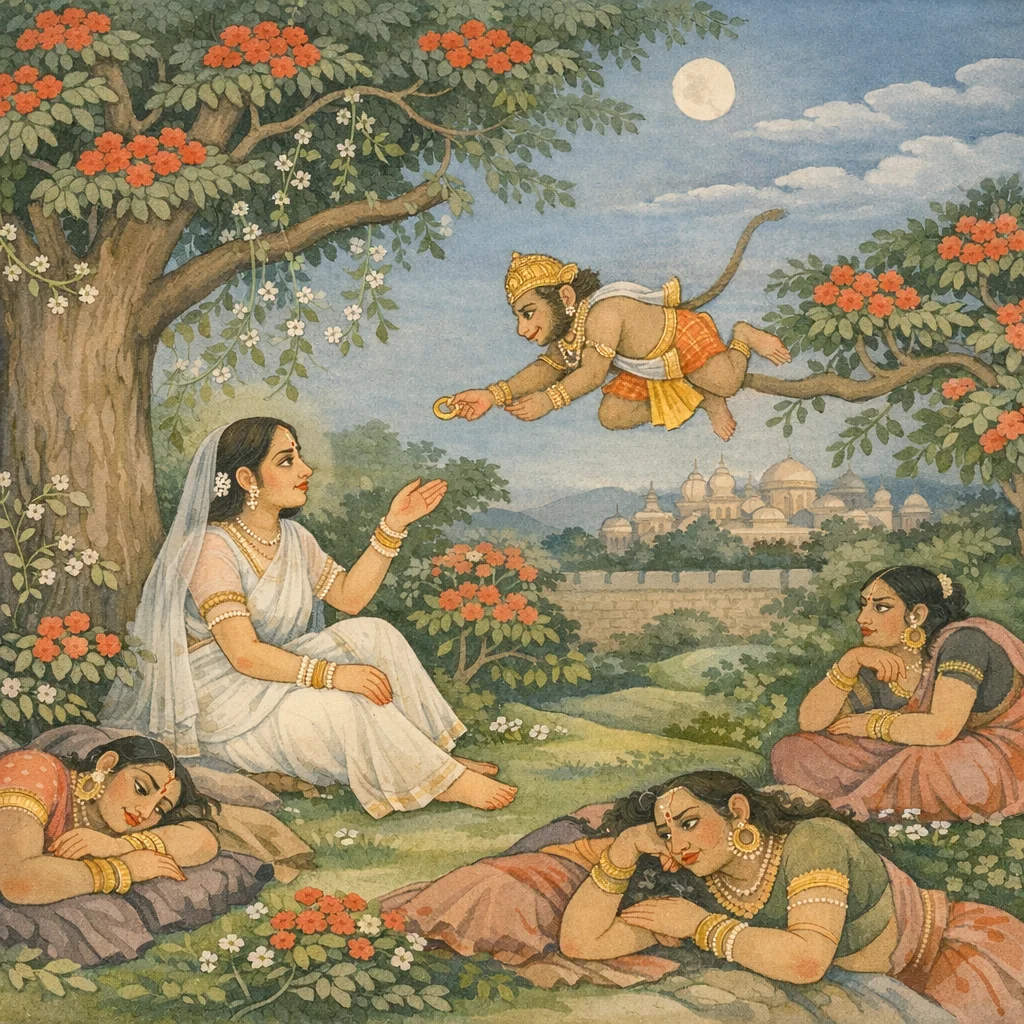
O best of the Vanaras, go forth safely and accomplish your purpose. Bring Vaidehī to reunion with the great-souled Rāghava. O mighty-armed Vanara, be happy—I am pleased with you.
Verse 33
ततोऽहं साधु साध्विति सर्वभूतैः प्रशंसितः।।।।ततोऽन्तरिक्षं विपुलं प्लुतोऽहं गरुडो यथा।
Then all beings praised me, saying, “Well done! Well done!” Thereafter I sprang into the vast sky, like Garuḍa.
Verse 34
छाया मे निगृहीता च न च पश्यामि किंचन।।।।सोऽहं विहतवेगस्तु दिशो दश विलोकयन्।न किञ्चित्तत्र पश्यामि येन मेऽपहृता गतिः।।।।
Then my shadow was seized, and I could not see anything at all (that had caught it).
Verse 35
छाया मे निगृहीता च न च पश्यामि किंचन।।5.58.34।।सोऽहं विहतवेगस्तु दिशो दश विलोकयन्।न किञ्चित्तत्र पश्यामि येन मेऽपहृता गतिः।।5.58.35।।
With my speed checked, I looked around in all ten directions, yet I saw nothing by which I could know who had stolen my movement.
Verse 36
ततो मे बुद्धिरुत्पन्ना किन्नाम गगने मम।ईदृशो विघ्न उत्पन्नो रूपं यत्र न दृश्यते।।5.58.36।।
Then a thought arose in me: “What sort of obstacle has appeared for me in the sky—one whose form cannot be seen?”
Verse 37
अधोभागेन मे दृष्टि श्शोचता पातिता मया।ततोऽद्राक्षमहं भीमां राक्षसीं सलिलेशयाम्।।।।
Thinking thus, I cast my gaze downward; then I saw a fearsome rākṣasī dwelling in the waters.
Verse 38
प्रहस्य च महानादमुक्तोऽहं भीमया तया।अवस्थितमसम्भ्रान्तमिदं वाक्यमशोभनम्।।।।
That fearsome one laughed and, in a loud voice, addressed me. Steady and unflinching, she spoke to me these inauspicious words:
Verse 39
क्वासि गन्ता महाकाय क्षुधिताया ममेप्सितः।भक्षः प्रीणय मे देहं चिरमाहारवर्जितम्।।।।
“Where do you think you are going, O huge-bodied one—desired prey of my hunger? Become my food; satisfy this body of mine, long deprived of nourishment.”
Verse 40
बाढमित्येव तां वाणीं प्रत्यगृह्णामहं ततः।अस्यप्रमाणादधिकं तस्याः कायमपूरयम्।।।।
Then I answered her speech with “So be it,” and I expanded my body to a size greater than what she could measure against me.
Verse 41
तस्याश्चास्यं महद्भीमं वर्धते मम भक्षणे।न च मां साधु बुबुधे मम वा विकृतं कृतम्।।।।
Her huge and dreadful mouth kept widening in order to devour me; yet she did not properly perceive that I had already, of my own will, assumed a monstrous form.
Verse 42
ततोऽहं विपुलं रूपं संक्षिप्य निमिषान्तरात्।तस्या हृदयमादाय प्रपतामि नभ:स्थलम्।।।।
Then, in the space of a blink, I contracted my vast form, tore out her heart, and sprang up into the open sky.
Verse 43
सा विसृष्टभुजा भीमा पपात लवणाम्भसि।मया पर्वतसङ्काशा निकृत्तहृदया सती।।।।
That fearsome one, her arms slackened, fell into the salty ocean—she who was mountain-like—her heart torn out by me.
Verse 44
शृणोमि खगतानां च सिद्धानां चारणैस्सह।राक्षसी सिंहिका भीमा क्षिप्रं हनुमता हता।।।।
I heard those moving in the sky—the Siddhas along with the Cāraṇas—saying: “The fearsome rākṣasī Siṁhikā has been swiftly slain by Hanuman.”
Verse 45
तां हत्वा पुनरेवाहं कृत्यमात्ययिकं स्मरन्।गत्वा चाह महध्वानं पश्यामि नगमण्डितम्।।।।दक्षिणं तीरमुदधेर्लङ्का यत्र च सा पुरी।
Having slain her, I once again remembered the urgent task. Proceeding on that great journey, I beheld the southern shore of the ocean, adorned with mountains—where the city of Laṅkā stands.
Verse 46
अस्तं दिनकरे याते रक्षसां निलयं पुरम्।।5.58.46।।प्रविष्टोऽहमविज्ञातो रक्षोभिर्भीमविक्रमैः।
When the sun had set, I entered—unnoticed by the fierce and valorous rākṣasas—the city that is the abode of the demons.
Verse 47
तत्र प्रविशतश्चापि कल्पान्तघनसन्निभा।।5.58.47।।अट्टहासं विमुञ्चन्ती नारी काप्युत्थिता पुरः।
As I was entering there, a certain woman—dark like a cloud at the end of an age—rose up before me, letting out a loud, terrifying laugh.
Verse 48
जिघांसन्तीं ततस्तां तु ज्वलदग्निशिरोरुहाम्।।।।सव्यमुष्टिप्रहारेण पराजित्य सुभैरवाम्।प्रदोषकाले प्रविशं भीतयाऽहं तयोदितः।।।।
Then that exceedingly terrifying one, whose hair blazed like fire, rushed forth to kill me. Striking with my left fist, I overcame her; and at twilight I entered the city, though she had tried to frighten me.
Verse 49
जिघांसन्तीं ततस्तां तु ज्वलदग्निशिरोरुहाम्।।5.58.48।।सव्यमुष्टिप्रहारेण पराजित्य सुभैरवाम्।प्रदोषकाले प्रविशं भीतयाऽहं तयोदितः।।5.58.49।।
Then that very terrifying one, with hair blazing like fire, came to kill me. I overcame her with a blow of my left fist and entered the city at twilight, despite the fear she sought to raise.
Verse 50
अहं लङ्कापुरी वीर निर्जिता विक्रमेण ते।यस्मात्तस्माद्विजेतासि सर्वरक्षांस्यशेषतः।।।।
“Hero, I am Laṅkā’s presiding power, subdued by your valour. Therefore you will conquer all the rākṣasas without remainder.”
Verse 51
तत्राहं सर्वरात्रं तु विचिन्वन् जनकात्मजाम्।रावणान्तःपुरगतो न चापश्यं सुमध्यमाम्।।।।
There, having entered Rāvaṇa’s inner palace, I searched all night for Janaka’s daughter, yet I did not see that fair-waisted lady.
Verse 52
तत स्सीतामपश्यंस्तु रावणस्य निवेशने।शोकसागरमासाद्य न पारमुपलक्षये।।।।
Then, not finding Sītā in Rāvaṇa’s residence, I fell into an ocean of sorrow and could not discern its far shore—no end in sight.
Verse 53
शोचता च मया दृष्टं प्राकारेण समावृतम्।काञ्चनेन विकृष्टेन गृहोपवनमुत्तमम्।।।।
While I was grieving, I noticed an excellent private garden, enclosed by a long golden wall.
Verse 54
स प्राकारमवप्लुत्य पश्यामि बहुपादपम्।अशोकवनिकामध्ये शिंशुपापादपो महान्।।।।तमारुह्य च पश्यामि काञ्चनं कदलीवनम्।
Crossing that wall, I beheld a grove filled with many kinds of trees. In the middle of the Aśoka garden stood a great śiṃśupā tree; climbing it, I saw a shining (golden) plantation of banana trees.
Verse 55
अदूरे शिंशुपावृक्षात्पश्यामि वरवर्णिनीम्।।।।श्यामां कमलपत्राक्षीमुपवासकृशाननाम्।तदेकवासस्संवीतां रजोध्वस्तशिरोरुहाम्।।।।शोकसन्तापदीनाङ्गीं सीतां भर्तृहिते स्थिताम्।राक्षसीभिर्विरूपाभिः क्रूराभिरभिसंवृताम्।।।।मांसशोणितभक्षाभिर्व्याघ्रीभिर्हरिणीमिव।
Not far from the śiṃśupā tree I saw Sītā—radiant in her natural beauty, dark-hued, lotus-eyed, her face thinned by fasting—clad in a single garment, her hair soiled with dust. Wasted by grief and anguish, she remained devoted to her husband’s good, yet was ringed about by hideous, cruel rākṣasī women who fed on flesh and blood, like a doe surrounded by tigresses.
Verse 56
अदूरे शिंशुपावृक्षात्पश्यामि वरवर्णिनीम्।।5.58.55।।श्यामां कमलपत्राक्षीमुपवासकृशाननाम्।तदेकवासस्संवीतां रजोध्वस्तशिरोरुहाम्।।5.58.56।।शोकसन्तापदीनाङ्गीं सीतां भर्तृहिते स्थिताम्।राक्षसीभिर्विरूपाभिः क्रूराभिरभिसंवृताम्।।5.58.57।।मांसशोणितभक्षाभिर्व्याघ्रीभिर्हरिणीमिव।
I saw her—dark-hued, lotus-petalled in her eyes—her face thinned by fasting; wrapped in a single garment, with her hair matted and dust-strewn.
Verse 57
अदूरे शिंशुपावृक्षात्पश्यामि वरवर्णिनीम्।।5.58.55।।श्यामां कमलपत्राक्षीमुपवासकृशाननाम्।तदेकवासस्संवीतां रजोध्वस्तशिरोरुहाम्।।5.58.56।।शोकसन्तापदीनाङ्गीं सीतां भर्तृहिते स्थिताम्।राक्षसीभिर्विरूपाभिः क्रूराभिरभिसंवृताम्।।5.58.57।।मांसशोणितभक्षाभिर्व्याघ्रीभिर्हरिणीमिव।
Sītā—her limbs weakened by grief and torment—remained fixed in devotion to her husband’s good; she was hemmed in by hideous, cruel rākṣasīs, flesh-and-blood eaters, like a doe surrounded by tigresses.
Verse 58
सा मया राक्षसीमध्ये तर्ज्यमाना मुहुर्मुहुः।।5.58.58।।एकवेणीधरा दीना भर्तृचिन्तापरायणा।भूमिशय्या विवर्णाङ्गी पद्मिनीव हिमागमे।।5.58.59।।रावणाद्विनिवृत्तार्था मर्तव्यकृतनिश्चया।कथञ्चिन्मृगशाबाक्षी तूर्णमासादिता मया।।5.58.60।।
There she was—again and again threatened—amidst the demonesses, as I observed.
Verse 59
सा मया राक्षसीमध्ये तर्ज्यमाना मुहुर्मुहुः।।5.58.58।।एकवेणीधरा दीना भर्तृचिन्तापरायणा।भूमिशय्या विवर्णाङ्गी पद्मिनीव हिमागमे।।5.58.59।।रावणाद्विनिवृत्तार्था मर्तव्यकृतनिश्चया।कथञ्चिन्मृगशाबाक्षी तूर्णमासादिता मया।।5.58.60।।
Wearing her hair in a single braid, miserable and wholly absorbed in thoughts of her husband, she lay upon the bare ground—her body grown pale, like a lotus at the coming of winter.
Verse 60
सा मया राक्षसीमध्ये तर्ज्यमाना मुहुर्मुहुः।।5.58.58।।एकवेणीधरा दीना भर्तृचिन्तापरायणा।भूमिशय्या विवर्णाङ्गी पद्मिनीव हिमागमे।।5.58.59।।रावणाद्विनिवृत्तार्था मर्तव्यकृतनिश्चया।कथञ्चिन्मृगशाबाक्षी तूर्णमासादिता मया।।5.58.60।।
Having turned away from any hope of yielding to Rāvaṇa, resolved upon death, that fawn-eyed lady was—somehow—found by me at last, and quickly.
Verse 61
तां दृष्ट्वा तादृशीं नारीं रामपत्नीं यशस्विनीम्।तत्रैव शिंशुपावृक्षे पश्यन्नहमवस्थितः।।।।
Having seen that renowned woman—Rāma’s wife—in such a state, I stayed right there, watching from the śiṃśupā tree.
Verse 62
ततो हलहलाशब्दं काञ्चीनूपुरमिश्रितम्।शृणोम्यधिकगम्भीरं रावणस्य निवेशने।।।।
Then I heard, from within Rāvaṇa’s residence, a deep and weighty clamor, mingled with the jingling of girdles and anklets.
Verse 63
ततोऽहं परमोद्विग्नः स्वं रूपं प्रत्यसंहरम्।अहं तु शिंशुपावृक्षे पक्षीव गहने स्थितः।।।।
Then, greatly alarmed, I drew my form back (made myself small), and stayed hidden in the dense foliage of the śiṃśupā tree like a bird.
Verse 64
ततो रावणदाराश्च रावणश्च महाबलः।तं देशं समनुप्राप्ता यत्र सीताऽभवत् स्थिता।।।।
Then the mighty Rāvaṇa, along with his women, came to that very spot where Sītā was staying.
Verse 65
तं दृष्ट्वाथ वरारोहा सीता रक्षोगणेश्वरम्।सङ्कुच्योरूस्तनौ पीनौ बाहुभ्यां परिरभ्य च।।।।
Seeing Rāvaṇa, the lord of the rākṣasa hosts, fair-hipped Sītā drew herself inward in fear, covering her full breasts by folding her arms and pressing her thighs together.
Verse 66
वित्रस्तां परमोद्विग्नां वीक्षमाणां ततस्ततः।त्राणं किञ्चिदपश्यन्तीं वेपमानां तपस्विनीम्।।।।तामुवाच दशग्रीवस्सीतां परमदुःखिताम्।अवाक्चिराः प्रपतितो बहुमन्यस्व मामिति।।।।
Sītā—terrified, deeply shaken, looking about in every direction, seeing no refuge at all, trembling, and firm in her austerity—was then addressed by Daśagrīva. Bowing his head, Rāvaṇa spoke to the grief-stricken Sītā: “Place your trust in me; honor me.”
Verse 67
वित्रस्तां परमोद्विग्नां वीक्षमाणां ततस्ततः।त्राणं किञ्चिदपश्यन्तीं वेपमानां तपस्विनीम्।।5.58.66।।तामुवाच दशग्रीवस्सीतां परमदुःखिताम्।अवाक्चिराः प्रपतितो बहुमन्यस्व मामिति।।5.58.67।।
This entry repeats the same content across two numbering points in the Southern Recension: Sītā, terrified and trembling, finds no refuge; Rāvaṇa bows his head and urges her, “Trust me; honor me.”
Verse 68
यदि चेत्त्वं तु दर्पान्मां नाभिनन्दसि गर्विते।द्वौ मासावन्तरं सीते पास्यामि रुधिरं तव।।।।
“If, proud woman, you do not accept me out of arrogance, then within two months, O Sītā, I shall see your blood.”
Verse 69
एतच्छ्रुत्वा वचस्तस्य रावणस्य दुरात्मनः।उवाच परमक्रुद्धा सीता वचनमुत्तमम्।।।।
Hearing those words of the evil-minded Rāvaṇa, Sītā—burning with anger—replied with a noble and fitting response.
Verse 70
राक्षसाधम रामस्य भार्याममिततेजसः।इक्ष्वाकुकुलनाथस्य स्नुषां दशरथस्य च।।।।अवाच्यं वदतो जिह्वा कथं न पतिता तव।
“O vilest of rākṣasas! I am the wife of Rāma of immeasurable splendor, the daughter-in-law of Daśaratha, lord of the Ikṣvāku line. How has your tongue not fallen out, speaking what should never be spoken?”
Verse 71
किञ्चिद्वीर्यं तवानार्य यो मां भर्तुरसन्निधौ।।।।अपहृत्याऽऽगतः पाप ते नादृष्टो महात्मना।
“You have no valor at all, ignoble sinner—you who, when my husband was absent, carried me off and came away without being seen by the great-souled Rāma.”
Verse 72
न त्वं रामस्य सदृशो दास्येऽप्यस्य न युज्यसे।।।।यज्ञीय स्सत्यवादी च रणश्लाघी च राघवः।
“You are not equal to Rāma—indeed, you are not fit even to be his servant. Rāghava is worthy of sacrifice, a speaker of truth, and renowned for valor in battle.”
Verse 73
जानक्या परुषं वाक्यमेवमुक्तो दशाननः।।।।जज्वाल सहसा कोपाच्चितास्थ इव पावकः।
Thus spoken to with harsh words by Jānakī, the ten-headed one suddenly flared up with anger, like fire blazing on a funeral pyre.
Verse 74
विवृत्य नयने क्रूरे मुष्टिमुद्यम्य दक्षिणम्।।।।मैथिलीं हन्तुमारब्ध: स्त्रीभिर्हाहाकृतं तदा।
Opening his cruel eyes wide and raising his right fist, Rāvaṇa began to strike Maithilī (Sītā); then the women there cried out in alarm, “Alas! Alas!”
Verse 75
स्त्रीणां मध्यात्समुत्पत्य तस्य भार्या दुरात्मनः।।।।वरा मन्दोदरी नाम तया स प्रतिषेधितः।
Then, rising from among the women, Mandodarī—wife of that evil-minded one, a noble lady—came forward and restrained him.
Verse 76
उक्तश्च मधुरां वाणीं तया स मदनार्दितः।।।।सीतया तव किं कार्यं महेन्द्रसमविक्रमः।
Speaking sweetly, Mandodarī addressed him—though he was tormented by desire: “You whose prowess equals Mahendra’s, what need have you of Sītā?”
Verse 77
देवगन्धर्वकन्याभिर्यक्षकन्याभिरेव च।।।।सार्धं प्रभो रमस्वेह सीतया किं करिष्यसि।
“O Lord, enjoy here with the daughters of the gods and Gandharvas, and with the maidens of the Yakṣas as well. What will you do with Sītā?”
Verse 78
ततस्ताभिस्समेताभिर्नारीभिस्स महाबलः।।।।प्रसाद्य सहसा नीतो भवनं स्वं निशाचरः।
Then, with those women gathered together, they appeased the mighty night-wanderer and quickly led him back to his own palace.
Verse 79
याते तस्मिन् दशग्रीवे राक्षस्यो विकृताननाः।।5.58.79।।सीतां निर्भर्त्सयामासुर्वाक्यैः क्रूरैस्सुदारुणैः।
When that ten-necked (Rāvaṇa) had gone, the hideous-faced demonesses began to harass Sītā with cruel and terrifying words.
Verse 80
तृणवद्भाषितं तासां गणयामास जानकी।।।।गर्जितं च तदा तासां सीतां प्राप्य निरर्थकम्।
Jānakī treated their talk like a mere blade of grass; and their roaring threats, directed at Sītā, proved useless.
Verse 81
वृथागर्जितनिश्चेष्टा राक्षस्यः पिशिताशनाः।।।।रावणाय शशंसुस्ताः सीताध्यवसितं महत्।
Finding their roaring threats futile, the flesh-eating demonesses reported to Rāvaṇa the great firmness of Sītā’s resolve.
Verse 82
ततस्तास्सहितास्सर्वा निहताशा निरुद्यमाः।।।।परिक्षिप्य समन्तात्तां निद्रावशमुपागताः।
Then all of them together—hopes dashed and efforts abandoned—spread themselves around her on every side and fell under the sway of sleep.
Verse 83
तासु चैव प्रसुप्तासु सीता भर्तृहिते रता।।5.58.83।।विलप्य करुणं दीना प्रशुशोच सुदुःखिता।
When those rākṣasī women had fallen asleep, Sītā—ever devoted to her husband’s welfare—cried piteously and, wretched and deeply afflicted, continued to lament.
Verse 84
तासां मध्यात्समुत्थाय त्रिजटा वाक्यमब्रवीत्।।।।आत्मानं खादत क्षिप्रं न सीता विनशिष्यति।जनकस्यात्मजा साध्वी स्नुषा दशरथस्य च।।।।
Rising from their midst, Trijaṭā said: “Eat me at once, if you wish—Sītā will not perish. She is the virtuous daughter of Janaka and the daughter-in-law of Daśaratha.”
Verse 85
तासां मध्यात्समुत्थाय त्रिजटा वाक्यमब्रवीत्।।5.58.84।।आत्मानं खादत क्षिप्रं न सीता विनशिष्यति।जनकस्यात्मजा साध्वी स्नुषा दशरथस्य च।।5.58.85।।
Again Trijaṭā, rising among them, declared: “Eat me at once if you will—Sītā will not be destroyed. She is Janaka’s virtuous daughter and Daśaratha’s daughter-in-law.”
Verse 86
स्वप्नो ह्यद्य मया दृष्टो दारुणो रोमहर्षणः।रक्षसां च विनाशाय भर्तुरस्या जयाय च।।।।
“Today I saw a dream—terrible and hair-raising—foretelling the destruction of the rākṣasas and the victory of her husband.”
Verse 87
अलमस्मात्परित्रातुं राघवाद्राक्षसीगणम्।अभियाचाम वैदेहीमेतद्धि मम रोचते।।।।
“To save the rākṣasī clan from Rāghava, it is enough that we beg Vaidehī for mercy—this is what seems right to me.”
Verse 88
यस्या ह्येवंविधस्स्वप्नो दुःखितायाः प्रदृश्यते।सा दुःखैर्विविधैर्मुक्ता सुखमाप्नोत्यनुत्तमम्।।।।प्रणिपातप्रसन्ना हि मैथिली जनकात्मजा।
“For one who is sorrowing, if such a dream is seen, she is freed from many griefs and attains unsurpassed happiness. Maithilī, Janaka’s daughter, becomes gracious when one bows down in supplication.”
Verse 89
ततस्सा ह्रीमती बाला भर्तुर्विजयहर्षिता।।।।अवोचद्यदि तत्तथ्यं भवेयं शरणं हि वः।
Then the modest young Sītā, gladdened at the thought of her husband’s victory, said: “If that proves true, I shall indeed be a refuge to you.”
Verse 90
तां चाहं तादृशीं दृष्ट्वा सीताया दारुणां दशाम्।चिन्तयामास विक्रान्तो न च मे निर्वृतं मनः।।।।
Seeing Sītā in such a dreadful condition, I—though valiant—began to brood, and my mind found no peace.
Verse 91
सम्भाषणार्थं च मया जानक्याश्चिन्तितो विधिः।।।।इक्ष्वाकूणां हि वंशस्तु ततो मम पुरस्कृतः।
And I devised a means to begin speaking with Jānakī; therefore I chose first to extol the lineage of the Ikṣvākus.
Verse 92
श्रुत्वा तु गदितां वाचं राजर्षिगणपूजिताम्।।।।प्रत्यभाषत मां देवी बाष्पैः पिहितलोचना।
After hearing my words—made reverent by the invocation of royal seers—the divine lady replied to me, her eyes veiled by tears.
Verse 93
कस्त्वं केन कथं चेह प्राप्तो वानरपुङ्गवः।।।।का च रामेण ते प्रीतिस्तन्मे शंसितुमर्हसि।
“Who are you, O best of the Vānaras? For what reason, and by what means, have you come here? And what bond of friendship do you have with Rāma? Tell me that fully.”
Verse 94
तस्यास्तद्वचनं श्रुत्वा ह्यहमप्यब्रुवं वचः।।।।देवि रामस्य भर्तुस्ते सहायो भीमविक्रमः।सुग्रीवो नाम विक्रान्तो वानरेन्द्रो महाबलः।।।।
Hearing her words, I too replied: “O noble lady, your lord Rāma has an ally—mighty and of fearsome valor—Sugrīva by name, the powerful king of the Vānaras.”
Verse 95
तस्यास्तद्वचनं श्रुत्वा ह्यहमप्यब्रुवं वचः।।5.58.94।।देवि रामस्य भर्तुस्ते सहायो भीमविक्रमः।सुग्रीवो नाम विक्रान्तो वानरेन्द्रो महाबलः।।5.58.95।।
This verse is a duplicated/overlapping transmission of the preceding statement in this Southern Recension stream: Hanumān reiterates that Rāma’s ally is Sugrīva, the powerful Vānara king of formidable prowess.
Verse 96
तस्य मां विद्धि भृत्यं त्वं हनुमन्तमिहागतम्।भर्त्राहं प्रेषितस्तुभ्यं रामेणाक्लिष्टकर्मणा।।।।
“Know me to be his servant—Hanumān—who has come here. I have been sent to you by your husband Rāma, tireless in action.”
Verse 97
इदं च पुरुषव्याघ्रः श्रीमान् दाशरथिः स्वयम्।अङ्गुलीयमभिज्ञानमदात्तुभ्यं यशस्विनि।।।।
“And this ring—sent as a sign of recognition—was given for you by the illustrious Dāśarathi himself, that tiger among men, O renowned lady.”
Verse 98
तदिच्छामि त्वयाऽऽज्ञप्तं देवि किं करवाण्यहम्।रामलक्ष्मणयोः पार्श्वं नयामि त्वां किमुत्तरम्।।।।
“O lady, I wish to know your command—what should I do? Shall I take you to the side of Rāma and Lakṣmaṇa? What is your decision?”
Verse 99
एतच्छ्रुत्वा विदित्वा च सीता जनकनन्दिनी।आहरावणमुत्साद्य राघवो मां नयत्विति।।।।
Having heard this and reflected, Sītā—Janaka’s beloved daughter—said: “Let Rāghava destroy Rāvaṇa and then take me away.”
Verse 100
प्रणम्य शिरसा देवीं महमार्यामनिन्दिताम्।राघवस्य मनोह्लादमभिज्ञानमयाचिषम्।।।।
Bowing my head, I paid reverence to the noble, blameless queen, and requested a token of recognition—one that would delight Rāghava’s heart.
Verse 101
अथ मामब्रवीत्सीता गृह्यतामयमुत्तमः।मणिर्येन महाबाहू रामस्त्वां बहुमन्यते।।।।
Then Sītā said to me, “Take this finest jewel—by which the long-armed Rāma will recognize you and hold you in high regard.”
Verse 102
इत्युक्त्वा तु वरारोहा मणिप्रवरमद्भुतम्।प्रायच्छत्परमोद्विग्ना वाचा मां सन्दिदेशह।।।।
Having spoken thus, the fair-hipped lady, deeply distressed, gave me that wondrous, foremost jewel and conveyed her message in words.
Verse 103
ततस्तस्यै प्रणम्याहं राजपुत्र्यै समाहितः।प्रदक्षिणं परिक्राममिहाभ्युद्गतमानसः।।।।
Then, with a composed mind, I bowed to that princess and circumambulated her reverently, my heart uplifted for the task ahead.
Verse 104
उक्तोऽहं पुनरेवेदं निश्चित्य मनसा तया।हनुमन्मम वृत्तान्तं वक्तुमर्हसि राघवे।।5.58.104।।
Again she told me this, having resolved it in her mind: “Hanumān, you must relate my full account to Rāghava.”
Verse 105
यथा श्रुत्वैव न चिरात्तावुभौ रामलक्ष्मणौ।सुग्रीवसहितौ वीरावुपेयातां तथा कुरु।।।।
“Speak in such a way that, as soon as they hear, those two heroes—Rāma and Lakṣmaṇa—may come here without delay, accompanied by Sugrīva; make it so.”
Verse 106
यद्यन्यथा भवेदेतद्द्वौ मासौ जीवितं मम।न मां द्रक्ष्यति काकुत्स्थो म्रिये साहमनाथवत्।।।।
If things turn out otherwise, I have only two months of life left. Kākutstha (Rāma) will not see me again; I shall die like one bereft of all protection.
Verse 107
तच्छ्रुत्वा करुणं वाक्यं क्रोधो मामभ्यवर्तत।उत्तरं च मया दृष्टं कार्यशेषमनन्तरम्।।।।
Hearing her pitiable words, anger surged over me; and at once I perceived what remained for me to do next as my reply in action.
Verse 108
ततोऽवर्धत मे कायस्तदा पर्वतसन्निभः।युद्धकाङ्क्षी वनं तच्च विनाशयितुमारभे।।।।
Then my body expanded, towering like a mountain. Longing for battle, I began to destroy that grove.
Verse 109
तद्भग्नं वनषण्डं तु भ्रान्तत्रस्तमृगद्विजम्।प्रतिबुद्धा निरीक्षन्ते राक्षस्यो विकृताननाः।।।।
The ugly-faced rākṣasī-women awoke and saw that thicket shattered—beasts and birds running about in terror and confusion.
Verse 110
मां च दृष्ट्वा वने तस्मिन् समागम्य ततस्ततः।ता स्समभ्यागताः क्षिप्रं रावणायाचचक्षिरे।।5.58.110।।
Seeing me in that grove, they gathered from here and there, and quickly went and reported the matter to Rāvaṇa.
Verse 111
राजस्वनमिदं दुर्गं तव भग्नं दुरात्मना।वानरेण ह्यविज्ञाय तव वीर्यं महाबल।।।।
O mighty king! This inaccessible grove of yours has been wrecked by an evil-minded vanara, not recognizing your valor.
Verse 112
दुर्बुद्धेस्तस्य राजेन्द्र तव विप्रियकारिणः।वधमाज्ञापय क्षिप्रं यथासौ विलयं व्रजेत्।।।।
O lord of kings, order the killing of that wicked-minded one who has acted against your interests, so that he may swiftly meet his end.
Verse 113
तच्छ्रुत्वा राक्षसेन्द्रेण विसृष्टा भृशदुर्जयाः।राक्षसाः किङ्करा नाम रावणस्य मनोनुगाः।।।।
Hearing this, the lord of rākṣasas dispatched rākṣasas called Kiṅkaras—fierce and hard to overcome—attuned to Rāvaṇa’s will.
Verse 114
तेषामशीतिसाहस्रं शूलमुद्गरपाणिनाम्।मया तस्मिन्वनोद्देशे परिघेण निषूदितम्।।।।
There, in that part of the grove, I slew eighty thousand of them—bearing tridents and maces—using an iron bar as my weapon.
Verse 115
तेषां तु हतशेषा ये ते गत्वा लघुविक्रमाः।निहतं च महत्सैन्यं रावणायाचचक्षिरे।।।।
Those who survived among them—the weaker fighters—went and reported to Rāvaṇa that the great force had been slain.
Verse 116
ततो मे बुद्धिरुत्पन्ना चैत्यप्रासादमाक्रमम्।तत्रस्थान्राक्षसान् हत्वा शतं स्तम्भेन वै पुनः।।।।ललामभूतो लङ्कायास्स वै विध्वंसितो मया।
Then a plan arose in my mind: I stormed the lofty shrine-mansion; and with a pillar I again slew a hundred rākṣasas stationed there. That building—an ornament of Laṅkā—was destroyed by me.
Verse 117
ततः प्रहस्तस्य सुतं जम्बुमालिनमादिशत्।।5.58.117।।राक्षसैर्बहुभिस्सार्धं घोररूपैर्भयानकैः।
Then (Rāvaṇa) ordered Jambumālin, the son of Prahasta, to go—together with many rākṣasas of dreadful and terrifying appearance.
Verse 118
तं महाबलसम्पन्नं राक्षसं रणकोविदम्।।।।परिघेणातिघोरेण सूदयामि सहानुगम्।
That rākṣasa—mighty in strength and skilled in battle—I slew with a most dreadful iron bar, along with his attendants.
Verse 119
तच्छ्रुत्वा राक्षसेन्द्रस्तु मन्त्रिपुत्त्रान्महाबलान्।।।।पदातिबलसम्पन्नान् प्रेषयामास रावणः।
Hearing this, Rāvaṇa—the lord of rākṣasas—sent forth the ministers’ sons, mighty and well-equipped in infantry strength.
Verse 120
परिघेणैव तान् सर्वान्नयामि यमसादनम्।।।।मन्त्रिपुत्त्रान्हतान्च्छृत्वा समरेऽलघुविक्रमान्।पञ्च सेनाग्रगाच्छ्रूरान्प्रेषयामास रावणः।।।।
With the iron bar alone I sent them all to Yama’s abode. When he heard that the ministers’ sons—fighters of no small prowess—had been slain in battle, Rāvaṇa dispatched five heroic leaders of the army’s vanguard.
Verse 121
परिघेणैव तान् सर्वान्नयामि यमसादनम्।।5.58.120।।मन्त्रिपुत्त्रान्हतान्च्छृत्वा समरेऽलघुविक्रमान्।पञ्च सेनाग्रगाच्छ्रूरान्प्रेषयामास रावणः।।5.58.121।।
With the iron bar alone I sent them all to Yama’s abode. Hearing that the ministers’ sons—formidable in battle—had been killed, Rāvaṇa dispatched five heroic vanguard leaders.
Verse 122
तानहं सहसैन्यान्वै सर्वानेवाभ्यसूदयम्।ततः पुनर्दशग्रीवः पुत्रमक्षं महाबलम्।।।।बहुभी राक्षसैस्सार्धं प्रेषयामास रावणः।
I slew all of them, indeed, along with their troops. Then Daśagrīva again—Rāvaṇa—sent his mighty son Akṣa, together with many rākṣasas.
Verse 123
तं तु मन्दोदरीपुत्त्रं कुमारं रणपण्डितम्।।।।सहसा खं समुत्क्रान्तं पादयोश्च गृहीतवान्।चर्मासिनं शतगुणं भ्रामयित्वा व्यपेषयम्।।।।
But that youth—Mandodarī’s son, skilled in war—when he suddenly rose into the sky, I seized him by both feet; whirling him a hundredfold, I crushed him down.
Verse 124
तं तु मन्दोदरीपुत्त्रं कुमारं रणपण्डितम्।।5.58.123।।सहसा खं समुत्क्रान्तं पादयोश्च गृहीतवान्।चर्मासिनं शतगुणं भ्रामयित्वा व्यपेषयम्।।5.58.124।।
When he suddenly leapt up into the sky, I seized him by both feet; then, whirling that fighter around a hundred times, I smashed him down.
Verse 125
तमक्षमागतं भग्नं निशम्य स दशाननः।तत इन्द्रजितं नाम द्वितीयं रावणस्सुतम्।।।।व्यादिदेश सुसंकृद्धो बलिनम् युद्धदुर्मदम्।
Hearing that Akṣa had come to ruin, the ten-faced Rāvaṇa flared up in fury; then he issued orders to his second son, named Indrajit—mighty and maddened with the pride of war.
Verse 126
तच्चाप्यहं बलं सर्वं तं च राक्षसपुङ्गवम्।।।।नष्टौजसं रणे कृत्वा परं हर्षमुपागमम्।
And after I had shattered all that force in battle—along with that foremost of rākṣasas, drained of his might—I experienced great joy.
Verse 127
महतापि महाबाहुः प्रत्ययेन महाबलः।।।।प्रेषितो रावणेनैव सह वीरैर्मदोत्कटैः।
Then the mighty, long-armed one—relying on great confidence—was dispatched by Rāvaṇa, accompanied by warriors swollen with pride.
Verse 128
सोऽविषह्यं हि मां बुद्ध्वा स्वं बलं चावमर्दितम्।।।।ब्राह्मणास्त्रेण स तु मां प्राबध्नाच्छातिवेगितः।
Knowing that I was hard to overpower and that his own strength had been checked, he swiftly bound me with the Brahmā-weapon.
Verse 129
रज्जुभिश्चाभिबध्नन्ति ततो मां तत्र राक्षसाः।।।।रावणस्य समीपं च गृहीत्वा मामुपानयन्।
Then the rākṣasas there bound me with ropes as well, seized me, and brought me into Rāvaṇa’s presence.
Verse 130
दृष्ट्वा सम्भाषितश्चाहं रावणेन दुरात्मना।।।।पृष्टश्च लङ्कागमनं राक्षसानां च तं वधम्।
On seeing me, the wicked-souled Rāvaṇa spoke with me and questioned me about my coming to Laṅkā and about the slaying of those rākṣasas.
Verse 131
तत्सर्वं च मया तत्र सीतार्थमिति जल्पितम्।।।।अस्याहं दर्शनाकाङ्क्षी प्राप्तस्त्वद्भवनं विभो।मारुतस्यौरसः पुत्रो वानरो हनुमानहम्।।।।
‘O son, in ancient times the foremost mountains had wings; moving as they pleased, they ranged over the earth on every side, causing distress.’
Verse 132
तत्सर्वं च मया तत्र सीतार्थमिति जल्पितम्।।5.58.131।।अस्याहं दर्शनाकाङ्क्षी प्राप्तस्त्वद्भवनं विभो।मारुतस्यौरसः पुत्रो वानरो हनुमानहम्।।5.58.132।।
There I stated everything plainly: ‘It was for Sītā’s sake. Desiring to see her, I have come to your palace, O lord. I am Hanumān, a vāṇara—the true-born son of Māruta.’
Verse 133
रामदूतं च मां विद्धि सुग्रीवसचिवं कपिम्।सोऽहं दूत्येन रामस्य त्वत्सकाशमिहागतः।।।।
Know me as a vānara—Rāma’s envoy and Sugrīva’s minister. It is I who have come here to you on Rāma’s mission as his messenger.
Verse 134
सुग्रीवश्च महातेजास्सत्वां कुशलमब्रवीत्।धर्मार्थकामसहितं हितं पथ्यमुवाच च।।।।
Sugrīva, of great splendour, inquires after your welfare; and he conveys counsel that is beneficial and wholesome—aligned with dharma, artha, and kāma.
Verse 135
वसतो ऋश्यमूके मे पर्वते विपुलद्रुमे।राघवो रणविक्रान्तो मित्त्रत्वं समुपागतः।।।।
While I was dwelling on Ṛśyamūka mountain, rich with great trees, Rāghava—valiant in battle—entered into friendship with us.
Verse 136
तेन मे कथितं राज्ञा भार्या मे रक्षसा हृता।तत्र साहाय्यमस्माकं कार्यं सर्वात्मना त्वया।।।।
Then the king told me: ‘My wife has been abducted by a rākṣasa. In that matter, you must render us help with your whole being.’
Verse 137
मया च कथितं तस्मै वालिनश्च वधं प्रति।तत्र साहाय्यहेतोर्मे समयं कर्तुमर्हसि।।।।
And I, in turn, told him about Vālin and the matter of his slaying; and for the sake of mutual aid, you should enter into an agreement (with us).
Verse 138
वालिना हृतराज्येन सुग्रीवेण महाप्रभुः।चक्रेऽग्निसाक्षिकं सख्यं राघवस्सह लक्ष्मणः।।।।
With Sugrīva—whose kingdom had been taken by Vālin—the great lord Rāghava, together with Lakṣmaṇa, made a friendship sworn with Fire as witness.
Verse 139
तेन वालिनमुत्पाट्य शरेणैकेन संयुगे।वानराणां महाराजः कृतस्स प्लवतां प्रभुः।।।।
Then, in battle, he struck down Vālin with a single arrow, and he made Sugrīva the great king—lord of the vānara hosts.
Verse 140
तस्य साहाय्यमस्माभिः कार्यं सर्वात्मना त्विह।तेन प्रस्थापितस्तुभ्यं समीपमिह धर्मतः।।।।
Therefore, here and now, we must aid him with our whole strength; for that reason I have been sent—rightfully and in accordance with dharma—into your presence.
Verse 141
क्षिप्रमानीयतां सीता दीयतां राघवाय च।यावन्न हरयो वीरा विधमन्ति बलं तव।।।।
Let Sītā be brought back at once and given to Rāghava—before the heroic vānara warriors destroy your forces.
Verse 142
वानराणां प्रभावो हि न केन विदितः पुरा।देवतानां सङ्काशं च ये गच्छन्ति निमन्त्रिताः।।।।
Who, in earlier times, did not know the might of the Vānara hosts? When summoned, they even go forth as the equals of the gods, ready to render aid.
Verse 143
इति वानरराजस्त्वामाहेत्यभिहितो मया।मामैक्षत ततः क्रुद्धश्चक्षुषा प्रदहन्निव।।।।
“Thus,” I said, “the king of the Vānaras has sent this message to you for your welfare.” Then Rāvaṇa glared at me in fury, as though his eyes would burn me.
Verse 144
तेन वध्योऽहमाज्ञप्तो रक्षसा रौद्रकर्मणा।मत्प्रभावमविज्ञाय रावणेन दुरात्मना।।।।
That wicked Rāvaṇa—doer of cruel deeds—ordered that I be slain, not understanding my true power.
Verse 145
ततो विभीषणो नाम तस्य भ्राता महामतिः।तेन राक्षसराजोऽसौ याचितो मम कारणात्।।।।
Then his brother named Vibhīṣaṇa, a man of noble understanding, pleaded with that king of the Rākṣasas on my account.
Verse 146
नैवं राक्षसशार्दूल त्यज्यतामेष निश्चयः।राजशास्त्रव्यपेतो हि मार्गः संसेव्यते त्वया।।।।
“Not so, O tiger among Rākṣasas—abandon this resolve. The path you are taking departs from the royal codes and ought not to be followed.”
Verse 147
दूतवध्या न दृष्टा हि राजशास्त्रेषु राक्षस।दूतेन वेदितव्यं च यथार्थं हितवादिना।।।।
“O Rākṣasa, the royal treatises do not sanction the killing of an envoy. A messenger who seeks the other’s good must be allowed to state the truth as it is.”
Verse 148
सुमहत्यपराधेऽपि दूतस्यातुलविक्रमः।विरूपकरणं दृष्टं न वधोऽस्तीति शास्त्रतः।।।।
“O man of immeasurable valor: even if an envoy commits a grave offense, the texts allow only disfigurement as punishment—never execution.”
Verse 149
विभीषणेनैवमुक्तो रावणस्सन्दिदेश तान्।राक्षसानेतदेवास्य लाङ्गूलं दह्यतामिति।।।।
Thus addressed by Vibhīṣaṇa, Rāvaṇa commanded those Rākṣasas: “Let his tail be burned—this alone.”
Verse 150
ततस्तस्य वचः श्रुत्वा मम पुच्छं समन्ततः।वेष्टितं शणवल्कैश्च जीर्णैः कार्पासजैः पटैः।।।।
Then, hearing his command, they wrapped my tail all around with strips of fiber-cloth and with worn-out cotton rags.
Verse 151
राक्षसाः सिद्धसन्नाहास्ततस्ते चण्डविक्रमाः।तदाऽदह्यन्त मे पुच्छं निघ्नन्त: काष्ठमुष्टिभिः।।।।बद्धस्य बहुभिः पाशैर्यन्त्रितस्य च राक्षसैः।
Then the rākṣasas—fully armed and fierce in valor—beat me with clubs of wood and with their fists. Having bound me with many ropes and held me fast, they set my tail on fire.
Verse 152
ततस्ते राक्षसाश्शूरा बद्धं मामग्निसंवृतम्।।।।अघोषयन्राजमार्गे नगरद्वारमागताः।
Then the courageous rākṣasas, keeping me bound and wreathed in flame, paraded me along the royal road, loudly proclaiming it as they reached the city-gate.
Verse 153
ततोऽहं सुमहद्रूपं संक्षिप्य पुनरात्मनः।।।।विमोचयित्वा तं बन्धं प्रकृतिस्थः स्थितः पुनः।आयसं परिघं गृह्य तानि रक्षांस्यसूदयम्।।।।
Then I drew my vast form back into a smaller one, slipped free of that bondage, and again stood in my natural power. Seizing an iron bar, I struck down those rākṣasas.
Verse 154
ततोऽहं सुमहद्रूपं संक्षिप्य पुनरात्मनः।।5.58.153।।विमोचयित्वा तं बन्धं प्रकृतिस्थः स्थितः पुनः।आयसं परिघं गृह्य तानि रक्षांस्यसूदयम्।।5.58.154।।
Then I contracted my immense form, freed myself from those bonds, and returned to my natural might; taking up an iron bar, I destroyed those rākṣasas.
Verse 155
ततस्तन्नगरद्वारं वेगेनाप्लुतवानहम्।पुच्छेन च प्रदीप्तेन तां पुरीं साट्टगोपुराम्।।।।दहाम्यहमसंभ्रान्तो युगान्ताग्निरिव प्रजाः।
Then I sprang swiftly to the city-gate; and with my tail blazing, I began to burn that city with its ramparts and great gateways—calm and unconfused, like the end-time fire consuming the world.
Verse 156
विनष्टा जानकी व्यक्तं न ह्यदग्धः प्रदृश्यते।।5.58.156।।लङ्कायां कश्चिदुद्धेशः सर्वा भस्मीकृता पुरी।
Surely Jānakī has been destroyed—no place in Lanka appears left unburnt; the entire city has been reduced to ash.
Verse 157
दहता च मया लङ्कां दग्धा सीता न संशयः।।।।रामस्य हि महत्कार्यं मयेदं वितथीकृतम्।
As I burned Lanka, Sītā too must have been burned—there is no doubt. By my own act, Rama’s great purpose has been made futile.
Verse 158
इति शोकसमाविष्टश्चिन्तामहमुपागतः।।।।अथाहं वाचमश्रौषं चारणानां शुभाक्षराम्।जानकी न च दग्धेति विस्मयोदन्तभाषिणाम्।।।।
Thus overcome with grief, I fell into anxious thought. Then I heard the auspicious words of the Cāraṇas, uttering wondrous tidings: “Jānakī has not been burned.”
Verse 159
इति शोकसमाविष्टश्चिन्तामहमुपागतः।।5.58.158।।अथाहं वाचमश्रौषं चारणानां शुभाक्षराम्।जानकी न च दग्धेति विस्मयोदन्तभाषिणाम्।।5.58.159।।
Overwhelmed with grief, I had fallen into worry; then I heard the Cāraṇas’ auspicious speech, proclaiming in wondrous news that Jānakī was not burned.
Verse 160
ततो मे बुद्धिरुत्पन्ना श्रुत्वा तामद्भुतां गिरम्।अदग्धा जानकीत्येवं निमित्तैश्चोपलक्षिता।।।।
Then, hearing those astonishing words, an understanding arose in me: “Janakī has not been burned.” By such signs I recognized it as an auspicious indication (of her protection).
Verse 161
दीप्यमाने तु लाङ्गूले न मां दहति पावकः।हृदयं च प्रहृष्टं मे वातास्सुरभिगन्धिनः।।।।
Though my tail was blazing, the fire did not burn me. My heart was filled with joy, and the winds carried a sweet fragrance.
Verse 162
तैर्निमित्तैश्च दृष्टाथै: कारणैश्च महागुणैः।ऋषिवाक्यैश्च सिद्धार्थैरभवं हृष्टमानसः।।।।
By those auspicious signs that proved true, by those excellent causes, and by the sage-utterances whose purpose is fulfilled, my mind became deeply glad.
Verse 163
पुनर्दृष्ट्वा च वैदेहीं विसृष्टश्च तया पुनः।ततः पर्वतमासाद्य तत्रारिष्टमहं पुनः।।5.58.163।।प्रतिप्लवनमारेभे युष्मद्धर्शनकांक्षया।
After seeing Vaidehī again, and once more being dismissed by her, I then reached the Ariṣṭa mountain; and longing to see you all, I began my return leap.
Verse 164
ततः पवनचन्द्रार्कसिद्धगन्धर्वसेवितम्।।।।पन्थानमहमाक्रम्य भवतो दृष्टवानिह।
Then, traversing the path frequented by the Wind-god, the Moon, the Sun, the Siddhas, and the Gandharvas, I have come here to see you.
Verse 165
राघवस्य प्रभावेण भवतां चैव तेजसा।।।।सुग्रीवस्य च कार्यार्थं मया सर्वमनुष्ठितम्।
By Rāghava’s power, by your very splendor, and for the sake of Sugrīva’s purpose, everything has been carried out by me.
Verse 166
एतत्सर्वं मया तत्र यथावदुपपादितम्।।।।अत्र यन्न कृतं शेषं तत्सर्वं क्रियतामिति।
All this has been duly carried out by me there. Whatever remains undone hereafter—let all of that now be done (by you).
Frequently Asked Questions
The sarga explicitly stages the rājaśāstra dilemma of whether an emissary may be killed: Vibhīṣaṇa argues that dūta-vadha is prohibited and that at most mutilation is prescribed, leading Rāvaṇa to order the burning of Hanumān’s tail rather than execution.
Knowledge must be made reliable through recognition (abhijñāna) and disciplined speech: Hanumān secures trust via tokens and truthful narration, while Sītā’s steadfastness and time-bound warning convert emotion into urgent, dharma-consistent action.
Mahendra’s summit frames the debrief; the oceanic midspace hosts Surasā and Siṃhikā; Laṅkā’s royal streets, city gate, Aśokavanikā, and the ornate caitya-prāsāda map the urban and ritual-political landscape in which diplomacy, punishment, and conflagration unfold.