Sarga 44
जम्बुमालिवधः (The Slaying of Jambumali)
सुन्दरकाण्ड
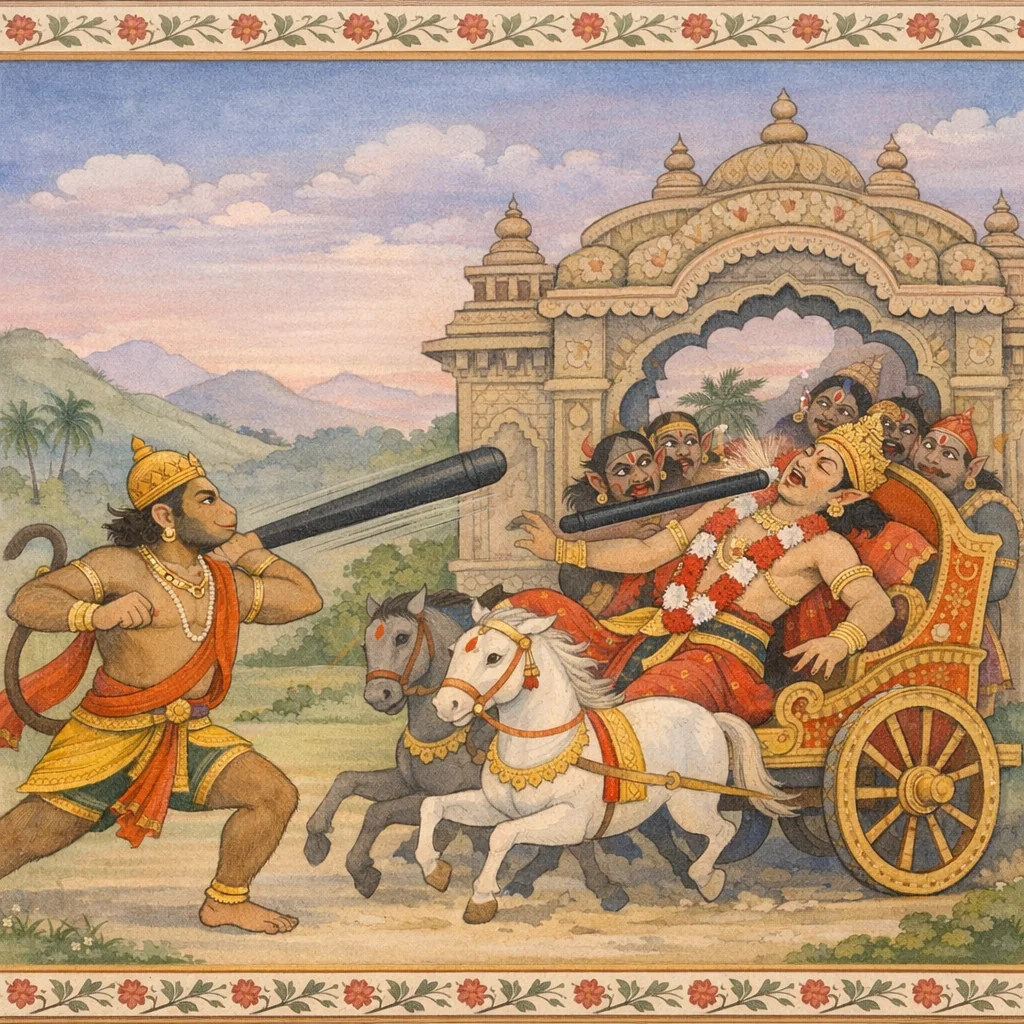
Sarga 44 intensifies the Laṅkā confrontation by introducing Jambumālī—Prahasta’s son—dispatched under Rāvaṇa’s command as a formidable archer. The chapter foregrounds martial aesthetics and sonic power: Jambumālī’s red garlands and attire, striking ornaments, and the thunder-like twang of his bow establish him as a ritualized emblem of Rakshasa force. He attacks Hanumān stationed at the city gate-arch (toraṇa), striking face, head, arms, chest, and the hollow of the chest with multiple arrow types. Hanumān’s response illustrates adaptive strategy under injury: after being enraged, he attempts to hurl a massive rock, which is shattered by Jambumālī’s arrows; he then uproots and whirls a sāla tree, only to have it cut down. Finally, Hanumān seizes an iron club/spear-like parigha and, with high-speed rotation, hurls it into Jambumālī’s broad chest, annihilating him so completely that limbs, weapons, chariot, and mounts are no longer discernible. The report of Jambumālī’s death (and earlier losses among the kiṅkaras) drives Rāvaṇa into visible rage, prompting him to order further elite forces—sons of ministers—thereby narratively escalating the conflict’s next phase.
Shlokas
Verse 1
सन्दिष्टो राक्षसेन्द्रेण प्रहस्तस्य सुतो बली।जम्बुमाली महादंष्ट्रो निर्जगाम धनुर्धरः।।।।रक्तमाल्याम्बरधरस्स्रग्वी रुचिरकुण्डलः।महान्विवृत्तनयनश्चण्डस्समरदुर्जयः।।।।धनुश्शक्रधनुः प्रख्यं महद्रुचिरसायकम्।विष्फारयाणो वेगेन वज्राशनिसमस्वनम्।।।।
Commanded by the rākṣasa-king, Jambumālī—the mighty son of Prahasta, large-tusked and bow-bearing—came forth: wearing red garlands and red garments, adorned with a chaplet and shining earrings, huge-bodied, round-eyed, fierce, and hard to defeat in battle. He swiftly twanged a bow like Indra’s rainbow, its vibration roaring like thunderbolt and lightning, with great and radiant arrows.
Verse 2
सन्दिष्टो राक्षसेन्द्रेण प्रहस्तस्य सुतो बली।जम्बुमाली महादंष्ट्रो निर्जगाम धनुर्धरः।।5.44.1।।रक्तमाल्याम्बरधरस्स्रग्वी रुचिरकुण्डलः।महान्विवृत्तनयनश्चण्डस्समरदुर्जयः।।5.44.2।।धनुश्शक्रधनुः प्रख्यं महद्रुचिरसायकम्।विष्फारयाणो वेगेन वज्राशनिसमस्वनम्।।5.44.3।।
Commanded by the lord of Rākṣasas, the mighty Jāmbumālin—Prahasta’s son, large-tusked and bearing a bow—came forth. Wearing a red garland and red garments, adorned with a chaplet and shining earrings, with wide, rolling eyes, fierce and hard to conquer in battle, he strode out. His bow, like Indra’s rainbow, he twanged at speed, its sound like a thunderbolt, while his great arrows gleamed.
Verse 3
सन्दिष्टो राक्षसेन्द्रेण प्रहस्तस्य सुतो बली।जम्बुमाली महादंष्ट्रो निर्जगाम धनुर्धरः।।5.44.1।।रक्तमाल्याम्बरधरस्स्रग्वी रुचिरकुण्डलः।महान्विवृत्तनयनश्चण्डस्समरदुर्जयः।।5.44.2।।धनुश्शक्रधनुः प्रख्यं महद्रुचिरसायकम्।विष्फारयाणो वेगेन वज्राशनिसमस्वनम्।।5.44.3।।
Commanded by the lord of Rākṣasas, the mighty Jāmbumālin—Prahasta’s son, large-tusked and bearing a bow—came forth. Wearing a red garland and red garments, adorned with a chaplet and shining earrings, with wide, rolling eyes, fierce and hard to conquer in battle, he strode out. His bow, like Indra’s rainbow, he twanged at speed, its sound like a thunderbolt, while his great arrows gleamed.
Verse 4
तस्य विष्फारघोषेण धनुषो महता दिशः।प्रदिशश्च नभश्चैव सहसा समपूर्यत।।।।
By the great twanging roar of his bow, the directions, the intermediate quarters, and even the sky were suddenly filled.
Verse 5
रथेन खरयुक्तेन तमागतमुदीक्ष्य सः।हनुमान्वेगसम्पन्नो जहर्ष च ननाद च।।।।
Seeing him approach in a chariot drawn by donkeys, Hanuman—swift and ready in action—rejoiced at the encounter and let out a loud roar.
Verse 6
तं तोरणविटङ्कस्थं हनुमन्तं महाकपिम्।जम्बुमाली महाबाहुर्विव्याध निशितैश्शरैः।।।।
Jambumali, strong-armed, struck that great monkey Hanuman—standing upon the projecting top of the gateway arch—with sharp arrows.
Verse 7
अर्धचन्द्रेण वदने शिरस्येकेन कर्णिना।बाह्वोर्विव्याध नाराचैर्दशभिस्तं कपीश्वरम्।।।।
He pierced the lord of monkeys with a crescent-headed arrow on the face, with a single barbed arrow on the head, and with ten iron arrows in the arms.
Verse 8
तस्य तच्छुशुभे ताम्रं शरेणाभिहतं मुखम्।शरदीवाम्बुजं फुल्लं विद्धं भास्कररश्मिना।।।।
His reddish face, struck by an arrow, shone beautifully—like a fully blossomed lotus in autumn pierced by the sun’s rays.
Verse 9
तत्तस्य रक्तं रक्तेन रञ्जितं शुशुभे मुखम्।यथाकाशे महापद्मं सिक्तं चन्दनबिन्दुभिः।।।।
That face of his—red, and further tinted by blood—shone like a great red lotus in the sky, sprinkled with drops of red sandal paste.
Verse 10
चुकोप बाणाभिहतो राक्षसस्य महाकपिः।ततः पार्श्वेऽतिविपुलां ददर्श महतीं शिलाम्।।।।
Struck by the rākṣasa’s arrows, the great monkey grew enraged; then, at his side, he spotted an enormous rock.
Verse 11
तरसा तां समुत्पाट्य चिक्षेप बलवद्भली।तां शरैर्दशभिः क्रुद्धस्ताडयामास राक्षसः।।।।
With a surge of force, the powerful one tore up that rock and hurled it; but the enraged rākṣasa shattered it with ten arrows.
Verse 12
विपन्नं कर्म तद्दृष्ट्वा हनुमांश्चण्डविक्रमः।सालं विपुलमुत्पाट्य भ्रामयामास वीर्यवान्।।।।
Seeing that his attempt had failed, Hanumān—fierce in prowess—tore up a huge śāla tree and began to whirl it with warrior strength.
Verse 13
भ्रामयन्तं कपिं दृष्ट्वा सालवृक्षं महाबलम्।चिक्षेप सुबहून्बाणान्जम्बुमाली महाबलः।।।।
Seeing the mighty monkey whirling the śāla tree, the powerful Jambumālī shot a great many arrows at him.
Verse 14
सालं चतुर्भिश्चिच्छेद वानरं पञ्चभिर्भुजे।उरस्येकेन बाणेन दशभिस्तु स्तनान्तरे।।।।
He cut the śāla tree with four arrows; he struck the Vanara on the arm with five; with one arrow he pierced the chest, and with ten more he hit the hollow between the breasts.
Verse 15
स शरैः पूरिततनु: क्रोधेन महता वृतः।तमेव परिघं गृह्य भ्रामयामास वेगितः।।।।
His body filled with arrows and enveloped in fierce anger, he seized that very iron bar and began to whirl it swiftly.
Verse 16
अतिवेगोऽतिवेगेन भ्रामयित्वा बलोत्कटः।परिघं पातयामास जम्बुमालेर्महोरसि।।।।
Mighty and irresistible in strength, after whirling it at tremendous speed, he brought the iron bar down upon Jāmbumālin’s broad chest.
Verse 17
तस्य चैव शिरो नास्ति न बाहू न च जानुनी।न धनुर्न रथो नाश्वास्तत्रादृश्यन्त नेषवः।।।।
There was no head to be seen, no arms, no knees—no bow, no chariot, no horses; nothing at all could be discerned there.
Verse 18
स हतस्सहसा तेन जम्बुमाली महाबलः।पपात निहतो भूमौ चूर्णिताङ्गविभूषणः।।।।
Thus the mighty Jāmbumālin, struck down in an instant by that blow, fell dead upon the ground—his ornaments and adornments smashed to powder.
Verse 19
जम्बुमालिं च निहतं किङ्करांश्च महाबलान्।चुक्रोध रावणश्शुत्वा कोपसंरक्तलोचनः।।।।
Hearing that Jāmbumālin had been slain, and that the mighty Kiṅkaras too were destroyed, Rāvaṇa flared up in fury—his eyes reddened with rage.
Verse 20
स रोषसंवर्तितताम्रलोचनः प्रहस्तपुत्त्रे निहते महाबले।अमात्यपुत्त्रानतिवीर्यविक्रमान् समादिदेशाशु निशाचरेश्वरः।।।।
When Prahasta’s mighty son was slain, the lord of the night-rangers—his copper-red eyes rolling with wrath—quickly commanded the ministers’ sons, warriors of exceptional valor and prowess.
Frequently Asked Questions
The pivotal action is Hanumān’s calibrated escalation: though heavily wounded by arrows, he shifts tactics (rock → sāla tree → parigha) to neutralize a state-dispatched warrior. The ethical emphasis is not indiscriminate violence but mission-protective force directed at an armed aggressor within a hostile military context.
Steadfast purpose can coexist with flexibility: endurance under pain, rapid reassessment after failure, and disciplined anger are portrayed as qualities that convert adversity into effective action without losing moral orientation.
The toraṇa (gateway arch) functions as a tactical landmark—an elevated defensive position and symbolic threshold of Laṅkā’s security. The depiction of the donkey-drawn chariot and the bow’s thunderous twang also encodes cultural-martial signaling: rank, intimidation, and battlefield presence are communicated through mounts, ornaments, and sound.