Sarga 42
द्विचत्वारिंशः सर्गः (Sarga 42): Omens in Laṅkā, Report to Rāvaṇa, and the Kinkara Assault
सुन्दरकाण्ड
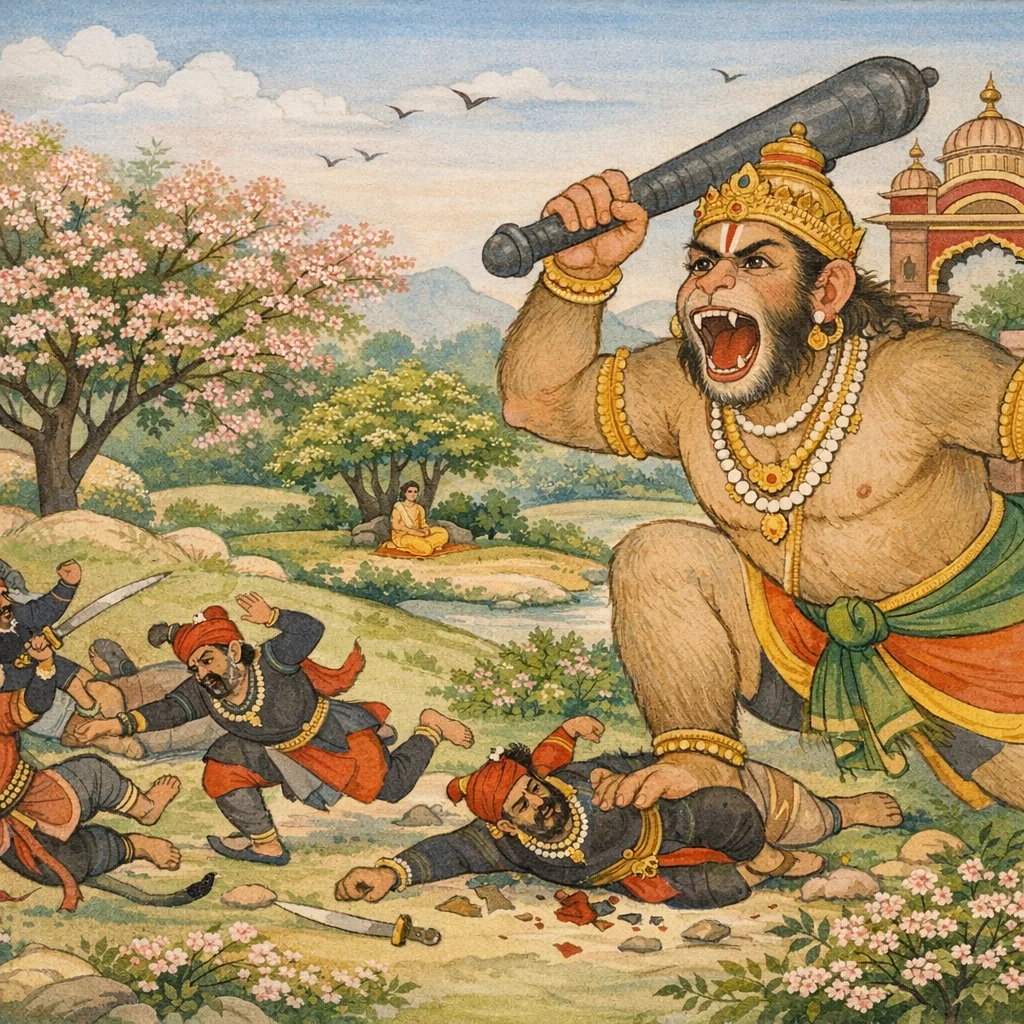
The sarga opens with Laṅkā’s sensory upheaval—bird-cries, splintering trees, and the flight of beasts—read as hostile portents for the rākṣasas. Awakened rākṣasīs witness Aśokavanikā devastated and interrogate Sītā about the intruder; Sītā replies with guarded epistemic restraint, implying that only those of the same kind truly know another’s intent. Some rākṣasīs rush to Rāvaṇa, describing a fearsome, powerful vāṇara who conversed with Sītā and spared only the area of her rest, including the śiṃśupā tree. Their report frames the incident as both breach of royal possession and strategic threat, urging severe punishment. Rāvaṇa’s rage is depicted through fire imagery and tears like oil-drops from lamps; he orders the “Kiṅkaras” to seize Hanumān. Eighty thousand armed kiṅkaras surge toward Hanumān near the toraṇa. Hanumān enlarges his form, roars proclamations of allegiance and victory for Rāma, and demonstrates martial superiority by wielding an iron beam (parigha), annihilating the force and returning to the archway seeking further combat. Survivors report the slaughter, prompting Rāvaṇa to dispatch Prahasta’s son—escalating the confrontation in a structured military sequence.
Shlokas
Verse 1
ततः पक्षिनिनादेन वृक्षभङ्गस्वनेन च।बभूवुस्त्राससम्भ्रान्तास्सर्वे लङ्कानिवासिनः।।5.42.1।।
Then, at the cries of birds and the crashing sound of broken trees, all the inhabitants of Laṅkā became panic-stricken and bewildered.
Verse 2
विद्रुताश्च भयत्रस्ता विनेदुर्मृगपक्षिणः।रक्षसां च निमित्तानि क्रूराणि प्रतिपेदिरे।।5.42.2।।
Terrified, the beasts and birds fled in panic and cried out in all directions; and for the rākṣasas, cruel omens began to appear.
Verse 3
ततो गतायां निद्रायां राक्षस्यो विकृताननाः।तद्वनं ददृशुर्भग्नं तं च वीरं महाकपिम्।।5.42.3।।
Then, when their sleep was broken, the hideous-faced rākṣasī women saw that garden shattered—and they beheld that heroic great monkey as well.
Verse 4
स ता दृष्ट्वा महाबाहुर्महासत्त्वो महाबलः।चकार सुमहद्रूपं राक्षसीनां भयावहम्।।5.42.4।।
Seeing those ogresses, Hanumān—strong-armed, great-souled, and mighty—assumed a very vast form, meant to strike fear into them.
Verse 5
ततस्तं गिरिसङ्काशमतिकायं महाबलम्।राक्षस्यो वानरं दृष्ट्वा पप्रच्छुर्जनकात्मजाम्।।5.42.5।।
Then, seeing that mighty vānara with a huge body, mountain-like in appearance, the ogresses questioned Janaka’s daughter, Sītā, about him.
Verse 6
कोऽयं कस्य कुतो वायं किं निमित्तमिहागतः।कथं त्वया सहानेन संवादः कृत इत्युत।।5.42.6।।
“Who is this? Whose man is he? From where has he come, and for what purpose has he arrived here? And how did you come to speak with him?”
Verse 7
आचक्ष्व नो विशालाक्षि मा भूत्ते सुभगे भयम्।संवादमसितापाङ्गे त्वया किं कृतवानयम्।।5.42.7।।
“Tell us, large-eyed lady; let there be no fear for you, fortunate one. O dark-glancing one—what conversation did this man have with you?”
Verse 8
अथाब्रवीन्महासाध्वी सीता सर्वाङ्गसुन्दरी।रक्षसां भीमरूपाणां विज्ञाने मम का गतिः।।5.42.8।।
Then Sītā—most virtuous and beautiful in every limb—said: “What ability have I to know the intentions of these fearsome rākṣasī-s?”
Verse 9
यूयमेवाभिजानीत योऽयं यद्वा करिष्यति।अहिरेव ह्यहेः पादान्विजानाति न संशयः।।5.42.9।।
“You alone can recognize who he is and what he intends to do. For only a serpent truly understands the track and movement of another serpent—there is no doubt.”
Verse 10
अहमप्यस्य भीतास्मि नैनं जानामि को न्वयं।वेद्मि राक्षसमेवैनं कामरूपिणमागतम्।।5.42.10।।
I too am afraid of him; I do not know who this one is. I only know this: he is a rākṣasa who has come here, assuming forms at will.
Verse 11
वैदेह्या वचनं श्रुत्वा राक्षस्यो विद्रुता दिशः।स्थिताः काश्चिद्गताः काश्चिद्रावणाय निवेदितुम्।।5.42.11।।
Hearing Vaidehī’s words, the rākṣasī women scattered in all directions: some stayed there, while others went to report to Rāvaṇa.
Verse 12
रावणस्य समीपे तु राक्षस्यो विकृताननाः।विरूपं वानरं भीममाख्यातुमुपचक्रमुः।।5.42.12।।
Then the ugly-faced she-demons went into Rāvaṇa’s presence and began to report about the terrifying, strange-looking vānarā.
Verse 13
अशोकवनिकामध्ये राजन्भीमवपुः कपिः।सीतया कृतसंवादस्तिष्ठत्यमितविक्रमः।।5.42.13।।
“O King, in the midst of the Aśoka grove stands a monkey of fearsome form and immeasurable prowess—one who has spoken with Sītā.”
Verse 14
न च तं जानकी सीता हरिं हरिणलोचना।अस्माभिर्बहुधा पृष्टा निवेदयितुमिच्छति।।5.42.14।।
“And deer-eyed Jānakī Sītā, though questioned by us again and again, does not wish to disclose who that monkey is.”
Verse 15
वासवस्य भवेद्दूतो दूतो वैश्रवणस्य वा।प्रेषितो वापि रामेण सीतान्वेषणकाङ्क्षया।।5.42.15।।
“He might be an envoy of Vāsava (Indra), or an envoy of Vaiśravaṇa (Kubera); or else he may have been sent by Rāma, desiring to search for Sītā.”
Verse 16
तेन त्वद्भुतरूपेण यत्तत्तव मनोहरम्।नानामृगगणाकीर्णं प्रमृष्टं प्रमदावनम्।।5.42.16।।
“By him—of wondrous form—your delightful pleasure-garden, crowded with herds of many kinds of animals, has been laid waste.”
Verse 17
न तत्र कश्चिदुद्देशो यस्तेन न विनाशितः।यत्र सा जानकी सीता स तेन न विनाशितः।।5.42.17।।
“There is no spot there that he did not destroy—except the place where Jānakī Sītā is; that place alone he did not ruin.”
Verse 18
जानकीरक्षणार्थं वा श्रमाद्वा नोपलभ्यते।अथवा कश्श्रमस्तस्य सैव तेनाभिरक्षिता।।5.42.18।।
“We cannot tell whether he spared it to protect Jānakī, or whether it was from fatigue. Or else—what fatigue could there be for him? Surely she alone was spared by him for her protection.”
Verse 19
चारुपल्लवपुष्पाढ्यं यं सीता स्वयमास्थिता।प्रवृद्धश्शिंशुपावृक्ष स्स च तेनाभिरक्षितः।।5.42.19।।
“And that great śiṃśupā tree—rich with lovely shoots and blossoms—under which Sītā herself has taken refuge, that too has been spared by him.”
Verse 20
तस्योग्ररूपस्योग्र त्वं दण्डमाज्ञातुमर्हसि।सीता सम्भाषिता येन तद्वनं च विनाशितम्।।5.42.20।।
“O fierce one, you should command severe punishment for that fierce-looking one—he is the one who spoke with Sītā and also destroyed that grove.”
Verse 21
मनः परिगृहीतां तां तव रक्षोगणेश्वर।कस्सीतामभिभाषेत यो न स्यात्त्यक्तजीवितः।।5.42.21।।
O lord of the rākṣasa hosts—since Sītā is the one desired by you—who would dare speak to her, unless he had already abandoned hope of his life?
Verse 22
राक्षसीनां वचश्त्रुत्वा रावणो राक्षसेश्वरः।हुताग्निरिव जज्वाल कोपसंवर्तितेक्षणः।।5.42.22।।
Hearing the words of the rākṣasīs, Rāvaṇa—the lord of the rākṣasas—blazed like the sacrificial fire, his eyes churning with wrath.
Verse 23
तस्य क्रुद्धस्य नेत्राभ्यां प्रापतन्नास्रबिन्दवः।दीप्ताभ्यामिव दीपाभ्यां सार्चिष स्स्नेहबिन्दवः।।5.42.23।।
From the eyes of that enraged one, tear-drops fell—like drops of oil from two blazing lamps, aflame with their wicks’ light.
Verse 24
आत्मनस्सदृशान्शूरान्किङ्करान्नाम राक्षसान्।व्यादिदेश महातेजा निग्रहार्थं हनूमतः।।5.42.24।।
Then the mighty one commanded heroic rākṣasas called Kiṅkaras—men of strength comparable to his own—to restrain and seize Hanumān.
Verse 25
तेषामशीतिसाहस्रं किङ्कराणां तरस्विनाम्।निर्ययुर्भवनात्तस्मात्कूटमुद्गरपाणयः।।5.42.25।।महोदरा महादंष्ट्रा घोररूपा महाबलाः।युद्धाभिमनसस्सर्वे हनुमद्ग्रहणोद्यताः।।5.42.26।।
From that palace there poured forth eighty thousand swift Kiṅkaras, holding clubs and hammers. All were huge-bellied, great-fanged, dreadful in form and mighty in strength—eager for battle and set on capturing Hanumān.
Verse 26
तेषामशीतिसाहस्रं किङ्कराणां तरस्विनाम्।निर्ययुर्भवनात्तस्मात्कूटमुद्गरपाणयः।।5.42.25।।महोदरा महादंष्ट्रा घोररूपा महाबलाः।युद्धाभिमनसस्सर्वे हनुमद्ग्रहणोद्यताः।।5.42.26।।
From that palace there poured forth eighty thousand swift Kiṅkaras, holding clubs and hammers. All were huge-bellied, great-fanged, dreadful in form and mighty in strength—eager for battle and set on capturing Hanumān.
Verse 27
ते कपीन्द्रं समासाद्य तोरणस्थमवस्थितम्।अभिपेतुर्महावेगाः पतङ्गा इव पावकम्।।5.42.27।।
Approaching the lord of monkeys standing by the gateway-arch, they rushed upon him at great speed—like moths flying into a flame.
Verse 28
ते गदाभिर्विचित्राभिः परिघैः काञ्चनाङ्गदैः।आजघ्नुर्वानरश्रेष्ठं शरैश्चादित्यसन्निभैः।।5.42.28।।
They struck the best of monkeys with ornate maces and iron bars fitted with golden ornaments, and with arrows blazing like the sun.
Verse 29
मुद्गरैः पट्टिशैश्शूलैः प्रासतोमरशक्तिभिः।परिवार्य हनूमन्तं सहसा तस्थुरग्रतः।।5.42.29।।
With hammers, axes, tridents, spears, barbed missiles, and javelins, they suddenly surrounded Hanumān and stood right before him.
Verse 30
हनुमानपि तेजस्वी श्रीमान्पर्वतसन्निभः।क्षितावाविध्य लाङ्गूलं ननाद च महास्वनम्।।5.42.30।।
Hanumān—radiant, illustrious, and mountain-like in stature—lashed his tail against the ground and let out a great roar that resounded loudly.
Verse 31
स भूत्वा सुमहाकायो हनुमान्मारुतात्मजः।धृष्टमास्फोटयामास लङ्कां शब्देन पूरयन्।।5.42.31।।
Then Hanumān, son of the Wind-god, taking on a vast form, clapped his body boldly, filling all of Laṅkā with the sound.
Verse 32
तस्यास्फोटितशब्देन महता सानुनादिना।पेतुर्विहङ्गा गगनादुच्चैश्चेदमघोषयत्।।5.42.32।।
By the great, reverberating sound of his clapping, birds fell from the sky; and then he proclaimed aloud the words that follow.
Verse 33
जयत्यतिबलो रामो लक्ष्मणश्च महाबलः।राजा जयति सुग्रीवो राघवेणाभिपालितः।।5.42.33।।
“Victory to Rāma, mighty beyond measure; victory to Lakṣmaṇa, the great in strength. Victory to King Sugrīva, who is protected and guided by Rāghava (Rāma).”
Verse 34
दासोऽहं कोसलेन्द्रस्य रामस्याक्लिष्टकर्मणः।हनुमान्शत्रुसैन्यानां निहन्ता मारुतात्मजः।।5.42.34।।
“I am the servant of Rāma, lord of Kosala, whose deeds never falter. I am Hanumān, son of the Wind-god, the destroyer of enemy armies.”
Verse 35
न रावणसहस्रं मे युद्धे प्रतिबलं भवेत्।शिलाभिस्तु प्रहरतः पादपैश्च सहस्रशः।।5.42.35।।
“In battle, even a thousand Rāvaṇas would not be a match for me—when I strike with stones and with trees, again and again in countless ways.”
Verse 36
अर्दयित्वा पुरीं लङ्कामभिवाद्य च मैथिलीम्।समृद्धार्थो गमिष्यामि मिषतां सर्वरक्षसाम्।।5.42.36।।
“After crushing the city of Laṅkā, and paying my respects to Maithilī (Sītā), I shall depart with my purpose fulfilled—while all the rākṣasas look on.”
Verse 37
तस्य सन्नादशब्देन तेऽभवन्भयशङ्किताः।ददृशुश्च हनूमन्तं सन्ध्यामेघमिवोन्नतम्।।5.42.37।।
At the sound of his roar they were seized with fear, and they beheld Hanumān towering—like a cloud at twilight.
Verse 38
स्वामिसन्देशनिश्शङ्कास्ततस्ते राक्षसाः कपिम्।चित्रैः प्रहरणैर्भीमैरभिपेतुस्ततस्ततः।।5.42.38।।
Then those rākṣasas, emboldened by their master’s command and casting aside fear, rushed at the monkey from every side with dreadful, varied weapons.
Verse 39
स तैः परिवृतश्शूरैस्सर्वतस्सुमहाबलः।आससादाऽयसं भीमं परिघं तोरणाश्रितम्।।5.42.39।।
Surrounded on every side by those valiant fighters, the exceedingly powerful Hanumān went to the gateway and seized a dreadful iron bar that lay there.
Verse 40
स तं परिघमादाय जघान रजनीचरान्।स पन्नगमिवादाय स्फुरन्तं विनतासुतः।।5.42.40।।विचचाराम्बरे वीरः परिगृह्य च मारुतिः।
Seizing that iron bar, he struck down the night-ranging demons. Like Garuḍa, son of Vinatā, who snatches up a writhing serpent, the hero Māruti grasped it and moved through the sky with it in hand.
Verse 41
स हत्वा राक्षसान्वीरान्किङ्करान्मारुतात्मजः।।5.42.41।।युद्धाकाङ्क्षी पुनर्वीरस्तोरणं समुपाश्रितः।
Having slain the heroic rākṣasas—the kiṅkara guards—the son of the Wind, still eager for battle, returned again to the gateway arch.
Verse 42
ततस्तस्माद्भयान्मुक्ताः कतिचित्तत्र राक्षसाः।।5.42.42।।निहतान्किङ्करान्सर्वान्रावणायन्यवेदयन्।
Then, a few rākṣasas there—released from that fear—reported to Rāvaṇa that all the kiṅkara guards had been slain.
Verse 43
स राक्षसानां निहतं महद्बलं निशम्य राजा परिवृत्तलोचनः।समादिदेशाप्रतिमं पराक्रमे प्रहस्तपुत्रं समरे सुदुर्जयम्।।5.42.43।।
Hearing that the great force of rākṣasas had been slain, the king—his eyes rolling in fury—issued orders to Prahasta’s son, matchless in valor and hard to conquer in battle.
Frequently Asked Questions
Sītā is pressed to disclose the intruder’s identity; she maintains strategic discretion, while Hanumān—though acting with overwhelming force—targets military responders and preserves Sītā’s immediate refuge, aligning action with mission rather than indiscriminate harm.
Knowledge and intent are contextual: Sītā’s “serpent knows serpent” maxim underscores limits of forced testimony under coercion, while Hanumān’s self-identification as Rāma’s servant models ego-less agency where might is justified only by dharmic purpose.
Aśokavanikā functions as a guarded royal-pleasure garden and captivity space; the toraṇa marks a tactical choke-point for combat; the śiṃśupā tree becomes a symbolic sanctuary around Sītā, preserved amid widespread destruction.