Sarga 3
लङ्काप्रवेशः — Hanuman Enters Lanka and Encounters Laṅkā-devatā
सुन्दरकाण्ड
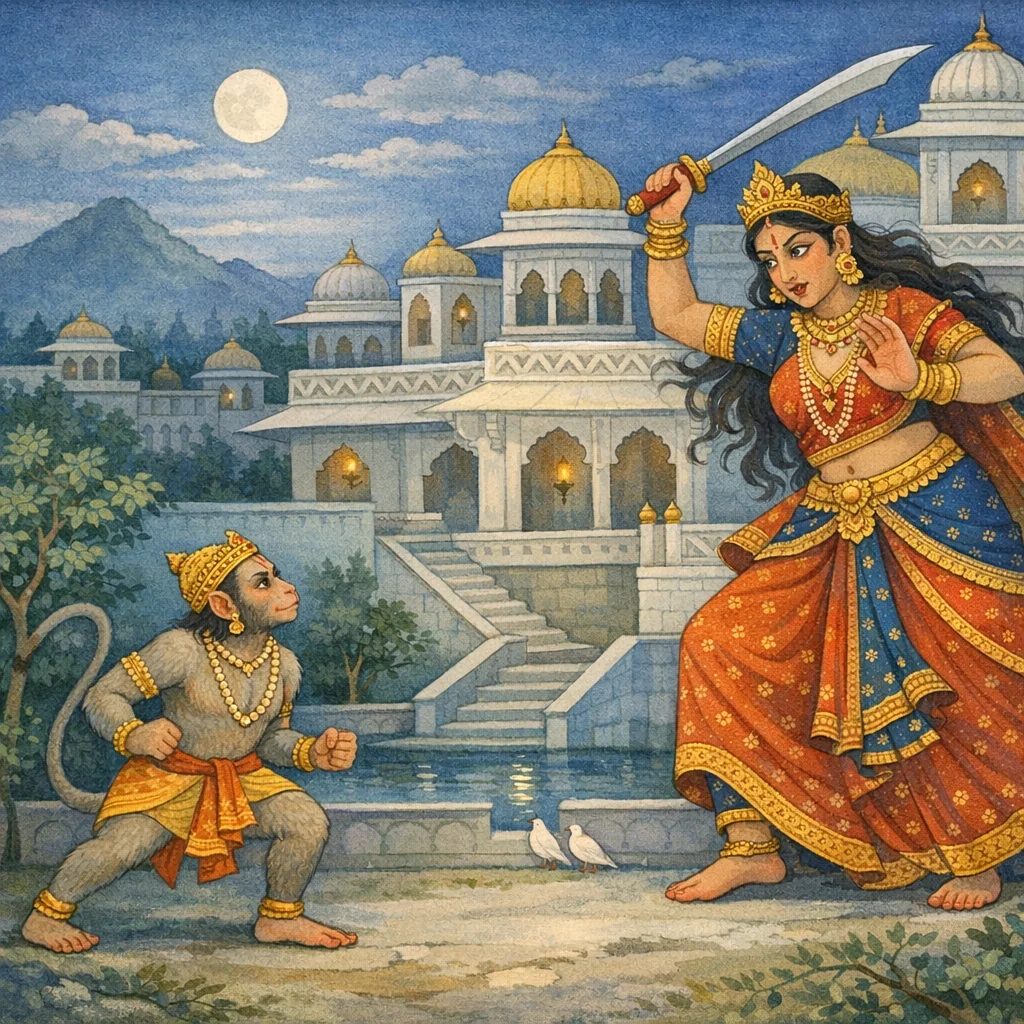
This sarga narrates Hanumān’s nocturnal entry into Laṅkā from the Lamba peak, emphasizing stealth, resolve, and situational awareness. He surveys the city’s extraordinary architecture—golden doors, gem-inlaid floors, vaidūrya platforms and stairways, resonant music, and bird-filled courtyards—framed through elevated similes that liken Laṅkā to celestial cities (Amarāvatī; Vasvaukasārā). After reflecting on the city’s near-impregnability and the caliber of forces required to reach it, Hanumān’s confidence is reinforced by remembrance of Rāma and Lakṣmaṇa’s valor. The presiding deity/ogress of Laṅkā manifests, challenges his identity and intent, and attempts to bar entry. A brief combat ensues: she strikes first; Hanumān responds with measured force, consciously restraining excessive anger because she is a woman. Defeated, Laṅkā-devatā reveals a boon of Brahmā: when a vānara subdues her, it signals impending ruin for Rāvaṇa’s rākṣasas due to Sītā’s abduction. She then permits Hanumān to enter freely and continue his search for Janaka’s daughter.
Shlokas
Verse 1
स लम्बशिखरे लम्बे लम्बतोयदसन्निभे।सत्त्वमास्थाय मेधावी हनुमान् मारुतात्मजः।।।।निशि लङ्कां महासत्त्वो विवेश कपिकुञ्जरः।रम्यकाननतोयाढ्यां पुरीं रावणपालिताम्।।।।
Standing on the lofty peak called Lamba, resembling a massive rain-bearing cloud, the intelligent Hanumān—son of the Wind—relying on his own courage, entered Laṅkā by night: the city ruled by Rāvaṇa, rich with lovely groves and waters.
Verse 2
स लम्बशिखरे लम्बे लम्बतोयदसन्निभे।सत्त्वमास्थाय मेधावी हनुमान् मारुतात्मजः।।5.3.1।।निशि लङ्कां महासत्त्वो विवेश कपिकुञ्जरः।रम्यकाननतोयाढ्यां पुरीं रावणपालिताम्।।5.3.2।।
The intelligent Hanumān, son of the Wind-god, taking firm courage as his support on lofty Lamba’s peak—like a hanging rain-cloud—entered by night Laṅkā, the city ruled by Rāvaṇa, rich with lovely groves, woods, and waters.
Verse 3
शारदाम्बुधरप्रख्यैर्भवनैरुपशोभिताम्।सागरोपमनिर्घोषां सागरानिलसेविताम्।।।।सुपुष्टबलसम्पुष्टां यथैव विटपावतीम्।चारुतोरणनिर्यूहां पाण्डुरद्वारतोरणाम्।।।।भुजगाचरितां गुप्तां शुभां भोगवतीमिव।तां स विद्युद्घनाकीर्णां ज्योतिर्मार्गनिषेविताम्।।।।मन्दमारुतसञ्चारां यथेन्द्रस्यामरावतीम्।शातकुम्भेन महता प्राकारेणाभिसंवृताम्।।।।किङ्किणीजालघोषाभिः पताकाभिरलङ्कृताम्।आसाद्य सहसा हृष्टः प्राकारमभिपेदिवान्।।।।
Reaching Laṅkā, Hanumān—thrilled—came at once to its rampart and surveyed the city: adorned with mansions like autumn clouds; resonant like the sea and refreshed by sea-breezes; strengthened by a well-nourished army like Viṭapāvatī; set with lovely gateways and pale-white door-arches; guarded like auspicious Bhogavatī, the serpent-city; clouded with lightning-bearing masses and attended by the paths of stars; with gentle winds, like Indra’s Amarāvatī; enclosed by a vast golden wall; and decorated with flags and the chiming of bell-nets.
Verse 4
शारदाम्बुधरप्रख्यैर्भवनैरुपशोभिताम्।सागरोपमनिर्घोषां सागरानिलसेविताम्।।5.3.3।।सुपुष्टबलसम्पुष्टां यथैव विटपावतीम्।चारुतोरणनिर्यूहां पाण्डुरद्वारतोरणाम्।।5.3.4।।भुजगाचरितां गुप्तां शुभां भोगवतीमिव।तां स विद्युद्घनाकीर्णां ज्योतिर्मार्गनिषेविताम्।।5.3.5।।मन्दमारुतसञ्चारां यथेन्द्रस्यामरावतीम्।शातकुम्भेन महता प्राकारेणाभिसंवृताम्।।5.3.6।।किङ्किणीजालघोषाभिः पताकाभिरलङ्कृताम्।आसाद्य सहसा हृष्टः प्राकारमभिपेदिवान्।।5.3.7।।
He beheld Laṅkā, strengthened by a well-nourished host, like Viṭapāvatī—adorned with splendid gate-arches and furnished with pale-white gateways and archways.
Verse 5
शारदाम्बुधरप्रख्यैर्भवनैरुपशोभिताम्।सागरोपमनिर्घोषां सागरानिलसेविताम्।।5.3.3।।सुपुष्टबलसम्पुष्टां यथैव विटपावतीम्।चारुतोरणनिर्यूहां पाण्डुरद्वारतोरणाम्।।5.3.4।।भुजगाचरितां गुप्तां शुभां भोगवतीमिव।तां स विद्युद्घनाकीर्णां ज्योतिर्मार्गनिषेविताम्।।5.3.5।।मन्दमारुतसञ्चारां यथेन्द्रस्यामरावतीम्।शातकुम्भेन महता प्राकारेणाभिसंवृताम्।।5.3.6।।किङ्किणीजालघोषाभिः पताकाभिरलङ्कृताम्।आसाद्य सहसा हृष्टः प्राकारमभिपेदिवान्।।5.3.7।।
He beheld that city—guarded and auspicious, like Bhogavatī, the serpent-city; clouded with lightning-bearing masses and attended by the paths of stars. With gentle breezes it resembled Indra’s Amarāvatī, encircled by a vast golden rampart, adorned with banners and the tinkling of bell-nets. Reaching it, Hanumān at once felt delight and surveyed the rampart.
Verse 6
शारदाम्बुधरप्रख्यैर्भवनैरुपशोभिताम्।सागरोपमनिर्घोषां सागरानिलसेविताम्।।5.3.3।।सुपुष्टबलसम्पुष्टां यथैव विटपावतीम्।चारुतोरणनिर्यूहां पाण्डुरद्वारतोरणाम्।।5.3.4।।भुजगाचरितां गुप्तां शुभां भोगवतीमिव।तां स विद्युद्घनाकीर्णां ज्योतिर्मार्गनिषेविताम्।।5.3.5।।मन्दमारुतसञ्चारां यथेन्द्रस्यामरावतीम्।शातकुम्भेन महता प्राकारेणाभिसंवृताम्।।5.3.6।।किङ्किणीजालघोषाभिः पताकाभिरलङ्कृताम्।आसाद्य सहसा हृष्टः प्राकारमभिपेदिवान्।।5.3.7।।
He beheld that city—guarded and auspicious, like Bhogavatī, the serpent-city; clouded with lightning-bearing masses and attended by the paths of stars. With gentle breezes it resembled Indra’s Amarāvatī, encircled by a vast golden rampart, adorned with banners and the tinkling of bell-nets. Reaching it, Hanumān at once felt delight and surveyed the rampart.
Verse 7
शारदाम्बुधरप्रख्यैर्भवनैरुपशोभिताम्।सागरोपमनिर्घोषां सागरानिलसेविताम्।।5.3.3।।सुपुष्टबलसम्पुष्टां यथैव विटपावतीम्।चारुतोरणनिर्यूहां पाण्डुरद्वारतोरणाम्।।5.3.4।।भुजगाचरितां गुप्तां शुभां भोगवतीमिव।तां स विद्युद्घनाकीर्णां ज्योतिर्मार्गनिषेविताम्।।5.3.5।।मन्दमारुतसञ्चारां यथेन्द्रस्यामरावतीम्।शातकुम्भेन महता प्राकारेणाभिसंवृताम्।।5.3.6।।किङ्किणीजालघोषाभिः पताकाभिरलङ्कृताम्।आसाद्य सहसा हृष्टः प्राकारमभिपेदिवान्।।5.3.7।।
He beheld that city—guarded and auspicious, like Bhogavatī, the serpent-city; clouded with lightning-bearing masses and attended by the paths of stars. With gentle breezes it resembled Indra’s Amarāvatī, encircled by a vast golden rampart, adorned with banners and the tinkling of bell-nets. Reaching it, Hanumān at once felt delight and surveyed the rampart.
Verse 8
विस्मयाविष्टहृदयः पुरीमालोक्य सर्वतः।जाम्बूनदमयैर्द्वारैर्वैडूर्यकृतवेदिकैः।।।।वज्रस्फटिकमुक्ताभिर्मणिकुट्टिमभूषितैः।तप्तहाटकनिर्यूहै राजतामलपाण्डुरैः।।।।वैढूर्यकृतसोपानैः स्फाटिकान्तरपांसुभिः।चारुसंजवनोपेतैः खमिवोत्पतितैः शुभैः।।।।क्रौञ्चबर्हिणसङ्घुष्टैः राजहंस निषेवितैः।तूर्याभरणनिर्घोषैः सर्वतः प्रतिनादिताम्।।।।वस्वौकसाराप्रतिमां तां वीक्ष्य नगरीं ततः।खमिवोत्पतितुं कामां जहर्ष हनुमान् कपिः।।।।
Wonder-struck at heart, he looked over the city on every side—its gateways fashioned of gold, its platforms made with vaidūrya.
Verse 9
विस्मयाविष्टहृदयः पुरीमालोक्य सर्वतः।जाम्बूनदमयैर्द्वारैर्वैडूर्यकृतवेदिकैः।।5.3.8।।वज्रस्फटिकमुक्ताभिर्मणिकुट्टिमभूषितैः।तप्तहाटकनिर्यूहै राजतामलपाण्डुरैः।।5.3.9।।वैढूर्यकृतसोपानैः स्फाटिकान्तरपांसुभिः।चारुसंजवनोपेतैः खमिवोत्पतितैः शुभैः।।5.3.10।।क्रौञ्चबर्हिणसङ्घुष्टैः राजहंस निषेवितैः।तूर्याभरणनिर्घोषैः सर्वतः प्रतिनादिताम्।।5.3.11।।वस्वौकसाराप्रतिमां तां वीक्ष्य नगरीं ततः।खमिवोत्पतितुं कामां जहर्ष हनुमान् कपिः।।5.3.12।।
Its gem-inlaid pavements shone with diamonds, crystal, and pearls; its structures blazed with heated gold, and its surfaces were pale-bright with stainless silver.
Verse 10
विस्मयाविष्टहृदयः पुरीमालोक्य सर्वतः।जाम्बूनदमयैर्द्वारैर्वैडूर्यकृतवेदिकैः।।5.3.8।।वज्रस्फटिकमुक्ताभिर्मणिकुट्टिमभूषितैः।तप्तहाटकनिर्यूहै राजतामलपाण्डुरैः।।5.3.9।।वैढूर्यकृतसोपानैः स्फाटिकान्तरपांसुभिः।चारुसंजवनोपेतैः खमिवोत्पतितैः शुभैः।।5.3.10।।क्रौञ्चबर्हिणसङ्घुष्टैः राजहंस निषेवितैः।तूर्याभरणनिर्घोषैः सर्वतः प्रतिनादिताम्।।5.3.11।।वस्वौकसाराप्रतिमां तां वीक्ष्य नगरीं ततः।खमिवोत्पतितुं कामां जहर्ष हनुमान् कपिः।।5.3.12।।
Looking all around the city with a heart filled with wonder, Hanumān saw gates of gold, platforms inlaid with vaidūrya, jewel-studded pavements set with diamonds, crystal, and pearls, and splendid structures of heated gold and pale silver. With stairways made of vaidūrya, with crystal-like grains between, and with lovely courtyards, the auspicious city seemed as though it were rising into the sky. It resounded everywhere with the calls of krauñca birds and peacocks, was frequented by royal swans, and echoed with music and ornamented bustle. Seeing that city like a counterpart of the divine city (of the gods), Hanumān rejoiced, as if it wished to soar into the heavens.
Verse 11
विस्मयाविष्टहृदयः पुरीमालोक्य सर्वतः।जाम्बूनदमयैर्द्वारैर्वैडूर्यकृतवेदिकैः।।5.3.8।।वज्रस्फटिकमुक्ताभिर्मणिकुट्टिमभूषितैः।तप्तहाटकनिर्यूहै राजतामलपाण्डुरैः।।5.3.9।।वैढूर्यकृतसोपानैः स्फाटिकान्तरपांसुभिः।चारुसंजवनोपेतैः खमिवोत्पतितैः शुभैः।।5.3.10।।क्रौञ्चबर्हिणसङ्घुष्टैः राजहंस निषेवितैः।तूर्याभरणनिर्घोषैः सर्वतः प्रतिनादिताम्।।5.3.11।।वस्वौकसाराप्रतिमां तां वीक्ष्य नगरीं ततः।खमिवोत्पतितुं कामां जहर्ष हनुमान् कपिः।।5.3.12।।
It rang everywhere with the cries of krauñca birds and peacocks, was frequented by royal swans, and resounded on all sides with the clamour of musical instruments and ornaments.
Verse 12
विस्मयाविष्टहृदयः पुरीमालोक्य सर्वतः।जाम्बूनदमयैर्द्वारैर्वैडूर्यकृतवेदिकैः।।5.3.8।।वज्रस्फटिकमुक्ताभिर्मणिकुट्टिमभूषितैः।तप्तहाटकनिर्यूहै राजतामलपाण्डुरैः।।5.3.9।।वैढूर्यकृतसोपानैः स्फाटिकान्तरपांसुभिः।चारुसंजवनोपेतैः खमिवोत्पतितैः शुभैः।।5.3.10।।क्रौञ्चबर्हिणसङ्घुष्टैः राजहंस निषेवितैः।तूर्याभरणनिर्घोषैः सर्वतः प्रतिनादिताम्।।5.3.11।।वस्वौकसाराप्रतिमां तां वीक्ष्य नगरीं ततः।खमिवोत्पतितुं कामां जहर्ष हनुमान् कपिः।।5.3.12।।
Then, beholding that city—like a counterpart of a celestial city—and as if eager to spring up into the sky, the monkey Hanumān rejoiced.
Verse 13
तां समीक्ष्य पुरीं रम्यां राक्षसाधिपतेः शुभाम्।अनुत्तमामृद्धियुतां चिन्तयामास वीर्यवान्।।।।
Having examined that enchanting, auspicious city of the lord of rākṣasas—unsurpassed and filled with prosperity—the valiant one (Hanumān) began to reflect.
Verse 14
नेयमन्येन नगरी शक्या धर्षयितुं बलात्।रक्षिता रावणबलैरुद्यतायुधधारिभिः।।।।
This city cannot be forcibly assaulted by others, for it is guarded by Rāvaṇa’s forces—warriors bearing weapons poised for combat.
Verse 15
कुमुदाङ्गदयोर्वापि सुषेणस्य महाकपेः।प्रसिद्धेयं भवेद्भूमिर्मैन्दद्विविदयोरपि।।।।
This land (approach to Laṅkā) might indeed be within reach of Kumuda and Aṅgada, of the great monkey Suṣeṇa, and even of Mainda and Dvivida as well.
Verse 16
विवस्वतस्तनूजस्य हरेश्च कुशपर्वणः।ऋक्षस्य केतुमालस्य मम चैव गतिर्भवेत्।।।।
“This place would be within the reach of Sugrīva, the son of Vivasvān, and of Kuśaparvan, and of Ṛkṣa (Jāmbavān), and of Ketumāla—and of me as well.”
Verse 17
समीक्ष्य तु महाबाहू राघवस्य पराक्रमम्।लक्ष्मणस्य च विक्रान्तमभवत् प्रीतिमान् कपिः।।।।
Having reflected on the valor of long-armed Rāghava (Rāma) and on Lakṣmaṇa’s bold prowess, the Vānara (Hanumān) became inwardly gladdened.
Verse 18
तां रत्नवसनोपेतां कोष्ठागारावतंसकाम्।यन्त्रागारस्तनीमृद्धां प्रमदामिव भूषिताम्।।।।तां नष्टतिमिरां दीप्तैर्भास्वरैश्च महागृहैः।नगरीं राक्षसेन्द्रस्य स ददर्श महाकपिः।।।।
The great Vānara beheld the city of the lord of Rākṣasas—its darkness dispelled by radiant, gleaming mansions—adorned like a young woman: gem-studded garments as her attire, storehouses as her earrings, and armories as her full breasts.
Verse 19
तां रत्नवसनोपेतां कोष्ठागारावतंसकाम्।यन्त्रागारस्तनीमृद्धां प्रमदामिव भूषिताम्।।5.3.18।।तां नष्टतिमिरां दीप्तैर्भास्वरैश्च महागृहैः।नगरीं राक्षसेन्द्रस्य स ददर्श महाकपिः।।5.3.19।।
The great Vānara saw the rākṣasa-king’s city—radiant with great glowing mansions, its darkness driven away—ornamented like a richly adorned maiden.
Verse 20
थ सा हरिशार्दूलं प्रविशन्तं महाबलम्।नगरी स्वेन रूपेण ददर्श पवनात्मजम्।।।।
Then the City (its presiding power), assuming her own true form, saw the son of the Wind-god—mighty, a tiger among Vānaras—entering.
Verse 21
सा तं हरिवरं दृष्ट्वा लङ्का रावणपालिता।स्वयमेवोत्थिता तत्र विकृताननदर्शना।।।।
Seeing that best of Vānaras, Laṅkā—ruled by Rāvaṇa—rose there of her own accord, appearing with a fearsome, distorted face.
Verse 22
पुरस्तात्कपिवर्यस्य वायुसूनोरतिष्ठत।मुञ्चमाना महानादमब्रवीत्पवनात्मजम्।।।।
Standing before the foremost of Vānaras, the son of the Wind-god, she spoke to him, letting out a great, resounding cry.
Verse 23
कस्त्वं केन च कार्येण इह प्राप्तो वनालय।कथयस्वेह यत्तत्त्वं यावत्प्राणा धरन्ति ते।।।।
“Who are you, forest-dweller, and for what purpose have you come here? Speak here the truth of the matter—so long as your life still remains.”
Verse 24
न शक्यं खल्वियं लङ्का प्रवेष्टुं वानर त्वया।रक्षिता रावणबलैरभिगुप्ता समन्ततः।।।।
“Surely this Laṅkā cannot be entered by you, O Vānara; it is guarded by Rāvaṇa’s forces and kept secured on every side.”
Verse 25
अथ तामब्रवीद्वीरो हनुमानग्रतः स्थिताम्।कथयिष्यामि ते तत्त्वं यन्मां त्वं परिपृच्छसि।।।।
Then the heroic Hanumān, standing before her, said: “I will tell you the truth, since you are questioning me.”
Verse 26
का त्वं विरूपनयना पुरद्वारेऽवतिष्ठसि।किमर्थं चापि मां रुद्ध्वा निर्भर्त्सयसि दारुणा।।।।
“Who are you, dreadful one with distorted eyes, standing at the city-gate? And why, after blocking me, do you threaten me?”
Verse 27
हनुमद्वचनं श्रुत्वा लङ्का सा कामरूपिणी।उवाच वचनं क्रुद्धा परुषं पवनात्मजम्।।।।
Hearing Hanumān’s words, that Laṅkā—able to assume forms at will—became angry and spoke harshly to the son of the Wind-god.
Verse 28
अहं राक्षसराजस्य रावणस्य महात्मनः।आज्ञाप्रतीक्षा दुर्धर्षा रक्षामि नगरीमिमाम्।।।।
“I, formidable and awaiting the command of Rāvaṇa, king of the Rākṣasas, guard this city.”
Verse 29
न शक्या मामवज्ञाय प्रवेष्टुं नगरी त्वया।अद्य प्राणैः परित्यक्तः स्वप्स्यसे निहतो मया।।।।
“You cannot enter this city by disregarding me. Today, slain by me, you will abandon your life and fall into the sleep of death.”
Verse 30
अहं हि नगरी लङ्का स्वयमेव प्लवङ्गम।सर्वतः परिरक्षामि ह्येतत्ते कथितं मया।।।।
“O monkey, I am Laṅkā herself, appearing in person. I guard this city on all sides—this is what I have told you.”
Verse 31
लङ्काया वचनं श्रुत्वा हनुमान् मारुतात्मजः।यत्नवान्स हरिश्रेष्ठः स्थितश्शैल इवापरः।।।।
Hearing Laṅkā’s words, Hanumān—the Wind-god’s son, best of the monkeys—readied himself and stood firm like another mountain.
Verse 32
स तां स्त्रीरूपविकृतां दृष्टवा वानरपुङ्गवः।आबभाषेऽथ मेधावी सत्त्ववान् प्लवगर्षभः।।।।
Seeing her—distorted in a woman’s form—the leader among monkeys, wise and powerful, the bull among the plavaṅgas, then spoke.
Verse 33
द्रक्ष्यामि नगरीं लङ्कां साट्टप्राकारतोरणाम्।निर्विशङ्कमिमंलोकं पश्यन्त्यास्तवसांप्रतम्।इत्यर्थमिह संप्राप्तः परं कौतूहलं हि मे।।।।
“I wish to see the city of Laṅkā, with its marketplaces, ramparts, and gateways, while you look on—without fear. For this purpose I have come here; indeed, great is my curiosity.”
Verse 34
वनान्युपवनानीह लङ्कायाः काननानि च।सर्वतो गृहमुख्यानि द्रष्टुमागमनं हि मे।।।।
I have come here to see Laṅkā’s gardens and groves, even its woodlands, and to look over its principal houses on every side.
Verse 35
तस्य तद्वचनं श्रुत्वा लङ्का सा कामरूपिणी।भूय एव पुनर्वाक्यं बभाषे परुषाक्षरम्।।।।
Hearing his words, Laṅkā—able to assume forms at will—spoke again, her speech now harsh in syllable and tone.
Verse 36
मामनिर्जित्य दुर्बुद्धे राक्षसेश्वरपालितां।न शक्यमद्य ते द्रष्टुं पुरीयं वानराधम।।।।
Without conquering me, evil-minded one—lowest of monkeys—you cannot today behold this city, guarded under the rule of the lord of rākṣasas.
Verse 37
ततः स कपिशार्दूलस्तामुवाच निशाचरीम्।दृष्ट्वा पुरीमिमां भद्रे पुनर्यास्ये यथागतम्।।।।
Then that tiger among monkeys said to the night-roaming one: “O noble lady, having seen this city, I shall depart again, just as I came.”
Verse 38
ततः कृत्वा महानादं सा वै लङ्का भयावहम्।तलेन वानरश्रेष्ठं ताडयामास वेगिता।।।।
Then Laṅkā raised a great, fearsome cry, and swiftly struck the foremost of monkeys with the palm of her hand.
Verse 39
ततः स कपिशार्दूलो लङ्कया ताडितो भृशम्।ननाद सुमहानादं वीर्यवान् पवनात्मजः।।।।
Then that tiger among monkeys—Hanumān, the mighty son of the Wind—struck hard by Laṅkā, let out a tremendous roar.
Verse 40
ततः संवर्तयामास वामहस्तस्य सोऽङ्गुलीः।मुष्टिनाऽऽभिजघानैनां हनुमान् क्रोधमूर्छितः।।।।स्त्री चेति मन्यमानेन नातिक्रोधः स्वयं कृतः।
Then Hanumān, overcome by anger, clenched the fingers of his left hand and struck her with his fist; yet, considering, “She is a woman,” he did not let his wrath become excessive.
Verse 41
सा तु तेन प्रहारेण विह्वलाङ्गी निशाचरी।।।।पपात सहसा भूमौ विकृताननदर्शना।
Struck by that blow, the night-roaming one’s limbs gave way; she fell suddenly to the ground, her face appearing distorted.
Verse 42
ततस्तु हनुमान् प्राज्ञस्तां दृष्ट्वा विनिपातिताम्।।।।कृपां चकार तेजस्वी मन्यमानः स्त्रियं तु ताम्।
But then wise, radiant Hanumān, seeing her cast down, showed compassion—reflecting that she was, after all, a woman.
Verse 43
ततो वै भृशसंविग्ना लङ्का सा गद्गदाक्षरम्।।।।उवाचागर्वितं वाक्यं हनूमन्तं प्लवङ्गमम्।
Then Lanka herself—now greatly shaken and with a choked voice, her pride quelled—spoke these words to Hanumān, the monkey hero.
Verse 44
प्रसीद सुमहाबाहो त्रायस्व हरिसत्तम ।।।।समये सौम्य तिष्ठन्ति सत्त्ववन्तो महाबलाः।
“Be gracious, O mighty-armed one—save me, O best of monkeys. Noble heroes of great strength show restraint and stand firm when the right moment comes.”
Verse 45
अहं तु नगरी लङ्का स्वयमेव प्लवङ्गम।।।।निर्जिताहं त्वया वीर विक्रमेण महाबल।
“O monkey, I am Laṅkā—the city itself, in person. O hero, mighty one: by your valor you have conquered me.”
Verse 46
इदं तु तथ्यं शृणु वै ब्रुवन्त्या मे हरीश्वर।।।।स्वयंभुवा पुरा दत्तं वरदानं यथा मम।
“But listen, O lord of the monkeys, to this truth as I tell it: long ago the Self-born Creator granted me a boon—just as it was given to me.”
Verse 47
यदा त्वां वानरः कश्चिद्विक्रमाद्वशमानयेत्।।।।तदा त्वया हि विज्ञेयं रक्षसां भयमागतम्।
“When some vānara, by sheer prowess, brings you under his power, then you must know that fear—indeed the doom—has come upon the rākṣasas.”
Verse 48
स हि मे समयः सौम्य प्राप्तोऽद्य तव दर्शनात्।।।।स्वयंभू विहितः सत्यो न तस्यास्ति व्यतिक्रमः।
“O gentle one, that very time has come to me today because of seeing you. What the Self-born ordained is true—there can be no deviation from it.”
Verse 49
सीतानिमित्तं राज्ञस्तु रावणस्य दुरात्मनः।।।।रक्षसां चैव सर्वेषां विनाशः समुपागतः।
“Because of Sītā, destruction has now drawn near—for the evil-minded king Rāvaṇa and for all the rākṣasas as well.”
Verse 50
तत्प्रविश्य हरिश्रेष्ठ पुरीं रावणपालिताम्।।।।विधत्स्व सर्वकार्याणि यानि यानीह वाञ्छसि।
“Therefore, O best of monkeys, enter this city ruled by Rāvaṇa and carry out whatever tasks you wish to accomplish here.”
Verse 51
प्रविश्य शापोपहतां हरीश्वर शुभां पुरीं राक्षसमुख्यपालिताम्।यदृच्छया त्वं जनकात्मजां सतीं विमार्ग सर्वत्र गतो यथासुखम्।।।।
“O lord of the monkeys, enter this auspicious city—yet stricken by a curse—ruled by the chief of rākṣasas. Roam everywhere as you please and search for Sītā, Janaka’s chaste daughter.”
Frequently Asked Questions
Hanumān must neutralize Laṅkā’s guardian without compromising dharma: after being struck, he counters with controlled force and explicitly restrains excessive anger because the opponent is a woman, prioritizing proportional response and mission integrity.
Power is validated by restraint and purpose: true capability is not mere domination but disciplined action aligned to a righteous objective (searching for Sītā), with anger subordinated to ethical judgment and strategic necessity.
The Lamba peak as the entry vantage point; Laṅkā’s fortified ramparts and gateways; and a cultural-urban portrait of gem-inlaid architecture, musical soundscapes, and auspicious fauna (swans, peacocks), presented through comparisons to Amarāvatī and Vasvaukasārā.