Sarga 4
कुशिलवगानप्रशंसा — The Commissioning and Public Performance of the Rāmāyaṇa
बालकाण्ड
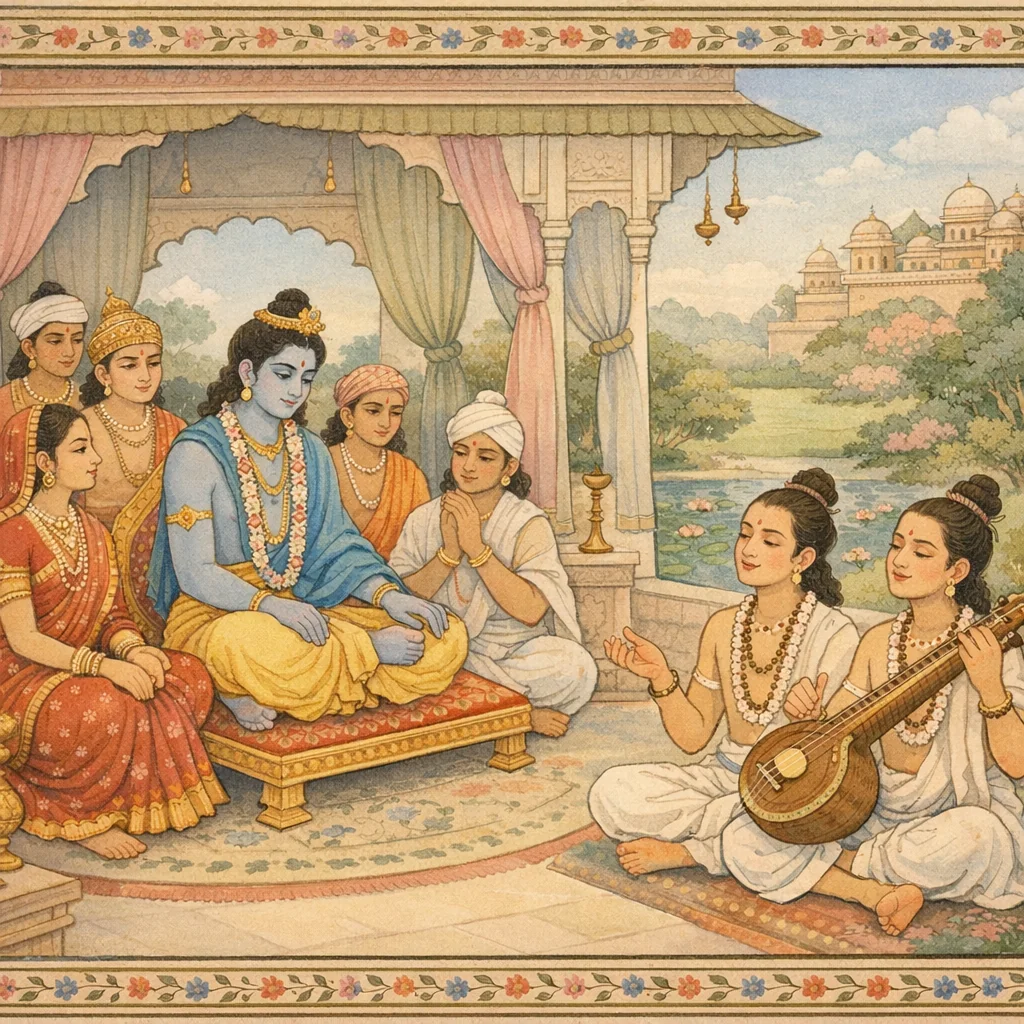
Sarga 4 formalizes the Rāmāyaṇa as an authored, teachable, and performable itihāsa-kāvya. Vālmīki, described as a divine sage, composes the complete life-story of Rāma who regains the kingdom, and the text explicitly situates the epic within a canonical scale (24,000 verses; six kāṇḍas with an additional Uttara). The poet then reflects on who can properly enact the work; Kuśa and Lava arrive in ascetic dress, are recognized as dharma-knowing royal sons, and are initiated so that the poem may ‘nourish the Vedas’ (vedopabṛṃhaṇa). Their performance is characterized with technical musical metadata—recitation and song, three tempo-measures, seven notes, string-instrument timing, and multiple rasas—presenting the epic as a multi-modal cultural artifact. In assemblies of sages and in public streets, their chanting elicits tears and acclaim; gifts are offered. Rāma later encounters them, hosts them at the palace, and urges a formal rendition in the royal assembly, where the performance produces aesthetic immediacy, as if past events were present.
Shlokas
Verse 1
प्राप्तराज्यस्य रामस्य वाल्मीकिर्भगवानृषि:।चकार चरितं कृत्स्नं विचित्रपदमात्मवान्।।1.4.1।।
The blessed sage Vālmīki, possessed of spiritual insight, composed in wonderfully varied verse the complete account of Rāma, who had regained his kingdom.
Verse 2
चतुर्विंशत्सहस्राणि श्लोकानामुक्तवानृषि:।तथा सर्गशतान्पञ्च षट्काण्डानि तथोत्तरम् ।।1.4.2।।
The sage composed and recited twenty-four thousand verses—arranged into five hundred sargas—forming six kāṇḍas, and additionally the Uttara portion.
Verse 3
कृत्वापि तन्महाप्राज्ञस्सभविष्यं सहोत्तरम्।चिन्तयामास कोन्वेतत्प्रयुञ्जीयादिति प्रभु:।।1.4.3।।
After composing that work—the Ramayana—together with what lay ahead and with the later continuation (Uttara), the capable and far-seeing sage reflected: “Who indeed could properly apply this (poem) in performance?”
Verse 4
तस्य चिन्तयमानस्य महर्षेर्भावितात्मन:।अगृह्णीतां तत: पादौ मुनिवेषौ कुशीलवौ ।।1.4.4।।
As that great seer—self-disciplined and inwardly refined—was still reflecting, the two, Kuśa and Lava, clad in ascetics’ attire, approached and reverently took hold of (bowed at) his feet.
Verse 5
कुशीलवौ तु धर्मज्ञौ राजपुत्रौ यशस्विनौ।भ्रातरौ स्वरसम्पन्नौ ददर्शाश्रमवासिनौ ।।1.4.5।।
The sage saw the two brothers Kuśa and Lava—illustrious princes, learned in dharma, gifted with a melodious voice—dwelling in the hermitage.
Verse 6
स तु मेधाविनौ दृष्ट्वा वेदेषु परिनिष्ठितौ।वेदोपबृंहणार्थाय तावग्राहयत प्रभु:।।1.4.6।।
Seeing the two as intelligent and firmly accomplished in Vedic learning, the master initiated them, so that this work might serve to enrich and support the Vedas.
Verse 7
काव्यं रामायणं कृत्स्नं सीतायाश्चरितं महत्।पौलस्त्यवधमित्येव चकार चरितव्रत:।।1.4.7।।
The vow-observing Vālmīki composed the entire epic called the Rāmāyaṇa—Sītā’s great life-story—and the account of the slaying of the Paulastya (Rāvaṇa).
Verse 8
पाठ्ये गेये च मधुरं प्रमाणैस्त्रिभिरन्वितम्।जातिभिस्सप्तभिर्बद्धं तन्त्रीलयसमन्वितम्।।1.4.8।। रसैश्शृङ्गारकारुण्यहास्यवीरभयानकै:।रौद्रादिभिश्च संयुक्तं काव्यमेतदगायताम्।।1.4.9।। तौ तु गान्धर्वतत्त्वज्ञौ मूर्छनास्थानकोविदौ।भ्रातरौ स्वरसम्पन्नौ गन्धर्वाविव रूपिणौ।।1.4.10।। रूपलक्षणसम्पन्नौ मधुरस्वरभाषिणौ।बिम्बादिवोद्धृतौ बिम्बौ रामदेहात्तथाऽपरौ।।1.4.11।।
That epic was sweet both for recitation and for singing, fitted to the three rhythmic measures, structured with seven musical modes, and aligned with instrumental tempo. Endowed with aesthetic flavors—love, compassion, humor, heroism, fear, and also fury and the rest—those two brothers sang it. Skilled in the principles of gandharva-music, expert in melodic movements and pitches, and gifted with fine voice, they appeared like gandharvas in human form. Handsome in form and mark, gentle in speech and tone, they seemed like two reflections drawn from the very body of Rāma.
Verse 9
पाठ्ये गेये च मधुरं प्रमाणैस्त्रिभिरन्वितम्।जातिभिस्सप्तभिर्बद्धं तन्त्रीलयसमन्वितम्।।1.4.8।। रसैश्शृङ्गारकारुण्यहास्यवीरभयानकै:।रौद्रादिभिश्च संयुक्तं काव्यमेतदगायताम्।।1.4.9।। तौ तु गान्धर्वतत्त्वज्ञौ मूर्छनास्थानकोविदौ।भ्रातरौ स्वरसम्पन्नौ गन्धर्वाविव रूपिणौ।।1.4.10।। रूपलक्षणसम्पन्नौ मधुरस्वरभाषिणौ।बिम्बादिवोद्धृतौ बिम्बौ रामदेहात्तथाऽपरौ।।1.4.11।।
That epic was sweet both for recitation and for singing, fitted to the three rhythmic measures, structured with seven musical modes, and aligned with instrumental tempo. Endowed with aesthetic flavors—love, compassion, humor, heroism, fear, and also fury and the rest—those two brothers sang it. Skilled in the principles of gandharva-music, expert in melodic movements and pitches, and gifted with fine voice, they appeared like gandharvas in human form. Handsome in form and mark, gentle in speech and tone, they seemed like two reflections drawn from the very body of Rāma.
Verse 10
पाठ्ये गेये च मधुरं प्रमाणैस्त्रिभिरन्वितम्।जातिभिस्सप्तभिर्बद्धं तन्त्रीलयसमन्वितम्।।1.4.8।। रसैश्शृङ्गारकारुण्यहास्यवीरभयानकै:।रौद्रादिभिश्च संयुक्तं काव्यमेतदगायताम्।।1.4.9।। तौ तु गान्धर्वतत्त्वज्ञौ मूर्छनास्थानकोविदौ।भ्रातरौ स्वरसम्पन्नौ गन्धर्वाविव रूपिणौ।।1.4.10।। रूपलक्षणसम्पन्नौ मधुरस्वरभाषिणौ।बिम्बादिवोद्धृतौ बिम्बौ रामदेहात्तथाऽपरौ।।1.4.11।।
Those two brothers, skilled in the principles of music and learned in melodic modes and pitch-places, were endowed with fine voice—appearing like Gandharvas in human form.
Verse 11
पाठ्ये गेये च मधुरं प्रमाणैस्त्रिभिरन्वितम्।जातिभिस्सप्तभिर्बद्धं तन्त्रीलयसमन्वितम्।।1.4.8।। रसैश्शृङ्गारकारुण्यहास्यवीरभयानकै:।रौद्रादिभिश्च संयुक्तं काव्यमेतदगायताम्।।1.4.9।। तौ तु गान्धर्वतत्त्वज्ञौ मूर्छनास्थानकोविदौ।भ्रातरौ स्वरसम्पन्नौ गन्धर्वाविव रूपिणौ।।1.4.10।। रूपलक्षणसम्पन्नौ मधुरस्वरभाषिणौ।बिम्बादिवोद्धृतौ बिम्बौ रामदेहात्तथाऽपरौ।।1.4.11।।
Endowed with beauty and auspicious marks, speaking in a sweet tone, they appeared like two images drawn from an original—like two other reflections as though taken from Rāma’s very body.
Verse 12
तौ राजपुत्रौ कार्त्स्न्येन धर्म्यमाख्यानमुत्तमम्। वाचोविधेयं तत्सर्वं कृत्वा काव्यमनिन्दितौ।।1.4.12।। ऋषीणां च द्विजातीनां साधूनां च समागमे।यथोपदेशं तत्त्वज्ञौ जगतुस्सुसमाहितौ।।1.4.13।।
Those two princes—blameless—made the entire, supreme, dharma-grounded narrative into a work mastered by speech, committing the whole poem perfectly to memory.
Verse 13
तौ राजपुत्रौ कार्त्स्न्येन धर्म्यमाख्यानमुत्तमम्। वाचोविधेयं तत्सर्वं कृत्वा काव्यमनिन्दितौ।।1.4.12।। ऋषीणां च द्विजातीनां साधूनां च समागमे।यथोपदेशं तत्त्वज्ञौ जगतुस्सुसमाहितौ।।1.4.13।।
In gatherings of sages, learned twice-born, and saints, those two knowers of truth—fully composed—chanted it exactly as they had been instructed.
Verse 14
महात्मानौ महाभागौ सर्वलक्षणलक्षितौ। तौ कदाचित्समेतानामृषीणां भावितात्मनाम्।आसीनानां समीपस्थाविदं काव्यमगायताम्।।1.4.14।।
Those two great-souled, highly fortunate princes, marked by every auspicious sign, once stood near the assembled, honored sages as they sat, and chanted this epic.
Verse 15
तच्छ्रुत्वा मुनयस्सर्वे बाष्पपर्याकुलेक्षणा:। साधुसाध्विति तावूचु: परं विस्मयमागता:।।1.4.15।।
Hearing it, all the sages—eyes clouded with tears—were filled with profound wonder and exclaimed to the two, “Excellent! Excellent!”
Verse 16
ते प्रीतमनसस्सर्वे मुनयो धर्मवत्सला:।प्रशशंसु: प्रशस्तव्यौ गायमानौ कुशीलवौ।।1.4.16।।
All the sages, lovers of dharma and pleased at heart, praised the praiseworthy singers Kuśa and Lava as the two continued their chant.
Verse 17
अहो गीतस्य माधुर्यं श्लोकानां च विशेषत:।चिरनिर्वृत्तमप्येतत्प्रत्यक्षमिव दर्शितम्।।1.4.17।।
"How sweet this singing is—especially these verses! Though these events occurred long ago, they are presented as if seen directly before our eyes," exclaimed the listeners.
Verse 18
प्रविश्य तावुभौ सुष्ठु भावं सम्यगगायताम्। सहितौ मधुरं रक्तं सम्पन्नं स्वरसम्पदा।।1.4.18।।
Entering fully into the intended mood, the two sang faultlessly—together in unison—sweet and captivating, richly endowed with musical notes.
Verse 19
एवं प्रशस्यमानौ तौ तपश्श्लाघ्यैर्महात्मभि:।संरक्ततरमत्यर्थं मधुरं तावगायताम्।।1.4.19।।
Thus praised by great souls renowned for austerity, the two sang on—ever more captivating and exceedingly sweet.
Verse 20
प्रीत: कश्चिन्मुनिस्ताभ्यां संस्थित: कलशं ददौ।प्रसन्नो वल्कलं कश्चिद्ददौ ताभ्यां महायशा:।।1.4.20।।
Pleased, one sage seated there gave the two a water-pitcher; another illustrious sage, delighted, gave them bark garments.
Verse 21
आश्चर्यमिदमाख्यानं मुनिना सम्प्रकीर्तितम्।परं कवीनामाधारं समाप्तं च यथाक्रमम्।।1.4.21।।
This wondrous narrative, proclaimed by the sage and completed in proper sequence, stands as the supreme foundation for poets.
Verse 22
अभिगीतमिदं गीतं सर्वगीतेषु कोविदौ।आयुष्यं पुष्टिजनकं सर्वश्रुतिमनोहरम्।।1.4.22।। प्रशस्यमानौ सर्वत्र कदाचित्तत्र गायकौ ।रथ्यासु राजमार्गेषु ददर्श भरताग्रज:।।1.4.23।।
Skilled in every kind of song, the two sang this poem excellently—delightful to every listener, bestowing longevity and bringing nourishment and well-being.
Verse 23
अभिगीतमिदं गीतं सर्वगीतेषु कोविदौ।आयुष्यं पुष्टिजनकं सर्वश्रुतिमनोहरम्।।1.4.22।। प्रशस्यमानौ सर्वत्र कदाचित्तत्र गायकौ ।रथ्यासु राजमार्गेषु ददर्श भरताग्रज:।।1.4.23।।
Admired everywhere, the two singers were once seen there by Bharata’s elder brother (Rāma) as they performed in the streets and on the royal highways.
Verse 24
स्ववेश्म चानीय तदा भ्रातरौ स कुशीलवौ।पूजयामास पूजार्हौ रामश्शत्रुनिबर्हण:।।1.4.24।।
Then Rāma, the destroyer of enemies, brought the two brothers Kuśa and Lava to his own residence and honored them with due hospitality, for they were worthy of reverence.
Verse 25
आसीन: काञ्चने दिव्ये स च सिंहासने प्रभु:।उपोपविष्टस्सचिवैर्भ्रातृभिश्च परन्तप:।।1.4.25।।
Rama, the subduer of foes, sat upon a splendid golden throne, attended closely by his ministers and his brothers.
Verse 26
दृष्ट्वा तु रूपसम्पन्नौ तावुभौ नियतस्तथा।उवाच लक्ष्मणं रामश्शत्रुघ्नं भरतं तदा।।1.4.26।।
Seeing those two handsome youths, Rama—composed and self-controlled—then addressed Lakshmana, Shatrughna, and Bharata.
Verse 27
श्रूयतामिदमाख्यानमनयोर्देववर्चसो:।विचित्रार्थपदं सम्यग्गायकौ तावचोदयत्।।1.4.27।।
“Let this narrative be heard—sung by these two, radiant like the gods, and rich in varied meaning and phrasing.” Saying so, he urged the two singers to begin.
Verse 28
तौ चापि मधुरं रक्तं स्वञ्चितायतनिस्वनम् ।तन्त्रीलयवदत्यर्थं विश्रुतार्थमगायताम् ।।1.4.28।।
And those two sang as well—sweetly and captivatingly—with well-modulated, ample resonance; keeping time with the stringed accompaniment, they rendered the meaning clearly and powerfully.
Verse 29
ह्लादयत्सर्वगात्राणि मनांसि हृदयानि च।श्रोत्राश्रयसुखं गेयं तद्बभौ जनसंसदि।।1.4.29।।
That song shone forth in the assembly, delighting the whole being—senses, mind, and heart—pleasant to the ear and soothing to those who heard it.
Verse 30
इमौ मुनी पार्थिवलक्षणान्वितौकुशीलवौ चैव महातपस्विनौ।ममापि तद्भूतिकरं प्रवक्ष्यतेमहानुभावं चरितं निबोधत।।1.4.30।।
Rama addressed the assembly: “These two are sages, endowed with royal marks; they are Kuśa and Lava, great ascetics and also trained singers. They will narrate a noble and profound history—one that is beneficial even to me. Attend to it carefully.”
Verse 31
ततस्तु तौ रामवच:प्रचोदितावगायतां मार्गविधानसम्पदा।स चापि राम: परिषद्गतः शनैर्बुभूषयासक्तमना बभूव।।1.4.31।।
Then, urged by Rama’s words, the two sang with the full discipline of the classical ‘mārga’ method. And Rama too, seated in the assembly, gradually became intent in mind—seeking inner calm—as he listened.
Verse 32
Then, urged by Rama’s words, the two sang with the full discipline of the classical ‘mārga’ method. And Rama too, seated in the assembly, gradually became intent in mind—seeking inner calm—as he listened.
Frequently Asked Questions
The pivotal action is the ethical authorization of narration: Vālmīki seeks a competent performer for a dharmic history, then initiates Kuśa and Lava—royal by birth yet ascetic by discipline—showing that legitimacy to transmit sacred-cultural memory rests on conduct, training, and restraint rather than status alone.
The sarga teaches that itihāsa becomes living guidance when preserved through disciplined pedagogy and aesthetically precise performance; rasa and musical structure are not mere ornament but instruments that render dharma experientially intelligible to both ascetic and civic audiences.
Culturally, the sarga highlights the transition from hermitage instruction to public and royal dissemination—assemblies of ṛṣis, streets and royal roads, and the palace court—alongside classical performance markers such as mārga-gāna, seven notes, three tempo-measures, and string-instrument timing.