Sarga 92
भरद्वाजाश्रमात् चित्रकूटमार्गनिर्देशः — Directions from Bharadvaja’s Hermitage to Chitrakuta
अयोध्याकाण्ड
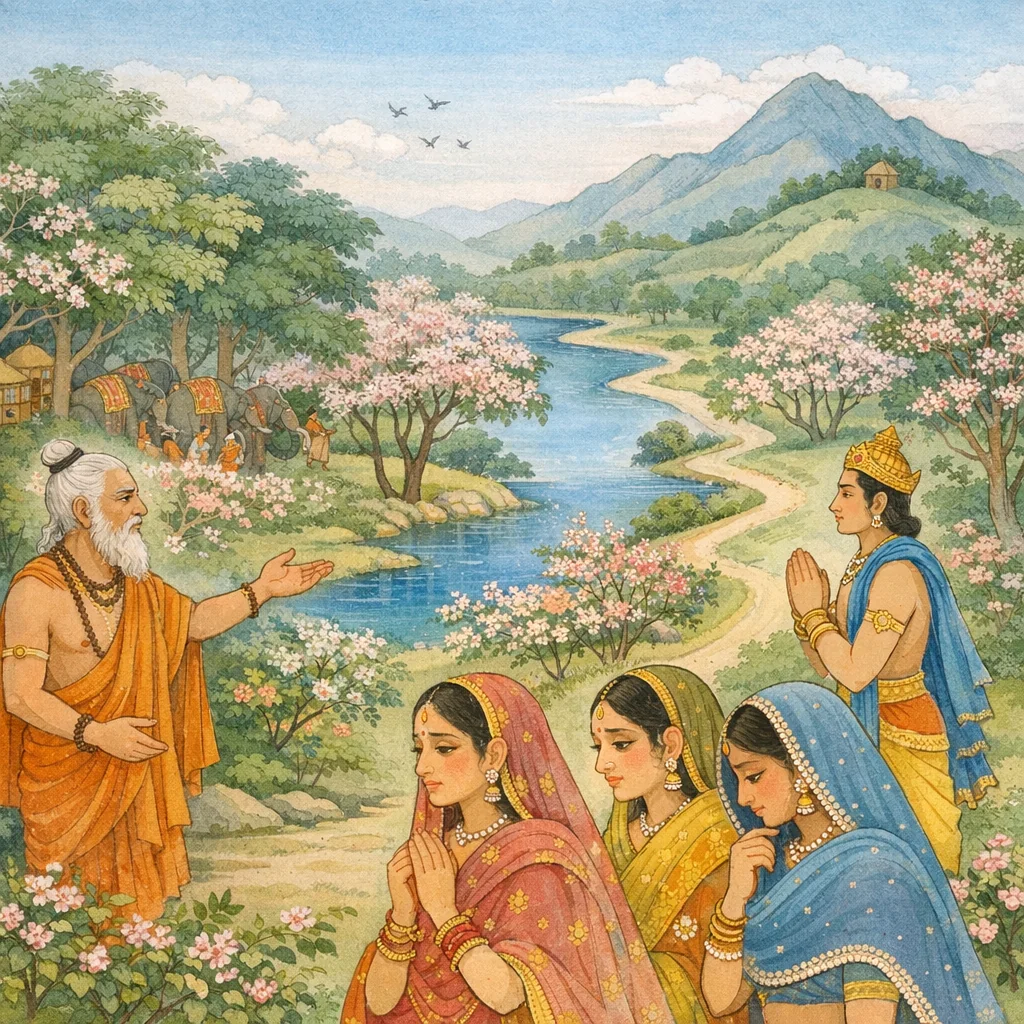
After receiving hospitality at Bharadvāja’s āśrama, Bharata—with a full retinue—formally takes leave and requests precise route guidance to reach Rāma. Bharadvāja describes the geography: Chitrakūṭa lies about three-and-a-half yojanas away in a solitary forest; on its northern side flows the Mandākinī, bordered by flowering trees, and beyond the river rises the mountain where Rāma and Sītā dwell in a leaf-hut. He instructs Bharata’s army to proceed by a southern or south-western path to encounter Rāghava. Hearing of departure, Daśaratha’s queens step down from their vehicles and approach the sage: Kauśalyā and Sumitrā in visible grief, and Kaikeyī in shame; Bharata then identifies the mothers individually, praising Kauśalyā as Rāma’s mother, naming Sumitrā as mother of Lakṣmaṇa and Śatrughna, and condemning Kaikeyī as the perceived root of the calamity. Bharadvāja replies with interpretive counsel, advising Bharata not to impute fault to Kaikeyī, asserting that Rāma’s exile will ultimately yield welfare for gods, demons, and sages. Bharata circumambulates the sage, orders the army to harness vehicles, and the force departs southward—elephants, chariots, infantry, and royal women—moving like a rising cloud through forests and riverine terrain beyond the Gaṅgā.
Shlokas
Verse 1
ततस्तां रजनीमुष्य भरतस्सपरिच्छदः। कृतातिथ्यो भरद्वाजं कामादभिजगाम ह।।2.92.1।।
Then, after spending that night—having received hospitality—Bharata, along with his attendants, approached Bharadvāja with a purpose in mind.
Verse 2
तं ऋषिः पुरुषव्याघ्रं प्राञ्जलिं प्रेक्ष्य चाऽगतम्।हुताग्निहोत्रो भरतं भरद्वाजोऽभ्यभाषत।।2.92.2।।
Seeing Bharata—the tiger among men—arrive with folded hands, the sage Bharadvāja, having completed his fire-rites, addressed him.
Verse 3
कच्चिदत्र सुखा रात्रिस्तवास्मद्विषये गता। समग्रस्ते जनः कच्चिदातिथ्ये शंस मेऽनघ।।2.92.3।।
O blameless one, did you pass the night here in our hermitage in comfort? Tell me also whether all your people were properly cared for in hospitality.
Verse 4
तमुवाचाञ्जलिं कृत्वा भरतोऽभिप्रणम्य च। आश्रमादभिनिष्क्रान्तमृषिमुत्तमतेजसम्।।2.92.4।।
With palms joined, Bharata bowed respectfully and addressed the sage of surpassing radiance as he came forth from the hermitage.
Verse 5
ससुखोषितोऽस्मि भगवन्समग्रबलवाहनः। तर्पितस्सर्वकामैश्च सामात्यो बलवत्त्वया।।2.92.5।।
“Blessed sir, I—together with my ministers, the full force, and the transport animals—have passed the night in comfort; by you we have been abundantly satisfied in every need and wish.”
Verse 6
अपेतक्लमसन्तापा स्सुभिक्षास्सुप्रतिश्रयाः। अपि प्रेष्यानुपादाय सर्वे स्म सुसुखोषिताः।।2.92.6।।
All of us—even including the messengers—were free from weariness and distress; we were well-provisioned and well-lodged, and we passed the night in comfort.
Verse 7
आमन्त्रयेऽहं भगवन् कामं त्वामृषिसत्तमः। समीपं प्रस्थितं भ्रातुर्मैत्रेणेक्षस्व चक्षुषा।।2.92.7।।
O venerable one, best among sages— I now take my leave of you; as I set out to be near my brother, look upon me with a friendly, blessing gaze.
Verse 8
आश्रमं तस्य धर्मज्ञ धार्मिकस्य महात्मनः। आचक्ष्व कतमो मार्गः कियानिति च शंस मे।।2.92.8।।
O knower of dharma, tell me of that righteous great-souled one’s hermitage: which path leads there, and how far is it from here?
Verse 9
इति पृष्टस्तु भरतं भ्रातृदर्शनलालसम्। प्रत्युवाच महातेजा भरद्वाजो महातपाः।।2.92.9।।
Thus questioned, the great ascetic Bharadvāja—radiant with spiritual power—answered Bharata, who longed to see his brother.
Verse 10
भरतार्धतृतीयेषु योजनेष्वजने वने। चित्रकूटो गिरिस्तत्र रम्यनिर्झरकाननः।।2.92.10।।
O Bharata, three and a half yojanas from here, in a solitary forest, stands Mount Citrakūṭa, charming with its streams and woodlands.
Verse 11
उत्तरं पार्श्वमासाद्य तस्य मन्दाकिनी नदी। पुष्पितद्रुमसञ्छन्ना रम्यपुष्पितकानना।।2.92.11।।
Reaching its northern side, there is the river Mandākinī, its banks covered with flowering trees and lovely blossoming groves.
Verse 12
अनन्तरं तत्सरितश्चित्रकूटश्च पर्वतः। तयोः पर्णकुटी तात तत्र तौ वसतो ध्रुवम्।।2.92.12।।
O dear child, beyond that river lies Mount Citrakūṭa; there, on those heights, is their leaf-hut—certainly, the two of them dwell there.
Verse 13
दक्षिणेनैव मार्गेण सव्यदक्षिणमेव वा। गजवाजिरथाकीर्णां वाहिनीं वाहिनीपते।।2.92.13।। वाहयस्व महाभाग ततो द्रक्ष्यसि राघवम्।
O lord of the host, illustrious one—lead your army, filled with elephants, horses, and chariots, by the southern route or even toward the southwest; then you will see Rāghava (Rāma).
Verse 14
प्रयाणमिति तच्छ्रुत्वा रजराजस्य योषितः। हित्वा यानानि यानार्हाः ब्राह्मणं पर्यवारयन्।।2.92.14।।
Hearing that it was time to depart, the wives of Daśaratha—though worthy of riding in fine carriages—left their vehicles and gathered around the brahmin-sage.
Verse 15
वेपमाना कृशा दीना सह देव्या सुमित्रया। कौसल्या तत्र जग्राह कराभ्यां चरणौ मुनेः।।2.92.15।।
There, Kausalyā—trembling, emaciated, and desolate—together with Queen Sumitrā, clasped the sage’s feet with her hands.
Verse 16
असमृद्धेन कामेन सर्वलोकस्य गर्हिता। कैकेयी तस्य जग्राह चरणौ सव्यपत्रपा।।2.92.16।।
Kaikeyī—her desire having gone unfulfilled, censured by all, and overcome with shame—also grasped his feet.
Verse 17
तं प्रदक्षिणमागम्य भगवन्तं महामुनिम्। अदूरार्भरतस्यैव तस्थौ दीनमनास्तदा।।2.92.17।।
Having reverently circumambulated that blessed great sage, she then stood not far from Bharata, her mind heavy with sorrow.
Verse 18
ततः पप्रच्छ भरतं भरद्वाजो दृढव्रतः। विशेषं ज्ञातुमिच्छामि मात्रूणां तव राघव।।2.92.18।।
Then Bharadvāja, firm in his vows, questioned Bharata: “O Rāghava, I wish to know distinctly about your mothers.”
Verse 19
एवमुक्तस्तु भरतो भरद्वाजेन धीमता। उवाच प्राञ्जलिर्भूत्वा वाक्यं वचनकोविदः।।2.92.19।।
Thus addressed by the wise Bharadvāja, Bharata—skilled in speech—replied with joined palms in reverence.
Verse 20
यामिमां भगवन् दीनां शोकानशनकर्शिताम्। पितुर्हि महिषीं देवीं देवतामिव पश्यसि।।2.92.20।। एषा तं पुरषव्याघ्रं सिंहविक्रान्तगामिनम्। कौसल्या सुषुवे रामं धातारमदितिर्यथा।।2.92.21।।
“Venerable sir, the queen whom you see here—wretched and wasted by grief and fasting—like a goddess in appearance, is Kausalyā, my father’s chief consort. It is she who bore Rāma, that tiger among men whose stride is like a lion’s, just as Aditi bore Dhātā.”
Verse 21
यामिमां भगवन् दीनां शोकानशनकर्शिताम्। पितुर्हि महिषीं देवीं देवतामिव पश्यसि।।2.92.20।। एषा तं पुरषव्याघ्रं सिंहविक्रान्तगामिनम्। कौसल्या सुषुवे रामं धातारमदितिर्यथा।।2.92.21।।
“Venerable sir, the queen whom you see here—wretched and wasted by grief and fasting—like a goddess in appearance, is Kausalyā, my father’s chief consort. It is she who bore Rāma, that tiger among men whose stride is like a lion’s, just as Aditi bore Dhātā.”
Verse 22
अस्या वामभुजं श्लिष्टा यैषा तिष्ठति दुर्मनाः। कर्णिकारस्य शाखेव शीर्णपुष्पा वनान्तरे।।2.92.22।। एतस्यास्तु सुतौ देव्याः कुमारौ देववर्णिनौ। उभौ लक्ष्मणशत्रुघ्नौ वीरौ सत्यपराक्रमौ।।2.92.23।।
“And this lady who stands sorrowful, clinging to her left arm—like a karnikāra branch in the forest whose blossoms have withered—is Queen Sumitrā. Of this queen were born two princes, radiant as gods: the heroes Lakṣmaṇa and Śatrughna, whose valor is steadfast and true.”
Verse 23
अस्या वामभुजं श्लिष्टा यैषा तिष्ठति दुर्मनाः। कर्णिकारस्य शाखेव शीर्णपुष्पा वनान्तरे।।2.92.22।। एतस्यास्तु सुतौ देव्याः कुमारौ देववर्णिनौ। उभौ लक्ष्मणशत्रुघ्नौ वीरौ सत्यपराक्रमौ।।2.92.23।।
“And this lady who stands sorrowful, clinging to her left arm—like a karnikāra branch in the forest whose blossoms have withered—is Queen Sumitrā. Of this queen were born two princes, radiant as gods: the heroes Lakṣmaṇa and Śatrughna, whose valor is steadfast and true.”
Verse 24
यस्याः कृते नरव्याघ्रौ जीवनाशमितो गतौ। राजपुत्रविहीनश्च स्वर्गं दशरथो गतः।।2.92.24।। क्रोधनामकृतप्रज्ञां दृप्तां सुभगमानिनीम्। ऐश्वर्यकामां कैकेयीमनार्यामार्यारूपिणीम्।।2.92.25।। ममैतां मातरं विद्धि नृशंसां पापनिश्चयाम्। यतोमूलं हि पश्यामि व्यसनं महदात्मनः।।2.92.26।।
Because of her, the two tiger-like best of men have gone from here toward a path that threatens life; and Daśaratha too—bereft of his son—has gone to heaven.
Verse 25
यस्याः कृते नरव्याघ्रौ जीवनाशमितो गतौ। राजपुत्रविहीनश्च स्वर्गं दशरथो गतः।।2.92.24।। क्रोधनामकृतप्रज्ञां दृप्तां सुभगमानिनीम्। ऐश्वर्यकामां कैकेयीमनार्यामार्यारूपिणीम्।।2.92.25।। ममैतां मातरं विद्धि नृशंसां पापनिश्चयाम्। यतोमूलं हि पश्यामि व्यसनं महदात्मनः।।2.92.26।।
Know Kaikeyī as one ruled by anger, lacking discernment, proud, imagining herself supremely beautiful—craving power and wealth—ignoble though wearing the appearance of nobility.
Verse 26
यस्याः कृते नरव्याघ्रौ जीवनाशमितो गतौ। राजपुत्रविहीनश्च स्वर्गं दशरथो गतः।।2.92.24।। क्रोधनामकृतप्रज्ञां दृप्तां सुभगमानिनीम्। ऐश्वर्यकामां कैकेयीमनार्यामार्यारूपिणीम्।।2.92.25।। ममैतां मातरं विद्धि नृशंसां पापनिश्चयाम्। यतोमूलं हि पश्यामि व्यसनं महदात्मनः।।2.92.26।।
Know her to be my mother—cruel and resolved upon sin—for I see in her the very root from which this great calamity has sprung.
Verse 27
इत्युक्त्वा नरशार्दूलो बाष्पगद्गदया गिरा। स निश्स्वास ताम्राक्षो नागः कृद्ध इव श्वसन्।।2.92.27।।
Having spoken thus, that tiger among men—eyes reddened—breathed heavily; his words were choked with tears, and he hissed like an enraged serpent.
Verse 28
भरद्वाजो महर्षिस्तं ब्रुवन्तं भरतं तथा। प्रत्युवाच महाबुद्धिरिदं वचनमर्थवत्।।2.92.28।।
Then the great sage Bharadvāja, wise in understanding, replied to Bharata as he spoke, with words full of meaning.
Verse 29
न दोषेणावगन्तव्या कैकेयी भरत त्वया। रामप्रव्राजनं ह्येतत्सुखोदर्कं भविष्यति।।2.92.29।।
O Bharata, you should not condemn Kaikeyī as culpable; for this sending of Rāma into exile will, in its final outcome, become a source of great good.
Verse 30
देवानां दानवानां च ऋषीणां भावितात्मनाम्। हितमेव भविष्यद्धि रामप्रव्राजनादिह।।2.92.30।।
Indeed, from Rāma’s exile here, welfare will arise—for the gods, for the dānavas, and for the sages whose selves are purified.
Verse 31
अभिवाद्य तु संसिद्धः कृत्वा चैनं प्रदक्षिणम्। आमन्त्र्य भरत स्सैन्यं युज्यतामित्यचोदयत्।।2.92.31।।
Then Bharata, having made ready for the journey, paid his obeisance and circumambulated him; taking leave, he urged the army, saying, “Harness up and prepare.”
Verse 32
ततो वाजिरथान्युक्तान् दिव्यान्हेमपरिष्कृतान्। अध्यारोहत्प्रयाणार्थी बहून्बहुविधो जनः।।2.92.32।।
Then many people of various ranks, eager to set out, mounted excellent horse-chariots—harnessed and ornamented with gold.
Verse 33
गजकन्या गजाश्चैव हेमकक्ष्याः पताकिनः। जीमूता इव घर्मान्ते सघोषास्सम्प्रतस्थिरे।।2.92.33।।
Female elephants and male elephants alike—girt with golden bands and bearing pennants—set out with resonant sound, like thunderclouds gathering at summer’s end.
Verse 34
विविधान्यपि यानानि महन्ति च लघूनि च। प्रययु स्सुमहार्हाणि पादै रेव पदातयः।।2.92.34।।
Costly vehicles of many kinds—both large and small—moved out, while the foot-soldiers marched on, simply on their own feet.
Verse 35
अथ यानप्रवेकैस्तु कौसल्याप्रमुखाः स्त्रियः। रामदर्शनकाङ्क्षिण्यः प्रययुर्मुदितास्तदा।।2.92.35।।
Thereafter, the women—led by Kauśalyā—set out joyfully in fine conveyances, longing for the sight of Rāma.
Verse 36
चन्द्रार्कतरुणाभासां निर्युक्तां शिबिकां शुभाम्। आस्थाय प्रययौ श्रीमान्भरत स्सपरिच्छदः।।2.92.36।।
Splendid Bharata, with his attendants and equipment, entered an auspicious palanquin made ready, radiant like the young sun and moon, and proceeded onward.
Verse 37
सा प्रयाता महासेना गजवाजिरथाकुला। दक्षिणां दिशमावृत्य महामेघ इवोत्थितः।।2.92.37।। वनानि तु व्यतिक्रम्य जुष्टानि मृगपक्षिभिः। गङ्गायाः परवेलायां गिरिष्वपि नदीषु च।।2.92.38।।
That vast host—dense with elephants, horses, and chariots—moved out to the south, spreading like a great cloud risen in the sky. Crossing forests frequented by beasts and birds, it advanced along the farther bank of the Gaṅgā, through hills and streams as well.
Verse 38
सा प्रयाता महासेना गजवाजिरथाकुला। दक्षिणां दिशमावृत्य महामेघ इवोत्थितः।।2.92.37।। वनानि तु व्यतिक्रम्य जुष्टानि मृगपक्षिभिः। गङ्गायाः परवेलायां गिरिष्वपि नदीषु च।।2.92.38।।
That vast host—dense with elephants, horses, and chariots—moved out to the south, spreading like a great cloud risen in the sky. Crossing forests frequented by beasts and birds, it advanced along the farther bank of the Gaṅgā, through hills and streams as well.
Verse 39
सा सम्प्रहृष्टद्विपवाजियोधा वित्रासयन्ती मृगपक्षिसङ्घान्। महद्वनं तत्प्रतिगाहमाना रराज सेना भरतस्य तत्र।।2.92.39।।
There Bharata’s army—its elephants, horses, and warriors high-spirited—entered the great forest, startling flocks of beasts and birds, and shone in its massed splendor.
Frequently Asked Questions
Bharata’s grief-driven moral judgment culminates in publicly blaming Kaikeyī as the root cause of exile and Daśaratha’s death, while Bharadvāja counters by urging non-imputation of fault. The dilemma is whether suffering should be assigned to an individual’s culpability or interpreted within a broader dharmic trajectory.
Bharadvāja’s upadeśa asserts that events appearing tragic can bear auspicious, welfare-producing consequences over time; therefore, a dharmic reader should avoid narrow blame and cultivate long-horizon discernment, especially when emotions distort judgment.
Chitrakūṭa is mapped as three-and-a-half yojanas away; the Mandākinī flows on its northern flank amid flowering woods; beyond the river lies the mountain with Rāma’s leaf-hut. The sarga also references crossing/terrain beyond the Gaṅgā and records travel logistics—army routes (south/south-west), vehicles, palanquins, and marching order.