Sarga 88
रामशय्यादर्शनम् — Bharata Beholds Rama’s Forest Bed
अयोध्याकाण्ड
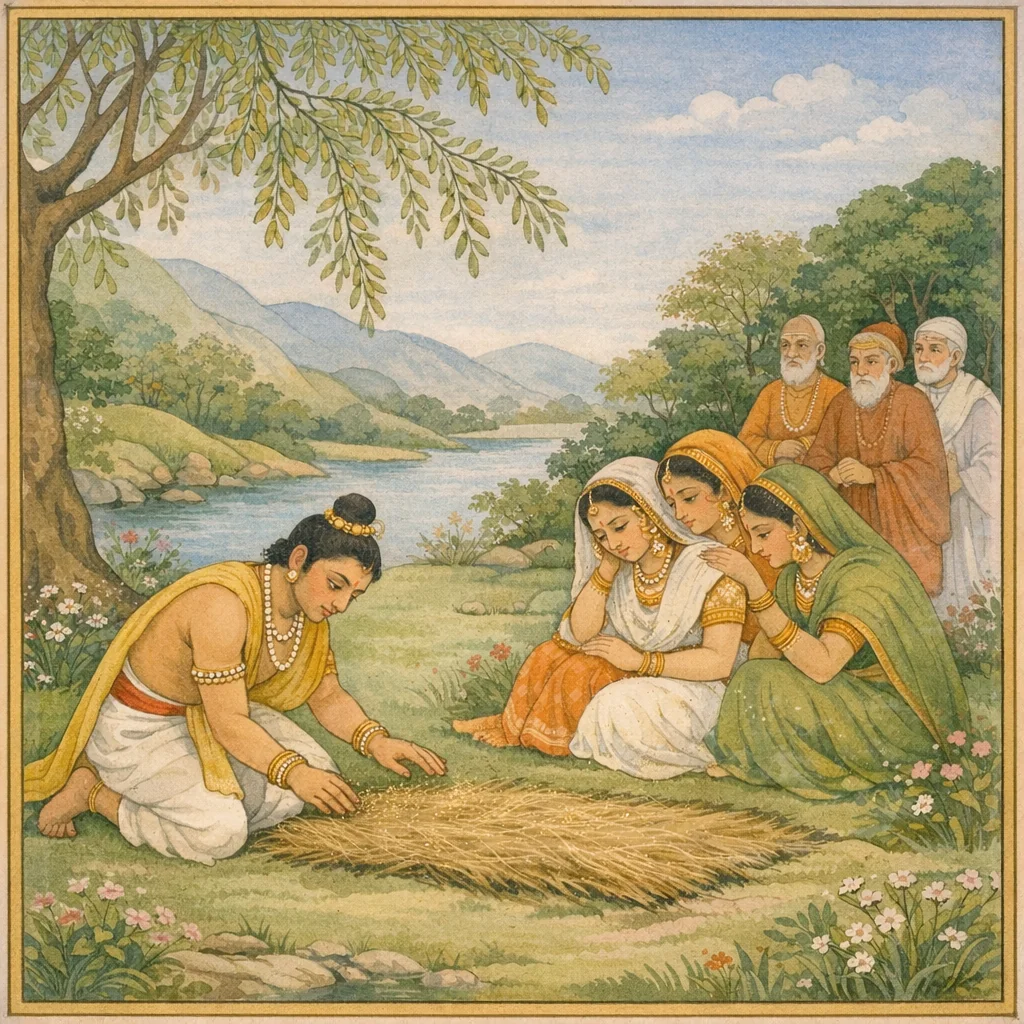
In this chapter Bharata, having heard Guha’s report, arrives with ministers at the ingudī tree and visually examines the crushed grass-bed where Rama slept on the ground. Speaking to his mothers, he turns observation into ethical reflection: the scene feels unreal, as if a dream, and he interprets it as evidence that Kāla (Time/Destiny) overpowers all worldly supports. He notes Sītā’s presence through traces of gold dust and silken threads, inferring her ornaments and garment touched the bedding; the material details intensify the pathos of royal austerity. Bharata contrasts Rama’s former palace luxury—gold-and-silver floors, perfumes, music, and panegyrics—with the present hardship of sleeping on bare earth, and he condemns himself as the cause of this displacement. He praises Lakṣmaṇa’s fidelity and acknowledges Sītā’s fulfilled purpose in following her husband. The political dimension emerges as Bharata likens the kingdom to a helmsmanless ship after Daśaratha’s death and Rama’s exile, describing Ayodhyā as dangerously unguarded and demoralized. The sarga closes with Bharata’s vow: he will adopt ascetic life, even live in the forest to uphold Rama’s vow, and persist in supplication until Rama accepts restoration.
Shlokas
Verse 1
तच्छ्रुत्वा निपुणं सर्वं भरत स्सह मन्त्रिभिः।इङ्गुदीमूलमागम्य रामशय्यामवेक्ष्य ताम्।।।।अब्रवीज्जननी स्सर्वा इह तेन महात्मना।शर्वरी शयिता भूमाविदमस्य विमर्दितम्।।।।
Having listened attentively to everything, Bharata arrived with his ministers at the foot of the iṅgudī tree. Seeing that bed of Rāma, he said to all the mothers: “Here that great-souled one slept on the ground through the night—this is the bedding of his, crushed down.”
Verse 2
तच्छ्रुत्वा निपुणं सर्वं भरत स्सह मन्त्रिभिः।इङ्गुदीमूलमागम्य रामशय्यामवेक्ष्य ताम्।।2.88.1।।अब्रवीज्जननी स्सर्वा इह तेन महात्मना।शर्वरी शयिता भूमाविदमस्य विमर्दितम्।।2.88.2।।
Having heard everything carefully, Bharata—along with his ministers—came to the foot of the iṅgudī tree and, looking at that bed of Rāma, said to all the mothers: “Here that great-souled one slept on the ground for the night; this is where his bedding has been crushed.”
Verse 3
महाभागकुलीनेन महाभागेन धीमता।जातो दशरथेनोर्व्यां न रामस्स्वप्तु मर्हति।।।।
Rama—born on this earth to Dasaratha, a sagacious and supremely fortunate king of noble lineage—does not deserve to sleep upon the bare ground.
Verse 4
अजिनोत्तरसंस्तीर्णे वरास्तरणसंचये।शयित्वा पुरुषव्याघ्रः कथं शेते महीतले।।।।
How can that tiger among men—who once slept on a fine bed layered with excellent coverings and overspread with deer-skin—now lie down upon the bare earth?
Verse 5
प्रासादाग्रविमानेषु वलभीषु च सर्वदा।हैमराजतभौमेषु वरास्तरणशालिषु।।।।पुष्पसञ्चयचित्रेषु चन्दनागरुगन्धिषु।पाण्डुराभ्रप्रकाशेषु शुकसङ्घरूतेषुच।।।।प्रासादवरवर्येषु शीतवत्सु सुगन्धिषु।उषित्वामेरुकल्पेषु कृतकाञ्चन भित्तिषु।।।।गीतवादित्रनिर्घोषैर्वराभरणनिस्स्वनैः।मृदङ्गवरशब्दैश्च सततं प्रतिबोधितः।।।।वन्दिभिर्वन्दितः काले बहुभि स्सूतमागधैः।गाथाभिरनुरूपाभि स्स्तुतिभिश्च परन्तपः।।।।
Rama, the subduer of enemies, had always lived in the lofts and upper chambers of splendid mansions—on floors inlaid with gold and silver, spread with the finest coverings, adorned with heaps of flowers, and fragrant with sandal and agaru. Those palace-heights shone like pale white clouds and rang with the cries of flocks of parrots; they were cool and sweet-smelling, with walls gilded like gold and grandeur comparable to Mount Meru. There he would be awakened constantly by music and instruments, by the delicate sound of ornaments, and by the noble beat of drums; and at the proper hour many bards, genealogists, and panegyrists would salute him with fitting songs and praises.
Verse 6
प्रासादाग्रविमानेषु वलभीषु च सर्वदा।हैमराजतभौमेषु वरास्तरणशालिषु।।2.88.5।।पुष्पसञ्चयचित्रेषु चन्दनागरुगन्धिषु।पाण्डुराभ्रप्रकाशेषु शुकसङ्घरूतेषुच।।2.88.6।।प्रासादवरवर्येषु शीतवत्सु सुगन्धिषु।उषित्वामेरुकल्पेषु कृतकाञ्चन भित्तिषु।।2.88.7।।गीतवादित्रनिर्घोषैर्वराभरणनिस्स्वनैः।मृदङ्गवरशब्दैश्च सततं प्रतिबोधितः।।2.88.8।।वन्दिभिर्वन्दितः काले बहुभि स्सूतमागधैः।गाथाभिरनुरूपाभि स्स्तुतिभिश्च परन्तपः।।2.88.9।।
Rama, the subduer of enemies, had always lived in the lofts and upper chambers of splendid mansions—on floors inlaid with gold and silver, spread with the finest coverings, adorned with heaps of flowers, and fragrant with sandal and agaru. Those palace-heights shone like pale white clouds and rang with the cries of flocks of parrots; they were cool and sweet-smelling, with walls gilded like gold and grandeur comparable to Mount Meru. There he would be awakened constantly by music and instruments, by the delicate sound of ornaments, and by the noble beat of drums; and at the proper hour many bards, genealogists, and panegyrists would salute him with fitting songs and praises.
Verse 7
प्रासादाग्रविमानेषु वलभीषु च सर्वदा।हैमराजतभौमेषु वरास्तरणशालिषु।।2.88.5।।पुष्पसञ्चयचित्रेषु चन्दनागरुगन्धिषु।पाण्डुराभ्रप्रकाशेषु शुकसङ्घरूतेषुच।।2.88.6।।प्रासादवरवर्येषु शीतवत्सु सुगन्धिषु।उषित्वामेरुकल्पेषु कृतकाञ्चन भित्तिषु।।2.88.7।।गीतवादित्रनिर्घोषैर्वराभरणनिस्स्वनैः।मृदङ्गवरशब्दैश्च सततं प्रतिबोधितः।।2.88.8।।वन्दिभिर्वन्दितः काले बहुभि स्सूतमागधैः।गाथाभिरनुरूपाभि स्स्तुतिभिश्च परन्तपः।।2.88.9।।
Rama, the subduer of enemies, had always lived in the lofts and upper chambers of splendid mansions—on floors inlaid with gold and silver, spread with the finest coverings, adorned with heaps of flowers, and fragrant with sandal and agaru. Those palace-heights shone like pale white clouds and rang with the cries of flocks of parrots; they were cool and sweet-smelling, with walls gilded like gold and grandeur comparable to Mount Meru. There he would be awakened constantly by music and instruments, by the delicate sound of ornaments, and by the noble beat of drums; and at the proper hour many bards, genealogists, and panegyrists would salute him with fitting songs and praises.
Verse 8
प्रासादाग्रविमानेषु वलभीषु च सर्वदा।हैमराजतभौमेषु वरास्तरणशालिषु।।2.88.5।।पुष्पसञ्चयचित्रेषु चन्दनागरुगन्धिषु।पाण्डुराभ्रप्रकाशेषु शुकसङ्घरूतेषुच।।2.88.6।।प्रासादवरवर्येषु शीतवत्सु सुगन्धिषु।उषित्वामेरुकल्पेषु कृतकाञ्चन भित्तिषु।।2.88.7।।गीतवादित्रनिर्घोषैर्वराभरणनिस्स्वनैः।मृदङ्गवरशब्दैश्च सततं प्रतिबोधितः।।2.88.8।।वन्दिभिर्वन्दितः काले बहुभि स्सूतमागधैः।गाथाभिरनुरूपाभि स्स्तुतिभिश्च परन्तपः।।2.88.9।।
Rama, the subduer of enemies, had always lived in the lofts and upper chambers of splendid mansions—on floors inlaid with gold and silver, spread with the finest coverings, adorned with heaps of flowers, and fragrant with sandal and agaru. Those palace-heights shone like pale white clouds and rang with the cries of flocks of parrots; they were cool and sweet-smelling, with walls gilded like gold and grandeur comparable to Mount Meru. There he would be awakened constantly by music and instruments, by the delicate sound of ornaments, and by the noble beat of drums; and at the proper hour many bards, genealogists, and panegyrists would salute him with fitting songs and praises.
Verse 9
प्रासादाग्रविमानेषु वलभीषु च सर्वदा।हैमराजतभौमेषु वरास्तरणशालिषु।।2.88.5।।पुष्पसञ्चयचित्रेषु चन्दनागरुगन्धिषु।पाण्डुराभ्रप्रकाशेषु शुकसङ्घरूतेषुच।।2.88.6।।प्रासादवरवर्येषु शीतवत्सु सुगन्धिषु।उषित्वामेरुकल्पेषु कृतकाञ्चन भित्तिषु।।2.88.7।।गीतवादित्रनिर्घोषैर्वराभरणनिस्स्वनैः।मृदङ्गवरशब्दैश्च सततं प्रतिबोधितः।।2.88.8।।वन्दिभिर्वन्दितः काले बहुभि स्सूतमागधैः।गाथाभिरनुरूपाभि स्स्तुतिभिश्च परन्तपः।।2.88.9।।
Rama, the subduer of enemies, had always lived in the lofts and upper chambers of splendid mansions—on floors inlaid with gold and silver, spread with the finest coverings, adorned with heaps of flowers, and fragrant with sandal and agaru. Those palace-heights shone like pale white clouds and rang with the cries of flocks of parrots; they were cool and sweet-smelling, with walls gilded like gold and grandeur comparable to Mount Meru. There he would be awakened constantly by music and instruments, by the delicate sound of ornaments, and by the noble beat of drums; and at the proper hour many bards, genealogists, and panegyrists would salute him with fitting songs and praises.
Verse 10
अश्रद्धेयमिदं लोके न सत्यं प्रतिभाति मा।मुह्यते खलु मे भाव स्स्वप्नोऽयमिति मे मतिः।।।।
“In this world, this is beyond belief; it does not appear true to me. My mind is indeed bewildered—my thought is that this is like a dream.”
Verse 11
न नूनं दैवतं किंचित्कालेन बलवत्तरम्।यत्र दाशरथी रामो भूमावेव शयीत सः।।।।
Surely no divine power is even slightly stronger than Time—since Rāma, Daśaratha’s son, had to sleep on the bare ground.
Verse 12
विदेहराजस्य सुता सीता च प्रियदर्शना।दयिता शयिता भूमौ स्नुषा दशरथस्य च।।।।
Sītā too—Janaka’s daughter, lovely to behold, beloved, and Daśaratha’s cherished daughter-in-law—lay down upon the ground.
Verse 13
इयं शय्या मम भ्रातुरिदं हि परिवर्तितम्।स्थण्डिले कठिने सर्वं गात्रै र्विमृदितं तृणम्।।।।
This is my brother’s bed; here he indeed turned and shifted about. On this hard patch of earth, all the grass is crushed by his limbs.
Verse 14
मन्ये साभरणा सुप्ता सीताऽस्मिञ्छयनोत्तमे।तत्र तत्र हि दृश्यन्ते सक्ताः कनकबिन्दवः।।।।
I think Sītā slept on this fine couch wearing her ornaments, for here and there one can see tiny specks of gold stuck to it.
Verse 15
उत्तरीयमिहाऽसक्तं सुव्यक्तं सीतया तदा।तथा ह्येते प्रकाशन्ते सक्ताः कौशेयतन्तवः।।।।
That Sītā’s upper garment caught here is clearly evident, for these silken threads are seen clinging and shining.
Verse 16
मन्ये भर्तु स्सुखा शय्या येन बाला तपस्विनी।सुकुमारी सती दुःखं न हि विजानाति मैथिली।।।।
I think she finds her husband’s bed comfortable—so that young, delicate, and devoted Maithilī, though living austerely, scarcely recognizes it as suffering.
Verse 17
हा हन्ताऽस्मि नृशंसोऽहं यत्सभार्यः कृते मम।ईदृशीं राघवश्शय्यामधिशेते ह्यनाथवत्।।।।
Alas—I am cruel, since because of me Rāghava, together with his wife, lies upon such a bed like one without protection.
Verse 18
सार्वभौमकुले जात स्सर्वलोकस्य सम्मतः।सर्वलोकप्रियस्त्यक्त्वा राज्यं सुखमनुत्तम्।।।।कथमिन्दीवरश्यामो रक्ताक्षः प्रियदर्शनः।सुखभागी न दुःखार्ह श्शयितो भुवि राघवः।।।।
How could Rāghava sleep upon the ground—he who was born in an imperial line, revered by all the world and dear to all; who abandoned a kingdom and unsurpassed comforts; lotus-dark in hue, red-eyed, pleasing to behold—fit for happiness, not for suffering?
Verse 19
सार्वभौमकुले जात स्सर्वलोकस्य सम्मतः।सर्वलोकप्रियस्त्यक्त्वा राज्यं सुखमनुत्तम्।।2.88.18।।कथमिन्दीवरश्यामो रक्ताक्षः प्रियदर्शनः।सुखभागी न दुःखार्ह श्शयितो भुवि राघवः।।2.88.19।।
Having heard everything carefully, Bharata—along with his ministers—came to the foot of the iṅgudī tree and, looking at that bed of Rāma, said to all the mothers: “Here that great-souled one slept on the ground for the night; this is where his bedding has been crushed.”
Verse 20
धन्यः खलु महाभागो लक्ष्मण श्शुभलक्षणः।भ्रातरं विषमे काले यो राममनुवर्तते।।।।
Truly blessed is the great-souled Lakṣmaṇa, marked by auspicious virtues—who, in a time of adversity, follows and stands by his brother Rāma.
Verse 21
सिद्धार्था खलु वैदेही पतिं याऽनुगता वनम्।वयं संशयिता स्सर्वे हीनास्तेन महात्मना।।।।
Surely Vaidehī has fulfilled her purpose, for she has followed her husband into the forest; but we—all bereft of that great-souled Rāma—are left in anxious uncertainty.
Verse 22
आकर्णधारा पृथिवी नौः इव प्रतिभाति मा।गते दशरथे स्वर्गं रामे चारण्यमाश्रिते।।।।
With Daśaratha gone to heaven and Rāma having taken refuge in the forest, this whole realm seems to me like a ship without a helmsman.
Verse 23
न च प्रार्थयते कच्चिन्मनसापि वसुन्धराम्।वनेऽपि वसतस्तस्य बाहुवीर्याभिरक्षिताम्।।।।
No one would desire this earth—protected by the strength of his arms—even in thought, though he dwells in the forest.
Verse 24
शून्यसंवरणारक्षामयन्त्रितहयद्विपाम्।अपावृतपुरद्वारां राजधानीमरक्षिताम्।।।।अप्रहृष्टबलां शून्यां विषमस्थामनावृताम्।शत्रवो नाभिमन्यन्ते भक्षान्विषकृतानिव।।।।
With no watch upon the ramparts, horses and elephants left undisciplined, and the city-gates standing open, the capital lies unguarded—its forces joyless, its spirit empty, its condition perilous and exposed. Even enemies would not choose to seize it, shunning it like food laced with poison.
Verse 25
शून्यसंवरणारक्षामयन्त्रितहयद्विपाम्।अपावृतपुरद्वारां राजधानीमरक्षिताम्।।2.88.24।।अप्रहृष्टबलां शून्यां विषमस्थामनावृताम्।शत्रवो नाभिमन्यन्ते भक्षान्विषकृतानिव।।2.88.25।।
This verse repeats the preceding description: Ayodhyā, with open gates and failing defenses, disheartened forces, and exposed vulnerability, is so afflicted that even enemies would avoid taking it—like food tainted with poison.
Verse 26
अद्यप्रभृति भूमौ तु शयिष्येऽहं तृणेषु वा।फलमूलाशनो नित्यं जटाचीराणि धारयन्।।।।
From this day onward, I too will sleep on the bare ground or upon grass, living always on fruits and roots, wearing matted hair and bark garments.
Verse 27
तस्यार्थमुत्तरं कालं निवत्स्यामि सुखं वने।तं प्रतिश्रवमामुच्य नास्य मिथ्या भविष्यति।।।।
For his sake, I will dwell gladly in the forest for the remaining time, taking upon myself that vow—so that his pledged word may not become false.
Verse 28
वसन्तं भ्रातुरर्थाय शत्रुघ्नो माऽनुवत्स्यति।लक्ष्मणेन सहत्वार्यो ह्ययोध्यां पालयिष्यति।।।।
As I live in the forest for my brother’s sake, Śatrughna will dwell there following me; and the noble one will govern Ayodhyā together with Lakṣmaṇa.
Verse 29
अभिषेक्ष्यन्ति काकुत्स्थमयोध्यायां द्विजातयः।अपि मे देवताः कुर्युरिमं सत्यं मनोरथम्।।।।
In Ayodhyā the twice-born will anoint the scion of the Kakutsthas; may the gods make this cherished wish of mine come true in truth.
Verse 30
प्रसाद्यमान श्शिरसा मया स्वयं बहुप्रकारं यदि नाभिपत्स्यते।ततोऽनुवत्स्यामि चिराय राघवम् वनेचरन्नार्हति मामुपेक्षितुम्।।।।
If, even after I personally seek his favor in many ways with my head bowed, my request is not granted, then I will follow Raghava and live in the forest for as long as it takes—he cannot rightly ignore me when I have become a forest-dweller too.
Frequently Asked Questions
Bharata confronts responsibility for Rama’s hardship and responds with a concrete ethical act: he vows to adopt ascetic practices and even live in the forest to ensure Rama’s exile-vow remains inviolate, while continuing to seek Rama’s consent for rightful restoration.
The sarga frames Kāla (Time/Destiny) as a superior force that can overturn royal comfort, teaching that dharma is tested not in prosperity but in adversity—where truth, vows, and compassion must be maintained despite personal grief.
The ingudī tree functions as a narrative landmark marking Rama’s austerity; Ayodhya is depicted as a vulnerable capital with open gates and weakened defenses, highlighting the cultural expectation that kingship includes vigilant protection of the city and morale of the army.