Sarga 72
भरतस्य मातृसदनगमनं कैकेय्या दारुणवृत्तान्तकथनं च (Bharata in Kaikeyi’s apartments: revelation of Daśaratha’s death and Rāma’s exile)
अयोध्याकाण्ड
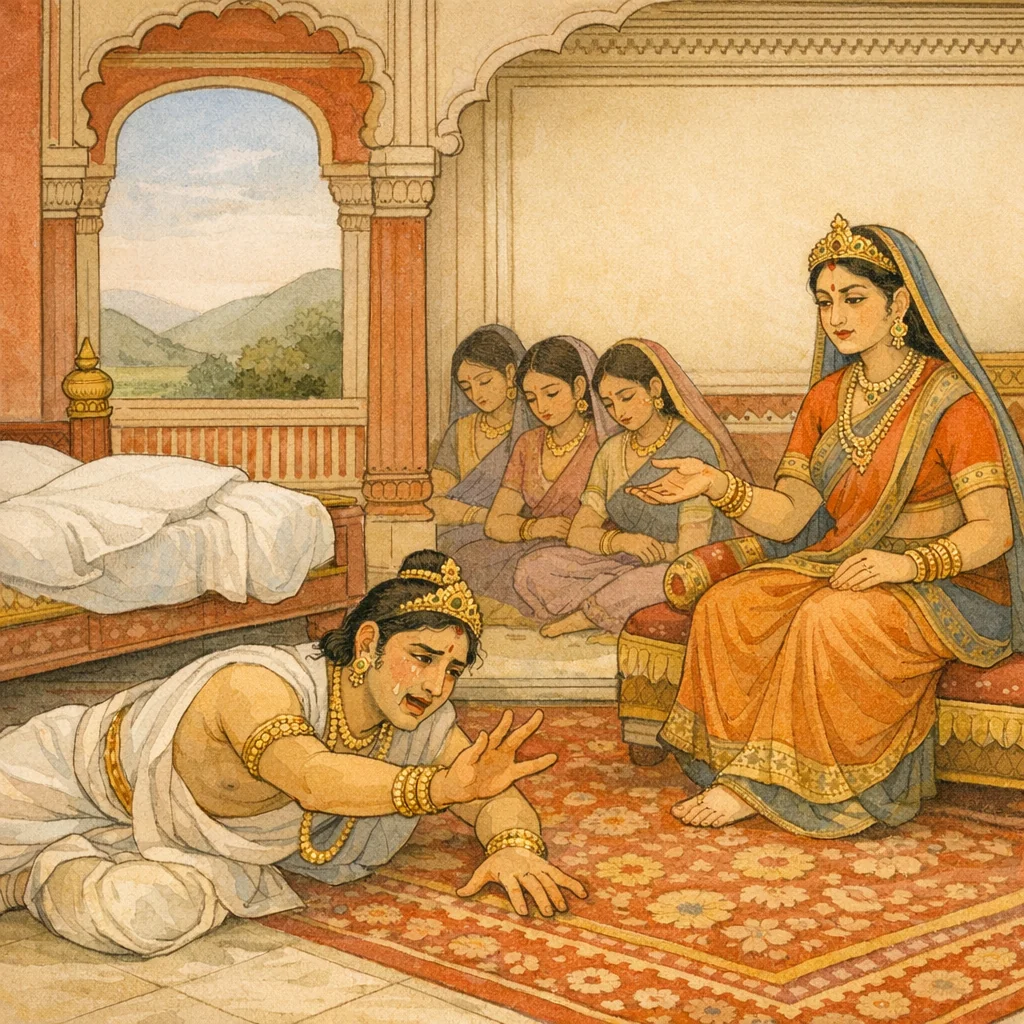
Sarga 72 begins with Bharata searching the royal residence and not finding Daśaratha; he proceeds to Kaikeyī’s apartments to seek his father and receive the customary paternal welcome. Noticing ominous emptiness—an unoccupied couch, joyless attendants, and a general absence of royal bustle—he presses Kaikeyī for an exact account of why he was summoned and where the king is. Kaikeyī, driven by political ambition, delivers the dreadful news: Daśaratha has died, lamenting Rāma, Sītā, and Lakṣmaṇa. Bharata collapses in grief, weeps, and laments the loss of the father’s affectionate touch. He then asks for the king’s final message and, fearing any stain on Rāma’s conduct, explicitly inquires whether Rāma committed any wrongdoing (harm, theft, or desire for another’s wife). Kaikeyī denies any fault in Rāma and openly confesses that she demanded Bharata’s kingship and Rāma’s banishment, after which Daśaratha died of sorrow. She urges Bharata to perform funeral rites and accept coronation, framing the city and kingdom as now dependent on him—an invitation that sets up Bharata’s later moral refusal and his commitment to Rāma’s rightful status.
Shlokas
Verse 1
अपश्यंस्तु ततस्तत्र पितरं पितुरालये।जगाम भरतो द्रष्टुं मातरं मातुरालये।।2.72.1।।
That radiant scion of Raghu set out from Rājagṛha facing east; then, after viewing the river Sudāmā, he crossed it, and also crossed the broad Hlādinī and the wave-crested Śatadrū flowing westward.
Verse 1
अपश्यंस्तु ततस्तत्र पितरं पितुरालये।जगाम भरतो द्रष्टुं मातरं मातुरालये।।2.72.1।।
That radiant scion of Raghu set out from Rājagṛha facing east; then, after viewing the river Sudāmā, he crossed it, and also crossed the broad Hlādinī and the wave-crested Śatadrū flowing westward.
Verse 2
अनुप्राप्तं तु तं दृष्ट्वा कैकेयी प्रोषितं सुतम्।उत्पपात तदा हृष्टा त्यक्त्वा सौवर्णमासनम्।।2.72.2।।
Seeing her son, who had been sent away and had now returned, Kaikeyī—delighted—rose at once, leaving her golden seat.
Verse 3
स प्रविश्यैव धर्मात्मा स्वगृहं श्रीविवर्जितम्।भरतः प्रतिजग्राह जनन्याश्चरणौ शुभौ।।2.72.3।।
Entering his own residence and finding it bereft of its former radiance, righteous Bharata bowed and clasped the auspicious feet of his mother.
Verse 3
स प्रविश्यैव धर्मात्मा स्वगृहं श्रीविवर्जितम्।भरतः प्रतिजग्राह जनन्याश्चरणौ शुभौ।।2.72.3।।
Entering his own residence and finding it bereft of its former radiance, righteous Bharata bowed and clasped the auspicious feet of his mother.
Verse 4
सा तं मूर्धन्युपाघ्राय परिष्वज्य यशस्विनम्।अङ्के भरतमारोप्य प्रष्टुं समुपचक्रमे।।2.72.4।।
She kissed him upon the head and embraced the illustrious Bharata; placing him upon her lap, she began to question him.
Verse 5
अद्य ते कतिचिद्रात्र्य श्च्युतस्याऽर्यकवेश्मनः।अपि नाध्वश्रमशशीघ्रं रथेनापततस्तव।।2.72.5।।
How many nights have passed for you now since you left your noble grandfather’s residence? And has not the hurried travel by chariot left you weary from the road?
Verse 5
अद्य ते कतिचिद्रात्र्य श्च्युतस्याऽर्यकवेश्मनः।अपि नाध्वश्रमशशीघ्रं रथेनापततस्तव।।2.72.5।।
How many nights have passed for you now since you left your noble grandfather’s residence? And has not the hurried travel by chariot left you weary from the road?
Verse 6
आर्यकस्ते सुकुशली युधाजिन्मातुलस्तव। प्रवासाच्च सुखं पुत्र सर्वं मे वक्तुमर्हसि।।2.72.6।।
Is your revered grandfather well, and your maternal uncle Yudhājit? And was your stay away pleasant, my son? You should tell me everything.
Verse 6
आर्यकस्ते सुकुशली युधाजिन्मातुलस्तव। प्रवासाच्च सुखं पुत्र सर्वं मे वक्तुमर्हसि।।2.72.6।।
Is your revered grandfather well, and your maternal uncle Yudhājit? And was your stay away pleasant, my son? You should tell me everything.
Verse 7
एवं पृष्टस्तु कैकेय्या प्रियं पार्थिवनन्दनः।आचष्ट भरत स्सर्वं मात्रे राजीवलोचनः।।2.72.7।।
Thus questioned affectionately by Kaikeyi, Bharata—lotus-eyed, delight of the king—told his mother everything.
Verse 7
एवं पृष्टस्तु कैकेय्या प्रियं पार्थिवनन्दनः।आचष्ट भरत स्सर्वं मात्रे राजीवलोचनः।।2.72.7।।
Thus questioned affectionately by Kaikeyi, Bharata—lotus-eyed, delight of the king—told his mother everything.
Verse 8
अद्य मे सप्तमी रात्रिश्च्युतस्याऽर्यकवेश्मनः।अम्बायाः कुशली तात युधाजिन्मातुलश्च मे।।2.72.8।।
Today is the seventh night since I departed from my noble grandfather’s residence. My mother’s father is well, and my maternal uncle Yudhājit also is well, father.
Verse 8
अद्य मे सप्तमी रात्रिश्च्युतस्याऽर्यकवेश्मनः।अम्बायाः कुशली तात युधाजिन्मातुलश्च मे।।2.72.8।।
Today is the seventh night since I departed from my noble grandfather’s residence. My mother’s father is well, and my maternal uncle Yudhājit also is well, father.
Verse 9
यन्मे धनं च रत्नं च ददौ राजा परन्तपः।परिश्रान्तं पथ्यभवत्ततोऽहं पूर्वमागतः।।2.72.9।।
The wealth and gems that the enemy-subduing king bestowed on me became exhausted on the journey (through the strain of travel). Therefore I have arrived ahead of the others.
Verse 9
यन्मे धनं च रत्नं च ददौ राजा परन्तपः।परिश्रान्तं पथ्यभवत्ततोऽहं पूर्वमागतः।।2.72.9।।
The wealth and gems that the enemy-subduing king bestowed on me became exhausted on the journey (through the strain of travel). Therefore I have arrived ahead of the others.
Verse 10
राजवाक्यहरैर्दूतैस्त्वर्यमाणोऽहमागतः।यदहं प्रष्टुमिच्छामि तदम्बा वक्तुमर्हति।।2.72.10।।
After crossing the Gaṅgā at Prāgvaṭa, he reached the Kuṭikōṣṭhikā; and then, crossing it with his army, he arrived at Dharmavardhana.
Verse 10
राजवाक्यहरैर्दूतैस्त्वर्यमाणोऽहमागतः।यदहं प्रष्टुमिच्छामि तदम्बा वक्तुमर्हति।।2.72.10।।
After crossing the Gaṅgā at Prāgvaṭa, he reached the Kuṭikōṣṭhikā; and then, crossing it with his army, he arrived at Dharmavardhana.
Verse 11
शून्योऽयं शयनीयस्ते पर्यङ्को हेमभूषितः।न चायमिक्ष्वाकुजनः प्रहृष्टः प्रतिभाति मा।।2.72.11।।
Passing along the southern part of Toraṇa, Daśaratha’s son reached Jambhūprastha and then went on to the pleasant village of Varūtha.
Verse 11
शून्योऽयं शयनीयस्ते पर्यङ्को हेमभूषितः।न चायमिक्ष्वाकुजनः प्रहृष्टः प्रतिभाति मा।।2.72.11।।
Passing along the southern part of Toraṇa, Daśaratha’s son reached Jambhūprastha and then went on to the pleasant village of Varūtha.
Verse 12
राजा भवति भूयिष्ठमिहाम्बाया निवेशने। तमहं नाद्य पश्यामि द्रष्टुमिच्छन्निहाऽगतः।।2.72.12।।
Having made a halt in that lovely forest, he continued eastward and reached the garden of Ujjihānā, where priyakā trees grew.
Verse 12
राजा भवति भूयिष्ठमिहाम्बाया निवेशने। तमहं नाद्य पश्यामि द्रष्टुमिच्छन्निहाऽगतः।।2.72.12।।
Having made a halt in that lovely forest, he continued eastward and reached the garden of Ujjihānā, where priyakā trees grew.
Verse 13
पितुर्ग्रहीष्ये चरणौ तं ममाऽख्याहि पृच्छतः।आहोस्विदम्ब ज्येष्ठायाः कौसल्याया निवेशने।।2.72.13।।
Reaching groves of sāla and priyakā trees, Bharata harnessed swift horses and, after directing his forces, pressed on in haste.
Verse 13
पितुर्ग्रहीष्ये चरणौ तं ममाऽख्याहि पृच्छतः।आहोस्विदम्ब ज्येष्ठायाः कौसल्याया निवेशने।।2.72.13।।
Reaching groves of sāla and priyakā trees, Bharata harnessed swift horses and, after directing his forces, pressed on in haste.
Verse 14
तं प्रत्युवाच कैकेयी प्रियवद्घोरमप्रियम्।अजानन्तं प्रजानन्ती राज्यलोभेन मोहिता।।2.72.14।।
After halting at Sarvatīrtha, he crossed the river Uttānikā and many other streams using mountain-bred horses. Mounting an elephant, the tiger among men crossed the Kuṭikā, and at Lauhitya he also forded the Kapīvatī.
Verse 14
तं प्रत्युवाच कैकेयी प्रियवद्घोरमप्रियम्।अजानन्तं प्रजानन्ती राज्यलोभेन मोहिता।।2.72.14।।
After halting at Sarvatīrtha, he crossed the river Uttānikā and many other streams using mountain-bred horses. Mounting an elephant, the tiger among men crossed the Kuṭikā, and at Lauhitya he also forded the Kapīvatī.
Verse 15
या गतिस्सर्वभूतानां तां गतिं ते पिता गतः। राजा महत्मा तेजस्वी यायजूकस्सतां गतिः।।2.72.15।।
Your father has gone to that destiny which comes to all living beings. That king—great-souled, radiant, ever devoted to sacrifice—was a refuge for the virtuous.
Verse 16
तच्छ्रुत्वा भरतो वाक्यं धर्माभिजनवाञ्चुचिः।पपात सहसा भूमौ पितृशोकबलार्दितः।।2.72.16।।
At Ekasāla he crossed the Sthāṇumatī, and at Vinata the river Gomatī. Reaching the sāla-forest at Kaliṅganagara then, Bharata—whose mounts were utterly exhausted—still pressed on swiftly.
Verse 16
तच्छ्रुत्वा भरतो वाक्यं धर्माभिजनवाञ्चुचिः।पपात सहसा भूमौ पितृशोकबलार्दितः।।2.72.16।।
At Ekasāla he crossed the Sthāṇumatī, and at Vinata the river Gomatī. Reaching the sāla-forest at Kaliṅganagara then, Bharata—whose mounts were utterly exhausted—still pressed on swiftly.
Verse 17
हा हतोऽस्मीति कृपणां दीनां वाचमुदीरयन्।निपपात महाबाहुर्बाहू विक्षिप्य वीर्यवान्।।2.72.17।।
Passing swiftly through the forest in the night, at sunrise he beheld Ayodhyā—the city built by King Manu.
Verse 17
हा हतोऽस्मीति कृपणां दीनां वाचमुदीरयन्।निपपात महाबाहुर्बाहू विक्षिप्य वीर्यवान्।।2.72.17।।
Passing swiftly through the forest in the night, at sunrise he beheld Ayodhyā—the city built by King Manu.
Verse 18
ततश्शोकेन संवीतः पितुर्मरणदुःखितः।विललाप महातेजा भ्रान्ताकुलितचेतनः।।2.72.18।।
After spending seven nights on the road, that tiger among men, seeing Ayodhyā before him, addressed his charioteer.
Verse 18
ततश्शोकेन संवीतः पितुर्मरणदुःखितः।विललाप महातेजा भ्रान्ताकुलितचेतनः।।2.72.18।।
After spending seven nights on the road, that tiger among men, seeing Ayodhyā before him, addressed his charioteer.
Verse 19
एतत्सुरुचिरं भाति पितुर्मे शयनं पुरा।शशिनेवामलं रात्रौ गगनं तोयदात्यये।।2.72.19।।
This couch of my father once shone with great beauty—like the spotless night sky lit by the moon when the rainy clouds have passed.
Verse 19
एतत्सुरुचिरं भाति पितुर्मे शयनं पुरा।शशिनेवामलं रात्रौ गगनं तोयदात्यये।।2.72.19।।
This couch of my father once shone with great beauty—like the spotless night sky lit by the moon when the rainy clouds have passed.
Verse 20
तदिदं न विभात्यद्य विहीनं तेन धीमता।व्योमेव शशिना हीनमप्च्छुष्क इव सागरः।।2.72.20।।
But today, bereft of that wise king, it no longer shines—like the sky without the moon, or like the ocean when its waters have dried away.
Verse 21
बाष्पमुत्सृज्य् कण्ठेन स्वात्मना परमपीडितः। आच्छाद्य वदनं श्रीमद्वस्त्रेण जयतां वरः।।2.72.21।।
The foremost among victors, tormented in his very self, released tears from his throat and covered his handsome face with a cloth.
Verse 21
बाष्पमुत्सृज्य् कण्ठेन स्वात्मना परमपीडितः। आच्छाद्य वदनं श्रीमद्वस्त्रेण जयतां वरः।।2.72.21।।
The foremost among victors, tormented in his very self, released tears from his throat and covered his handsome face with a cloth.
Verse 22
तमार्तं देवसङ्काशं समीक्ष्य पतितं भुवि।निकृत्तमिव सालस्य स्कन्धं परशुना वने।।2.72.22।।मत्तमातङ्गसङ्काशं चन्द्रार्कसदृशं भुवः।उत्थापयित्वा शोकार्तं वचनं चेदमब्रवीत्।।2.72.23।।
Seeing him anguished—godlike—fallen upon the earth, she beheld him like the trunk of a sāla tree cut down by an axe in the forest.
Verse 22
तमार्तं देवसङ्काशं समीक्ष्य पतितं भुवि।निकृत्तमिव सालस्य स्कन्धं परशुना वने।।2.72.22।।मत्तमातङ्गसङ्काशं चन्द्रार्कसदृशं भुवः।उत्थापयित्वा शोकार्तं वचनं चेदमब्रवीत्।।2.72.23।।
Seeing him anguished—godlike—fallen upon the earth, she beheld him like the trunk of a sāla tree cut down by an axe in the forest.
Verse 23
तमार्तं देवसङ्काशं समीक्ष्य पतितं भुवि।निकृत्तमिव सालस्य स्कन्धं परशुना वने।।2.72.22।।मत्तमातङ्गसङ्काशं चन्द्रार्कसदृशं भुवः।उत्थापयित्वा शोकार्तं वचनं चेदमब्रवीत्।।2.72.23।।
Lifting up the grief-stricken Bharata—like a mighty rutting elephant, like the moon and the sun—she spoke these words.
Verse 23
तमार्तं देवसङ्काशं समीक्ष्य पतितं भुवि।निकृत्तमिव सालस्य स्कन्धं परशुना वने।।2.72.22।।मत्तमातङ्गसङ्काशं चन्द्रार्कसदृशं भुवः।उत्थापयित्वा शोकार्तं वचनं चेदमब्रवीत्।।2.72.23।।
Lifting up the grief-stricken Bharata—like a mighty rutting elephant, like the moon and the sun—she spoke these words.
Verse 24
न ह्यत्र यानैर्दृश्यन्ते न गजैर्न च वाजिभिः।।2.71.24।। निर्यान्तो वाऽभियान्तो वा नरमुख्या यथापुरम्।
“Rise, rise—why do you lie thus, O illustrious prince? Men like you, honoured among the good in the assembly, ought not to grieve in this manner.”
Verse 24
न ह्यत्र यानैर्दृश्यन्ते न गजैर्न च वाजिभिः।।2.71.24।। निर्यान्तो वाऽभियान्तो वा नरमुख्या यथापुरम्।
“Rise, rise—why do you lie thus, O illustrious prince? Men like you, honoured among the good in the assembly, ought not to grieve in this manner.”
Verse 25
दानयज्ञाधिकारा हि शीलश्रुतिवचोऽनुगा। बुद्धिस्ते बुद्धिसम्पन्न प्रभेवार्कस्य मन्दिरे।।2.72.25।।
“O intelligent one, your understanding—aligned with good conduct, sacred learning, and right counsel—makes you fit for charity and sacrifice; you will shine like sunlight within its own abode.”
Verse 25
दानयज्ञाधिकारा हि शीलश्रुतिवचोऽनुगा। बुद्धिस्ते बुद्धिसम्पन्न प्रभेवार्कस्य मन्दिरे।।2.72.25।।
“O intelligent one, your understanding—aligned with good conduct, sacred learning, and right counsel—makes you fit for charity and sacrifice; you will shine like sunlight within its own abode.”
Verse 26
स रुदित्वा चिरं कालं भूमौ विपरिवृत्य च।जननीं प्रत्युवाचेदं शोकैर्बहुभिरावृतः।।2.72.26।।
After weeping for a long time and rolling upon the ground, Bharata—covered over by many griefs—answered his mother with these words.
Verse 26
स रुदित्वा चिरं कालं भूमौ विपरिवृत्य च।जननीं प्रत्युवाचेदं शोकैर्बहुभिरावृतः।।2.72.26।।
After weeping for a long time and rolling upon the ground, Bharata—covered over by many griefs—answered his mother with these words.
Verse 27
अभिषेक्ष्यति रामं नु राजा यज्ञं नु यक्ष्यते।इत्यहं कृतसङ्कल्पो हृष्टो यात्रामयासिषम्।।2.72.27।।
Thinking, ‘Perhaps the king will consecrate Rama—or perhaps he will perform a sacrifice,’ I set out on my journey with my mind made up and my heart delighted.
Verse 27
अभिषेक्ष्यति रामं नु राजा यज्ञं नु यक्ष्यते।इत्यहं कृतसङ्कल्पो हृष्टो यात्रामयासिषम्।।2.72.27।।
Thinking, ‘Perhaps the king will consecrate Rama—or perhaps he will perform a sacrifice,’ I set out on my journey with my mind made up and my heart delighted.
Verse 28
तदिदं ह्यन्यथा भूतं व्यवदीर्णं मनो मम।पितरं यो न पश्यामि नित्यं प्रियहिते रतम्।।2.72.28।।
But all this has turned out otherwise; my mind is torn apart—since I no longer see my father, who was ever devoted to what was dear and beneficial to me.
Verse 28
तदिदं ह्यन्यथा भूतं व्यवदीर्णं मनो मम।पितरं यो न पश्यामि नित्यं प्रियहिते रतम्।।2.72.28।।
But all this has turned out otherwise; my mind is torn apart—since I no longer see my father, who was ever devoted to what was dear and beneficial to me.
Verse 29
अम्ब केनात्यगाद्राजा व्याघिना मय्यनागते।धन्या रामादयस्सर्वे यैः पिता संस्कृत स्स्वयम्।।2.72.29।।
Mother, by what illness did the king pass away before I could return? Fortunate indeed are Rama and the others, by whom my father’s last rites were themselves performed.
Verse 29
अम्ब केनात्यगाद्राजा व्याघिना मय्यनागते।धन्या रामादयस्सर्वे यैः पिता संस्कृत स्स्वयम्।।2.72.29।।
Mother, by what illness did the king pass away before I could return? Fortunate indeed are Rama and the others, by whom my father’s last rites were themselves performed.
Verse 30
न नूनं मां महाराजः प्राप्तं जानाति कीर्तिमान्। उपजिघ्रेद्धि मूर्ध्नि तात स्सन्नम्य सत्वरम्।।2.72.30।।
Surely the illustrious maharaja does not know that I have arrived; for my father would have quickly bent down and kissed my head.
Verse 30
न नूनं मां महाराजः प्राप्तं जानाति कीर्तिमान्। उपजिघ्रेद्धि मूर्ध्नि तात स्सन्नम्य सत्वरम्।।2.72.30।।
Surely the illustrious maharaja does not know that I have arrived; for my father would have quickly bent down and kissed my head.
Verse 31
क्व स पाणिस्सुखस्पर्शस्तातस्याक्लिष्टकर्मणः। येन मां रजसा ध्वस्तमभीक्ष्णं परिमार्जति।।2.72.31।।
Where is that hand of my father—gentle to the touch, tireless in action—by which he would again and again wipe away the dust that covered me?
Verse 31
क्व स पाणिस्सुखस्पर्शस्तातस्याक्लिष्टकर्मणः। येन मां रजसा ध्वस्तमभीक्ष्णं परिमार्जति।।2.72.31।।
Where is that hand of my father—gentle to the touch, tireless in action—by which he would again and again wipe away the dust that covered me?
Verse 32
यो मे भ्राता पिता बन्धुर्यस्य दासोऽस्मि धीमतः।तस्य मां शीघ्रमाख्याहि रामस्याक्लिष्टकर्मणः।।2.72.32।।
Announce my arrival at once to Rama—tireless in action—who is to me as brother, father, and kinsman; to that wise one I am a servant.
Verse 32
यो मे भ्राता पिता बन्धुर्यस्य दासोऽस्मि धीमतः।तस्य मां शीघ्रमाख्याहि रामस्याक्लिष्टकर्मणः।।2.72.32।।
Announce my arrival at once to Rama—tireless in action—who is to me as brother, father, and kinsman; to that wise one I am a servant.
Verse 33
पिता हि भवति ज्येष्ठो धर्ममार्यस्य जानतः। तस्य पादौ ग्रहीष्यामि स हीदानीं गतिर्मम।।2.72.33।।
For to one who understands the dharma of the noble, the elder brother becomes as a father. I shall clasp his feet—he alone is now my refuge.
Verse 33
पिता हि भवति ज्येष्ठो धर्ममार्यस्य जानतः। तस्य पादौ ग्रहीष्यामि स हीदानीं गतिर्मम।।2.72.33।।
For to one who understands the dharma of the noble, the elder brother becomes as a father. I shall clasp his feet—he alone is now my refuge.
Verse 34
धर्मविद्धर्मनित्यश्च सत्यसन्धो दृढव्रतः। आर्यः किमब्रवीद्राजा पिता मे सत्यविक्रमः।।2.72.34।।
What did my father—the noble king, knower of dharma, ever steadfast in dharma, true to his pledged word, firm in vow, whose valor was truth itself—say (at the end)?
Verse 34
धर्मविद्धर्मनित्यश्च सत्यसन्धो दृढव्रतः। आर्यः किमब्रवीद्राजा पिता मे सत्यविक्रमः।।2.72.34।।
What did my father—the noble king, knower of dharma, ever steadfast in dharma, true to his pledged word, firm in vow, whose valor was truth itself—say (at the end)?
Verse 35
पश्चिमं साधु सन्देशमिच्छामि श्रोतुमात्मनः।इति पृष्टा यथातत्त्वं कैकेयी वाक्यमब्रवीत्।।2.72.35।।
“I wish to hear my father’s final, proper message to me.” Thus questioned, Kaikeyi spoke words that set forth the matter as it truly was.
Verse 35
पश्चिमं साधु सन्देशमिच्छामि श्रोतुमात्मनः।इति पृष्टा यथातत्त्वं कैकेयी वाक्यमब्रवीत्।।2.72.35।।
“I wish to hear my father’s final, proper message to me.” Thus questioned, Kaikeyi spoke words that set forth the matter as it truly was.
Verse 36
रामेति राजा विलपन् हा सीते लक्ष्मणेति च।स महात्मा परं लोकं गतो गतिमतां वरः।।2.72.36।।
Lamenting, “O Rāma! Alas, O Sītā! O Lakṣmaṇa!” the great-souled king—foremost among those who attain the highest state—departed to the other world.
Verse 36
रामेति राजा विलपन् हा सीते लक्ष्मणेति च।स महात्मा परं लोकं गतो गतिमतां वरः।।2.72.36।।
Lamenting, “O Rāma! Alas, O Sītā! O Lakṣmaṇa!” the great-souled king—foremost among those who attain the highest state—departed to the other world.
Verse 37
इमां तु पश्चिमां वाचं व्याजहार पिता तव।कालधर्मपरिक्षिप्तः पाशैरिव महागजः।।2.72.37।।
But your father, ensnared by the law of Time—like a great elephant bound by ropes—uttered these final words.
Verse 37
इमां तु पश्चिमां वाचं व्याजहार पिता तव।कालधर्मपरिक्षिप्तः पाशैरिव महागजः।।2.72.37।।
But your father, ensnared by the law of Time—like a great elephant bound by ropes—uttered these final words.
Verse 38
सिद्धार्थास्ते नरा राममागतं सह सीतया।लक्ष्मणं च महाबाहुं द्रक्ष्यन्ति पुनरागतम्।।2.72.38।।
“Fulfilled in their aims will be those people who behold Rāma returned—together with Sītā—and mighty-armed Lakṣmaṇa come back again.”
Verse 39
तच्छ्रुत्वा विषसादैव द्वितीयाप्रियशंसनात्।विषण्णवदनो भूत्वा भूयः पप्रच्छ मातरम्।।2.72.39।।
Hearing this second grievous report, Bharata sank into deeper distress; with a downcast face, he again questioned his mother.
Verse 40
क्व चेदानीं स धर्मात्मा कौसल्यानन्दवर्धनः। लक्ष्मणेन सह भ्रात्रा सीतया च समं गतः।।2.72.40।।
Where has that righteous-souled one—who increases Kausalyā’s joy—gone now, together with his brother Lakṣmaṇa and with Sītā?
Verse 40
क्व चेदानीं स धर्मात्मा कौसल्यानन्दवर्धनः। लक्ष्मणेन सह भ्रात्रा सीतया च समं गतः।।2.72.40।।
Where has that righteous-souled one—who increases Kausalyā’s joy—gone now, together with his brother Lakṣmaṇa and with Sītā?
Verse 41
तथा पृष्टा यथातत्त्वमाख्यातुमुपचक्रमे।मातास्य सुमहद्वाक्यं विप्रियं प्रियशङ्कया।।2.72.41।।
Thus questioned, his mother began to relate the matter exactly as it was—speaking a weighty message, painful though she feared he might expect something pleasant.
Verse 41
तथा पृष्टा यथातत्त्वमाख्यातुमुपचक्रमे।मातास्य सुमहद्वाक्यं विप्रियं प्रियशङ्कया।।2.72.41।।
Thus questioned, his mother began to relate the matter exactly as it was—speaking a weighty message, painful though she feared he might expect something pleasant.
Verse 42
स हि राजसुतः पुत्र चीरवासा महावनम्।दण्डकान्सह वैदेह्या लक्ष्मणानुचरो गतः।।2.72.42।।
O son, that prince—clad in bark garments—has gone to the great forest of Daṇḍaka, together with Vaidehī (Sītā) and followed by Lakṣmaṇa.
Verse 42
स हि राजसुतः पुत्र चीरवासा महावनम्।दण्डकान्सह वैदेह्या लक्ष्मणानुचरो गतः।।2.72.42।।
O son, that prince—clad in bark garments—has gone to the great forest of Daṇḍaka, together with Vaidehī (Sītā) and followed by Lakṣmaṇa.
Verse 43
तच्छ्रुत्वा भरतस्त्रस्तो भ्रातुश्चारित्रशङ्कया।स्वस्य वंशस्य महात्म्यात्प्रष्टुं समुपचक्रमे।।2.72.43।।
Hearing that, Bharata—alarmed by a fear concerning his brother’s conduct—began to question further, mindful of the noble greatness of his own lineage.
Verse 43
तच्छ्रुत्वा भरतस्त्रस्तो भ्रातुश्चारित्रशङ्कया।स्वस्य वंशस्य महात्म्यात्प्रष्टुं समुपचक्रमे।।2.72.43।।
Hearing that, Bharata—alarmed by a fear concerning his brother’s conduct—began to question further, mindful of the noble greatness of his own lineage.
Verse 44
कच्चिन्न ब्राह्मणधनं हृतं रामेण कस्यचित्।कच्चिन्नाढ्यो दरिद्रो वा तेनापापो विहिंसितः।।2.72.44।।
Surely Rāma has not taken any brāhmaṇa’s wealth? Surely no innocent person—whether rich or poor—has been harmed by him?
Verse 45
कच्चिन्न परदारान्वा राजपुत्रोऽभिमन्यते।कस्मात्स दण्डकारण्ये भ्रूणहेव विवासितः।।2.72.45।।
Surely the prince did not covet another man’s wife, did he? Why then has he been exiled to the Daṇḍaka forest as though he were a slayer of an unborn child?
Verse 45
कच्चिन्न परदारान्वा राजपुत्रोऽभिमन्यते।कस्मात्स दण्डकारण्ये भ्रूणहेव विवासितः।।2.72.45।।
Surely the prince did not covet another man’s wife, did he? Why then has he been exiled to the Daṇḍaka forest as though he were a slayer of an unborn child?
Verse 46
अथास्य चपला माता तत्स्वकर्म यथातथम्। तेनैव स्त्रीस्वभावेन व्याहर्तुमुपचक्रमे।।2.72.46।।
Thereafter his capricious mother, with that same womanly disposition (she had shown before), began to recount her own actions just as they had occurred.
Verse 46
अथास्य चपला माता तत्स्वकर्म यथातथम्। तेनैव स्त्रीस्वभावेन व्याहर्तुमुपचक्रमे।।2.72.46।।
Thereafter his capricious mother, with that same womanly disposition (she had shown before), began to recount her own actions just as they had occurred.
Verse 47
एवमुक्ता तु कैकेयी भरतेन महात्मना।उवाच वचनं हृष्टा मूढा पण्डितमानिनी।।2.72.47।।
Thus addressed by the great-souled Bharata, Kaikeyī—delighted, yet foolish and imagining herself wise—spoke these words.
Verse 47
एवमुक्ता तु कैकेयी भरतेन महात्मना।उवाच वचनं हृष्टा मूढा पण्डितमानिनी।।2.72.47।।
Thus addressed by the great-souled Bharata, Kaikeyī—delighted, yet foolish and imagining herself wise—spoke these words.
Verse 48
न ब्राह्मणधनं किञ्चिद्धृतं रामेण कस्यचित्कश्चिन्नाढ्यो दरिद्रो तेनापापो विहिंसितः।न रामः परदारांश्च चक्षुर्भ्यामपि पश्यति।।2.72.48।।
Rāma has seized not even the least wealth belonging to any brāhmaṇa; nor has he harmed any innocent person, whether rich or poor. Nor does Rāma even look upon another man’s wife with his eyes.
Verse 49
मया तु पुत्र श्रुत्वैव रामस्यैवाभिषेचनम्।याचितस्ते पिता राज्यं रामस्य च विवासनम्।।2.72.49।।
But, my son, the moment I heard of Rāma’s consecration, I asked your father to grant the kingdom to you and to banish Rāma.
Verse 50
स स्ववृत्तिं समास्थाय पिता ते तत्तऽथाकरोत्।रामश्च सह सौमित्रिः प्रेषितस्सह सीतया।।2.72.50।।
Your father, holding fast to his own pledged course, did exactly that; and Rāma was sent away, along with Saumitrī (Lakṣmaṇa) and with Sītā.
Verse 51
तमपश्यन्प्रियंपुत्रं महीपालो महायशाः।पुत्रशोकपरिद्यूनः पञ्चत्वमुपपेदिवान्।।2.72.51।।
That renowned ruler of the earth, unable to see his beloved son, withered by grief for his son and passed into ‘the state of the five’—he died.
Verse 52
त्वयात्विदानीं धर्मज्ञ राजत्वमवलम्ब्यताम्।त्वत्कृते हि मया सर्वमिदमेवं विधं कृतम्।।2.72.52।।
Therefore now, O knower of dharma, you should take up kingship; for it was for your sake that I did all of this in such a manner.
Verse 53
मा शोकं मा च सन्तापं धैर्यमाश्रय पुत्रक। त्वदधीना हि नगरी राज्यं चैतदनामयम्।।2.72.53।।
Do not give way to sorrow or anguish, my son; take refuge in steadfastness. For the city—and this unobstructed kingdom as well—now lies under your authority.
Verse 54
Therefore, my son—together with the foremost brahmins headed by Vasiṣṭha, who are expert in ritual—quickly perform the king’s funeral rites according to proper procedure; and, without letting your spirit sink, have yourself consecrated as king over this earth.
Verse 55
अपश्यंस्तु ततस्तत्र पितरं पितुरालये।जगाम भरतो द्रष्टुं मातरं मातुरालये।।2.72.1।।
Then, not seeing his father there in the father’s residence, Bharata went to see his mother in her own apartments.
Verse 56
अपश्यंस्तु ततस्तत्र पितरं पितुरालये।जगाम भरतो द्रष्टुं मातरं मातुरालये।।2.72.1।।
Then, not seeing his father in the royal residence, Bharata went to see his mother in her apartments.
Verse 57
अपश्यंस्तु ततस्तत्र पितरं पितुरालये।जगाम भरतो द्रष्टुं मातरं मातुरालये।।2.72.1।।
Then, not seeing his father in his residence, Bharata went to see his mother in her own quarters.
Verse 58
अपश्यंस्तु ततस्तत्र पितरं पितुरालये।जगाम भरतो द्रष्टुं मातरं मातुरालये।।2.72.1।।
Surely the illustrious king does not know that I have arrived; for otherwise my father would quickly have bent down and kissed me upon the head.
Verse 59
अपश्यंस्तु ततस्तत्र पितरं पितुरालये।जगाम भरतो द्रष्टुं मातरं मातुरालये।।2.72.1।।
Then, not seeing his father in the father’s residence, Bharata went to see his mother in her apartments.
Verse 60
अपश्यंस्तु ततस्तत्र पितरं पितुरालये।जगाम भरतो द्रष्टुं मातरं मातुरालये।।2.72.1।।
Then, not seeing his father in his residence, Bharata went to see his mother in her apartments.
Frequently Asked Questions
The central dharma-sankat is Kaikeyī’s attempt to convert Bharata into the beneficiary of a vow-driven political transfer—pressing him to accept kingship gained through Rāma’s banishment and Daśaratha’s fatal grief—while Bharata’s immediate response is grief, moral suspicion, and a search for righteous explanation.
The dialogue contrasts ambition with moral scrutiny: Bharata’s first instinct is to test whether Rāma’s exile could be justified by any adharma, implying that legitimate power must be grounded in ethical conduct, not merely in procedural outcomes or coerced promises.
The sarga emphasizes courtly and ritual spaces rather than travel geography: Kaikeyī’s inner apartments, the king’s resting couch, and the implied ritual framework of funeral obsequies and coronation under Vasiṣṭha and leading brahmins; it also names Daṇḍaka forest as the exile destination, anchoring the political decision to a concrete landscape.