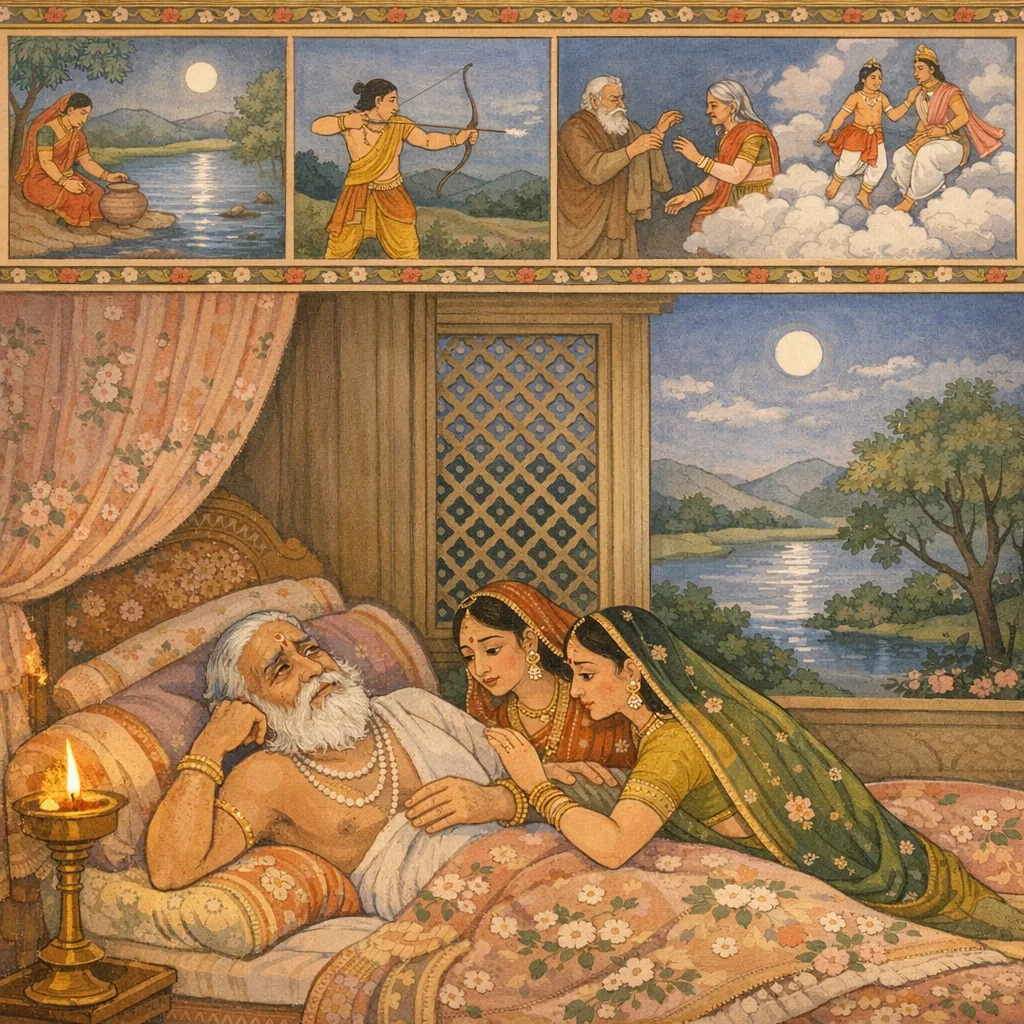
Sarga 64
शब्दवेध्य-अनर्थः, ऋषिशापः, दशरथस्य प्राणत्यागः (The Sound-Target Tragedy, the Sage’s Curse, and Dasaratha’s Death)
अयोध्याकाण्ड
अस्मिन् सर्गे दशरथः कौसल्यां प्रति करुणया विलपन् स्वजीवनस्य पूर्वकृतं ‘शब्दवेध्य’ अभ्यासजन्यं पापप्रसङ्गं निवेदयति। सरयूतीरे जले घटपूरणशब्दं द्विपशब्द इति मत्वा बाणं विसृज्य, वास्तवतः तापसपुत्रं हतवान् इति कथयति। ततः स मृत्युमुखे पतितं मुनिपुत्रं दृष्ट्वा बाणोद्धरणं कृत्वा, अन्ध-वृद्धयोः पितृमातृयोः शोकं, पुत्रवियोगविलापं, तथा अन्त्यदर्शनं च अनुवर्तते। मुनिः धर्म-न्यायपरं वचनं वदन् अज्ञानकृतत्वात् त्वरितं ब्रह्महत्यादोषं न प्रवर्तते इति सूचयति; किन्तु पुत्रशोकसमं राज्ञः मरणं भविष्यति इति शापं ददाति। मुनिदम्पती चितामारोप्य स्वर्गं गच्छतः, मुनिपुत्रः दिव्यरूपेण शक्रेण सह स्वर्गारोहणं करोति। एषः शापः ‘कर्मविपाक’ इव वर्तमानकाले फलितः—रामवियोगशोकेन दशरथः इन्द्रियक्षय-चित्तनाशान् अनुभूय, रामदर्शनाभावं महादुःखतमं मन्यमानः, कौसल्यासुमित्रयोः सन्निधौ अर्धरात्रोत्तरं प्राणान् जहाति।
Shlokas
Verse 1
वधमप्रतिरूपं तु महर्षेस्तस्य राघवः।विलपन्नेव धर्मात्मा कौसल्यां पुनरब्रवीत्।।।।
Lamenting over that grievously improper killing of the great sage, the righteous scion of the Raghus (Daśaratha) again spoke to Kauśalyā.
Verse 2
तदज्ञानान्महत्पापं कृत्वाहं सङ्कुलेन्द्रियः।एकस्त्वचिन्तयं बुध्या कथं नु सुकृतं भवेत्।।।।
Having, through ignorance, committed that great sin, my senses were thrown into turmoil; alone I pondered in my mind: “How might there be some right action—some atonement—for this?”
Verse 3
ततस्तं घटमादाय पूर्णं परमवारिणा।आश्रमं तमहं प्राप्य यथाऽख्यातपथं गतः।।।।
Then, taking up that water-pot filled with pure water, I reached the hermitage, proceeding along the path exactly as I had been instructed.
Verse 4
तत्राहं दुर्बलावन्धौ वृद्धावपरिणायकौ।अपश्यं तस्य पितरौ लूनपक्षाविव द्विजौ।।।।तन्निमित्ताभिरासीनौ कथाभिरपरिश्रमौ।तामाशां मत्कृते हीनावुदासीनावनाथवत्।।।।
There I saw his parents—frail, blind, aged, and without any protector—like birds whose wings had been cut. Seated idly, speaking only of their son, they were like orphans, deprived (because of me) of that hope on which they depended.
Verse 5
तत्राहं दुर्बलावन्धौ वृद्धावपरिणायकौ। अपश्यं तस्य पितरौ लूनपक्षाविव द्विजौ।।2.64.4।।तन्निमित्ताभिरासीनौ कथाभिरपरिश्रमौ।तामाशां मत्कृते हीनावुदासीनावनाथवत्।।2.64.5।।
There I saw his parents—frail, blind, and aged, without any protector—like birds whose wings had been cut. They sat idly, speaking only of him; and because of what I had done, they were deprived of their hope, desolate like the orphaned.
Verse 6
शोकोपहतचित्तश्च भयसन्त्रस्तचेतनः।तच्चाऽश्रमपदं गत्वा भूयश्शोकमहं गतः।।।।
My mind struck by grief and my awareness shaken with fear, I went to that hermitage—and there my sorrow grew all the more.
Verse 7
पदशब्दं तु मे श्रुत्वा मुनिर्वाक्यमभाषत।किं चिरायसि मे पुत्र पानीयं क्षिप्रमानय।।।।
Hearing the sound of my footsteps, the sage spoke these words: “My son, why are you delayed? Bring water quickly.”
Verse 8
यन्निमित्तमिदं तात सलिले क्रीडितं त्वया।उत्कण्ठिता ते मातेयं प्रविश क्षिप्रमाश्रमम्।।।।
Dear child, for whatever reason you have been playing in the water so long—enter the hermitage quickly; your mother here is anxious.
Verse 9
यद्व्यलीकं कृतं पुत्र मात्रा ते यदि वा मया।न तन्मनसि कर्तव्यं त्वया तात तपस्विना।।।।
O son, if your mother—or I—has done anything displeasing, you should not hold it in your heart, dear child; you are one trained in ascetic restraint.
Verse 10
त्वं गतिस्त्वगतीनां चक्षुस्त्वं हीनचक्षुषाम्।समासक्तास्त्वयि प्राणाः किं त्वं नो नाभिभाषसे।।।।
You are the refuge of those who have no refuge, and the eyes of those who are without sight. Our very life-breath clings to you—why do you not speak to us?
Verse 11
मुनिमव्यक्तया वाचा तमहं सज्जमानया।हीनव्यञ्जनया प्रेक्ष्य भीतचित्त इवाब्रुवम्।।।।
Seeing that sage, I spoke with an indistinct voice—stammering, my syllables faltering—like one whose mind is seized by fear.
Verse 12
मनसः कर्म चेष्टाभिरभिसंस्तभ्य वाग्बलम्।आचचक्षे त्वहं तस्मै पुत्रव्यसनजं भयम्।।।।
Steadying my power of speech by deliberate effort and controlled thought, I told him—though afraid—the calamity born of his son’s death.
Verse 13
क्षत्रियोऽहं दशरथो नाहं पुत्रो महात्मनः।सज्जनावमतं दुःखमिदं प्राप्तं स्वकर्मजम्।।।।
I am Daśaratha, a kṣatriya; I am not the son of that great-souled one. This sorrow—blameworthy in the eyes of the virtuous—has come upon me as the fruit of my own deed.
Verse 14
भगवंश्चापहस्तोऽहं सरयूतीरमागतः।जिघांसुश्श्वापदं कञ्चिन्निपाने चाऽगतं गजम्।।।।
O venerable one, bow in hand I went to the bank of the Sarayū, intending to kill a wild beast—an elephant that had come to the watering place.
Verse 15
ततश्श्रुतो मया शब्दो जले कुम्भस्य पूर्यतः।द्विपोऽयमिति मत्वाऽयं बाणेनाभिहतो मया।।।।
Then I heard the sound of a water-pot filling in the river; thinking, ‘This is an elephant,’ I struck him with an arrow.
Verse 16
गत्वा नद्यास्तत स्तीरमपश्यमिषुणा हृदि।विनिर्भिन्नं गतप्राणं शयानं भुवि तापसम्।।।।
Going then to the riverbank, I saw an ascetic lying on the ground, his chest pierced by an arrow, his life-breath ebbing away.
Verse 17
भगवच्छशब्दमालक्ष्य मया गजजिघांसुना।विसृप्टोऽम्भसि नाराचस्तेन ते निहतस्सुतः।।।।
O venerable one, aiming at that sound in the water—desiring to kill an elephant—I released a sharp arrow; by that, your son was struck down.
Verse 18
ततस्तस्यैव वचनादुपेत्य परितप्यतः।स मया सहसा बाण उधृतो मर्मतस्तदा।।।।
Then, at his own request, I went up to him as he writhed in agony, and at once I drew out that arrow from his vital spot.
Verse 19
स चोधृतेन बाणेन तत्रैव स्वर्गमास्थितः।भवन्तौ पितरौ शोचन्नन्धाविति विलप्य च।।।।
And when the arrow was drawn out, he attained heaven there itself—lamenting and grieving for you, his parents, crying, ‘You are blind!’
Verse 20
अज्ञानाद्भवतः पुत्र स्सहसाऽभिहतो मया।शेषमेवं गते यत्स्यात्तत्प्रसीदतु मे मुनिः।।।।
Through my ignorance, your son was struck down by me in sudden haste. Now that this has happened, may the sage be gracious and tell me what remains to be done.
Verse 21
स तच्च्रुत्वा वचः क्रूरं मयोक्तमघशंसिना।नाशकत्तीव्रमायासमकर्तुं भगवानृषिः।।।।
Hearing those harsh words spoken by me—one confessing a sinful deed—the venerable sage could not restrain the surge of intense anguish.
Verse 22
स बाष्पपूर्णवदनो निश्श्वसन्शोककर्शितः।मामुवाच महातेजाः कृताञ्जलिमुपस्थितम्।।।।
That radiant ascetic—his face filled with tears, sighing and worn down by grief—spoke to me as I stood before him with folded hands.
Verse 23
यद्येतदशुभं कर्म न त्वं मे कथयेस्स्वयम्।फलेन्मूर्धा स्म ते राजन् सद्य श्शतसहस्रधा।।।।
“O King, if you had not yourself disclosed to me this inauspicious deed, your head would have shattered at once into a hundred thousand pieces.”
Verse 24
क्षत्रियेण वधो राजन् वानप्रस्थे विशेषतः।ज्ञानपूर्वं कृत स्स्थानाच्च्यावयेदपि वज्रिणम्।।।।
“O King, a killing done by a kṣatriya—especially of a forest-dweller—when committed knowingly, can unseat even Vajrin (Indra) from his station.”
Verse 25
सप्तधा तु फलेन्मूर्धा मुनौ तपसि तिष्ठति।ज्ञानाद्विसृजतश्शस्त्रं तादृशे ब्रह्मावादिनि।।।।
“But the head of one who knowingly releases a weapon against such a sage—standing in austerity, a teacher of brahman—will split into seven.”
Verse 26
अज्ञानाद्धिकृतं यस्मादिदं तेनैव जवसि।अपि ह्यद्य कुलं न स्यादिक्ष्वाकूणां कुतो भवान्।।।।
“Because this was done in ignorance, you still live. Had it been otherwise, even the Ikṣvāku line would not remain today—what then of you?”
Verse 27
नय नौ नृप तं देशमिति मां चाभ्यभाषत।अद्य तं द्रष्टुमिच्छावः पुत्रं पश्चिमदर्शनम्।।।।रुधिरेणावसिक्ताङ्गं प्रकीर्णाजिनवाससम्।शयानं भुवि निस्संज्ञं धर्म राजवशं गतम्।।।।
He said to me, “O King, lead us to that place. Today we wish to see our son for the last time”—his body spattered with blood, his antelope-skin garment disheveled, lying senseless upon the ground, gone under the dominion of Dharmarāja (the Lord of Death).
Verse 28
नय नौ नृप तं देशमिति मां चाभ्यभाषत।अद्य तं द्रष्टुमिच्छावः पुत्रं पश्चिमदर्शनम्।।2.64.27।।रुधिरेणावसिक्ताङ्गं प्रकीर्णाजिनवाससम्।शयानं भुवि निस्संज्ञं धर्म राजवशं गतम्।।2.64.28।।
He said to me, “O King, lead us to that place. Today we wish to see our son for the last time”—his body spattered with blood, his antelope-skin garment disheveled, lying senseless upon the ground, gone under the dominion of Dharmarāja (the Lord of Death).
Verse 29
अथाहमेकस्तं देशं नीत्वा तौ भृशदुःखितौ।अस्पर्शयमहं पुत्रं तं मुनिं सह भार्यया।।।।
Then I alone led those two, overwhelmed with grief, to that very spot, and I made the ascetic and his wife touch the body of their son.
Verse 30
तौ पुत्रमात्मन स्स्पृष्ट्वा तमासाद्य तपस्विनौ।निपेततुश्शरीरेऽस्य पिता चास्येदमब्रवीत्।।।।
Approaching and touching their own son, the two ascetics fell upon his body; and then his father spoke these words.
Verse 31
नाभिवादयसे माद्य न च माऽमभिभाषसे।किं नु शेषे तु भूमौ त्वं वत्स किं कुपितो ह्यसि।।।।
“My child, why do you not greet me today, and why do you not speak to me? Why do you lie here on the ground—are you angry with us?”
Verse 32
न त्वहं ते प्रियं पुत्र मातरं पश्य धार्मिक।किं नु नालिङ्गसे पुत्र सुकुमार वचो वद।।।।
“O son—righteous one—if I am no longer dear to you, at least look upon your mother. Why do you not embrace me, tender child? Speak a word.”
Verse 33
कस्य वाऽपररात्रेऽहं श्रोष्यामि हृदयङ्गमम्।अधीयानस्य मधुरं शास्त्रं वान्यद्विशेषतः।।।।
“In the last watch of the night, from whom shall I now hear that sweet recitation—scripture or other texts—so pleasing to the heart?”
Verse 34
को मां सन्द्यामुपास्यैव स्नात्वा हुतहुताशनः।श्लाघयिष्यत्युपासीनः पुत्र शोकभयार्दितम्।।।।
“O son, tormented by sorrow and fear as I am—who will now attend to me, after bathing, worshipping at Sandhyā, and offering oblations into the sacred fire, seated close by my side?”
Verse 35
कन्दमूलफलं हृत्वा को मां प्रियमिवातिथिम्।भोजयिष्यत्यकर्मण्यमप्रग्रहमनायकम्।।।।
“Who will bring tubers, roots, and fruits and feed me like a cherished guest—me who am helpless, unable to do work, unable to procure what is needed, and without any guide?”
Verse 36
इमामन्धां च वृद्धां च मातरं ते तपस्विनीम्।कथं वत्स भरिष्यामि कृपणां पुत्रगर्धिनीम्।।।।
“My child, how shall I support this mother of yours—blind and aged, wretched in her austerity—who yearns only for her son?”
Verse 37
तिष्ठ मां मागमः पुत्र यमस्य सदनं प्रति।श्वो मया सह गन्तासि जनन्या च समेधितः।।।।
“Stay with me, my son—do not go to the dwelling of Yama. Tomorrow you may go, accompanied by me and by your mother as well.”
Verse 38
उभावपि च शोकार्तावनाथौ कृपणौ वने।क्षिप्रमेव गमिष्यावस्त्वया हीनौ यमक्षयम्।।2.4.38।।
Abandoned by you, helpless in the forest, and crushed by grief, we two—wretched and without support—will soon go to the realm of Yama.
Verse 39
ततो वैवस्वतं दृष्ट्वा तं प्रवक्ष्यामि भारतीम्।क्षमतां धर्मराजो मे बिभृयात्पितरावयम्।।।।
Then, on seeing Vaivasvata (Yama), I shall speak to him: ‘May the Lord of Dharma forgive me—let this boy continue to care for his parents.’
Verse 40
दातुमर्हति धर्मात्मा लोकपालो महायशाः।ईदृशस्य ममाक्षय्या मेकामभयदक्षिणाम्।।।।
That righteous, greatly renowned guardian of the worlds (Yama) ought to grant to one such as me a single unfailing boon—protection from fear.
Verse 41
अपापोऽसि यदा पुत्र निहतः पापकर्मणा।तेन सत्येन गच्छाऽऽशु ये लोकाश्शस्त्रयोधिनाम्।।।।
‘O son, you are sinless, yet you have been slain by one of sinful deed. By that very truth—go swiftly to those worlds attained by weapon-bearing heroes.’
Verse 42
यान्ति शूरा गतिं यां च सङ्ग्रामेष्वनिवर्तिनः।हतास्त्वभिमुखाः पुत्र गतिं तां परमां व्रज।।2.64.42।।
‘The very state attained by warriors who do not retreat in battle—those who fall facing the foe—attain that supreme state, my son.’
Verse 43
यां गतिं सगरश्शैब्यो दिलीपो जनमेजयः।नहुषो दुन्दुमारश्च प्राप्तास्तां गच्छ पुत्रक।।।।
‘Go, dear son, to that very state which Sagara, Śaibya, Dilīpa, Janamejaya, Nahusha, and Dundumāra attained.’
Verse 44
या गति स्सर्वसाधूनां स्वाध्यायात्तपसाच या।या भूमिदस्याहिऽताग्नेरेकपत्नी व्रतस्य च।।।।गोसहस्रप्रदातृ़णां या या गुरुभृतामपि।देहन्यासकृतां या च तां गतिं गच्छ पुत्रक।।।।
‘Go, dear son, to that state won by all the virtuous—by Vedic study and by austerity; by those who give land in charity, who maintain the sacred fires, and who are faithful to one wife; by givers of a thousand cows, by those who serve and sustain their elders and teachers, and by those who voluntarily lay down the body.’
Verse 45
या गति स्सर्वसाधूनां स्वाध्यायात्तपसाच या।या भूमिदस्याहिऽताग्नेरेकपत्नी व्रतस्य च।।2.64.44।।गोसहस्रप्रदातृ़णां या या गुरुभृतामपि।देहन्यासकृतां या च तां गतिं गच्छ पुत्रक।।2.64.45।।
‘For one born in this lineage does not go to an inauspicious state; but the one by whom you were slain—my kinsman—he will go to that evil destiny.’
Verse 46
न हि त्वस्मिन्कुले जातो गच्छत्यकुशलां गतिम्।स तु यास्यति येन त्वं निहतो मम बान्धवः।।।।
‘For one born in this lineage does not go to an inauspicious state; but the one by whom you were slain—my kinsman—he will go to that evil destiny.’
Verse 47
एवं स कृपणं तत्र पर्यदेवयतासकृत्।ततोऽस्मै कर्तुमुदकं प्रवृत्तस्सहभार्यया।।।।
Thus, there he lamented piteously again and again. Then, together with his wife, he began to perform the funeral water-offerings for their son.
Verse 48
स तु दिव्येन रूपेण मुनिपुत्रस्स्वकर्मभिः।स्वर्गमध्यारुहत्क्षिप्रं शक्रेण सह धर्मवित्।।।।
But the sage’s son—knowing dharma—assumed a celestial form through the merit of his own deeds and swiftly ascended to heaven together with Indra.
Verse 49
आबभाषे च वृद्धौ तौ सह शक्रेण तापसः।आश्वास्यच मुहूर्तं तु पितरौ वाक्यमब्रवीत्।।।।
In Indra’s company, the ascetic spoke to those two aged parents; after consoling them briefly, he addressed them with words.
Verse 50
स्थानमस्मि महत्प्राप्तो भवतोः परिचारणात्।भवन्तावपि च क्षिप्रं मम मूलमुपैष्यतः।।।।
“By serving you both, I have attained a great state; and you too will soon reach my own abode (the same higher state).”
Verse 51
एवमुक्त्वा तु दिव्येन विमानेन वपुष्मता।आरुरोह दिवं क्षिप्रं मुनिपुत्रो जितेन्द्रियः।।।।
Having spoken thus, the sage’s son—master of his senses—swiftly rose to heaven in a radiant, celestial aerial chariot.
Verse 52
स कृत्वा तूदकं तूर्णं तापस स्सह भार्यया।मामुवाच महातेजाः कृताञ्जलिमुपस्थितम्।।।।
After quickly completing the funeral water-offering with his wife, the radiant ascetic addressed me, as I stood before him with folded hands.
Verse 53
अद्यैव जहिं मां राजन्मरणे नास्ति मे व्यथा।यच्छरेणैकपुत्रं मां त्वमकर्षीरपुत्रकम्।।।।
“Slay me this very day, O king—death brings me no pain—since with your arrow you have made me, who had but one son, bereft of a son.”
Verse 54
त्वया तु यदविज्ञानान्निहतो मे सुतश्शुचिः।तेन त्वामभिशप्स्यामि सुदुःखमतिदारुणम्।।।।
“Although you killed my pure-hearted son out of ignorance (without intent), for that very reason I shall curse you with a calamity of intense and dreadful sorrow.”
Verse 55
पुत्रव्यसनजं दुःखं यदेतन्मम साम्प्रतम्।एवं त्वं पुत्रशोकेन राजन्कालं करिष्यसि।।।।
“As I now suffer this grief born of my son’s death, so too, O king, shall you meet your end through sorrow for your own son.”
Verse 56
अज्ञानात्तु हतो यस्मात्क्षत्रियेण त्वया मुनिः।तस्मात्त्वां नाविशत्याशु ब्रह्महत्या नराधिप।।।।
Since the sage was killed by you, a kṣatriya, through ignorance, O lord of men, the sin of brahmin-slaying will not seize you immediately.
Verse 57
त्वामप्येतादृशो भावः क्षिप्रमेव गमिष्यति।जीवितान्तकरो घोरो दातारमिव दक्षिणा।।।।
Yet this very kind of dreadful state—ending your life—will soon come upon you, just as a sacrificial fee (dakṣiṇā) surely reaches the giver.
Verse 58
एवं शापं मयि न्यस्य विलप्य करुणं बहु।चितामारोप्य देहं तन्मिथुनं स्वर्गमभ्ययात्।।।।
Thus, having laid the curse upon me and lamented long and piteously, that pair mounted the funeral pyre with their bodies and departed to heaven.
Verse 59
तदेतच्छिन्तयानेन स्मृतं पापं मया स्वयम्।तदा बाल्यात्कृतं देवि शब्दवेध्यनुशिक्षिणा।।।।
Reflecting now, O queen, I myself recall that sin—committed then in youthful folly, while I was training in the skill of shooting by sound.
Verse 60
तस्यायं कर्मणो देवि विपाकस्समुपस्थितः।अपथ्यैस्सहम्भुक्ते व्याधिरन्नरसे यथा।।।।
O queen, the ripened consequence of that deed has now come upon me—like sickness that arises when one eats and drinks what is unwholesome.
Verse 61
तस्मान्मामागतं भद्रे तस्योदारस्य तद्वचः।यदहं पुत्रशोकेन सन्त्यक्ष्याम्यद्य जीवितम्।।।।
Therefore, O gentle one, the words of that noble ascetic have come true for me: today, from sorrow for my son, I shall give up my life.
Verse 62
चक्षुभ्यां त्वां न पश्यामि कौसल्ये साधु मां स्फृश।इत्युक्त्वा स रुदंस्त्रस्तो भार्यामाह च भूमिपः।।।।
“I cannot see you with my eyes, O Kausalyā—touch me gently.” Saying this, the lord of the land, frightened and weeping, spoke to his wife.
Verse 63
एतन्मे सदृशं देवि यन्मया राघवे कृतम्।सदृशं तत्तु तस्यैव यदनेन कृतं मयि।।।।
O queen, what I have done to Rāghava is fittingly returned upon me; and what he has done toward me is fitting of him alone.
Verse 64
दुर्वृत्तमपि कः पुत्रं त्यजेद्भुवि विचक्षणः।कश्च प्रव्राज्यमानो वा नासूयेत्पितरं सुतः।।।।
Who, being discerning in this world, would abandon a son even if he were ill-conducted? And what son, when being banished, would not resent his father?
Verse 65
यदि मां संस्पृशेद्रामस्सकृदद्य लभेत वा।यमक्षयमनुप्राप्ता द्रक्ष्यन्ति न हि मानवाः।।।।
Before I die, will Rama touch me even once today, or come to my side? For once one has reached Yama’s abode, people do not see their loved ones again.
Verse 66
चक्षुषा त्वां न पश्यामि स्मृतिर्मम विलुप्यते।दूता वैवस्वतस्यैते कौसल्ये त्वरयन्ति माम्।।।।
O Kausalyā, I cannot see you with my eyes; my memory is slipping away. These messengers of Vaivasvata (Yama) are hurrying me onward.
Verse 67
अतस्तु किं दुःखतरं यदहं जीवितक्षये।न हि पश्यामि धर्मज्ञं रामं सत्यपराक्रमम्।।।।
What sorrow could be greater than this—that at the end of my life I do not behold Rama, the knower of dharma, whose strength is grounded in truth?
Verse 68
तस्यादर्शनजश्शोकस्सुतस्याप्रतिकर्मणः।उच्छोषयति मे प्राणान्वारिस्तोकमिवातपः।।।।
The grief born of not seeing that son of incomparable deeds is drying up my very life-breath, as heat dries a small pool of water.
Verse 69
न ते मनुष्या देवास्ते ये चारुशुभकुण्डलम्।मुखं द्रक्ष्यन्ति रामस्य वर्षे पञ्चदशे पुनः।।।।
Those who will behold Rama’s face—adorned with beautiful, auspicious earrings—when he returns again in the fifteenth year are not mere humans; they are like gods.
Verse 70
पद्मपत्रेक्षणं सुभ्रु सुदंष्ट्रं चारुनासिकम्।धन्या द्रक्ष्यन्ति रामस्य ताराधिपनिभं मुखम्।।।।
Blessed are those who will behold Rama’s moonlike face—eyes like lotus petals, graceful brows, even teeth, and a shapely nose.
Verse 71
सदृशं शारदस्येन्दोः पुल्लस्य कमलस्य च।सुगन्धि मम नाथस्य धन्या द्रक्ष्यन्ति तन्मुखम्।।।।
Blessed are those who will behold the fragrant face of my lord—like the autumn moon and like a fully-bloomed lotus.
Verse 72
निवृत्तवनवासं तमयोध्यां पुनरागतम्।द्रक्ष्यन्ति सुखिनो रामं शुक्रं मार्गगतं यथा।।।।
Happy people will behold Rama returning again to Ayodhyā after completing his forest-exile—like Venus moving along its appointed path.
Verse 73
कौसल्ये चित्तमोहेन हृदयं सीदतीव मे।वेदये न च संयुक्तान् शब्दस्पर्शरसानहम्।।।।
O Kausalyā, my heart seems to sink under this bewilderment; I can no longer properly perceive the combined sensations of sound, touch, and taste.
Verse 74
चित्तनाशाद्विपद्यन्ते सर्वाण्येन्द्रियाणि मे।क्षीणस्नेहस्य दीपस्य संसक्ता रश्मयो यथा।।।।
With the collapse of my mind, all my senses are failing—like the rays of a lamp that fade together when its oil is exhausted.
Verse 75
अयमात्मभवश्शोको मामनाथमचेतनम्।संसादयति वेगेन यथा कूलं नदीरयः।।।।
This grief, born from myself, is swiftly wearing me down—like a river’s current rapidly erodes its bank—leaving me helpless and insensible.
Verse 76
हा राघव महाबाहो हा ममाऽयासनाशन।हा पितृप्रिय मे नाथ हाऽद्य क्वासि गतस्सुत।।।।
Alas, Rāghava, mighty-armed! Alas, remover of my torment! Alas, beloved of your father—my protector, my son—where have you gone today?
Verse 77
हा कौसल्ये नशिष्यामि हा सुमित्रे तपस्विनि।हा नृशंसे ममामित्रे कैकेयि कुलपांसनि।।।।
Alas, Kausalyā! Alas, Sumitrā—long-suffering one! Alas, cruel Kaikeyī, my enemy, defiler of my lineage—I am perishing.
Verse 78
इति रामस्य मातुश्च सुमित्रायाश्च सन्निधौ।राजा दशरथ श्शोचञ्जीवितान्तमुपागमत्।।।।
Thus, in the presence of Rāma’s mother and of Sumitrā, King Daśaratha—lamenting—reached the end of his life.
Verse 79
यदा तु दीनं कथयन्नराधिपः प्रियस्य पुत्त्रस्य विवासनातुरः।गतेऽर्धरात्रे भृशदुःखपीडितस्तदा जहौ प्राणमुदारदर्शनः।।।।
As the lord of men lamented pitiably, distressed by the exile of his beloved son, and when midnight had passed, tormented by intense sorrow, that noble-souled king then gave up his life-breath.
Frequently Asked Questions
A fatal misrecognition in hunting practice: Dasaratha, aiming at a sound (śabda) believing it to be an elephant, releases an arrow that kills an ascetic’s son—raising questions of culpability (ajñāna vs. jñāna), kṣatriya violence, and responsibility for unintended harm.
The sarga frames suffering as karma-vipāka: even unintentional wrongdoing can yield delayed consequences. It also distinguishes immediate legal-theological guilt from inevitable moral repercussion—‘brahmahatyā’ may not accrue instantly, yet the curse manifests as existential grief culminating in death.
The Sarayu riverbank and the forest hermitage (āśrama) ground the episode; culturally, it references śabdavedhi training (archery by sound), funeral libations (udaka/obsequies), and the conception of Yama/Dharmarāja as the moral governor of post-mortem order.