Sarga 29
सीताया वनगमननिश्चयः — Sita’s Resolve to Accompany Rama to the Forest
अयोध्याकाण्ड
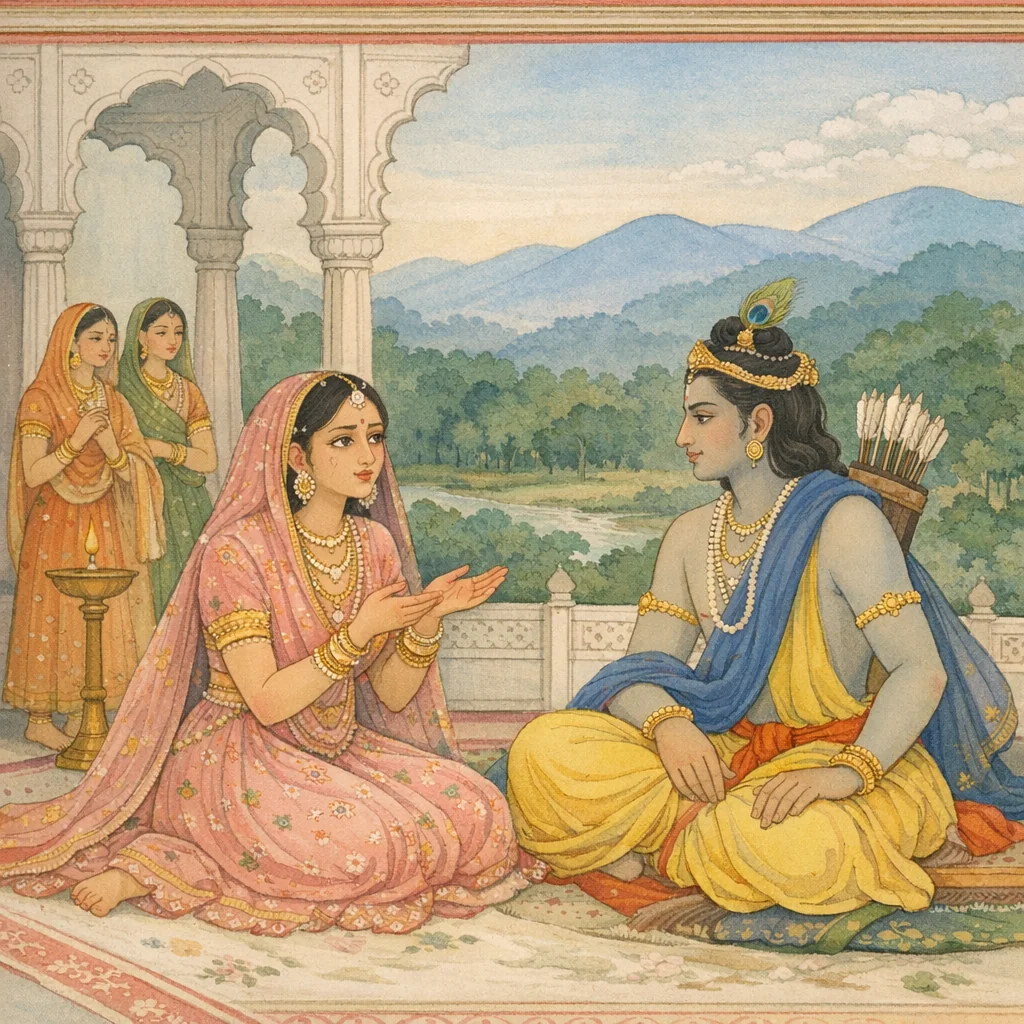
Sarga 29 is a sustained persuasive discourse in which Sītā responds to Rāma’s announcement and implied refusal regarding her forest accompaniment. Opening in grief and tears, she reframes the alleged “faults” (doṣa) of forest life as potential virtues when shared in mutual affection. She argues from multiple normative registers: (1) elder-command and marital inseparability—separation from her husband is tantamount to death; (2) personal security through Rāma’s presence, even against divine threats; (3) śruti-backed marital continuity beyond death, citing Vedic tradition that a wife given with ritual water belongs to her husband even after death; and (4) prophetic destiny—prior brahmin and female mendicant predictions that she would dwell in the forest, which she embraces as already anticipated. She intensifies her plea with an ultimatum (poison, fire, or water) if denied. Rāma, characterized as self-possessed, does not consent to take her into the desolate forest and instead consoles her repeatedly to dissuade her, while Sītā’s sorrow is depicted through vivid tear imagery. The Southern Recension presentation includes repeated verse blocks (notably around 2.29.3–4 and 2.29.17–18), reflecting recensional reinforcement of key claims.
Shlokas
Verse 1
एतत्तु वचनं श्रुत्वा सीता रामस्य दुःखिता।प्रसक्ताश्रुमुखी मन्दमिदं वचनमब्रवीत्।।।।
Hearing Rāma’s words, Sītā—sorrowful—her face streaming with unceasing tears, spoke these words in a faint, gentle voice.
Verse 2
ये त्वया कीर्तिता दोषा वने वस्तव्यतां प्रति।गुणानित्येव तान्विद्धि तव स्नेहपुरस्कृतान्।।।।
The hardships you have described about living in the forest—know them to be virtues, if they are borne with your love at the forefront.
Verse 3
मृगा स्सिंहा गजाश्चैव शार्दूला श्शरभास्तथा।पक्षिण स्सृमराश्चैव ये चान्ये वनचारिणः।।।।अदृष्टपूर्वरूपत्वात्सर्वे ते तव राघव।रूपं दृष्ट्वाऽपसर्पेयुर्भये सर्वे हि बिभ्यति।।।।
Deer, lions, elephants, tigers, and śarabhas; birds, sṛmaras, and other creatures that roam the forest—since they have never before seen your form, O Rāghava, they would retreat on seeing you; for all beings are afraid when fear arises.
Verse 4
मृगा स्सिंहा गजाश्चैव शार्दूला श्शरभास्तथा। पक्षिण स्सृमराश्चैव ये चान्ये वनचारिणः।।2.29.3।।अदृष्टपूर्वरूपत्वात्सर्वे ते तव राघव। रूपं दृष्ट्वाऽपसर्पेयुर्भये सर्वे हि बिभ्यति।।2.29.4।।
Deer, lions, elephants, tigers, and śarabhas; birds, sṛmaras, and other creatures that roam the forest—since they have never before seen your form, O Rāghava, they would retreat on seeing you; for all beings are afraid when fear arises.
Verse 5
त्वया च सह गन्तव्यं मया गुरुजनाज्ञया।त्वद्वियोगेन मे राम त्यक्तव्यमिह जीवितम्।।।।
By the command of the elders, I must go with you. If I am separated from you, O Rāma, I would have to give up my life here itself.
Verse 6
न हि मां त्वत्समीपस्थामपि शक्नोतिराघव।सुराणामीश्वर श्शक्रः प्रधर्षयितुमोजसा।।।।
For, O Rāghava, when I am close by you, even Śakra—lord of the gods—cannot, with all his might, harm me.
Verse 7
पतिहीना तु या नारी न सा शक्ष्यति जीवितुम्।काममेवं विधं राम त्वया मम निदर्शितम्।।।।
A woman who is without her husband cannot truly live. This very truth, O Rāma, you have clearly shown to me.
Verse 8
अथ चापि महाप्राज्ञ ब्राह्मणानां मया श्रुतम्।पुरा पितृगृहे सत्यं वस्तव्यं किल मे वने।।।।
Moreover, O great sage in wisdom, I once heard at my father’s house, from brāhmaṇas, a true prediction: that I would certainly have to dwell in the forest.
Verse 9
लक्षणिभ्यो द्विजातिभ्य श्शृत्वाऽहं वचनं पुरा।वनवासकृतोत्साहा नित्यमेव महाबल।।।।
O mighty one, long ago, after hearing the words of the twice-born palmists, I have ever since been filled with resolve for life in the forest.
Verse 10
आदेशो वनवासस्य प्राप्तव्य स्स मया किल।सा त्वया सह तत्राहं यास्यामि प्रिय नान्यथा।।।।
O beloved, I too must surely receive this very command of forest-dwelling; and there, with you, I will go—there is no other way.
Verse 11
कृतादेशा भविष्यामि गमिष्यामि सह त्वया।कालश्चायं समुत्पन्न स्सत्यवाग्भवतु द्विजः।।।।
I shall fulfill the command; I shall go with you. This is the appointed time—let the brahmin who foretold it be proved true to his words.
Verse 12
वनवासेऽभिजानामि दुःखानि बहुथा किल।प्राप्यन्ते नियतं वीर पुरुषैरकृतात्मभिः।।।।
O hero, I know well that forest-life brings many kinds of hardships; yet such sufferings surely fall upon those men who have not mastered themselves.
Verse 13
कन्यया च पितुर्गेहे वनवास श्शृतो मया।भिक्षिण्या स्साधुवृत्ताया मम मातुरिहाग्रतः।।।।
Even as a girl in my father’s house, I heard of this forest-dwelling—spoken by a virtuous female mendicant in my mother’s presence.
Verse 14
प्रसादितश्च वै पूर्वं त्वं मे बहुतिथं प्रभो।गमनं वनवासस्य काङ्क्षितं हि सह त्वया।।।।
O lord, long ago you were gracious to me for a long time (as I pleaded), for I had indeed desired to go with you to the forest.
Verse 15
कृतक्षणाऽहं भद्रं ते गमनं प्रति राघव।वनवासस्य शूरस्य चर्या हि मम रोचते।।।।
O Rāghava, I have been counting the days for this departure—may good be yours. For the forest-life’s course of my valiant one truly pleases me (to share).
Verse 16
शुद्धात्मन्प्रेमभावाध्दि भविष्यामि विकल्मषा।भर्तारमनुगच्छन्ती भर्ता हि मम दैवतम्।।।।
O pure-hearted one, by following my husband in love I shall be without stain; for my husband is, to me, a very deity.
Verse 17
प्रेत्यभावे हि कल्याण स्सङ्गमो मे सह त्वया।श्रुतिर्हि श्रूयते पुण्या ब्राह्मणानां यशस्विनाम्।।।।इहलोके च पितृभिर्या स्त्री यस्य महामते।अद्भिर्दत्ता स्वधर्मेण प्रेत्यभावेऽपि तस्य सा।।।।
O noble-minded one, my union with you is auspicious even after death. For a sacred Vedic teaching, recited by renowned brahmins, is heard: the woman whom her parents give—according to their own rite, with the water-offering—belongs to that very husband even beyond death.
Verse 18
प्रेत्यभावे हि कल्याण स्सङ्गमो मे सह त्वया। श्रुतिर्हि श्रूयते पुण्या ब्राह्मणानां यशस्विनाम्।।2.29.17।।इहलोके च पितृभिर्या स्त्री यस्य महामते। अद्भिर्दत्ता स्वधर्मेण प्रेत्यभावेऽपि तस्य सा।।2.29.18।।
And in this very world, O great-minded one, the woman whom a man’s parents give to him—according to customary dharma, with the ritual gift of water—belongs to him even after death.
Verse 19
एवमस्मात्स्वकां नारीं सुवृत्तां हि पतिव्रताम्।नाभिरोचयसे नेतुं त्वं मां केनेह हेतुना।।।।
Why, then, do you not consent to take me from here—your own wife, of good conduct and devoted to her husband? What reason can there be for it now?
Verse 20
भक्तां पतिव्रतां दीनां मां समां सुखदुःखयोः।नेतुमर्हसि काकुत्स्थ समान सुखदुःखिनीम्।।।।
O Kākutstha, you should take me—devoted, faithful, and distressed—one who remains even in happiness and sorrow, sharing your welfare and adversity alike.
Verse 21
ययदि मां दुःखितामेवं वनं नेतुं न चेच्छसि।विषमग्निं जलं वाऽहमास्थास्ये मृत्युकारणात्।।।।
If you do not wish to take me—thus distressed—into the forest, then I will resort to poison, or fire, or water, seeking death as the cause.
Verse 22
एवं बहुविधं तं सा याचते गमनं प्रति।नानुमेने महाबाहुस्तां नेतुं विजनं वनम्।।।।
Though she begged him in many ways about going, the mighty-armed one would not consent to take her to the lonely forest.
Verse 23
एवमुक्ता तु सा चिन्तां मैथिली समुपागता।स्नापयन्तीव गामुष्णैरश्रुभिर्नयनच्युतैः।।।।
Thus addressed, Maithilī fell into anguish, as though bathing the earth with warm tears that streamed from her eyes.
Verse 24
चिन्तयन्तीं तथा तां तु निवर्तयितुमात्मवान्।ताम्रोष्ठीं स तदा सीतां काकुत्स्थो बह्वसान्त्वयत्।।।।
Seeing her thus grieving, the self-possessed Kākutstha then consoled Sītā—she of copper-red lips—in many ways, seeking to dissuade her.
Frequently Asked Questions
The dilemma is whether Sita should be permitted to join Rama in a hazardous forest exile: Sita frames accompaniment as marital duty and existential necessity, while Rama withholds consent to protect her from the desolation and risks of vanavasa.
The dialogue models how dharma is argued through layered pramāṇas—affection, social duty, scriptural testimony, and destiny—while also highlighting that ethical intention (to protect) can conflict with another’s dharmic self-understanding (to accompany and share fate).
The chapter emphasizes the cultural institution of marriage via the ‘water-gifting’ rite (adbhir-dattā) and the forest (vana/vanavasa) as a civilizational counter-space marked by wildlife and austerity, rather than naming a specific forest locale.